What a Bus Stop Teaches Us About Food Access
Every city has an invisible curriculum.
Without quite meaning to, a city teaches its residents what they may expect from public life and, by extension, from one another. A sidewalk suggests that walking is ordinary. A library proposes that knowledge belongs to everyone. A neighborhood park makes a similar claim about leisure: that it need not always be purchased. Even a bus stop offers a lesson. It tells us who is expected to wait, under what conditions, and whether that waiting is worthy of comfort, safety, or dignity.
We tend to think of infrastructure as concrete and steel, the solid and technical background against which life unfolds. But infrastructure is also the architecture of opportunity. It determines, often quietly, which parts of daily life will be easy and which will require patience, improvisation, or risk.
Food is no exception.
For years, conversations about food access have often begun with a map of grocery stores. The language of “food deserts” helped draw attention to real inequities in where healthy food is sold and where it is not. But the metaphor also encouraged a particular way of seeing the problem. It suggested that access was largely a matter of distance, and that placing a store inside a neglected radius might resolve what the map had revealed.
Life is rarely so orderly.
A grocery store can be two miles away and remain practically unreachable. A food pantry may distribute thousands of pounds of fresh produce each month and still lie beyond the path of the people who could most benefit from it. Most households do not simply shop at the nearest store. They shop where the prices fit their budget, where the produce is fresh, and where they can find the ingredients that belong on their family’s table.
For households with limited income, the closest store may not be the most useful one. Research in other cities has found that the people most likely to experience hunger, particularly those who depend on public transit, often travel the farthest to buy food.
The question, then, is not simply where food is located. It is whether people can reach the places that actually meet their needs.
That distinction seems small. It changes almost everything.
We often speak about transportation as though it were separate from food. One agency runs the buses. Another studies hunger. Another tracks public health. But no one experiences transportation at nine o’clock, food at ten, and health at eleven. A parent leaves work, catches a bus, picks up a child, stops for groceries, and heads home. An older adult leaves a medical appointment hoping to buy vegetables before making the return trip. A family passes through a library, a park, and a market in the course of a single Saturday afternoon.
Institutions divide a city into functions. Life does not.
Once we begin with the journey a person is actually making, rather than with the organizational chart of city government, the boundaries among transportation, housing, health, and food begin to soften. A grocery store without a safe sidewalk is less accessible than it appears on a map. A produce prescription has limited value when fresh food lies beyond a practical bus route. A bus stop without a bench or shelter discourages the very trips on which a family’s access to healthy food may depend.
Food access, in other words, is not only a quality of a place. It is a quality of the relationships among places.
This understanding led The Nashville Food Project to look closely at an unlikely piece of the food system: the bus stop.
Earlier this year, residents and community partners helped us document conditions at 373 bus stops across North Nashville. After a morning of training, neighbors walked the corridors stop by stop, recording the presence, or absence, of sidewalks, shelters, curb ramps, benches, lighting, and safe crossings. We then considered what they found alongside the locations of grocery stores, food pantries, and community meal sites.
At first glance, it resembled a transportation study. It was, more broadly, a study of how civic infrastructure shapes access to food.
Fewer than one in four stops met basic accessibility standards. Fewer than fifteen percent had a shelter. Fewer than six in ten were connected to the surrounding neighborhood by a sidewalk. Barely a quarter could clearly accommodate a neighbor using a wheelchair, pushing a stroller, or carrying several bags of groceries.
One resident described a stop as “just a stick in the ground.”
From the window of a passing car, the difference between a signpost and a true bus stop may seem minor. For the person waiting beside it in the summer heat, or stepping from the curb with groceries in both hands, it can be the difference between access and isolation.
The barriers were not distributed evenly. Near the State Capitol and areas of new development, stops were more likely to have shelters and smooth sidewalks. Along residential blocks where many neighbors actually waited, there was often little more than a sign beside the road. Infrastructure appeared to have followed real-estate investment more closely than it had followed need.
Cities are always deciding whose journeys should be easy. Most of those decisions are made quietly.
A sidewalk. A bench. A curb ramp. A bus shelter.
We classify these as engineering details, but they are also civic choices. Each answers a set of questions that cities rarely ask aloud: Whose time matters? Whose safety counts? Who is expected to participate in public life, and under what conditions?
Seeing food access this way changes more than transportation policy. It also changes how we understand the movement of food through a city.
For generations, we have organized food largely around commerce. Grocery stores open where the market will support them, and households are expected to arrange their lives accordingly. When nourishing food proves difficult to reach, the usual response is to help people travel farther.
There is another possibility.
Instead of organizing people around food, we can organize food around the ordinary rhythms of people’s lives.
Schools already gather families. Transit centers already gather commuters. Public housing communities already gather neighbors. Libraries already serve as places of learning, connection, and refuge. These are not merely convenient locations for distributing food. They are civic institutions around which daily life is already arranged.
When residents are asked which approaches they would actually use, the strongest interest is often not in a subsidized trip to a distant store. It is in bringing fresh food closer through a neighborhood market or produce box. People have been telling us where food belongs. The task is to listen carefully enough to build around what we hear.
This is the idea behind The Nashville Food Project’s growing Community Markets initiative.
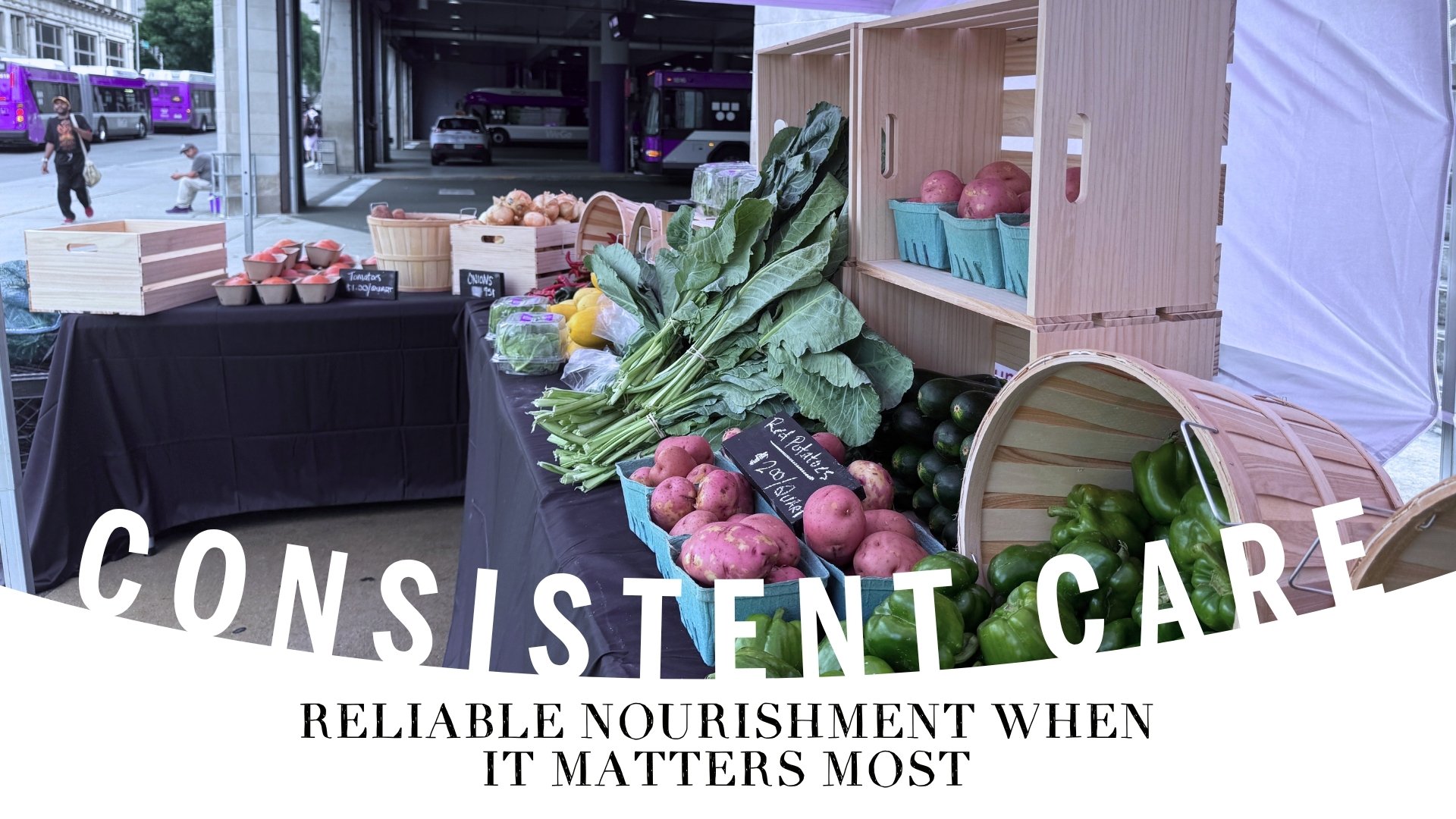
Beginning August 12, we are partnering with WeGo Public Transit and Cul2vate to bring a fresh produce market to the Elizabeth Duff Transit Center at WeGo Central. The premise is almost disarmingly simple. Thousands of riders already pass through the station each day. Instead of asking someone to make an additional trip after work, the market makes fresh food part of the journey already underway.
A commute home can include tomatoes, greens, peppers, or squash for dinner.
This same principle shapes the Growing Together Farmers Market in South Nashville, where immigrant and refugee growers have helped define what the market should be. It may also shape future markets in public housing communities or at other neighborhood gathering places. The form will change because every community is different.
The principle will remain: good food access begins where people already are.
Bringing food closer does not, of course, let the bus stop off the hook. A neighborhood market is no excuse for leaving the journey unsafe. The improvements needed are neither novel nor extravagant: a shelter, a bench, a light, a curb ramp, a safe sidewalk connecting the stop to the surrounding neighborhood.
Considered against what they make possible, these are among the smallest investments a city can make and among the most consequential. They determine whether a neighbor with a cane can board the bus, whether a parent and child can wait safely through a July afternoon, and whether a bag of groceries makes it home intact.
Those investments should follow need, reaching the residential corridors where people wait every day. The neighbors who walked North Nashville’s bus routes did more than document what was missing. They created a stop-by-stop record of where the work could begin. That record belongs in the city’s planning, not in a drawer.
This may be the larger lesson of the project.
We often measure cities by the projects they complete and the services they provide. Those measures matter. But another measure is whether a city’s institutions recognize their dependence on one another. Whether transportation advances public health. Whether housing supports education. Whether parks cultivate community. Whether nourishing food is woven into the ordinary places where daily life unfolds.
The most resilient cities are not necessarily the ones with the greatest number of programs. They are the ones that make the conditions for flourishing feel ordinary.
That work often begins in places so familiar that they nearly escape our attention: the sidewalk outside a grocery store, the path between a clinic and a bus route, the bench where someone rests on the way home.
Or a bus stop that becomes, for a few hours each week, a place to bring home dinner.
For generations we have organized food around commerce. Grocery stores rise where markets support them, and the rest of the city is expected to arrange its life accordingly. When healthy food proves hard to reach, we help people travel farther.
There is another possibility.
Rather than organizing people around food, we can organize food around the ordinary rhythms of people's lives. Schools already gather families. Transit centers already gather commuters. Public housing already gathers neighbors. Libraries already gather communities. These are not merely convenient places to hand out food. They are civic institutions around which daily life is already organized. And when residents are asked which solutions they would actually use, the strongest interest is not in a subsidized ride to a distant store. It is in fresh food brought closer: a produce box, a neighborhood market. People have been telling us, all along, where food belongs.
This is the idea behind our growing Community Markets initiative.
Later this year, The Nashville Food Project will partner with WeGo Public Transit to open a fresh produce market inside the Elizabeth Duff Transit Center. The concept is almost disarmingly simple. Thousands of riders already pass through the station every day. Instead of asking someone to make another trip after work, fresh food becomes part of the trip they are already making. The commute home becomes a chance to buy vegetables for dinner.
The same principle shapes our Growing Together Farmers Market in Antioch, where immigrant and refugee growers and shoppers have helped define what the market should be. It may shape future markets in public housing communities or other neighborhood anchors. The format will change because communities differ.
The principle will not.
Good food access begins where people already are.
None of this lets the bus stop off the hook. Bringing food closer is no excuse for leaving the journey unsafe. The remedies are neither exotic nor costly: a shelter, a bench, a light, a curb ramp, a safe sidewalk to the door. Set against what they return — whether a neighbor with a cane can board, whether a parent can wait out a July afternoon, whether the groceries make it home — they are among the smallest investments a city can make and among the most consequential. They should follow need rather than development, reaching first the residential blocks where people actually wait. The neighbors who walked these corridors did more than document what was broken. They left a stop-by-stop record of where to begin. That record belongs in the city's planning, not in a drawer.
This, perhaps, is the larger lesson.
We measure cities by the projects they complete and the services they provide. Those things matter. But the deeper measure is whether the institutions of a city recognize one another. Whether transportation advances public health. Whether housing supports education. Whether parks strengthen community. Whether food is woven into the ordinary places where life already unfolds.
The most resilient cities are not those with the most programs. They are those that make flourishing ordinary.
And that work begins, more often than we imagine, in the places between.