
What Gardens Can Teach Cities
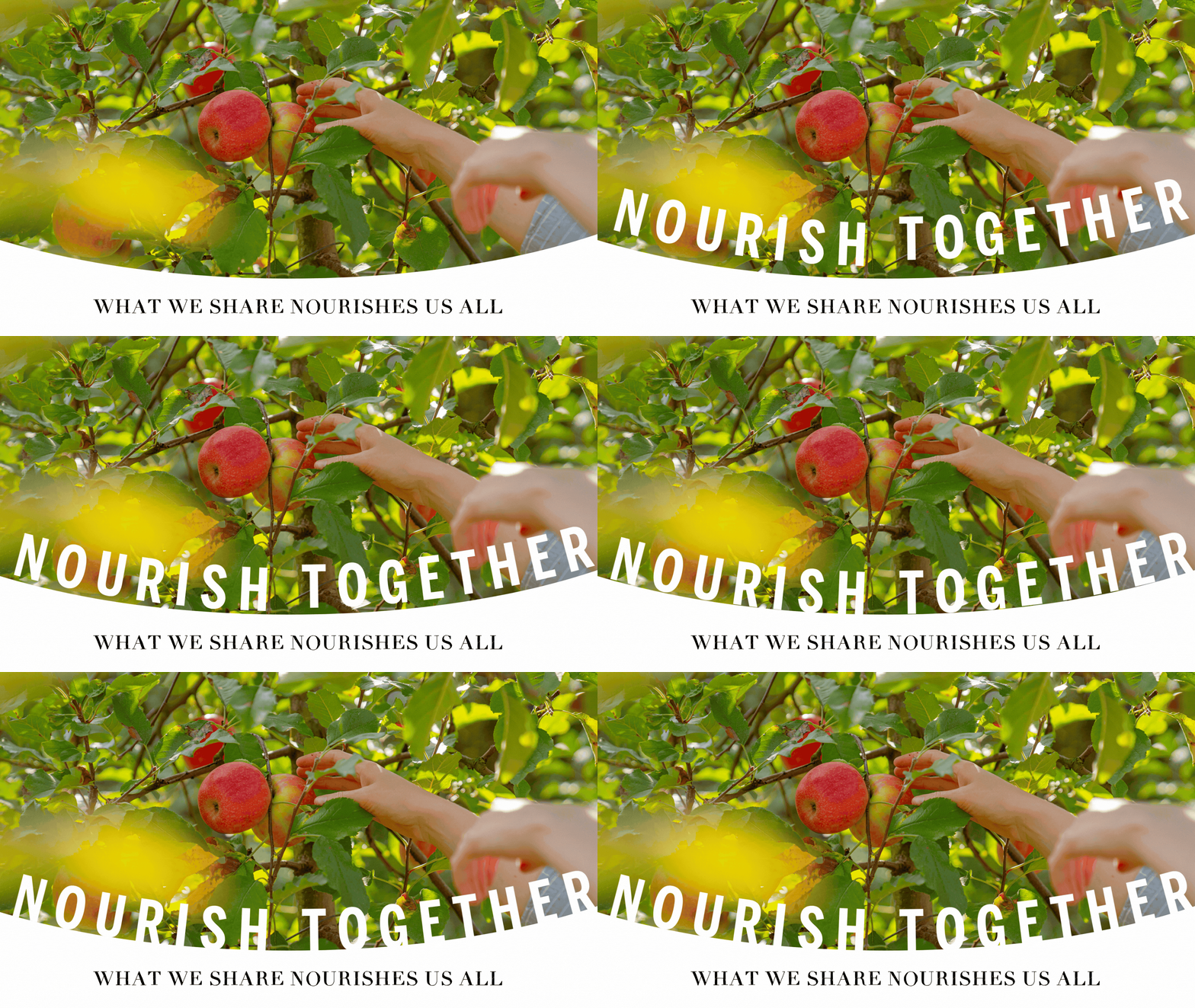
Earlier this spring, on a bright morning at the Community Farm at Mill Ridge, volunteers and neighbors put more than 140 fruit and nut trees, berry brambles, and companion plants into the ground. Most had not met before that morning. By the time the trees bear fully, some of the children who carried water that day will have children of their own. We did not plant this food forest — an orchard designed to grow like a woodland, in layers, feeding people and soil at once — to solve next month's hunger. We planted it as a wager on a shared future and the people who will tend the grove for decades to come.
The gardens, orchards, and farms we steward as part of the Community Agriculture Network are not merely a charming complement to the work of feeding a city. They are among the most important forms of civic infrastructure a city has, and their importance extends far beyond the food they produce.
The simplest thing a garden does is also the easiest to overlook: It puts people in one another's company. Not in a meeting, not in a program, not in a transaction. Just near each other, hands busy, across weeks and seasons. A man waters his tomatoes at the same hour each evening and falls into conversation with the woman in the next plot. A teenager learns to graft a fruit tree from an elder who learned it in another country. Someone's grandmother grows okra from seeds she has saved across two generations, and by August three families on the block are growing it too.
No one planned any of this. A garden does not organize community; it makes community possible, holding open a place where connection has room to happen. You cannot schedule belonging. You can only tend the ground where it tends to grow. We have built a world remarkably good at keeping people busy and apart at the same time. A garden is a small refusal.
The relationships that grow there are only the beginning. Once people share a thing, they cannot help but govern it together. The garden has a fixed number of plots and, often, a waiting list, and someone must decide who gets one. The water bill comes due, and someone must decide how it is shared. The gardener who keeps tidy rows and the one who lets her beans run wild have to work out how to be neighbors. None of this is grand. All of this is political in the oldest sense of the word: people deciding together how to live with something they share.
We have come to treat citizenship mostly as a status, a document, a box on a form. But there is an older meaning. Citizenship is also something you do: the plain capacity to show up among others and act on the things you share. Much of our public life has thinned against that measure. We do remarkably little in concert with the people who live nearest us. A garden reverses this, and on terms the formal order often denies to the very people we work beside. Many of the stewards who lead our sites are immigrants and refugees, elders and pastors, longtime residents of neighborhoods the city wrote off long ago. Some have no ground of their own to cultivate. Some cannot vote. But on a piece of co-stewarded land they are no one's clients. Growers set the rules, hold one another to them, teach the next steward, and decide together what the harvest is for.
It is often taken for granted that anything held in common will be ruined, overused, neglected and wrecked, unless it is carved into private property or policed from above. Whatever belongs to everyone, the thinking goes, belongs to no one. But gardens quietly prove otherwise. Ordinary people have been disproving this for as long as there have been commons, writing their own rules, keeping them, passing them down. A community garden is exactly that: a small, self-governed commons, a place where people practice running a shared world before and beyond anyone's permission. Schools of democracy turn out to be hidden inside the work of growing tomatoes, in a place where no one came to learn democracy and everyone does.
None of this is new, and we did not invent it. Through a new national network called the Urban Garden Project, TNFP now helps lead this work alongside some of the oldest community-gardening organizations in the country: Denver Urban Gardens, New York's GreenThumb, the Pennsylvania Horticultural Society, Seattle's P-Patch. They have spent decades proving what a city's gardens are actually for. What unites us is the conviction that the humblest patch of ground can be a place where a democracy practices being one. Few investments in a city's future matter more.
Democracy survives only where people practice its habits. Gardens are among the few places left where those habits are quietly learned. In this sense, community gardens, farms, and orchards do not teach political opinions. They teach the habits without which politics cannot succeed.
So the next time you pass one of our sites, a few raised beds and a hand-lettered sign and an older man bent over his peppers, see what is actually there. Not a hobby, not a charity, but a small and stubborn experiment in whether a city can belong to everyone who lives in it. We plant trees whose fruit we will not control and whose shade we may never sit under. There may be no more hopeful—or more democratic—thing to do.
— C.J. Sentell
