The Table Was the Point
In 2013, a Tuesday night meal at Trinity United Methodist Church offered an early lesson in what hospitality could become when everyone had something to give.
On Tuesday evenings in 2013, volunteers loaded prepared food into The Nashville Food Project’s trucks and drove toward the intersection of Trinity Lane and Dickerson Pike.
Inside Trinity United Methodist Church, the fellowship hall was being made ready. Tables were covered with cloths and flowers. Real plates replaced disposables. Cups, forks, and knives were set in their places. At 6:30, neighbors gathered for a blessing, and the meal was served family style.
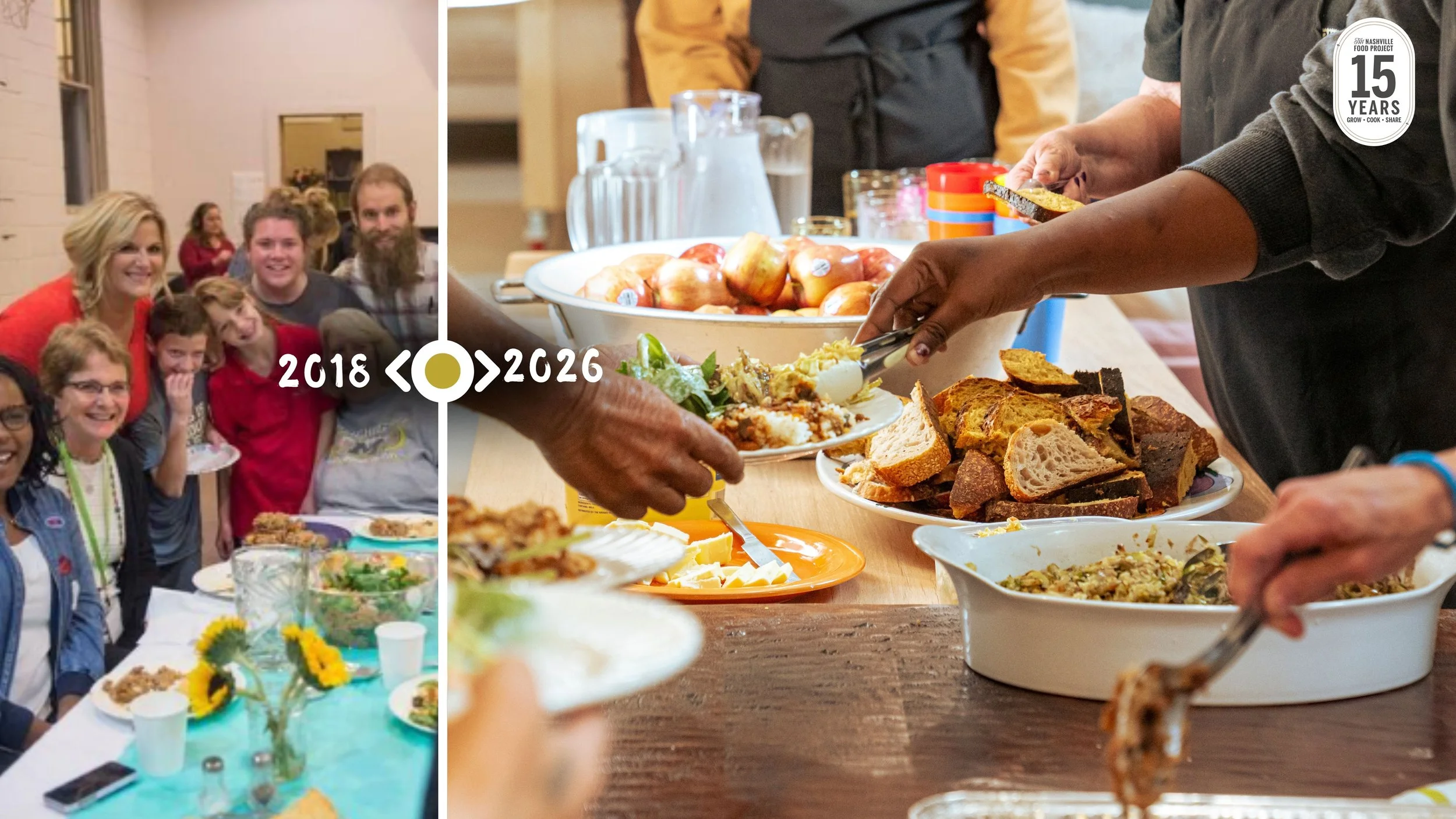
The room held children eager to finish dinner and reach the basketball court, babies watching the commotion from highchairs, families, older neighbors, church members, people living outside, people in recovery, volunteers, and staff. It was loud. It could be hectic. More than anything, people felt welcome.
The meal was nourishing, but the arrangement of the room mattered just as much.
Community members greeted people at the door, hosted tables, helped with setup, and stayed to clean. The Nashville Food Project arrived with food, but the evening did not belong to any one organization or group. Its success depended on many people deciding that the gathering was theirs to shape.
In a reflection titled “Breaking Down the Barriers,” The Nashville Food Project’s founder, Tallu Quinn, wrote about what these evenings were teaching her. Those accustomed to thinking of themselves as the givers had to learn when to step forward and when to step back. Around the tables, the distinction between those who had plenty and those experiencing poverty became less certain.
Everyone arrived needing something. Everyone arrived carrying something to offer.
That idea challenged a familiar model of service, one that divides a room into helpers and people being helped. A shared meal offered another possibility. A person might arrive hungry and still be the first to welcome a newcomer. Someone who helped set the table might later need food placed before them. The host could become the guest, and the guest could become the host, sometimes in the course of a single evening.
The table made room for both.
More than a decade later, Tuesday meals continue on the same property, now known as Trinity Community Commons. The name reflects a larger transition. Trinity Community Commons began within the active church in 2013, growing from a question posed by United Methodist pastors and members: What might happen if the property were reimagined as a place of radical hospitality for all its neighbors?
Trinity United Methodist Church closed in 2022, following a fire that had badly damaged the sanctuary the year before. The congregation transferred the property to Trinity Community Commons, an independent neighborhood nonprofit carrying the work forward. The historic site is now being reimagined as a community hub with gathering spaces, food access, gardens, services, and affordable housing.
The building’s future is changing, but Tuesday evenings remain.
Today, neighbors gather for a weekly potluck. It is a contemporary expression of the lesson Tallu observed in 2013: hospitality becomes something deeper when it is not performed by one group for another, but practiced among neighbors.
Over 15 years, The Nashville Food Project has prepared and shared millions of meals. Those numbers help convey the scale of the work, but they do not fully explain what a meal can hold.
A table can hold dinner. It can also hold the person who cooked, the neighbor who arranged the flowers, the child already thinking about basketball, the volunteer learning to listen, and the guest who notices that someone new has entered the room.
It can hold hunger without reducing anyone to it.
It can hold the possibility that giving and receiving are not fixed identities, but ordinary parts of belonging to one another.
In 2013, the tables at Trinity were dressed with flowers, real plates, and silverware because the meal was worth taking seriously. The people gathering around it were worth taking seriously, too.
That is still the point.