
The Nashville Food Project’s Blog




Food is Medicine Fault Lines
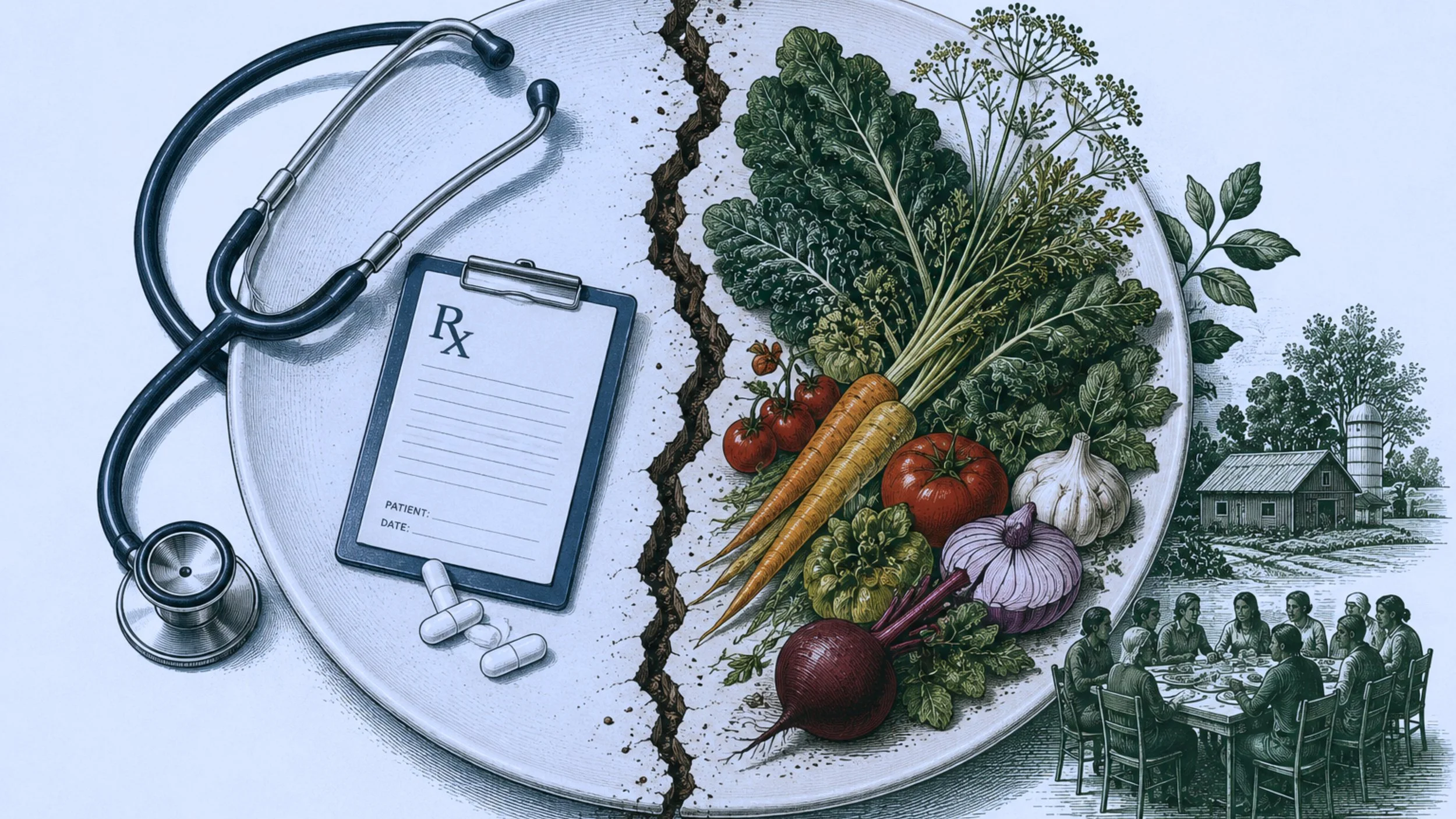
“At one pole is a clinical, reimbursement-oriented, standardized worldview. At the other pole is a community-centered, systems-oriented, flexible worldview.” - C.J. Sentell, CEO
Every field reaches a point where its arguments stop being about tactics and start being about identity. Food Is Medicine (FIM) has largely arrived there. Beneath the visible debates — over terminology, evidence, eligibility, and sourcing — sits a single, deeper question: what kind of thing is Food Is Medicine, and whom does it serve?
After attending FIMCON in D.C. earlier this year, I wanted to understand how the key debates and conceptual tensions of the movement map onto its widely varying implementations. What I found is that these issues are not independent disputes but surface expressions of two coherent worldviews, and that understanding this structure clarifies where alliances are durable, where they are fragile, and where the field’s most generative opportunities lie.
Two poles
At one pole is a clinical, reimbursement-oriented, standardized worldview. It understands FIM as a medical intervention: food prescribed at the point of care to treat or manage diagnosed disease, validated by rigorous evidence, delivered to uniform standards, and ultimately paid for by health insurers. Its promise is durability and scale — a permanent place in the healthcare system.
At the other pole is a community-centered, systems-oriented, flexible worldview. It understands FIM as one component of a just food system: nourishing food connected to people through dignity and relationship, prioritizing local and equitable sourcing, prevention, and community engagement. Its promise is reach, legitimacy, and the capacity to address the conditions that produce diet-related disease in the first place.
Neither pole is wrong, and most organizations hold a blend of both. But nearly every contested choice in the field pulls toward one or the other, which is why the disagreements rhyme.
A quick way to locate a program’s orientation is to ask three questions: whom does it serve, how does it source, and what does it count as success? A program organized around becoming reimbursable will tend to serve the diagnosed, source by nutrient specification, and measure clinical and cost outcomes. A program organized around a particular community’s health will tend to serve by need, often source locally or regionally, and measure food security, trust, and reach. The three answers move together because they are driven by a single prior question — what the program is ultimately for. That motivation is the generative variable beneath the ten fault lines that follow; the columns are its visible signatures.
Importantly, motivation and position are not the same thing, which is what makes the fault lines worth thinking about. A program can be motivated by community health yet be pulled by funding structures toward the reimbursement pole — e.g., medically-tailored meal providers and produce-prescription programs that begin in the community and move into the payer world. It is worth paying attention to where a program’s heart sits and if, and how, its funding shapes its implementation.
The fault lines
Ten recurring fault lines run through the movement. Read down either column and a consistent posture emerges; the rows are not separate arguments so much as ten windows onto the same divide.
A structural note: these fault lines tend to travel together. Clinical integration correlates with sourcing-agnosticism (standardize the food to nutrition specifications and the lowest compliant supplier wins), while community-centered work correlates with local and equitable sourcing (the farm relationships are part of the point). The columns above are therefore best read as a single diagonal, not ten dials to be set independently.
How the field lines up
Plotting the major players against two axes — community-centered versus clinically integrated, and sourcing-agnostic versus equitable-sourcing-prioritized — makes the coalitions and rifts legible.
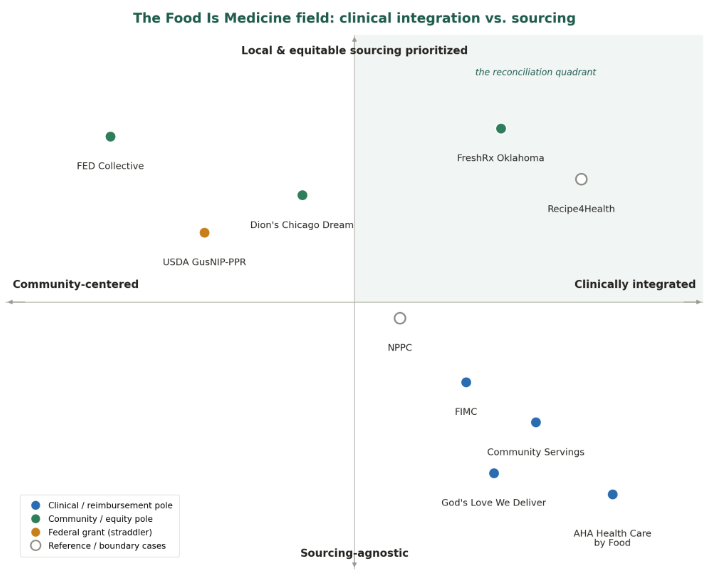
Major FIM organizations plotted by clinical integration (horizontal) and sourcing values (vertical). Color marks each organization's home pole; position marks where it actually operates — so the green markers in the upper-right reconciliation quadrant are community-rooted programs that have reached clinical integration. Hollow markers (Recipe4Health, NPPC) are reference points.
The American Heart Association’s Health Care by Food initiative is the purest expression of the clinical pole: a large, research-driven effort built to generate the randomized evidence that will make FIM a reimbursable medical benefit, essentially agnostic on where the food comes from. The Food is Medicine Coalition (FIMC) sits close beside it on standardization and reimbursement — it owns the field’s tightest accreditation criteria for medically tailored meals — but arrives there from the opposite origin: its members are CBO providers climbing into the clinical-payer world from community roots.
That shared destination is also the field’s most consequential latent rift. AHA and FIMC agree that FIM should be standardized, medically necessary, and reimbursed — but the moment reimbursement arrives, their interests can diverge over who sets quality standards, who is credentialed to deliver, and whether CBOs survive a payer market that rewards scale and low cost. The very mechanism that promises sustainability may narrow the mission that justified it.
The FED Collective — a group of BIPOC-led CBOs organized around the principles of fidelity, equity, and dignity — anchors the opposing pole. Crucially, it is not outside the movement in opposition; its framework was built specifically for the produce-prescription field. It is best understood as the equity conscience working from within, in tension with the clinical pole over gatekeeping, power, and sourcing rather than over whether FIM should exist. USDA’s produce-prescription work (the GusNIP program) is the quiet hinge between the poles: it funds the community and prevention end through grants while generating the standardized evaluation data that the reimbursement end depends on — building, somewhat ironically, the runway for the clinical world that may one day absorb it.
The diagonal predicts that one quadrant should be nearly vacant: organizations that are both clinically integrated and committed to local, equitable sourcing. That quadrant is where the field’s two worldviews would reconcile rather than split — and it is not entirely empty. Models such as Recipe4Health, a clinically integrated program embedded in federally qualified health centers and moving toward covered-benefit status, nonetheless write regenerative, local, and BIPOC-farmer sourcing into both their design and the coverage language they advocate. Such models are existence proofs that the diagonal is a tendency, not a law. For any organization rooted in the community-and-equity pole, this quadrant — not the clinical pole itself — is the strategically interesting frontier: it shows that a CBO can engage the reimbursement world without being flattened by it.
The pattern holds when more organizations are added. The medically-tailored-meal providers — e.g., God's Love We Deliver and Community Servings — sit beside FIMC in the clinical, standardized, sourcing-agnostic corner, as its member organizations would. Two cases complicate the diagonal in instructive ways. FreshRx Oklahoma, a produce prescription that pairs clinic referral and outcome tracking with local, regenerative, equity-driven sourcing, lands in the reconciliation quadrant — reaching it from the community side, just as Recipe4Health reached it from the clinical side. And Dion's Chicago Dream, a dignity-first, food-security-centered delivery model, has built a Medicaid-funded produce prescription channel that pulls it from the community pole toward the center — a community organization bridging into reimbursement.
Agency and Dignity
One further fault line deserves separate treatment, precisely because it does not travel on this diagonal: participant agency, or the degree of choice a program affords. At one end, food is prescribed with no selection — a medically tailored meal or a pre-packed produce box; at the other, participants choose freely, through farmers-market tokens or a produce-prescription card redeemed at retail, with curated boxes and delivery on one side and vouchers and cards on the other. What makes it distinct is that all four combinations exist: medically tailored meals are clinical and low-choice; a produce-prescription debit card is clinical but high-choice; farmers-market token programs are community-rooted and high-choice; and a curated box of local-farm produce is community-rooted yet low-choice. Because agency does not reduce to the clinical-versus-community divide, it is a semi-independent axis rather than another reading of the same one.
Its deeper significance is that it splits the idea of dignity itself — and the split runs inside the community-and-equity pole, not only between the poles. One reading of dignity is autonomy: people are not patients to be dosed, so let them choose, which favors vouchers and culturally relevant selection. The competing reading is dignity as access and quality: curate the best local, regenerative food, strip away the transportation and time barriers, and deliver it, which favors the box. These two dignities genuinely conflict, because tight local and regenerative sourcing from a handful of small farms often only works as a curated seasonal share — so maximizing choice tends to route programs through retail and cede the farm relationship, while maximizing equitable sourcing tends to constrain choice. A quieter force reinforces the same divide: a fixed box is a cleaner “dose” to study, so the clinical evidence agenda subtly favors controlled contents, while choice introduces the variability that complicates a trial.
Food insecurity & the clinical gateway
A question that looks merely administrative — must a participant be food insecure to receive FIM? — carries the entire clinical-versus-community divide inside it. Two terms do quiet work here. Food security measures quantity and access — whether a household reliably has enough food for an active, healthy life — and carries the anti-hunger, anti-poverty lineage of the safety net. Nutrition security is a newer framing centered on quality: consistent, affordable access to foods that actively promote health and prevent or treat disease. The shift is not merely additive — recasting the goal as nutrition security makes it legible to healthcare and to reimbursement, but it can also abstract hunger into a clinical risk factor and quietly displace the structural poverty that food insecurity names.
In practice, eligibility follows one of four logics. Most produce-prescription and medically-tailored grocery programs use a dual gate: a qualifying diet-related condition together with a positive food-insecurity screen. Many substitute a proxy, treating enrollment in a means-tested program such as Medicaid or SNAP as evidence of food insecurity. Some require a clinical diagnosis alone, with no food-access test — the medically-tailored-meal tradition and the framing favored by the clinical pole, where the warrant is the disease rather than household budget. And some, mostly in the grant-funded CBO world, require food insecurity alone (or residence in a high-need area) with no clinical gate at all.
Beneath the variation sits a collision between two logics of who deserves the benefit. Food insecurity is a social and economic criterion; medical necessity — the gateway to insurance reimbursement — is a clinical one, and by law a permanent Medicaid benefit generally cannot single out particular conditions or means-test medical care the way an anti-poverty program does. The community pole targets the food insecure precisely because they are the people for whom food access, not diagnosis, is the binding constraint. So the eligibility question is actually a proxy for another, deeper question: is FIM medical treatment or social policy?
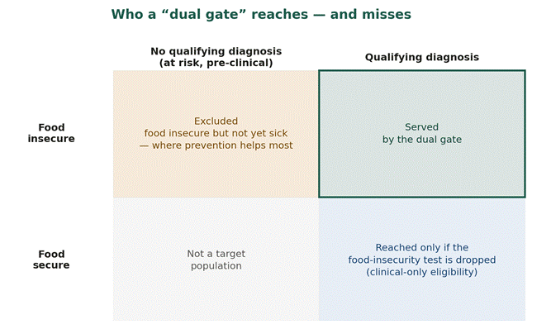
A dual gate serves only those who clear both tests, and misses the food insecure who are not yet sick. A proxy such as Medicaid or SNAP enrollment shifts the dividing line toward insurance status.
The concept doing the work here is “health-related social needs” (HRSN). This is the term the healthcare system uses to reclassify non-medical conditions — food, housing, transportation, interpersonal safety — as health-relevant, and therefore as something payers can be asked to cover. Health-related social needs are the conceptual bridge across the central divide: they are the mechanism by which a community concern like hunger becomes a reimbursable medical service. That makes it the field’s most consequential policy instrument — the door to the reconciliation quadrant, where Medicaid pays CBOs to do FIM work — but it opens that door on the clinical pole’s terms, medicalized and dual-gated. Its partial retraction in 2025, then, is not a technicality; it is the field’s central tension playing out in real time, deciding whether the social and the clinical can be funded as one thing or must split apart again.
The dominant federal pathway tried to split the difference, and in doing so revealed which way the field is tilting. Under the Centers for Medicare and Medicaid Services’ Health-Related Social Needs framework for Section 1115 waivers, nutrition supports were offered only to enrollees who were medically appropriate and met both clinical and social risk-factor criteria — a dual gate, but one in which hunger was reframed as “nutrition insecurity,” and the services were positioned as treatments for defined patient populations rather than as programs addressing poverty. Even where food insecurity survives as a criterion, the framing battle is being won by the clinical worldview. Nor is the ground stable: in March 2025 the federal guidance underwriting that framework was rescinded, leaving existing approvals intact but future social-need coverage to be decided case by case — throwing weight back onto grant funding and state improvisation, and reopening the eligibility question rather than settling it.
The consequences are significant, and in places perverse. The dual gate — diagnosis and food-insecurity screen together — is the most exclusionary design of all, and it cuts directly against prevention: it cannot reach the food insecure who are not yet sick, the very people upstream help would serve best for public health goals. Proxies ease the screening burden but redraw the boundary of “the deserving” around insurance status, excluding the food insecure who are uninsured, just above the income line, or barred from Medicaid by immigration status, while including enrollees who are not currently in need. And if reimbursement pressure pushes the field toward clinical-only eligibility, the benefit can drift up the income gradient toward insured, diagnosed, comparatively better-off patients — an equity failure hidden inside a scalability win. For an organization that treats food security as the very point of its work, this is the eligibility-level form of the field’s central choice: keep food insecurity central and remain in the equity lane, harder to reimburse, or adopt clinical eligibility to reach reimbursement and risk drifting from the people it exists to serve.
Why the fault lines matter
Read as a single structure, rather than a list of policy choices, these tensions become predictive, explaining in advance which alliances will hold, which will fracture, and why. They explain why allies who agree on the goal can still collide over implementation, why the grant world and the reimbursement world are more entangled than they appear, and why the contest over sourcing is ultimately an argument about whether FIM is a narrow health intervention or a broader instrument of food-system change through the lens of public health.
The most important strategic questions for the field follow directly: Can the clinical pole’s drive for evidence and reimbursement be harnessed without surrendering community ownership and equitable sourcing? Can standardization and local autonomy be reconciled in a single accreditation logic? Must a person be hungry to deserve nourishing food as care — or sick to deserve it at all? And who will occupy the reconciliation quadrant in numbers, proving that the movement’s two worlds can in fact be one?
These questions matter because the fault lines in the FIM movement reveal deeper institutional pressures. Reimbursement rules shape eligibility. Evidence standards shape intervention design. Agricultural policy shapes what food is grown, what it costs, and whose farms survive. Community organizations, health systems, funders, and policymakers are not simply choosing among neutral alternatives; they are responding to incentives built into larger economic and political systems. Recognizing this does not make the movement's internal debates less important. It makes them more consequential. Every decision about evidence, sourcing, eligibility, or delivery quietly answers a larger question about what FIM is becoming—and whether it will merely treat the consequences of a broken food system or help reshape the conditions that made it necessary in the first place.
Beyond FIM
The framework presented here also points beyond FIM itself. The movement did not create the conditions it now seeks to address. Rising rates of diet-related disease reflect decades of choices about agricultural subsidies, food manufacturing, labor markets, housing, health care, transportation, education, and economic opportunity. Likewise, the movement's internal fault lines are not simply products of competing philosophies; they are shaped by reimbursement systems, philanthropic priorities, regulatory structures, and political incentives that reward some approaches while constraining others.
Seen this way, FIM is less a complete solution than a revealing intervention. It exposes the places where healthcare, agriculture, and social policy fail to align. No single reimbursement model, produce prescription, or medically tailored meal program can resolve those underlying contradictions. Human flourishing ultimately depends on a broader ecosystem of institutions: a food system that rewards nutritious production rather than simply inexpensive calories; healthcare that values prevention alongside treatment; labor policies that provide living wages; housing and transportation that make healthy food accessible; and communities with the capacity to shape their own food futures.
The question, then, is not whether FIM should become more clinical or more community-centered. It is whether the movement can hold these commitments together while building a world in which food is once again ordinary nourishment rather than extraordinary medicine.
Get involved:
Volunteer | Give Food | Donate | Attend an Event
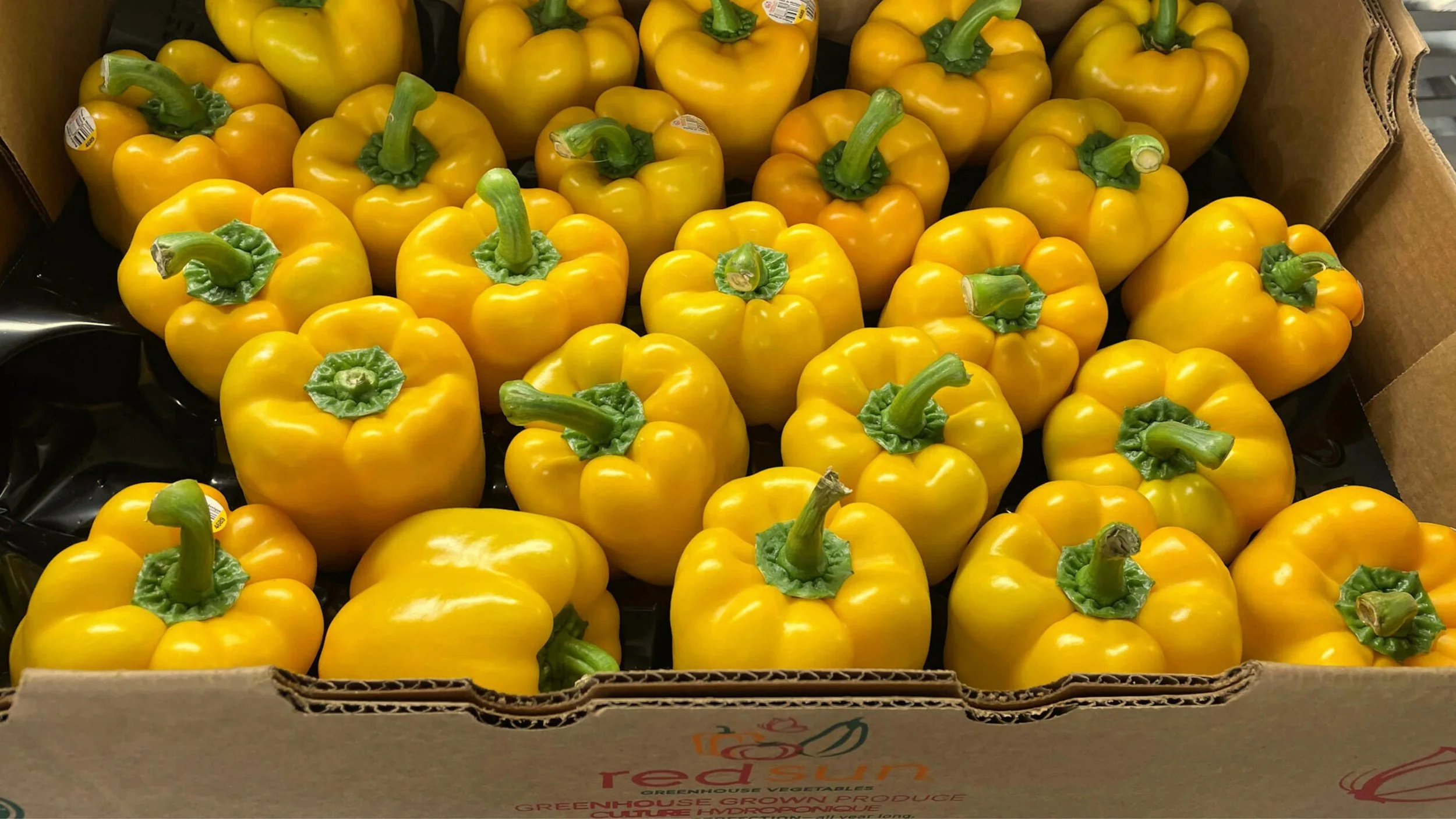
Anatomy of a Meal
Have you ever wondered what it takes to place a hot, nourishing meal in a neighbor’s hands? For us, a meal does not begin in the kitchen. It begins much earlier.
What follows is a careful, collective process shaped by stewardship, skill, and care. It is the work of turning surplus into nourishment, and nourishment into connection.
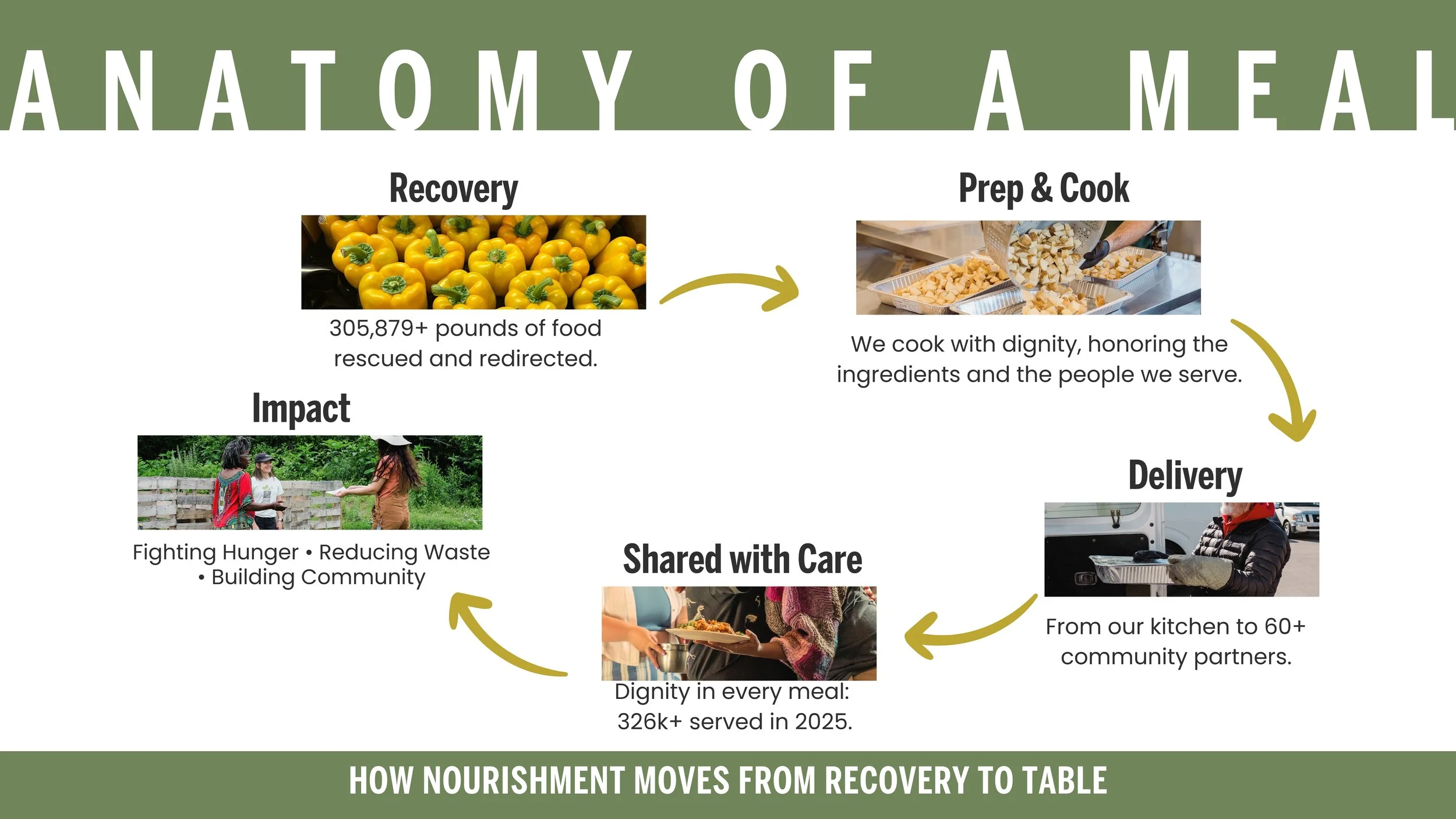
Recovery
The first step is recovery. Across Nashville, food that is still fresh and abundant is often left without a destination. We work alongside grocers, farmers, markets, restaurants, and individuals to recover food that would otherwise go to waste. This is not about scraps or leftovers. It is about recognizing the value of food that has already been grown, harvested, and prepared with care.
Recovering food is an act of responsibility. It acknowledges that hunger and waste exist side by side, and that abundance can be redirected toward justice when we choose to act.
Prep and Cook
Once recovered, food moves into our kitchens. Here, volunteers, cooks, and staff prepare meals from scratch, guided by skill and intention. Vegetables are washed and chopped. Recipes are tested and refined. Meals are prepared with the understanding that the people who will receive them deserve food that is nourishing, thoughtful, and well made.
Cooking is where transformation becomes visible. Ingredients become meals. Surplus becomes sustenance. And strangers become neighbors through shared effort.
Delivery
Meals do not remain in our kitchens. They travel outward, carried by partnerships and logistics that make access possible. Through coordination with nonprofit partners across the city, meals are delivered to places where they can be shared with care and dignity.
Delivery is not simply about transportation. It is about trust. It depends on relationships built over time and a shared commitment to meeting people where they are.
Shared with Care
The final step happens around tables, in community spaces, and through organizations doing vital work across Nashville. Meals are served alongside programs that support children, seniors, immigrants, and unhoused neighbors. In these moments, food becomes more than nutrition. It becomes an expression of hospitality and belonging.
A meal shared with care communicates something essential. You matter. You are welcome. You are not alone.
Impact
Every meal tells a larger story. It is a story of hunger addressed and waste reduced. It is a story of volunteers showing up, partners collaborating, and systems working together in service of the common good.
This work fights hunger by increasing access to consistent nourishment. It reduces waste by honoring the value of food already grown. And it builds community by creating spaces where people come together around a shared table.
Be Part of the Journey
The anatomy of a meal is a collective effort. It relies on people who believe that good food should not be wasted and that neighbors deserve to be nourished with dignity.
If you want to be part of this transformation, there are many ways to get involved. Whether through volunteering, donating food, or offering financial support, your participation helps keep this cycle of care moving forward.
Together, we turn what might be thrown away into meals that strengthen our community, one plate at a time.

Fueling Potential: How Summer Meals Support Youth at the Boys & Girls Club
At the Andrew Jackson Clubhouse of the Boys & Girls Clubs of Middle Tennessee, kids are spending the summer learning, growing—and thanks to The Nashville Food Project’s made-from-scratch meals—staying nourished, too.
Through the Sweet Peas Summer Eats for Kids program, sponsored by Jackson®, hundreds of healthy meals are delivered each week to support youth during a time when access to regular food can drop off.
This partnership is part of The Nashville Food Project’s Community Meals program, which brings nutritious food directly to organizations already creating safe, supportive spaces for young people.
Now in its sixth year, the collaboration with Jackson is helping serve over 100,000 meals this summer—fueling not just plates, but potential across the city.
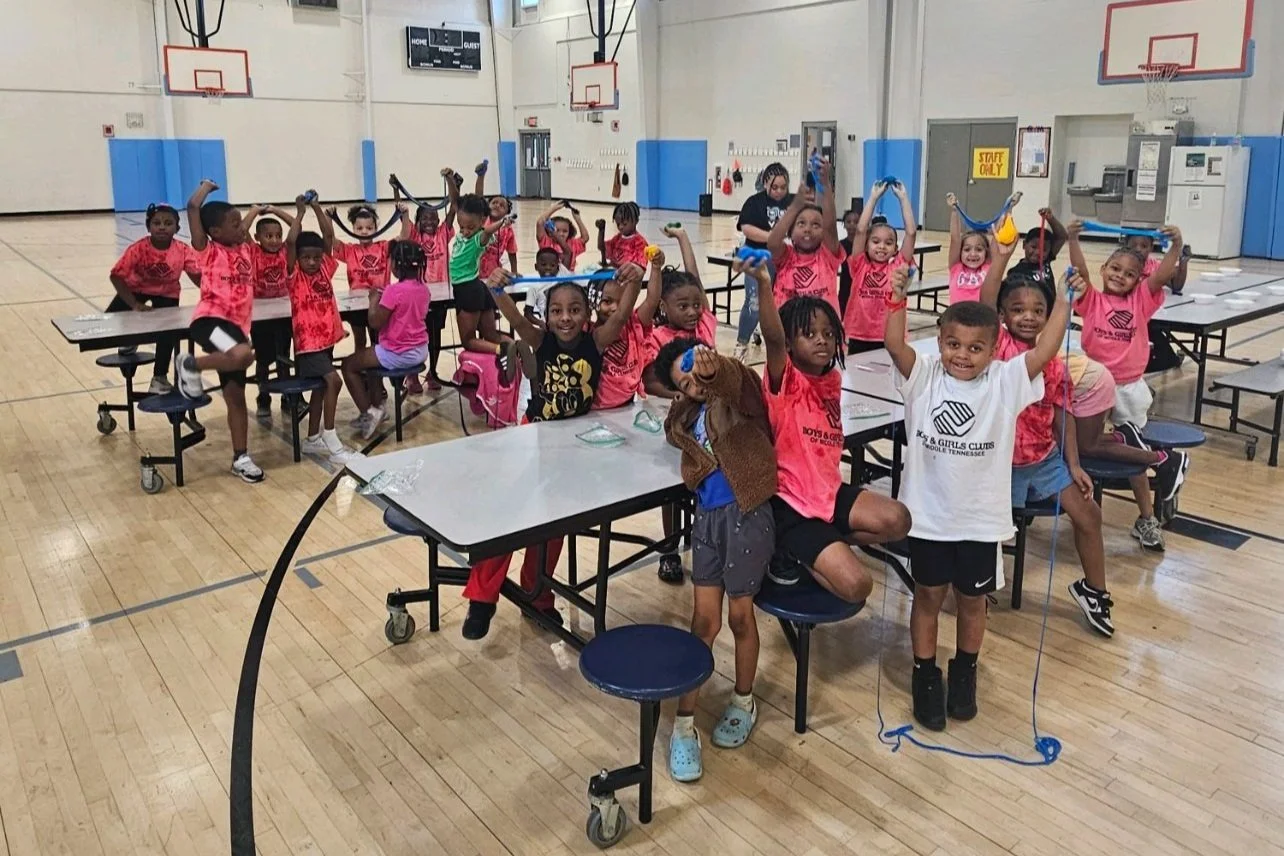
At the Boys & Girls Clubs of Middle Tennessee’s Andrew Jackson Clubhouse, every day is filled with opportunities for youth to learn, grow, and connect. And thanks to Sweet Peas Summer Eats for Kids—sponsored by Jackson National Life Insurance Company® (Jackson®)—those days are also fueled by healthy, made-from-scratch meals from The Nashville Food Project.
We handle the food so BGCMT can stay focused on its mission: to help all young people—especially those who need us most—reach their full potential as productive, caring, responsible citizens.
“When school is out, many children and teens lose access to regular meals,” says Denise Carothers with BGCMT. “The Nashville Food Project’s summer meals ensure that youth have access to healthy food even when school is out. These meals do more than fill plates—they strengthen support systems, create safe spaces, and help children and teens thrive.”
Each week this summer, the Andrew Jackson Clubhouse receives hundreds of meals packed with local produce and kid-friendly favorites like veggie pasta and chicken tacos. And they’re just one of many partners receiving meals through Sweet Peas this summer. With Jackson’s incredible support—now in its sixth consecutive year—we’ll serve more than 100,000 meals this summer to children across the city.

This partnership is part of our Community Meals program, which provides nutritious, made-from-scratch meals to organizations already gathering people in meaningful ways. Our meals help reduce barriers to food access by showing up where people already are—programs like BGCMT that offer stability, community, and a sense of belonging.
This work is only possible because of corporate partners like Jackson, who share our belief that good food is a powerful way to build stronger, healthier communities—one meal at a time.
Hunger vs. Food Insecurity: Why the Difference Matters for Food Justice in Nashville
If we think only in terms of hunger, our response will be emergency food. This is important, but it’s reactive. If we frame the problem as food insecurity, we begin to think bigger. We move from charity to justice. In other words, you can end someone's hunger for a day. But ending food insecurity means making sure they don't face that hunger tomorrow, next week, or next year.
At The Nashville Food Project, we often find ourselves using the terms "hunger" and "food insecurity" side by side. They sound similar. They even seem interchangeable. But in truth, they point to very different challenges—and understanding the distinction is critical if we are to build a more just and sustainable food system for Nashville.
In simple terms, hunger is the physical sensation of not having enough to eat. It is immediate. It is urgent. It is visceral. On the other hand, food insecurity refers to a broader condition: the lack of consistent, reliable access to enough affordable, nutritious food. It is chronic. It is shaped by systems. And it is often invisible.
Hunger: A Symptom

When someone shows up at a food pantry or meal program, what they are experiencing is hunger. It is the tangible result of deeper structural forces, and it calls for an urgent response. In Nashville, we see this every day through our community meals program, which last year alone provided over 325,000 scratch-made meals to individuals and families experiencing hunger. We partner with more than 60 community organizations to make this possible, ensuring that food is delivered in dignified, culturally appropriate ways to those who need it most.
Many of our partners—from Second Harvest Food Bank to Catholic Charities’ Loaves and Fishes program—are on the frontlines of this hunger response. Their work is crucial. Without it, thousands of Nashvillians would go without their next meal.
But as essential as this work is, it is not enough to truly end hunger. Because hunger, while visible and immediate, is only the tip of the iceberg.
Food Insecurity: The System Beneath the Surface

Food insecurity looks deeper. It asks why that person was hungry in the first place.
It considers the mother who skips meals so her kids can eat, the senior choosing between medication and groceries, or the family living in a neighborhood without a nearby grocery store or affordable transit. It acknowledges how structural racism, disinvestment, gentrification, and economic inequality create ongoing barriers to food access.
Here in Nashville, food insecurity is often hidden. It is not always marked by empty stomachs, but by chronic tradeoffs, instability, and stress. It affects health outcomes, educational performance, and community well-being. And it disproportionately impacts Black and Latino households, single mothers, and the working poor.
That’s why The Nashville Food Project is committed to not just feeding people, but transforming the systems that produce food insecurity. Through urban agriculture, culinary job training, food recovery, and partnerships with healthcare providers, we are building long-term pathways toward food security and food sovereignty.
Why the Difference Matters

Why does this distinction matter?
Because how we define the problem shapes how we solve it.
If we think only in terms of hunger, our response will be emergency food—meals, food boxes, donations. These are important, but they are reactive.
If we frame the problem as food insecurity, we begin to think bigger. We look at land access, wages, housing, healthcare, education, and transportation. We move from charity to justice.
In other words, you can end someone's hunger for a day. But ending food insecurity means making sure they don't face that hunger tomorrow, next week, or next year.
Both/And: Bridging the Immediate and the Transformative

At TNFP, we believe in a both/and approach. We will continue to provide nourishing meals—because hunger cannot wait. And we will continue to grow our work in food systems change—because food insecurity will not be solved with meals alone.
That means partnering with local growers and advocating for urban agriculture policies that increase land access. It means teaching cooking and nutrition skills using recovered food that would otherwise go to waste. It means collaborating with healthcare providers on food-as-medicine models. And it means participating in citywide coalitions like FeedBack Nashville to reimagine the future of food in our city.
What You Can Do

Understanding the difference between hunger and food insecurity helps us all become more effective advocates and allies in this work.
Here are a few ways you can take action:
Support both immediate relief and long-term change. Donate to organizations meeting urgent needs, but also invest in those changing the system.
Ask deeper questions. When you hear about hunger, ask what’s causing it. What barriers are upstream?
Talk about the difference. Help others understand that ending hunger is not the same as achieving food security.
Join the movement. Volunteer in a community garden, attend a food policy forum, or support policies that center equity in food access.
A Just and Nourishing Future

Hunger and food insecurity are connected, but they are not the same. At The Nashville Food Project, we are committed to addressing both—with urgency, compassion, and a systems lens.
Because in our vision of a just food future, everyone in Nashville not only has a meal today—they have reliable, dignified access to the foods they want and need for the long haul.
That’s the difference. And that’s the work.
The Role of Public Transportation in Food Accessibility: Part Three
In part three of this series, Director of Food Access Tera Ashley evaluates how public transit systems may or may not meet the needs of its city's residents, and explores improvements to these systems that could also improve food accessibility for low-income, low-access residents.
By Tera Ashley, Director of Food Access
In parts one and two of this blog series, we looked at the meaning of the term “food desert” and explored how limited availability, variety and affordability of food in low-income, low-access communities creates misconceptions about the demand for fresh, quality produce. Catch up here.

In part two of this series, a study was referenced in which it was found that survey respondents without vehicles were only 40% as likely to consume fresh fruits and vegetables as car-owning respondents. While one could assume that the respondents who did not use their own cars to purchase fresh fruits and vegetables perhaps lived in rural areas without a public transportation system in place, it may be just as likely that they lived in an urban area in which the public transportation system simply did not meet their needs.
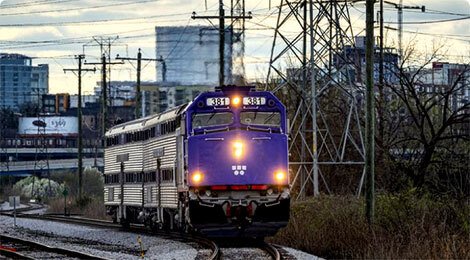
D. Weatherspoon’s 2014 article, “Fresh vegetable demand behavior in an urban food desert,” sheds light on Detroit’s public transit conundrum: “Detroit’s inadequate public transportation system exacerbates its food access problems — a light rail train covers only the immediate downtown area, and a limited number of bus routes link the centre to the more affluent suburban food oases. Each shopping trip provides an inconvenience to the consumer, as it requires walking to and from a bus stop, transferring, and carrying bags.”

Missed opportunities to increase food accessibility within a public transportation system are not just confined to Detroit, as seen in “Barriers to Food Security and Community Stress in an Urban Food Desert,” an assessment by Jessica Crowe and her colleagues of a South Dallas food desert. Crowe found that bus routes – which served as the dominant available public transportation — were “either local and did not go to a large grocery store or led to a transit center in which one had to make several transfers to arrive at a large grocery store or supermarket.” Residents in this South Dallas community who rode the bus to visit larger grocery stores had a travel time of between two and three hours one way, despite some grocery stores averaging twenty minutes away by car. To combat long bus rides to the supermarket, residents who are able often turn to family members or friends with cars, or expensive ride-sharing services, such as Uber or Lyft.
A focus on efficiency and reliability is key when considering improvements to a public bus system. Efficiency in the form of direct routes (without transfers) may not only decrease a consumer’s travel time to a supermarket, but may also allow them the freedom to purchase refrigerated items. Additional buses can ensure more frequent run times, thus increasing reliability if one bus is late or encounters difficulties, as well as potentially decreasing a rider’s wait time at a stop. An increased number of buses can correlate positively with food accessibility, as seen in Deokrye Baek’s study entitled, “The Effect of Public Transportation Accessibility on Food Insecurity,” which found that “one additional bus-equivalent vehicle per 10,000 people decreases the probability of food insecurity of households by 1.6 percentage points.” So if public transportation improvements such as direct routes and additional buses would lead to improved food accessibility, why are cities not implementing these measures?

For decades, it would seem, cities have focused their efforts on increasing public transportation ridership by targeting wealthier individuals – such as commuters – in attempts to decrease congestion and/or improve the environment, rather than meeting the needs of LILA residents, as echoed in Elnaz Yousefzadeh Barri’s article entitled, “Can transit investments in low-income neighbourhoods increase transit use? Exploring the nexus of income, car-ownership, and transit accessibility in Toronto.”
““Many socioeconomically disadvantaged communities, home to transit-dependent populations, were largely overlooked during the transit planning process of the post-war era. The rationale being that investing in low-income neighborhoods, where transit ridership is already very high, would be less likely to result in mode-shifting, congestion relief, and environmental benefits.””
However, not centering public transportation on meeting the needs of the residents who would most utilize the service can create an inefficient system that results in both decreased ridership and increased food inaccessibility. This can perpetuate an already complicated problem: cities may confuse decreased ridership with decreased need and, with less income generated from ticket sales, may be wary of spending money to improve a public service that is already losing funds.
Public transportation improvements – such as direct bus routes to supermarkets – have the ability to increase ridership, and not just among those without vehicles. According to a Toronto study, improvements to public transportation not only resulted in increased ridership amongst those without cars, but also amongst low-income households with one or more cars per adult. In fact, the most elastic relationship with public transportation use seems to not rest with wealthy individuals, but instead with low-income car owners. When a city focuses on the food accessibility needs of its most vulnerable residents when designing public transportation, its ridership increases, resulting in greater economic benefit through increased ridership as well as a higher chance that its environmental and congestion goals will be achieved.

The Role Of Public Transportation In Food Accessibility: Part Two
In part two of her blog series on public transit's impact on food availability, Director of Food Access Tera Ashley evaluates the affordability, variety, and quality of produce typically available in low-income, low-access areas. While many might draw conclusions that there is not demand for as much produce in these areas, anecdotal evidence indicates otherwise.
By Tera Ashley, Director of Food Access
If you missed part one of this blog series, you can catch up here.

““The poor may be disadvantaged in at least three ways as a result of limited mobility. First, the poor may be captive consumers of goods, services, or medical care. Retail establishments may be able to charge higher prices when consumers are limited to local neighborhood stores; social, recreational, and medical opportunities may be limited. Studies have demonstrated the scarcity of major supermarkets and banks in inner-city areas and have shown that inner-city and minority residents pay more for groceries because of the absence of major chains.” ”
In her eloquent assessment of U.S. poverty, Genevieve Giuliano sheds light on an often unseen disadvantage that non-driving and/or vehicle-less residents in food deserts and swamps face: the inability to shop around for lower prices. It is a prevalent belief that residents of LILA (low-income, low-access) areas do not purchase healthy foods because they simply lack the money to do so. While fresh fruit and vegetables may, indeed, be more difficult for low-income residents to afford than higher-income residents, the LILA environment itself may exacerbate this struggle. In an analysis of the small, independent grocery stores located within two urban food deserts in Minnesota, a significant number of food items were found to be significantly more expensive than the Thrifty Food Plan’s “market basket price” — the USDA’s national standard for low-cost, nutritious foods. An assessment of a food desert in South Dallas revealed a similar pattern: the majority of the focus group participants chose to shop outside of the community to avoid the higher prices of the small, independent stores nearby. Though the higher costs of groceries found in food deserts and food swamps may be due largely to the inability of smaller grocers to achieve the same discounts that large-scale chain grocers can negotiate with suppliers, higher costs can unfortunately lead to distrust between residents and local stores. Efficient, reliable public transportation may increase the choices of grocery stores available to a resident in a LILA area, which may lead to a wider range of prices – perhaps some more affordable – from which to choose.

The price of fresh fruits and vegetables is not the only concern facing residents of LILA areas. A lack of variety of fresh fruits and vegetables persists, and when these items are offered, residents sometimes complain of poor quality. Consider quotes taken from residents of a Nashville food desert when interviewed for a study on food accessibility in 2013:
““The quality is not as good as you would find in an actual grocery store. This can cause people to feel like they have to use a lot of canned or frozen goods.”
”When they do have fruits and vegetables, they are too often of such poor quality that we wouldn’t even want to buy them.”
”Companies vary their quality from store to store in different areas: low-income areas equal worse quality equal higher prices.””

Produce offered in a Nashville store.
The poor quality of fruits and vegetables found in the small, local stores located in LILA areas may be due to the quantity that store owners must order at one time, paired with the inability to absorb spoilage costs and replenish the fresh vegetables and fruit at the same rate as chain supermarkets. If this theory is correct, this situation perpetuates a conundrum: due to the low quality and low variety of fresh fruits and vegetables found in the small, independent neighborhood markets, residents in LILA areas make few purchases of fruit and vegetables from these stores. However, due to the residents making so few purchases of fruit and vegetables, the store owners may infer that residents do not want to purchase these items and allow the produce supply to dwindle or spoil before ordering more, which, in turn, affirms the residents’ perception of their neighborhood markets as having both low quality and low variety of fresh fruits and vegetables.

Despite evidence to support the cycle described above, there remains the popular notion — though unfounded — that residents of LILA areas simply do not prefer to eat healthy foods, particularly fruit and vegetables. To test this assumption, researchers in Detroit, MI devised a study in conjunction with the opening of a non-profit green grocer in a food desert to test the consumption behavior of the residents. Their findings revealed that neither the amounts nor the types of fruits and vegetables purchased by the residents significantly varied from that of the U.S. consumer average, thus demonstrating that the consumption of fresh fruits and vegetables is dependent on the accessibility of a wide variety of high quality, affordable produce.
In part three of this series, we will explore how a public transportation system that prioritizes residents’ accessibility to fresh fruits and vegetables can also help a city reach its environmental goals.
The Role of Public Transportation in Food Accessibility: Part One
To combat food insecurity among low-income, low-access households without vehicle ownership, the availability of public transportation is paramount. The increased mobility that often comes with efficient, reliable public transportation may affect the accessibility of fresh fruits and vegetables in three ways: increased affordability, increased variety, and elevated quality. Director of Food Access Tera Ashley explores how food access and transportation are related in the first installment of this three-part series.
By Tera Ashley, Director of Food Access

The USDA’s published report “Low-Income and Low-Supermarket-Access Census Tracts,” revealed in 2017 that nearly 39.5 million U.S. residents lived in areas defined as both low-income and having low supermarket access. These regions can be referred to as LILA (low-income, low-access) areas, but they are most commonly known as “food deserts,” a term coined in the 1990s to define locations in the United Kingdom with low supermarket access. Though the definition of the term has varied since its conception, the most widely used one comes from the USDA: “An area with limited access to affordable and nutritious food, particularly such an area composed of predominantly lower income neighborhoods and communities.”
The USDA uses even more specific parameters to define food deserts in urban settings: “low-income census tracts (tracts with a poverty rate of 20% or greater) where a significant number of people (at least 500) or share of the population (at least 33%) live greater than one mile from the nearest supermarket, super center, or large grocery store.” It is important to note that, in measuring food accessibility of vehicle-less urban households, the distance indicator lowers from 1 mile to 0.5 mile from a supermarket.

In more recent years, the term “food swamp” was invented to describe areas in which options for unhealthy food abound (such as convenience stores or fast food purveyors), all the while healthy food options continue to have restricted access. As time progresses, the term food swamp may come to be more commonplace than its predecessor. Jonatan Fielding and Paul Simon hint at this in their article, Food Deserts or Food Swamps?, “In many disadvantaged communities, the food environment is more swamp than desert, with a plethora of fast food; convenience stores selling calorie-dense packaged foods, super-sized sodas, and other sugar-loaded beverages; and other non-food retail venues selling junk food as a side activity.” It should come as no surprise, then, that in addition to the typical hurdles that a low-income resident may face, studies have linked residing in food deserts and food swamps with disproportionately high rates of obesity and diet-related chronic diseases. It is important to note here that “healthy food” can, at times, be subjective. To avoid confusion, studies often measure the availability of fresh fruit and vegetables to gauge food security in LILA areas.
It may be tempting to search for a silver bullet of sorts to solve the issue of low access to fresh fruit and vegetables in food deserts and food swamps, such as building a new grocery store in a LILA area. However, a “solution” of that nature would require there to exist only a single cause to an area having low access — proximity — when, in fact, there are several interconnected contributing factors to low access. Indeed, factors of proximity, food quality, food affordability, systemic racism, and access to efficient, reliable public transportation all converge to create food deserts and food swamps. It is the latter, access to efficient, reliable public transportation, that will serve as the focal point of this three-part series.
The Importance of Public Transportation

Although it is estimated that over 89 percent of U.S. households own vehicles, households with lower incomes are more likely to not own a vehicle. Financial challenges, including the cost of the car itself, along with maintenance and repairs, insurance premiums, and fluctuating fuel costs can be prohibitive for low-income households. Other factors, such as mental or physical disabilities, and even drivers’ license exams not offered in a resident’s native language could also contribute to a lack of a household vehicle or the inability to drive. Whatever the contributing factor(s) for not owning a vehicle, the number of low-income tracts with a significant number of households that do not own a vehicle and live more than 0.5 mile from a supermarket experienced a four percent increase between 2010 and 2015.
Not having access to a vehicle can have a negative impact on a LILA resident’s ability to access fresh fruits and vegetables. As found in Stuart Strome’s study, Elements of Access: The Effects of Food Outlet Proximity, Transportation, and Realized Access on Fresh Fruit and Vegetable Consumption in Food Deserts, “respondents who did not use their own car to buy fresh fruits and vegetables and were from food insecure households were only about 40% as likely to consume fresh fruits and vegetables as other respondents.” To combat food insecurity among LILA households without vehicle ownership, the availability of public transportation is paramount. The increased mobility that often comes with efficient, reliable public transportation may affect the accessibility of fresh fruits and vegetables in three ways: increased affordability, increased variety, and elevated quality. We will explore all of these ways in part two of this series.
Addressing Child Poverty Beyond the Pandemic
Development Manager Johnisha Levi wrote an article for Yes! Media on the American Rescue Plan’s potential to reduce child poverty in the United States. The plan seeks to uplift American families suffering from the economic impacts of COVID-19 with a series of cash transfers and expansion of benefits. While the focus of the bill is specifically COVID-19 relief, it has potential to have lasting impacts on childhood poverty and hunger in our country.
by Johnisha Levi
Last month I wrote an article for Yes! Media on the American Rescue Plan’s potential to reduce child poverty in the United States. The plan, which was signed into law in March, seeks to uplift American families suffering from the economic impacts of COVID-19 with a series of cash transfers and expansion of benefits. While the focus of the bill is specifically COVID-19 relief, it has potential to have lasting impacts on childhood poverty and hunger in our country.
At The Nashville Food Project, we have long recognized that child hunger is not an isolated problem, but one that is inextricably linked to housing, education, employment and a host of other systemic failures. This is why we work collaboratively with local organizations that provide child and youth poverty-alleviating programming so that we can augment the impact that our work has on children and families in our community. Sharing our nutritious meals and fresh produce supports the essential work that these organizations do every day to help lift children and their families out of poverty. Just look at our Sweet Peas: Summer Meals for Children program, which will provide close to 15,000 meals for children over the next two months, lessening the critical summer nutrition gap for area children and youth who rely on school meals for their daily nutrition.
The benefits that the American Rescue Plan offers to U.S. families have the potential to significantly reduce the child poverty rate in America, giving it great historical context. You can learn more about the bill’s provisions in the Yes! piece and in the excerpt below:
The Center on Social Policy at Columbia University has estimated that the American Rescue Plan will cut the child poverty rate by as much as 56% this year, which will alleviate the suffering of children of all races. The poverty rate for Black, Hispanic and Indigenous children, who are disproportionately impacted by both poverty and COVID-19, would decline by 52%, 45% and 61% percent respectively. However, as the Children’s Defense Fund’s Director of Poverty Policy, Emma Mehrabi, cautions, “Th[is] data will only live up to its projections if families—especially the hardest to reach—know about the benefits [offered through the plan] and can easily access them. So we need to make sure that families and communities on the ground are aware of this program and we need to work aggressively to get them signed up.”
The Plan’s newly liberalized child tax credit, which is a cash transfer that can be spent as parents/guardians determine, has been receiving a lot of media coverage due to its transformational potential. The Plan’s child tax credit is fully refundable, and therefore does not phase out jobless parents nor those with the lowest incomes who pay little to no federal income; it will benefit 93% of the parents of American children, or 69 million people. Prior to the legislation, the poorest 10% of children did not receive any benefit from the child tax credit and approximately 25% received only a partial benefit. Many of the children whose families were excluded from the original tax credit were the children of single parents, Black and Hispanic children, and those who live in rural areas.
Effectively, parents who receive the child tax credit under the Rescue Plan are getting a small taste of what it would be like to have a guaranteed minimum income to support their children. According to a recent UNICEF report, at least 23 countries guarantee a minimum income for families with children. A guaranteed minimum income for children not only alleviates poverty in real time; it has also been linked to better health outcomes for children, improved performance in schools, and the ability to earn higher incomes as adults.
The temporary child tax credit is only a start; to have a significant and far-reaching impact, we’d have to make such assistance to families permanent and also combine it with other legislative solutions that address the deep economic and racial disparities in this country. But we hope that the American Rescue Plan opens doors to a more empathetic manner of addressing poverty in this country—one that treats it as a societal failure rather than an individual moral shortcoming. We owe it to our children to give them a better start in life.
A Spirit of Service
"What I love about these programs as we think about the spirit of service is these programs are built on the strengths of those who participate and not their deficits." - our founder Tallu Schuyler Quinn delivering her acceptance speech for the 2020 Alumna Spirit of Service Award at Harpeth Hall School. You can watch the full speech here, where we also offer our gratitude to Harpeth Hall for their recent donations helping us stock our pantry and provide nourishing meals in the community.

Our founder Tallu Schuyler Quinn took the stage recently at Harpeth Hall School to accept the 2020 Alumna Spirit of Service Award. She shared about her journey and our work at The Nashville Food Project including programs like Growing Together.
“What I love about these programs as we think about the spirit of service is that they are built on the strengths of those who participate and not their deficits. I think that's an important and extraordinary way for us to think about poor people. Those of us who haven’t grown up in poverty can often think about poor people as just what they lack. Many of these program participants, while they lack much in life because of an unjust economic system, have incredible strengths, knowledge and experience that contributes something really meaningful in our community. To me that’s such a core tenant in the spirit of service.”
It was a particularly special time, too, as the school’s students and parents also worked that week to raise funds and gather pantry supplies to help keep our kitchens stocked and our community fed. A spirit of service showing up in multiple ways!

During the drive—as well as one Harpeth Hall hosted in 2020—the Harpeth Hall community pulled together an incredible 2,300 pounds of often-used ingredients including cooking oils, stocks, beans, rice and other highly adaptable and fundamental building blocks to our meals.
“These ingredients can be used to add substance and nutrition to such a wide variety of dishes and really help take the edge off of our budget,” says Procurement Manager David Frease. “This frees the kitchen up to spend their resources on more fresh, high-quality produce and protein, adding more diversity to the meals they create.”
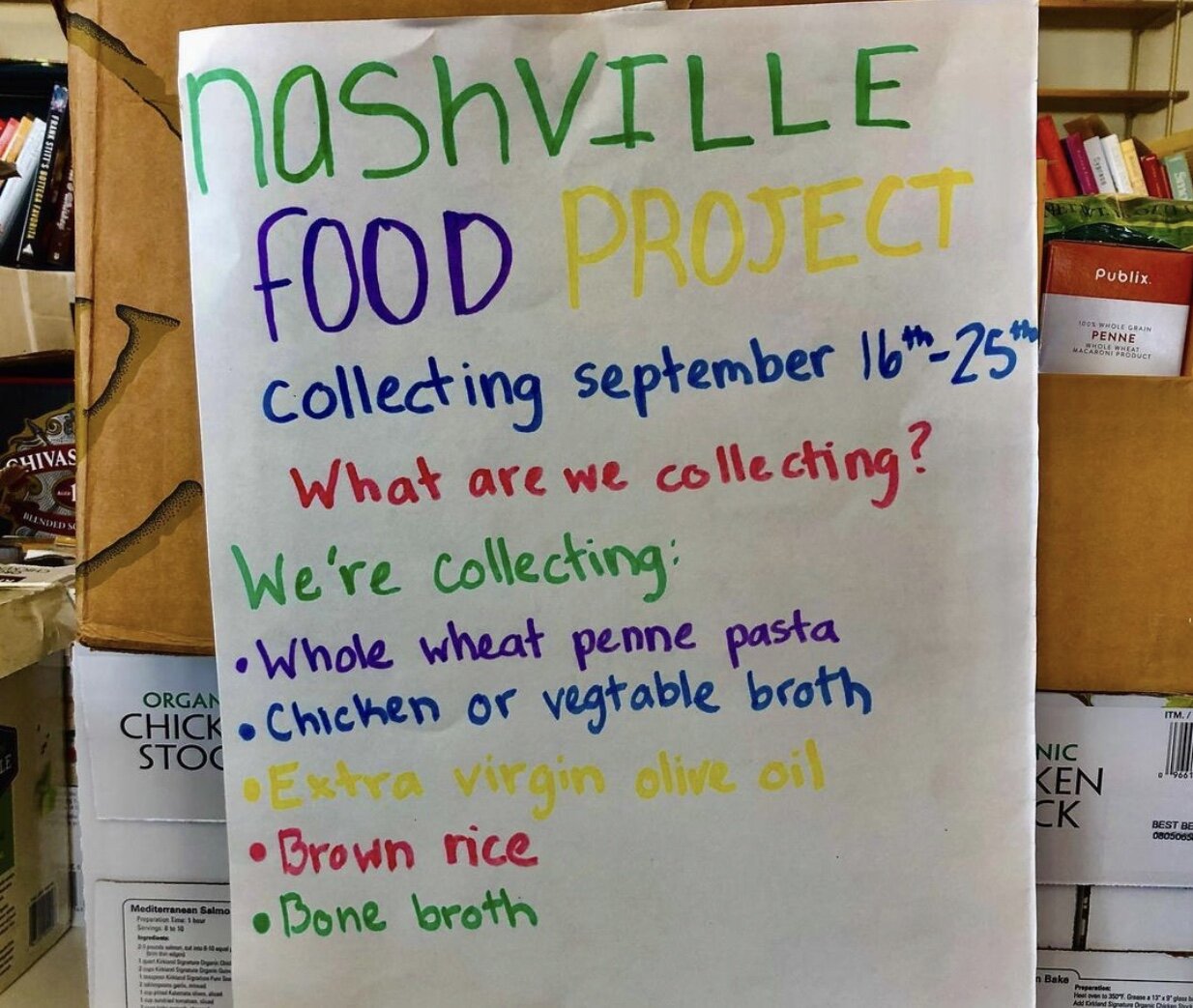

David finds some peace after sorting donations at The Nashville Food Project headquarters.
The latest drive also happened toward the end of the cooler months, a particularly lean time for us when the majority of our local farm partners go into hibernation and there aren't as many donations coming into the kitchen.
“The idea of the students rallying behind our cause in such great numbers is really incredible,” David says.

You can hear Tallu’s full speech from Harpeth Hall at the video below.
Fighting for Tennessee’s Food Security Safety Net: Pandemic EBT and Food Assistance in the Age of Coronavirus
We know how important free and reduced-price meals are for Tennessee families—over 663,000 Tennessee kids rely on free lunch and breakfast during a typical school year. As the pandemic shutters businesses and causes unprecedented layoffs, families are more vulnerable to food insecurity than ever before. While support from incredible locally-run organizations like The Nashville Food Project, this does not replace the need for food assistance legislation from state governments—especially in times of crisis.

Image from @tnjustice
guest post by Lauryn Cravens
Passionate about nutrition, food policy, and food justice, I have had the incredible privilege this summer of splitting my time working between The Nashville Food Project and the Tennessee Justice Center’s Nutrition Team. This has afforded me the opportunity to work with this concept of “food” with my hands in the Food Project’s Growing Together garden, and at the federal policy level with the Justice Center, all as the coronavirus pandemic has put a greater strain on our food system than ever before.
No one on the Tennessee Justice Center’s Nutrition Team expected our summer to be consumed by Pandemic EBT, but it has. What is Pandemic EBT? Pandemic EBT provides financial benefits for families of children in grades K-12 who receive free or reduced-price school meals or attend a Community Eligibility Provision school (a school where meals are free for all students) to help families that missed school meals during March, April, and May when children were not in school due to COVID-19. The only requirement is a child must be eligible for free or reduced-price school meals; P-EBT is for all students regardless of citizenship or immigration status.
The state of Tennessee boarded the P-EBT boat later than other states and was not approved for the program until mid-May. Since approval, Tennessee has failed to implement the program quickly, and several obstacles remain in place, making it hard for too many families to access food. Due to significant administrative barriers, a lack of sufficient marketing and outreach to inform the public of the expanded benefits and a short application window for families, thousands of Tennessee families are still without their desperately needed benefits.
We know how important free and reduced-price meals are for Tennessee families—over 663,000 Tennessee kids rely on free lunch and breakfast during a typical school year. As the pandemic shutters businesses and causes unprecedented layoffs, families are more vulnerable to food insecurity than ever before. While support from incredible locally-run organizations like The Nashville Food Project, this does not replace the need for food assistance legislation from state governments—especially in times of crisis.
For example, one way to help keep Tennessee students and their families afloat would be eliminating the P-EBT application altogether, allowing every family who qualifies to automatically participate. And although the state is responsible for publicizing P-EBT, everyday Tennesseans can also do their part to spread the word and advocate for this food assistance program, whether that be via word of mouth, social media, or by contacting local representatives.
Furthermore, as those who work with The Nashville Food Project and the Growing Together program know all too well, not all Tennessee families are fluent in English. Translation of the P-EBT application into Spanish, Kurdish and other languages would make the program more accessible for the many immigrants and refugees who call this state home. These actions and more can help ensure that all eligible Tennessee families receive the benefits they need and deserve during this critical time.
Stay updated with Tennessee Justice Center’s nutrition advocacy efforts, and see what you can do to help here: https://www.tnjustice.org/child-nutrition.

Image from @tnjustice
What it Means to Nourish Community
Nourishment, after all, is about so much more than feeding and eating. To nourish another centers on the emotional tie—the care, regard, and concern—you have for another. It is about maintaining a relationship by prioritizing and cherishing another, not imposing what you think you know, but rather about listening. And it is this relationship that informs what makes another person or a community healthy and strong.

by Johnisha Levi, Development Manager
Since its inception, The Nashville Food Project has operated in a foodscape saturated with inequity. Our mission is to ensure that people are getting the food they need and want, with “want” being as vital to us as “need.” And now, after a series of life altering events, including tornadoes, a pandemic, fatal police shootings and mass protest, we are in a moment that is utterly destabilizing. But this is not necessarily a negative. Although it is admittedly easy for each of us to vocalize what we fear and dislike about 2020, this year also presents a rare opportunity to reset. When we emerge from this crucible, what new shape will we assume? Who and what will we be—as a nation, and as a people?
Now is the time to re-imagine, re-create, take response-ability, and re-assess. There is so much that has been and is broken about our government, our country, and our world. Stressors have better exposed these breaks, giving us a clearer picture of our failings, so the question is what do we do to improve and innovate, to move beyond and above? These are challenges for us as individuals, but also as organizations. Currently, The Nashville Food Project may not be able to carry out the part of our mission that “brings people together” physically—whether in our kitchens or for charitable fundraisers like Nourish—but that doesn’t stop up from querying how we can continue to sustain and nourish our community in new and even better ways.

Nourishment, after all, is about so much more than feeding and eating. To nourish another centers on the emotional tie—the care, regard, and concern—you have for another. It is about maintaining a relationship by prioritizing and cherishing another, not imposing what you think you know, but rather about listening. And it is this relationship that informs what makes another person or a community healthy and strong. What comes to mind is the phrase “community of feeling,” which appears in letters that Sigmund Freud and Albert Einstein exchanged on the question of war. What I think it means to nourish a community is to nurture “a community of feeling,” and this is at the heart of TNFP’s vision for a just and sustainable food system. As Tim Mwizerwa, program director at one of our emergency partners Legacy Mission Village explains, “ T[he Nashville Food Project was] willing to provide fresh produce to a lot of our families that were also culturally competent. You can gather a lot of goods but if families don’t recognize how to cook that produce, it goes to waste. We really appreciate your partnership and support and just knowing that we are not sending [our client families] filler foods, we are sending them nourishment on top of that.”

Although many things remain uncertain in the coming months, one essential truth, as stated in a recent New Yorker piece, emerges: “civic connection is the only way to survive” in a time when physical contact can present such danger to so many in our community. And it is this civic connection that is at the heart of our community food model at TNFP. Typically, mutual aid efforts and charitable organizations take different approaches. The former tend to be more grass roots and shaped by volunteers and the needs of recipients and services, while the latter tend to be more hierarchical and governed by boards and donors. What is beautiful about The Nashville Food Project model is that it is more a hybrid—a charitable organization that operates like a mutual aid project in seeking to empower, involve and amplify the needs of those it serves. For example, when a Burmese community leader and former Growing Together farmer approached TNFP about the particular need in her hard-hit community for fresh produce, we were able to use unrestricted funding to pay our Growing Together families to supply these vegetables. Thus, families affected by COVID outbreaks at their workplaces were able to enjoy the labors of what their farming neighbors produced, while the farmers could continue to earn income from their agricultural efforts. This is a community of feeling and of nourishing—of listening, responding, and creatively meeting a need.

When reading the news can be so grim, it is inspiring to see the impact that spontaneous mutual aid networks and charitable organizations are making to help ameliorate suffering during this pandemic. While TNFP will seek to carry forward some of the lessons we learn in crisis to keep nourishing our community, we must never lose sight of the underlying reality that these unmet needs should never have existed within our systems in the first place. And we must continue to strive to make our own work obsolete one day. As Martin Luther King Jr. said, “Philanthropy is commendable but it must not cause the philanthropist to overlook the circumstances of economic injustice which make philanthropy necessary.”
Dispatch from the Community Gardens
In the community garden program, we're always looking for ways to evolve and learn from our work. And this year, we are already reflecting and learning from the adaptations we've had to make due to COVID-19.

by Lauren Bailey, Director of Garden Programs
In the community garden program, we're always looking for ways to evolve and learn from our work. And this year, we are already reflecting and learning from the adaptations we've had to make due to COVID-19. We’ve been focused on adapting the program with these priorities in mind: keeping everyone safe and ensuring that everyone has access to fresh produce.
I've been reflecting a lot lately on the bounty of harvest being shared and on the community of gardeners who were willing to try out a new garden model with us. Right now, we are all facing circumstances that the world has never seen. And more than ever, it feels like the right time to build community in the ways that we can, safely, at a distance. For the time being, instead of tending individual plots, we’re all working together to grow for the nourishment of everyone. Gardeners have been joining us in the garden to tend to our communal plots, and they've shared some of what they've been trying out at home.


Our gardens have always flourished from the wisdom, experiences and curiosities that gardeners bring to the space; this year is no different. The gardens are still a place of respite and inspiration. They still provide for us in these uncertain times. We've just had to be creative in how that has happened. Our staff has learned how to grow some crops that we've never grown before, like bitter gourd, bottle gourd and taro root. Gardeners have tried new vegetables like kohlrabi, fennel and kale. And though this year looks so different than past years, we're still a community of people who love the act of growing food, sharing recipes and eating good food.

A Spirit of Abundance
At TNFP, we often talk about our value of Stewardship and the belief we believe that there is enough. I’ll say it again, there is enough.

by Lauren Bailey, Director of Garden Programs
It’s a hot afternoon at the Community Farm at Mill Ridge, and as I’m starting to pack up from our communal garden produce pick up, Lu Lu arrives. She’s wearing her straw hat and a smile. She seems to have a lot on her heart as she tells me about her previous engagements of the day. She tells me how she and other leaders have been meeting to find ways to support refugees in Malaysia. Over the course of the next hour, she tells me about the experiences that led her to help others. And what is so clear for me as I listen to her is her courage, bravery and generous spirit. And on a hot day like today, her words land as a challenge and inspiration to exercise a spirit of abundance.
Lulu Nhkum’s leadership has been critical to the development of the garden programs since they first began. I think back to a shared dinner that she, I and two other colleagues had. It was LuLu who said that she had dreams of becoming a farmer and in that very moment, the momentum for applying for the Refugee Agricultural Partnership Program grant was sparked (which eventually became Growing Together and initial programming for some of the community gardens). Her leadership, insight and advocacy have been essential to the success of our work. She has been a champion of this work, even as she’s been fully employed elsewhere. If you know her, then, maybe you’ve seen the way she delights in learning about and growing food. Her enthusiasm is contagious.
It has come as no surprise that during this crisis, her leadership and enthusiasm continue to shape our programming in important ways .In a time of crisis, a scarcity mindset is easy to embrace. One of the things that I've learned from Lu Lu’s leadership during this time is that abundance manifests in many ways. It looks like folks showing up to support one another. It can look like a circle of leaders and organizers hearing need and mobilizing resources.
This year, as the effects of COVID began to be felt in our city, Lu Lu seeing and hearing the need of those in her community, advocated for TNFP to support these families in some way. She had intimate knowledge of the Growing Together program and the food grown there and knowledge of the communities' needs. Because of her advocacy and with the help of other leaders, over 100 families impacted by the virus received fresh vegetables from the Growing Together farm.
At TNFP, we often talk about our value of Stewardship and the belief we believe that there is enough. I’ll say it again, there is enough. One of Adriennne Maree Brown’s Principles of Emergent Strategy is that there’s always enough time for the right work. There is enough time; there are enough resources; there is enough food. And the leadership of women like Lu Lu Nkhum show that there are ways to make sure that people have what they need, even in times of crisis, if we can all get better at exercising this spirit of abundance.


Dispatch from our Kitchens: "The Coat"
My deepest hope in all of this is that I can honor the people who paid the price for my new creative outlet, to serve others with that sacrifice, and in some Karmic way I can make the best of what’s shared with us to do good in this world.

by David Price, Kitchen Manager, St. Luke’s Kitchen
Last year at The Nashville Food Project holiday gift exchange among staff, I opened my gift with caution. I wanted to prepare myself to be excited about something that a co-worker who barely knew me bought for me. I am ridiculously hard to shop for, and you can ask my partner Keeli about it sometime. I opened the box with cautious optimism and there it was— a chef’s coat.
To give you some context, I would never buy such a thing for myself, because it says that I have arrived in a way that I had not yet. When you have been a professional cook for two years and crank out steamed veggies and casseroles on the regular, it is an overstatement to call yourself a chef especially when you have only been the head of a kitchen for a few short months.
From the moment I decided to leave my previous career of seventeen years and started cooking at the Food Project, I wanted to be a chef. A part of me always felt that the people who referred to themselves as “chefs” and not “cooks” were trying to prove something they didn’t yet believe about themselves. Still, a piece of me wanted that external validation for something I’d never believe on my own. On the night of that holiday party, I was validated (though I still refer to myself as a cook). It wasn’t the simple fact that someone bought me a chef’s coat. It was who did it. It was my TNFP boss whom I deeply respect.
I have eaten some very amazing food in my lifetime, but Bianca Morton (TNFP Chef Director) made me the best food I have ever put in my mouth from trimmings off of a pork loin that were destined for the trash. She did it on the fly and with zero doubt. It came from a confidence of knowing exactly what she wanted her guests to eat and how she was going to get it done. It changed my perspective. I could cook like that one day if I really drove myself and never forgot to be creative and take risks. She will probably just tell you that she was hungry, but the reality is that creativity is based in what we want and what we have simultaneously. It’s the restriction that gives us our direction to flesh out a dream. That is the purest form of the art.
When she gave me that coat, what that moment did for me was give me the “ok” to do and be creative. She gave me heart and strength and a courage to believe that I was able to be what that coat would say I already was. That was a beautiful moment and the next time I stepped back in the kitchen I got my ass kicked to the point I wanted to give up. That was an equally beautiful day in hindsight because I realized that you never arrive. You just keep learning and trying and getting the hell kicked out of you. I just can’t help myself. I love that. I want to win just enough to keep me from giving up when I just can’t get on the plate what I had in my head.

David working alongside Top Chef-alum Arnold Myint at a TNFP Simmer event.
We, especially in this kitchen, are living in some uniquely bittersweet times. Everything seems to cut both ways. We have received some incredible donations of products lately that inspire me yet also sadden me in ways that I can’t really ever put words to. Some of it is from restaurant closures in the wake of COVID-19 pandemic, meaning much of it is food that we would never be able to serve on our own budget. Yet I know that every steak, shrimp, or salmon that we have the privilege to cook is a brutal reminder that it was someone else’s job to cook that thing. You just can’t help but wonder where they are and if they are okay. The thing that I love about kitchen work is that it is communal, so I’m always hoping the best for every person crazy enough to live this life. This creates conflict inside my heart when I cook their food. This is one of the countless ways that my world has changed.

Meals by David and his team made with donated ingredients.
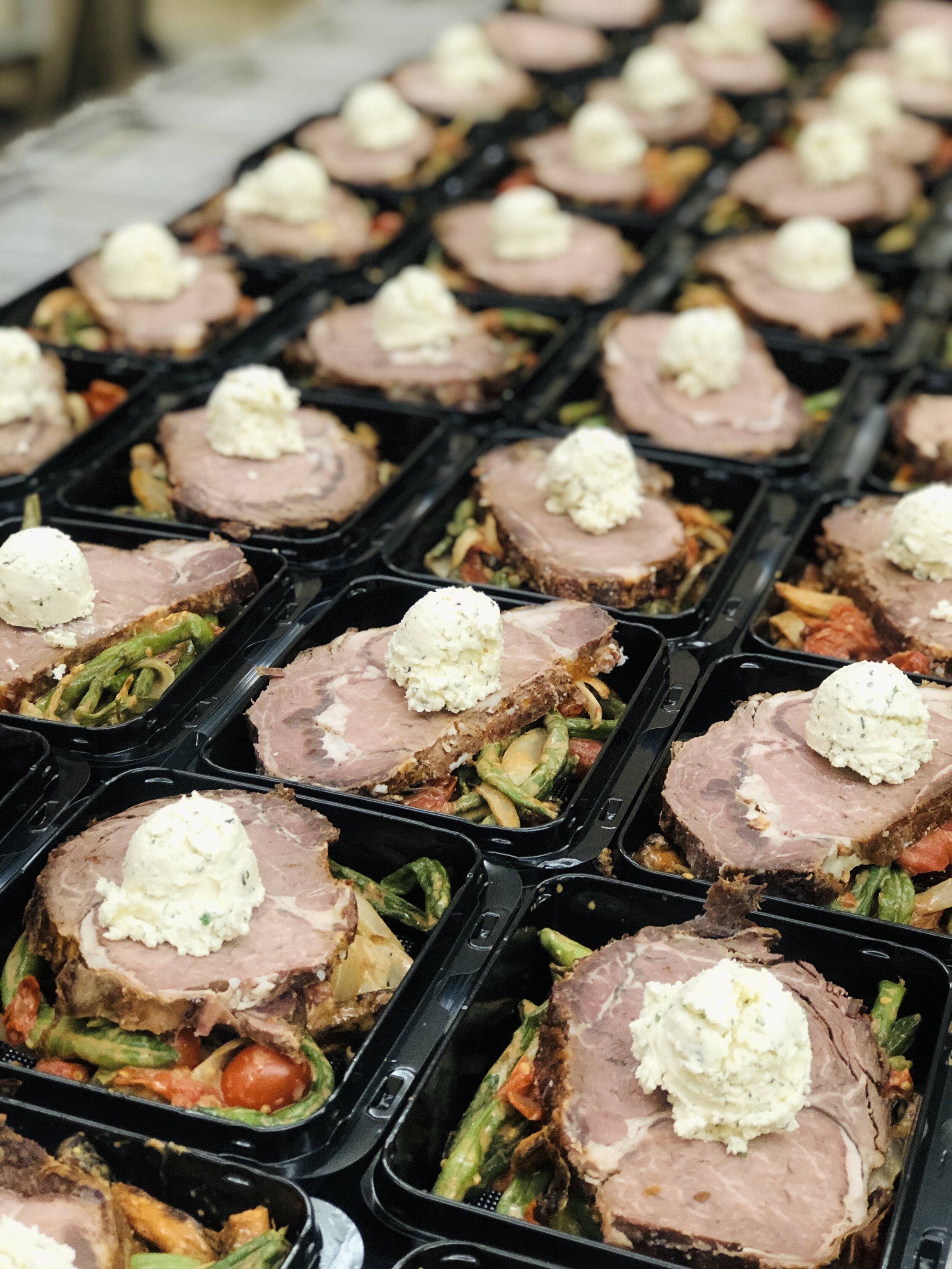
Today, we are constantly reimagining things we thought of as constants. In a million years I could have never imagined a world without the tremendous volunteer support we receive in the kitchen. I could never have imagined creating meals that were not regulated by certain guidelines for federal reimbursement. These days the meals come with fewer restrictions but they also come at a great cost. It becomes a very real challenge to enjoy the privilege that symbolizes the loss of another person’s livelihood. I’ve always hated the saying, “There is no such thing as a free lunch,” because most people use it to justify societal oppression, but I am uniquely aware that everything comes with a price tag these days. All too often it’s rarely the price you want to pay and more often than not it’s the person who least deserves it who foots the bill.
My deepest hope in all of this is that I can honor the people who paid the price for my new creative outlet, to serve others with that sacrifice, and in some Karmic way I can make the best of what’s shared with us to do good in this world. I deeply, and to the point of tears, believe that all ships rise in the tide together. I believe that all people deserve to eat amazing food and to share it together even if you don’t conventionally have access to it. So, I dedicate myself to becoming as good as the best chef turning out food in this city, country and world. I dedicate myself so that I can give delicious food to the people I serve. That is my small place in the universe and it’s the only place I want to live. I have a long way to go, and so much to learn— but that coat said I could do it.

TNFP staff at the holiday party.
Nourish Nashville
“I must remind you that starving a child is violence. Neglecting school children is violence. Punishing a mother and her family is violence. Discrimination against a working man is violence. Ghetto housing is violence. Ignoring medical need is violence. Contempt for poverty is violence.”
— Coretta Scott King

““I must remind you that starving a child is violence. Neglecting school children is violence. Punishing a mother and her family is violence. Discrimination against a working man is violence. Ghetto housing is violence. Ignoring medical need is violence. Contempt for poverty is violence.” ”
The devastation caused by the pandemic has left millions of American households without adequate resources to put sufficient food on their tables. Families with young children are hardest hit, with more than 40% of them unable to afford enough food to meet their needs. The pandemic is not the cause of the gross inequity and economic distress that is pervasive across our nation. The crisis called poverty started long before the first COVID case was confirmed in our community. Decades of underfunding, oppressive policy, band-aid fixes, and neglect have resulted in a torn safety net that has left American families without the money, power and other resources they need to thrive.
As many Americans start or continue their journeys of learning and unlearning right now, we are all waking up to the many forms of institutional violence that are directed at BIPOC (Black, Indigenous, People of Color). Food aparteid, food insecurity, and land dispossession are forms of violence, and with renewed passion, we at The Nashville Food Project are digging into the healing work to make our vision a reality--that all Nashvillians have access to the food they want and need, through a just and sustainable food system.
“You have the duty to change what you have the power to change,” says author and activist Austin Channing Brown. We know that if we tried to do everything we would fail. But we also know we have a moral obligation and community responsibility to step in everywhere we can to uproot the violence of poverty. In this time of crisis that is not new but growing more complex, The Nashville Food Project is on the frontlines, growing food, cooking food, and sharing food in equitable ways throughout the city. We take seriously the clarion call from the late, great Mary "Mother" Jones who said while we "pray for the dead, we fight like hell for the living."
NOURISH NASHVILLE
As many of you already know, this year's Nourish fundraising dinner and auction event is cancelled. It’s not the year for a large, celebratory gathering, nor is it the year to pour our limited efforts of time and creativity into a special event when the critical needs of our neighbors continue to mount. But it is a time to Nourish Nashville more than ever. Nourish will be coming into your homes this year, and although virtual, we hope this makes for an intimate experience of connection with those in your household. Our team has enjoyed finding creative ways to raise the critical funds the Nourish event brings in, while engaging with you all virtually. We hope you enjoy these scrappy, behind-the-scenes snapshots at thenashvillefoodproject.org/nourish2020!
Sowing Seeds of Justice
It is past time to sow seeds that yield justice and a more equitable future. The profound impact of racism on life and death demands a full response from every single part of American society. At The Nashville Food Project we know we do not have all the answers, but we believe we can be part of the solution. We have learned and continue to learn that anti-racism work cannot be treated as side work, but it is the work of community food justice.

Greetings from my small corner of this city I love.
Emergency and urgency are all around us. Institutional violence, spiking unemployment, food insecurity, low-wage work without adequate protection, crippling debt, insufficient healthcare—all of these emergencies amplified by the weight of a global pandemic. The roots of these and other disparities are the result of legacies of white supremacy and systemic racism that have for centuries shaped policing, housing, food and land access, criminal justice, education, and healthcare.
So the turned up patches of dark, fertile soil in our gardens seem more urgent than ever. As we consider what we plant and how we plant, we’re mindful that we can’t expect a just yield without centering the work of equity and racial justice. The luminous Toni Morrison, in her novel The Bluest Eye, has me thinking about what soil can nurture and yield when she wrote, "the land of the entire country was hostile to marigolds that year. The soil is bad for certain kinds of flowers. Certain seeds it will not nurture, certain fruit, it will not bear, and when the land kills of its own volition, we acquiesce and say the victim had no right to live. We are wrong, of course, but it doesn't matter. It's too late."
It is past time to sow seeds that yield justice and a more equitable future. The profound impact of racism on life and death demands a full response from every single part of American society. At The Nashville Food Project we know we do not have all the answers, but we believe we can be part of the solution. We have learned and continue to learn that anti-racism work cannot be treated as side work, but it is the work of community food justice. The crucial nature of our mission to grow, cook, and share nutritious food must be paired with an active commitment to learn and unlearn, to listen, to deepen empathy, to name injustice, and to leverage every resource available to us—money, relationships, time, effort, ideas and more—to address and undo the systemic racism that permeates every aspect of American life.
In full transparency, in this time of COVID emergency and all the ensuing change, so much of what we at The Nashville Food Project want for our community has been relegated to the back burner. We are guilty of pausing our momentum towards fulfillment of our current equity goals, and we have work to do to re-center anti-racism as a crucial part of our daily work and identity. I want to share with you The Nashville Food Project’s Equity and Inclusion Plan, a true work in progress that we have been pulling together over the last few years. It is not perfect but neither is this work, and if these recommendations can amplify your own organization’s commitment to anti-racism, please feel free to lean on them and borrow freely! Our staff and board recommit to educating ourselves, amplifying voices of Black and brown leaders and communities, sharing resources and moving many of our equity and inclusion goals into actionable next steps. We recommit to making room for this work and funding our capacity to grow it. We will also be using our blog and social platforms to listen, share, respond, lead.
To the Black members of our community and other affected people of color—we mourn your pain, celebrate your joy, lift up your contributions, honor your experiences. We see you and are with you.
To the white members of our community, this work is lifelong. Start where you are and attend to it daily. Skip no days. Get in the conversation, do the work, listen deeply, make mistakes and own them, stay with it, and be transformed. Galvanize what you learn by turning your learning into action. It is our responsibility to bring our personal privileges into public life in support of real and lasting change.
Grace and peace,

Tallu Schuyler Quinn
Click here to read The Nashville Food Project’s Statement of Anti-Racism, as well as our other core organizational values that ground us to this work to which we are called and by which we are challenged.
I really appreciate this post by the brilliant nonprofit leader Vu Le about doing the daily work of flossing out racism.
Food as a Lens
On a recent Thursday, more than 45 people filed into The Nashville Food Project’s community dining room, shaking umbrellas and shedding coats to join us for a hot cup of scratch-made sweet potato chili, a panel, and community conversation on the complexities of food injustice and how hunger intersects with other systemic inequities.
By Elizabeth Langgle-Martin, Community Engagement Manager

On a recent Thursday, more than 45 people filed into The Nashville Food Project’s community dining room. Guests entered shaking umbrellas and shedding coats to join us for a hot cup of scratch-made sweet potato chili, a panel, and community conversation on the complexities of food injustice and how hunger intersects with other systemic inequities.
Panelists (featured below) sat perched on tall, colorful stools as moderator and the Nashville Food Project’s CEO, Tallu Schuyler Quinn, set intentions for the evening.
The conversation, like the reality of food inequity, was messy. Mentions of racial tensions, top-down versus bottom-up change, the stigma that inhibits folks from accessing lifesaving safety-nets, and institutions that have long held up inequity speckled across panelist contributions. Through our Q and A time, it was evident that guests were also struggling with how to reconcile the picture of what a just food system could look like with the reality of the amount of brokenness we see splintering across so many people’s access to elements that should be basic human rights. It’s an uncomfortable and necessary conversation. It’s a discussion that requires both fierce hope and space to feel the deep brokenness of our existing system.
Here are some snapshots of the many contributions from each of the folks who leveraged their time to discuss how food can be a lens for other pressing justice issues.

“ We have a federal government actively working to dismantle SNAP… One of the changes that recently came out was a proposal on time limits. Individuals between the age of 18-49 are only allowed to be on SNAP for three months unless you meet certain requirements or are working… If you are struggling to find a job, why is taking food away going to help you find a job? There is no research that exists that shows that that is the case. Another one that happened this past Friday, is a proposal that is attacking the school system and the nutrition standard. So, when you have a government that is going through not normal channels to dismantle these programs, that’s going to impact all of our communities.”
“We need shared ownership and shared equity… We need grocery stores that are cooperatives… For-profit entities where people actually get to own and buy from the same place… We need to figure out neighborhood connectivity. I’m thinking of neighborhood ownership, farmlands, grocery stores. I’m thinking large scale so that way we could actually sustain a city.”

“People’s access to housing affects where people live. Where people live affects the schools their children go to and where they can get food… these issues are so interconnected. In Nashville for instance, our housing costs have almost doubled in the last 10 years, from around $700 or 750 to around $1400... that’s double. When our housing costs go up people have less money spent on healthy food and have to start cutting corners. In the United States, we have dug a very deep hole… We have divested from the lives of poor, indigenous, black, and brown folks. That hole has been dug by slavery, redlining, not having a living wage, not supporting the rights of workers who need to organize… we have the gutting of the federal funding of housing... same thing with cutting food stamps. This hole is man-made, women-made, made by the people in power, and this hole is deep.”

“ Many [older people] have never been at a place in their lives [until now] where they need help accessing food. When you become older, you can be invisible and you can look like you are okay… But I’ve seen people who were emaciated from malnutrition. I see hunger manifested through isolation. It is hard for [aging adults] emotionally to be at a place in their lives where they have to seek food [assistance].”

“When we talk about equality, we are talking about sameness. When we talk about equity, that is when we move into the realm of justice and fairness. That is where we need to be in a systematic approach in everything that we do in our country and in our city. Nashville operates in a silo tendency. We look at everything in its own specialized department. We want to talk about housing today, so let’s open the housing drawer. We want to open about transportation, let’s open the transportation door and close this [housing] drawer. All of this is a systematic, circular framework that we need to put equity at the top. ”
Tallu closed by paraphrasing a past professor who noted that we have to absorb enough of the world’s brokenness not to paralyze but to galvanize us, moving us to action.
Signe noted “People often feel intimidated by being advocates but it can be as simple as saying ‘This is what I believe and this is what I see and I think others should see this.’ Find stories, share stories, learn more…”
Inspired to act? Here are a few ideas!
Click here to find council person by your home address.
To receive nutrition policy updates, click here to follow Tennessee Justice Center and sign up for email updates.
To learn more about OTN’s work around homelessness, and to join them in advocacy and action, visit their website.
To volunteer for Fifty Forwards Meals on Wheels Program, contact: sloik@fiftyforward.org
To learn about My Brother’s Keepers Network visit their Facebook.
Missed the conversation? Click here to check out our recording of Food as a Lens.
Senior Meals Make A Big Impact
The barriers our community face can seem overwhelming. Today's seniors are more likely to have chronic diseases such as diabetes, high cholesterol and obesity than ever before, leading to increasing healthcare costs which further burden seniors living on a fixed income…
By Grace Biggs, TNFP’s Impact Manager

Photo courtesy of St. Luke’s Community House
The barriers our community face can seem overwhelming. Today's seniors are more likely to have chronic diseases such as diabetes, high cholesterol and obesity than ever before, leading to increasing healthcare costs which further burden seniors living on a fixed income.
More and more, research is showing the importance of nutrition to good health among older adults. According to this report on Tennessee seniors, about 1 in 6 older adults in our state is food insecure. This report also found that for every 100 seniors with independent living difficulty in Tennessee only 3.6 home-delivered meals are available: the lowest percentage available among all other US states.
At The Nashville Food Project, we understand health as a state of complete physical, mental and social well-being -- not merely the absence of disease. And we know that good food alone is not a solution to these complex problems. That’s why we make sure our nutritious meals and snacks are supporting the vibrant, creative work of other anti-poverty and community-building organizations in our city.

TNFP volunteer plating mobile meals at St. Luke’s Community House
Meals On Wheels and Mobile Meals programs are an essential service, supporting not only nutrition but also regular social contact and ‘safety checks’ for homebound seniors. Or as one mobile meal participant put it, “All the carriers make me feel that a friend dropped by.”
TNFP is on track to cook and share over 51,000 senior meals this year, thanks to deep partnerships with incredible local senior-serving partner organizations and significant support from West End Home Foundation, National Benevolent Association and Dandridge Trust.
Here’s a look at the many ways a few of TNFP’s senior-serving meal partners are supporting seniors in our community with home-delivered meals and community-building programs:
The Ark
The Ark, a senior-serving TNFP meals partner added in 2018, was founded to address severe gaps in social services and community resources in South Cheatham County, including Pegram and Kingston Springs. TNFP provides made-from-scratch meals for The Ark’s Meals On Wheels program 3 days a week, as well as a weekly community meal shared in their Resource Center.
“Our motto is very simple,” says Anne Carty, Program Director with the Ark. “We want to help people stay afloat when they have a time of need. Rather than leading the food prep and the decision-making of menus, we’re able to pick up the food from The Nashville Food Project, repackage it to send out for Meals On Wheels or serve it at our Wednesday lunch. Then we can really concentrate on the other services, especially for homebound seniors, like home repair and utility assistance.”
These meals wouldn’t be served without the hard work of committed Ark staff and volunteers. Butch Rogers and Melanie Smiley, who both work with Ark’s Meals On Wheels program, pick up the food from TNFP’s California Avenue kitchen 3 times a week. The following mornings, Melanie arrives at Pegram United Methodist Church to package the meals to be ready for volunteers to make the home deliveries. On Wednesdays, she also heats up the food for seniors coming to the resource center for a weekly community meal.

Photo courtesy of the Ark
“They love the companionship,” says Melanie. “They get to see each other each week and catch up on things that are going on. And there’s also a hot game of bingo after the meal. And nobody interferes with that hot game of bingo, let me tell you!”
“I think the food plays a big part of it, because they’re talking to people they haven’t talked to before, and they’re talking about the food -- ‘I haven’t had this before, I haven’t tried this before.’ You have to sell it because it’s not food they’re used to. I’m a big seller. Then they come back and say, ‘Oh Melanie, you were right, it was so good!’ And they’re cleaning their plates. That makes me feel really good when they clean their plates.”
Visit the Ark’s website to learn more about their work and what you can do to support.
Fifty Forward

FiftyForward has been in existence since 1956, and their home-delivered meals started in 1969. So for about 50 years, they prepared their own meals in-house with their own cook and an assistant cook. “The meals were what people would typically think of as a home-delivered meal,” shared Gretchen, Associate Executive Director at FiftyForward. “We did a great job, but then we looked up and saw their were community partners like The Nashville Food Project available. TNFP brings all that expertise of fresh, locally sourced food. And we can bring the senior service piece. So it’s been just beautiful.”
When FiftyForward first began considering a partnership with TNFP, Gretchen shared that some were unsure about the change and whether the older adults would be interested in the menus. “It’s a different variety of food than we’d had,” explained Gretchen. “So we did a two week pilot, and every day we had a nutrition student ask participants ask what they thought about the lunches. And on the very last day, I’m walking through the adult day service area one of our participants called me over, saying ‘Ms. Gretchen, Ms. Gretchen, come see what we’re eating!’ It was this beautiful, very fresh potato salad, and fresh green salad, and a barbeque sandwich. Then she said, ‘This is the best meal.’ And there you go! Right from the mouth of the person that we’re aiming to serve. From there, we expanded our partnership to cover all of our meals beginning in 2018, and it’s just been a wonderful partnership where we can share our expertise and really serve seniors well.”

Photo courtesy of Fifty Forward
The Nashville Food Project currently supports FiftyForward’s home delivered meal program, FiftyForward Fresh Meals On Wheels, and a daily lunch for their adult day service program for older adults who can’t remain home safely alone during the day -- a total of about 550 weekly meals. This summer we were also able to prepare extra meals for a senior’s summer singing program at FiftyForward’s KNOWLES center.
“We understand now that nutrition is so important to older adults as they age,” says Gretchen. “We used to work with older adults who thought, ‘I’m 85, I can eat Hershey’s Kisses, and that’s my daily food.’ And we’ve really worked with them to understand you could eat that now, but you’re going to feel a certain way if you do. Whereas nutrient dense food like the Food Project’s will give you the energy to live your best life at 85 and beyond.”
FiftyForward operates a network of seven centers and offers a wealth of resources for adults 50+ in Middle Tennessee. You can learn more on their website, including volunteer opportunities in support of their work.
St. Luke’s Community House
St. Luke's Community House, a United Way Family Resource Center, has been meeting the needs of families in The Nations community for more than 100 years through programs and services for children, youth, adults, seniors, and families as a whole. In 2016 we formed a unique partnership with St. Luke's Community House in West Nashville, operating a portion of our meals programming from their commercial kitchen and serving 1,330 meals each week for the St. Luke's preschool and mobile meals programs.
St. Luke’s senior services support seniors aged 60 and over and adults with disabilities who live in specific West Nashville areas. Mobile meals are delivered to each participant’s door by trusted and trained St. Luke’s volunteers. And their Friend Senior Club offers weekly social and recreational opportunities for West Nashville seniors of all ages, such as bingo parties, crafts, group fitness classes and more.
Each weekday morning, TNFP volunteers help with plating St. Luke’s mobile meals lunches as part of morning meal prep. Most days, the lunch is shared with both the seniors receiving mobile meals and the preschoolers. At about 10:15 AM, St. Luke's mobile meals volunteers arrive to pack up the lunches and begin deliveries to seniors and adults with disabilities throughout the West Nashville community.

Photo courtesy of St. Luke’s Community House
Running the kitchen on site means we hear more stories of the impact of the meals shared in partnership with St. Luke’s firsthand. As one St. Luke’s mobile meals participant shared, “Before I wasn't eating, I was forgetting to eat. Now I'm eating more regularly. It's helping my health. I had a stroke about 3 and a half years ago, and the healing process is taking a lot of my energy. This is a convenience for me, because it's brought right to my door. And a lot of the time it has brain food. I don't have to cook a meal when I'm about to conk out. You have no idea how much of a help it is. It's just beautiful.”
St. Luke’s Community House offers lots of ways you can get involved in their mission to create a community where children, families, and seniors from different backgrounds can easily access the resources needed to live fulfilling lives.
Sweet Peas: Summer Eats for Kids
Over the last few years, we have been learning about the incredible need for summer meals for youth in Nashville and wishing we could do more. Every school year, Metro Nashville Public Schools serves 8.4 million lunches and 4 million breakfasts. During the summer months, without these daily meals, many children and youth are at risk of hunger. According to Feeding America, this could be as many as 1 in 5 children under the age of 18. These numbers are staggering, and we are finally in a position to do something about it. We are thrilled to announce a new initiative for our meals program: Sweet Peas, summer eats for kids.
By Christa Bentley, Interim Chief Programs Officer

Since moving into our new building in December we have been learning a lot. Dipping our toes into what’s possible in our incredible, shiny new kitchen; inviting our volunteers to get comfy here; meeting our neighbors; making new friends; and working hard to make this kitchen a home for ourselves and, we hope, for many others. Our meals program has been slowly adding meals as we’ve been getting to know this new space and the incredible capacity that comes alongside it.
But now, we’re ready to GROW. Over the last few years, we have been learning about the incredible need for summer meals for youth in Nashville and wishing we could do more. Every school year, Metro Nashville Public Schools serves 8.4 million lunches and 4 million breakfasts. During the summer months, without these daily meals, many children and youth are at risk of hunger. According to Feeding America, this could be as many as 1 in 5 children under the age of 18.

These numbers are staggering, and we are finally in a position to do something about it. We are thrilled to announce a new initiative for our meals program: Sweet Peas, summer eats for kids. This summer, The Nashville Food Project is partnering with the YMCA of Middle Tennessee, Project Transformation, the Martha O’Bryan Center, United Way’s SPARK program at Haywood Elementary, and Nashville International Center for Empowerment to share over 35,000 nutritious meals with over 600 of Nashville’s children and youth. This is in addition to the ongoing local meals partnerships the Food Project maintains all year long.
These meals will not just be another drop in the bucket. They will be healthy, delicious, local, and made-from-scratch. Our hope is that the love that goes into these meals from the hundreds of volunteers who had a hand in their making will be evident to the children who eat them. That they will inspire a new salad lover, a new broccoli eater, some orange smiles. This is the kind of community food we have been working towards all these many years, and now we are ready to act in a larger way.

We need your help to bring this work to life! This expansion will cost over $36,000 and require hours of additional volunteer time, but the impact -- putting good food on the table for so many children and community partners this summer -- will be well worth the effort and expense. You can help us today by donating or signing up to volunteer at one of our kitchens in West Nashville, St. Luke’s Kitchen and California Avenue.
I hope daily that our work at The Nashville Food Project will no longer be necessary because everyone in our community will have access to the most basic human right of nutritious food. But as long as we are needed, these meals, and the many more we plan to cook over years to come, will continue to amplify our vision of nourishing, community food for all.
I hope you’ll consider supporting this important work.
Christa Bentley, Interim Chief Programs Officer

Want to learn more about meals available for Nashville area children and youth this summer? Addressing the summer nutrition gap requires collective work by many, and we’re grateful for the incredible programs and community partners who are sharing in this work! As we learn about additional summer meal resources, we’ll be adding and updating information here.
Metro Action Commission’s Summer Food Service Program prepares nearly 6,000 meals daily during June and July for an average of 110 sites and 3 communities served by the agency's Mobile Youth Café Diners.
Information on Metro Action Commission sites and all Summer Food Service Program sites is available on the Department of Human Service website. You can find meal sites near you by:
1. Going to https://www.fns.usda.gov/summerfoodrocks to use the Site Finder
2. Texting “Summer Meals” to 97779
3. Calling 1-866-348-6479
Metro Nashville Public Schools’ summer meals program is free to children ages 0 to 18, regardless of whether or not they attend Metro Schools. Adults aged 19 and over can receive meals at a reduced cost of $3.75. There are no income requirements or registration. It is paid for through the U.S. Department of Agriculture and comes to Nashville at no net cost to taxpayers.
J.E. Moss Elementary School - June 3 to July 12
1-2 p.m.
4701 Bowfield Dr.
Antioch, TN 37013
Gra Mar Middle School - June 10 to July 3
1-2 p.m.
575 Joyce Ln.
Nashville, TN 37216
The Nashville Food Project is partnering with local organizations this summer to share over 35,000 nutritious meals with over 600 of Nashville’s children and youth. This is in addition to the ongoing local meals partnerships the Food Project maintains all year long. Click here for a list of all Sweet Peas partner locations and dates/times of meal service - note that some of these sites require enrollment.
Second Harvest Food Bank of Middle Tennessee sponsors the Summer Food Service Program (SFSP) at sites throughout Middle Tennessee each summer. Free meals that meet Federal nutrition guidelines are provided to all children at SFSP sites in areas with significant concentrations of low-income children.
List of Second Harvest’s open SFSP Sites
List of Second Harvest’s SFSP Sites that require enrollment
Do you know of additional summer meal resources for children and youth in the Nashville area? Add them in the comments!
In Case of Emergency
We certainly don’t need any reminders that it is a deeply difficult time for humanity and for our fragile earth. This time is fraught with tense borders, fractured politics, ideological bunkers, politicized echo chambers, egregious waste and pandemic loneliness…
We certainly don’t need any reminders that it is a deeply difficult time for humanity and for our fragile earth. This time is fraught with tense borders, fractured politics, ideological bunkers, politicized echo chambers, egregious waste and pandemic loneliness. We’re feeling that acutely as we ring in the 33rd day of the longest partial government shutdown in US history, in a community where already thousands lack access to the basic things they need for life. We’re anxiously refreshing our news feeds for the latest updates, any word of a resolution… but in the meantime, what does the shutdown mean for our Nashville and Tennessee neighbors?
The partial government shutdown began December 22nd, 2018. This means all “nonessential” government workers have been asked not to report to work, and “essential” employees are continuing work without pay. There are several affected federal agencies with local offices such as the USDA, IRS, TSA and National Weather Service.

The effects of the shutdown will grow even more stark moving beyond February 1st, as the impact reaches nutrition programs, rental assistance and other safety net programs. As of now, federal nutrition programs are continuing to operate through February. Who is at risk if the shutdown continues into March? Nearly 1 in 6 of our Tennessee neighbors receive benefits from SNAP (the Supplemental Nutrition Assistance Program). Among them, 40% are children, a third are seniors or adults with disabilities, and 144,000 are working households (that’s more than 3 times the same number 15 years ago). The federally funded National School Lunch Program also could be at risk if the shutdown continues. The initiative currently provides meals for more than 30 million at-need youth nationally.
Here at TNFP, we often emphasize that we are not in the business of emergency food. But what about when emergencies arise? As we believe we are all called to do, we are asking ourselves… “What do we have to offer?”

This past week, we have been working with TSA, which has one of the largest federal work forces locally also among the lowest paid, to pull together a plan of support for their roughly 200 furloughed employees here in Nashville with made-from-scratch meals to eat during their work shifts, as well as some nutritious meals to take home for their families. Beginning today, we have added an additional 600+ meals per week to our menu planning and next week we will begin deliveries to the airport at least once per day. Additional volunteer teams as well as local restaurants, hotels and bakeries have pitched in making this a true community effort. The Omni Hotel has offered boxed lunches as well as canned goods that we can incorporate into hot meals. The Thompson Hotel and Loews Hotel have offered food from their kitchens, and Dozen Bakery and Charpier’s Bakery will be providing fresh breads. We’ve added additional meal prep times throughout the week to support these extra meals. You can sign up to volunteer for meal prep in our kitchens here.
It has been made clear by the folks at TSA locally that while relief support is deeply appreciated, the absolute best case scenario would be that the shut-down comes to an end as soon as possible. If you haven’t already--and if it is possible for you to do so--we encourage you to call, email, or tweet your members of Congress to let them know how the partial shutdown is affecting our local community.
Talking points from our friends at Tennessee Justice Center:
As long as the government remains partially shutdown, Tennesseans are at increased risk of hunger, and many children, seniors, vets, and families are in limbo.
Over 900,000 Tennesseans are at risk of hunger, including 467,000 children.
One third of TN SNAP recipients are seniors or adults with disabilities.
Food retailers will lose business. In TN, food retailers earn over $110 million in revenue from SNAP every month.
Call Senator Lamar Alexander – (615) 736-5129
Call Senator Marsha Blackburn – (202) 224-3344
For more details on what’s happening with SNAP, see TDHS’s FAQ or call Legal Aid Society of Middle TN at 1-800-238-1443.