
The Nashville Food Project’s Blog





Meet the 2022 Growing Together Farmers
The 2022 Growing Together harvest season is kicking off! With CSAs and produce shares about to begin, it is important for our community to know the farmers who grow their food. Lal Subba, Chandra and Tonka Poudel, Sumitra and Pabitra Guragai, Nar and Tek Guragai, and La Sa Roi all steward plots at our Growing Together farm, and their personalities are each as vibrant as their veggies.
By Tallahassee May, Director of Growing Together
The Growing Together community farm is gearing up for a busy season ahead! The farmers have expertly nurtured the soil, raised the transplants, sown the seed, and coaxed their crops through the roller coaster spring weather. Next week we begin our Veggie Box Community Supported Agriculture (CSA) program as well as start our produce share deliveries to community partners new and returning. To say the Growing Together farmers are ready is an understatement, as they have worked tirelessly to have our now bountiful field of produce ready for our customers.
As the market-farming program of The Nashville Food Project, the work of growing food and increasing food access is a primary goal. The participating farmers came to this country as either refugees or recent immigrants and face significant barriers due to language, literacy, and transportation. With land access, skills training, market connections, and a space free from the pressure of cultural assimilation, the Growing Together farmers significantly increase food security through their contribution to our local food system.
But the Growing Together farm, while a busy and productive place, is also about cultivating community and connection through meaningful work. It is a place for the farmers to experience belonging and purpose, and each of them brings unique skills and incredible heart to their work every day.


Long-time community farm participants Chandra and Tonka Poudel, Lal Subba, and Nar and Tek Guragai have been with the Growing Together program since the beginning and form the cornerstones of our production. Because of their excellent skills and commitment, we are able to hold more produce sharing opportunities than ever before, ensuring as many local, organically grown vegetables as possible are feeding our communities. As elders in their communities, they offer much wisdom, experience, humor and insight. These farmers carry with them traditional agricultural and cultural knowledge, and the time we spend together working, learning, laughing, problem-solving, and sharing food together in the garden helps to keep this knowledge alive for younger generations.

The sister team of Sumitra and Pabitra Guragai are also a large part of the farm. Having worked alongside their parents for years, they are amazing growers themselves and pursue new and diverse crops, such as cut flowers and medicinal herbs, with the energy of true entrepreneurs. Sumitra and Pabitra are the youngest farmers and also juggle full time work commitments, GED courses and citizenship classes. Although they are busy, their time on the farm is marked by their shared laughter and song as it drifts over our acreage.
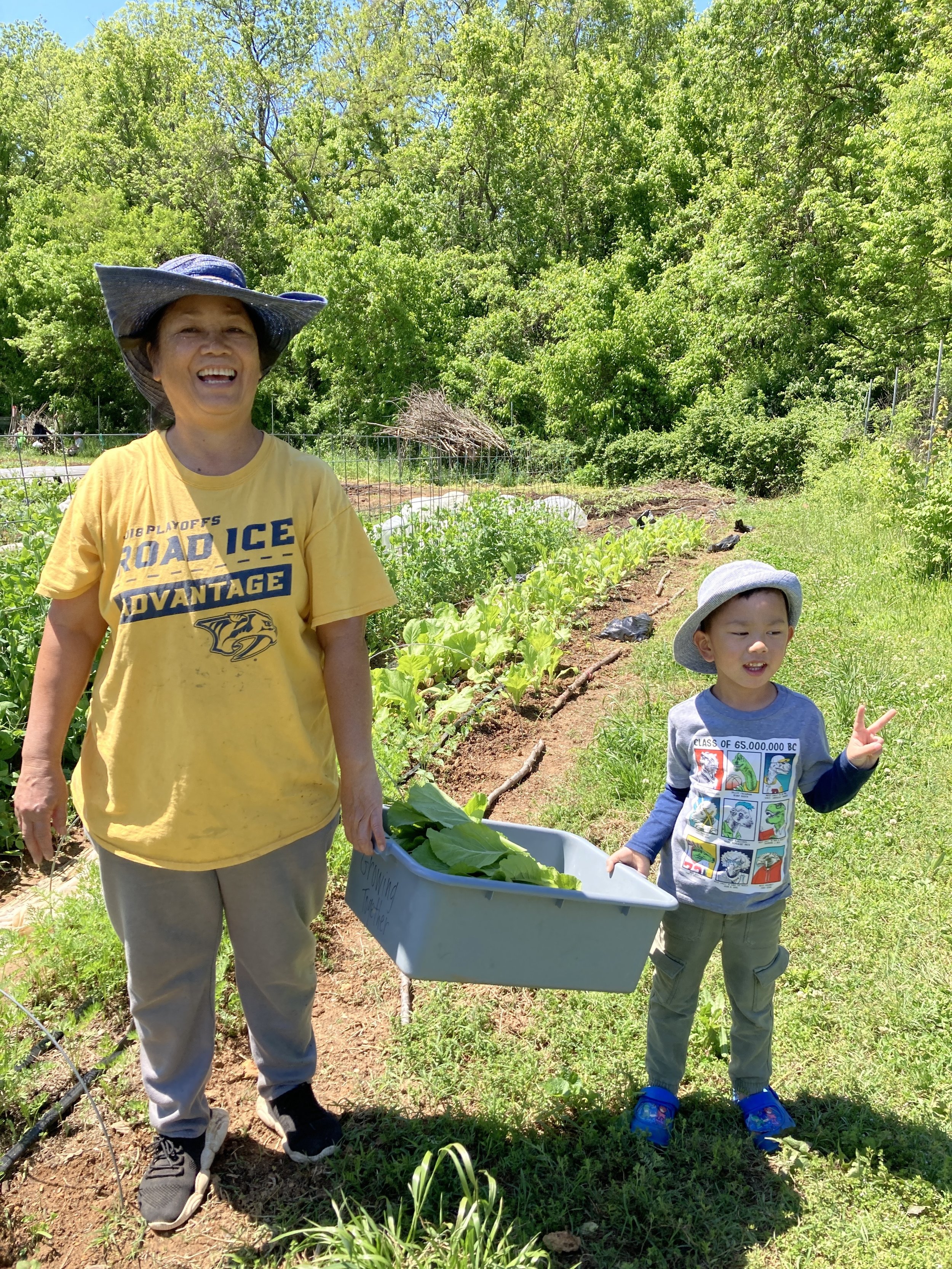
The newest farmer is La Sa Roi, who arrived in the United States 3 years ago from Myanmar. She has taken to full-time farming with great joy and passion, and has now expanded into a 3,500 square foot growing area. Roi and her daughter-in-law, interpreter Lulu Nkum, help organize and distribute 175 pounds of produce a week to their Burmese community members who lack access to fresh, culturally relevant produce. Roi loves to grow all vegetables, but mostly water spinach, long beans, and heirloom hot chili peppers—coveted crops by her community.
We are excited to have our first Growing Together community farm apprentice, Lu Ja! Our program aims to continue to offer this farm opportunity to new arrivals in the Burmese and Bhutanese communities. However, the program does require a very large commitment and has a steep learning curve. The apprenticeship allows someone who is interested in farming to work with other Growing Together farmers and participate in training, but without the full-time responsibilities. Instead of growing vegetables to sell, they learn alongside experienced farmers and provide supplemental support. The Nashville Food Project is gratefully paying the apprentice an hourly wage for their time for the season with the goal that next year, they will participate in the program as a full time farmer.
These Growing Together farmers love what they do everyday: growing food for our community. The Nashville Food Project provides access to support that otherwise would not be available to them. But, the farmers bring so much of themselves every day to the work — dedication, joy, gratitude, knowledge, perspective, and humor — that they are truly the heart of the program.

Stay connected with the Growing Together farmers on our website or via Instagram, @growingtogethernashville. You can also enjoy their produce at our favorite local restaurants, City House and TKO!
Remembrance at the Community Farm at Mill Ridge
Let us first remember the trees.
If you can imagine 1,000 years ago, to when this hillside and all that our eyes could see was covered in a vast forest of maple, oak, chestnut, and hickory. A squirrel could travel for miles without touching the ground.
by Tallahassee May, Growing Together Education Manager, with information from the Southeast Davidson Regional Park Master Plan

Let us first remember the trees.
If you can imagine 1,000 years ago, to when this hillside and all that our eyes could see was covered in a vast forest of maple, oak, chestnut, and hickory. A squirrel could travel for miles without touching the ground.
Let us remember the indigenous people who lived here from time immemorial, who hunted the buffalo, elk, and deer that once roamed here. The Mississippian Indian Culture who created vast networks of agricultural communities and large cities, who raised the three sisters of corn, beans and squash and who built large ceremonial mounds throughout Tennessee and the Southeast.
Let us remember the Cherokee and the Shawnee, who thrived here for hundreds of years before European settlers arrived, who were forcibly removed by Andrew Jackson and his Indian Removal Act of 1830 and were marched on the Trail of Tears off of this land they had lived on for generations to new, unfamiliar, and unwelcoming territory.
European settlers started arriving in this area in the 1700’s. By 1850, the railroad had arrived, and this area of Mill Ridge supported a 400-acre, mixed-use vegetable and animal farm, owned by James Holloway. Twenty percent of Tennessee residents at that time were blacks living in slavery. Thirty-two enslaved people lived and worked on this nearby Holloway farm, and the graves of their descendants can now be found throughout this park property.
Let us remember that the conversion of these fields from forest to agricultural use—that the development of this community with a thriving agricultural economy—was dependent on the labor of black slaves.
The Moore Family bought this property in 1919. It was a dairy farm for many years, then converted to cattle only in 1950. In 1930, the house was built. It was one of the first in the area to have running water and an indoor bathroom. The house of the Moore Family Farm is now owned by Metro Parks, and it is hoped to be an integral part of this community farm development in the future.
Let us remember, and let us move forward in this remembering, giving thanks to those who came before and embracing the stewardship that is now our privilege to uphold.

Photo from the Grand Opening of the Community Farm at Mill Ridge, 2019.