
Food Waste Prevention

Anatomy of a Meal

Have you ever wondered what it takes to place a hot, nourishing meal in a neighbor’s hands? For us, a meal does not begin in the kitchen. It begins much earlier.

What follows is a careful, collective process shaped by stewardship, skill, and care. It is the work of turning surplus into nourishment, and nourishment into connection.
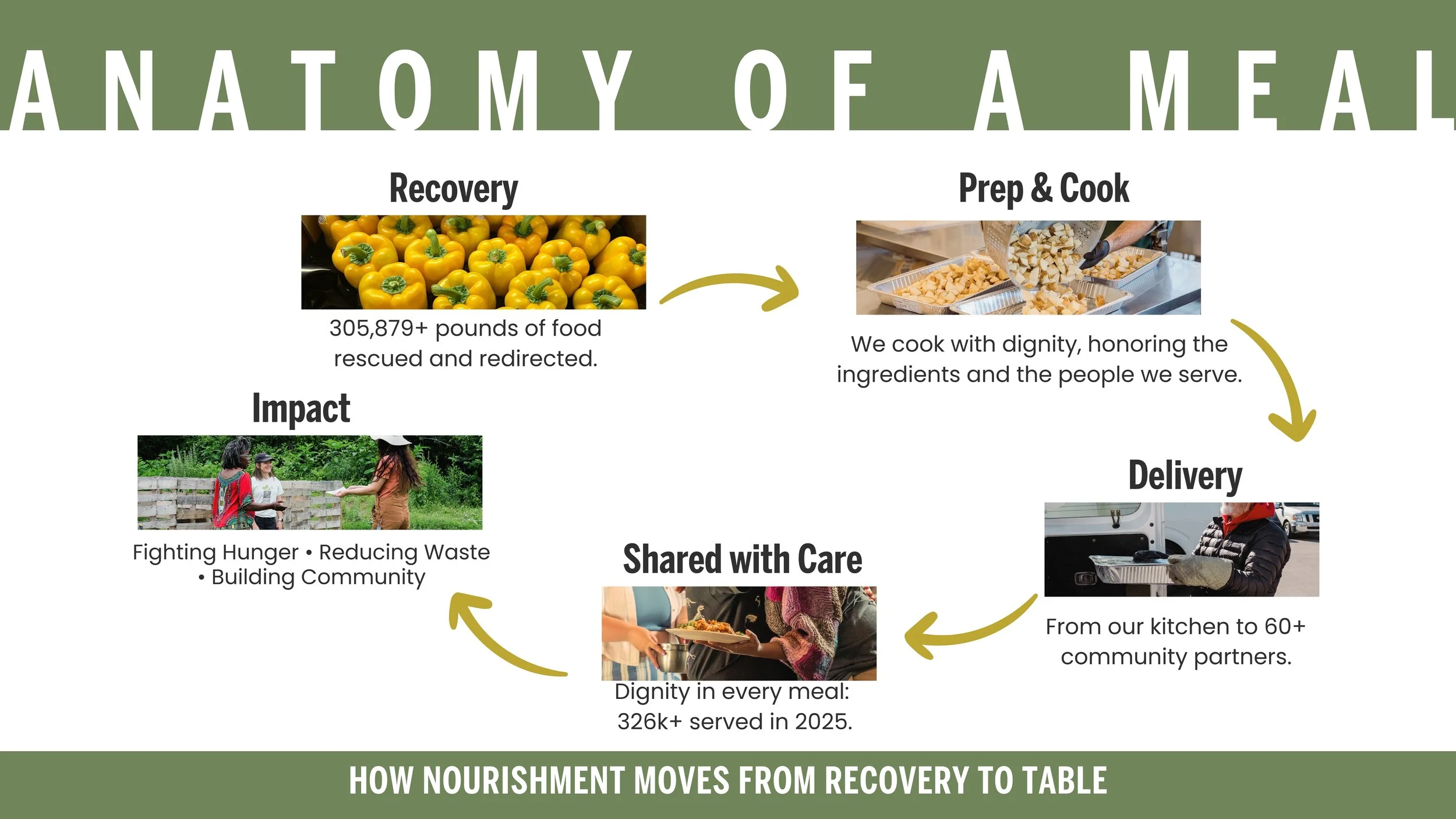
Recovery

The first step is recovery. Across Nashville, food that is still fresh and abundant is often left without a destination. We work alongside grocers, farmers, markets, restaurants, and individuals to recover food that would otherwise go to waste. This is not about scraps or leftovers. It is about recognizing the value of food that has already been grown, harvested, and prepared with care.

Recovering food is an act of responsibility. It acknowledges that hunger and waste exist side by side, and that abundance can be redirected toward justice when we choose to act.

Prep and Cook

Once recovered, food moves into our kitchens. Here, volunteers, cooks, and staff prepare meals from scratch, guided by skill and intention. Vegetables are washed and chopped. Recipes are tested and refined. Meals are prepared with the understanding that the people who will receive them deserve food that is nourishing, thoughtful, and well made.

Cooking is where transformation becomes visible. Ingredients become meals. Surplus becomes sustenance. And strangers become neighbors through shared effort.

Delivery

Meals do not remain in our kitchens. They travel outward, carried by partnerships and logistics that make access possible. Through coordination with nonprofit partners across the city, meals are delivered to places where they can be shared with care and dignity.

Delivery is not simply about transportation. It is about trust. It depends on relationships built over time and a shared commitment to meeting people where they are.

Shared with Care

The final step happens around tables, in community spaces, and through organizations doing vital work across Nashville. Meals are served alongside programs that support children, seniors, immigrants, and unhoused neighbors. In these moments, food becomes more than nutrition. It becomes an expression of hospitality and belonging.

A meal shared with care communicates something essential. You matter. You are welcome. You are not alone.

Impact

Every meal tells a larger story. It is a story of hunger addressed and waste reduced. It is a story of volunteers showing up, partners collaborating, and systems working together in service of the common good.

This work fights hunger by increasing access to consistent nourishment. It reduces waste by honoring the value of food already grown. And it builds community by creating spaces where people come together around a shared table.

Be Part of the Journey

The anatomy of a meal is a collective effort. It relies on people who believe that good food should not be wasted and that neighbors deserve to be nourished with dignity.

If you want to be part of this transformation, there are many ways to get involved. Whether through volunteering, donating food, or offering financial support, your participation helps keep this cycle of care moving forward.

Together, we turn what might be thrown away into meals that strengthen our community, one plate at a time.

Volunteer
Give food
DONATE

Week Two: Earth Month Challenge!

For Week 2 of Earth Month Challenge, we’re taking a look at food waste.In the U.S. alone, food waste is estimated at between 30-40 percent of all food produced. Wasted food is the largest contributor of material placed in landfills, which produces approximately 15% of all methane emissions. The water, energy, and labor used to produce wasted food could have been directed for other purposes. Not to mention the nourishment that is wasted that could have gone to feed families in need.

Goodbye (and Thank You), Winter: A Reflection on Finding Beauty Even in the Toughest Seasons

Winter holds space for all of us to deal with the hard truths of the year that has just passed. And through the sharp lens of winter’s harsh reality, it gives us something else too: the prospect of new beginnings, and with it, the arrival of spring.

State of the Plate: A Meal Study for Better Nutrition and Less Waste

Vanderbilt University Medical Center researchers studied our meals for children this summer to help us learn more about how meals are consumed—and to help us maximize economically sustainable nutrition for better child health. While we always try to include as many fresh vegetables from our gardens and local farms as possible, researchers formally measured the nutritional value of our meals. Then they looked at the parts of the meals children wanted to eat, and which parts were left on the plate.

Recommended Reads: Thanksgiving Edition

For the Thanksgiving weekend, we pulled together a few recent, thought-provoking articles, podcasts and threads, from how to reduce waste to the story of Thanksgiving from the Indigenous perspective as well as an immigrant story of the holiday, and a Twitter thread that lifts up farm workers who help bring us the dishes that grace our tables on this day.

A Food Waste Challenge Friendsgiving

For November’s Simmer series dinner, the fabulous Chef Maneet Chauhan had the idea to host a Friendsgiving in our Community Dining Room. But rather than bring in the typical Thanksgiving turkey and sides, she wanted to see what she could whip up with just the ingredients we had on hand in our kitchen — a special Food Waste Challenge Friendsgiving to celebrate abundance.

Making Gold: Composting In Nashville

Did you know 28% of all waste in Nashville is compostable material? Here at TNFP, the idea and act of composting is a value: taking our forgotten bits, our discarded carrot ends, broken eggshells and spent coffee grounds and diverting them to be used as rich inputs for the earth which we've too often abused and abandoned. Learn how YOU can make gold out of your own leftovers, including FREE compost drop-off at select Metro convenience centers.

Wasted Food = Wasted Nutrition

We’ve all been there before - the broccoli stems left over after a dinner party, strawberries that you meant to eat but didn’t get to - all thrown out and wasted. 40-percent of all food produced is wasted while at the same time 1 in 7 children are struggling with hunger according to Feeding America. Believe it or not, there are some staggering nutritional benefits to lowering your food waste…

Best If Used: SAVE THE FOOD

Earlier this month, The Nashville Food Project was invited to participate in an exciting event with state and local partners, including the Nashville Farmers’ Market, the Tennessee Department of Environment and Conservation (TDEC) and Metro Nashville Public Works, among others.

Waste Not, Want Not

Putting a dent in those numbers could feel daunting, but it’s an issue that we hope to continue working on in 2016. In addition to gleaning from farms, restaurants and grocery stores each week for meals, we’ll be partnering with Zero Percent, a Chicago-based organization that has developed a mobile app and online platform to maximize our food recovery efforts…