
The Nashville Food Project’s Blog



What it Means to Nourish Community
Nourishment, after all, is about so much more than feeding and eating. To nourish another centers on the emotional tie—the care, regard, and concern—you have for another. It is about maintaining a relationship by prioritizing and cherishing another, not imposing what you think you know, but rather about listening. And it is this relationship that informs what makes another person or a community healthy and strong.

by Johnisha Levi, Development Manager
Since its inception, The Nashville Food Project has operated in a foodscape saturated with inequity. Our mission is to ensure that people are getting the food they need and want, with “want” being as vital to us as “need.” And now, after a series of life altering events, including tornadoes, a pandemic, fatal police shootings and mass protest, we are in a moment that is utterly destabilizing. But this is not necessarily a negative. Although it is admittedly easy for each of us to vocalize what we fear and dislike about 2020, this year also presents a rare opportunity to reset. When we emerge from this crucible, what new shape will we assume? Who and what will we be—as a nation, and as a people?
Now is the time to re-imagine, re-create, take response-ability, and re-assess. There is so much that has been and is broken about our government, our country, and our world. Stressors have better exposed these breaks, giving us a clearer picture of our failings, so the question is what do we do to improve and innovate, to move beyond and above? These are challenges for us as individuals, but also as organizations. Currently, The Nashville Food Project may not be able to carry out the part of our mission that “brings people together” physically—whether in our kitchens or for charitable fundraisers like Nourish—but that doesn’t stop up from querying how we can continue to sustain and nourish our community in new and even better ways.

Nourishment, after all, is about so much more than feeding and eating. To nourish another centers on the emotional tie—the care, regard, and concern—you have for another. It is about maintaining a relationship by prioritizing and cherishing another, not imposing what you think you know, but rather about listening. And it is this relationship that informs what makes another person or a community healthy and strong. What comes to mind is the phrase “community of feeling,” which appears in letters that Sigmund Freud and Albert Einstein exchanged on the question of war. What I think it means to nourish a community is to nurture “a community of feeling,” and this is at the heart of TNFP’s vision for a just and sustainable food system. As Tim Mwizerwa, program director at one of our emergency partners Legacy Mission Village explains, “ T[he Nashville Food Project was] willing to provide fresh produce to a lot of our families that were also culturally competent. You can gather a lot of goods but if families don’t recognize how to cook that produce, it goes to waste. We really appreciate your partnership and support and just knowing that we are not sending [our client families] filler foods, we are sending them nourishment on top of that.”

Although many things remain uncertain in the coming months, one essential truth, as stated in a recent New Yorker piece, emerges: “civic connection is the only way to survive” in a time when physical contact can present such danger to so many in our community. And it is this civic connection that is at the heart of our community food model at TNFP. Typically, mutual aid efforts and charitable organizations take different approaches. The former tend to be more grass roots and shaped by volunteers and the needs of recipients and services, while the latter tend to be more hierarchical and governed by boards and donors. What is beautiful about The Nashville Food Project model is that it is more a hybrid—a charitable organization that operates like a mutual aid project in seeking to empower, involve and amplify the needs of those it serves. For example, when a Burmese community leader and former Growing Together farmer approached TNFP about the particular need in her hard-hit community for fresh produce, we were able to use unrestricted funding to pay our Growing Together families to supply these vegetables. Thus, families affected by COVID outbreaks at their workplaces were able to enjoy the labors of what their farming neighbors produced, while the farmers could continue to earn income from their agricultural efforts. This is a community of feeling and of nourishing—of listening, responding, and creatively meeting a need.

When reading the news can be so grim, it is inspiring to see the impact that spontaneous mutual aid networks and charitable organizations are making to help ameliorate suffering during this pandemic. While TNFP will seek to carry forward some of the lessons we learn in crisis to keep nourishing our community, we must never lose sight of the underlying reality that these unmet needs should never have existed within our systems in the first place. And we must continue to strive to make our own work obsolete one day. As Martin Luther King Jr. said, “Philanthropy is commendable but it must not cause the philanthropist to overlook the circumstances of economic injustice which make philanthropy necessary.”
Dispatch from the Community Gardens
In the community garden program, we're always looking for ways to evolve and learn from our work. And this year, we are already reflecting and learning from the adaptations we've had to make due to COVID-19.

by Lauren Bailey, Director of Garden Programs
In the community garden program, we're always looking for ways to evolve and learn from our work. And this year, we are already reflecting and learning from the adaptations we've had to make due to COVID-19. We’ve been focused on adapting the program with these priorities in mind: keeping everyone safe and ensuring that everyone has access to fresh produce.
I've been reflecting a lot lately on the bounty of harvest being shared and on the community of gardeners who were willing to try out a new garden model with us. Right now, we are all facing circumstances that the world has never seen. And more than ever, it feels like the right time to build community in the ways that we can, safely, at a distance. For the time being, instead of tending individual plots, we’re all working together to grow for the nourishment of everyone. Gardeners have been joining us in the garden to tend to our communal plots, and they've shared some of what they've been trying out at home.


Our gardens have always flourished from the wisdom, experiences and curiosities that gardeners bring to the space; this year is no different. The gardens are still a place of respite and inspiration. They still provide for us in these uncertain times. We've just had to be creative in how that has happened. Our staff has learned how to grow some crops that we've never grown before, like bitter gourd, bottle gourd and taro root. Gardeners have tried new vegetables like kohlrabi, fennel and kale. And though this year looks so different than past years, we're still a community of people who love the act of growing food, sharing recipes and eating good food.

A Spirit of Abundance
At TNFP, we often talk about our value of Stewardship and the belief we believe that there is enough. I’ll say it again, there is enough.

by Lauren Bailey, Director of Garden Programs
It’s a hot afternoon at the Community Farm at Mill Ridge, and as I’m starting to pack up from our communal garden produce pick up, Lu Lu arrives. She’s wearing her straw hat and a smile. She seems to have a lot on her heart as she tells me about her previous engagements of the day. She tells me how she and other leaders have been meeting to find ways to support refugees in Malaysia. Over the course of the next hour, she tells me about the experiences that led her to help others. And what is so clear for me as I listen to her is her courage, bravery and generous spirit. And on a hot day like today, her words land as a challenge and inspiration to exercise a spirit of abundance.
Lulu Nhkum’s leadership has been critical to the development of the garden programs since they first began. I think back to a shared dinner that she, I and two other colleagues had. It was LuLu who said that she had dreams of becoming a farmer and in that very moment, the momentum for applying for the Refugee Agricultural Partnership Program grant was sparked (which eventually became Growing Together and initial programming for some of the community gardens). Her leadership, insight and advocacy have been essential to the success of our work. She has been a champion of this work, even as she’s been fully employed elsewhere. If you know her, then, maybe you’ve seen the way she delights in learning about and growing food. Her enthusiasm is contagious.
It has come as no surprise that during this crisis, her leadership and enthusiasm continue to shape our programming in important ways .In a time of crisis, a scarcity mindset is easy to embrace. One of the things that I've learned from Lu Lu’s leadership during this time is that abundance manifests in many ways. It looks like folks showing up to support one another. It can look like a circle of leaders and organizers hearing need and mobilizing resources.
This year, as the effects of COVID began to be felt in our city, Lu Lu seeing and hearing the need of those in her community, advocated for TNFP to support these families in some way. She had intimate knowledge of the Growing Together program and the food grown there and knowledge of the communities' needs. Because of her advocacy and with the help of other leaders, over 100 families impacted by the virus received fresh vegetables from the Growing Together farm.
At TNFP, we often talk about our value of Stewardship and the belief we believe that there is enough. I’ll say it again, there is enough. One of Adriennne Maree Brown’s Principles of Emergent Strategy is that there’s always enough time for the right work. There is enough time; there are enough resources; there is enough food. And the leadership of women like Lu Lu Nkhum show that there are ways to make sure that people have what they need, even in times of crisis, if we can all get better at exercising this spirit of abundance.


An American Pandemic: Meditations on Black Death
With hope because hopelessness is the enemy of justice. With courage because peace requires bravery. With persistence because justice is a constant struggle. With faith because we shall overcome.”
- The National Memorial for Peace and Justice, Montgomery, Alabama
by Johnisha Levi, Development Manager

“For the hanged and beaten. For the shot, drowned, and burned. For the tortured, tormented and terrorized. For those abandoned by the rule of law.
We will remember.
With hope because hopelessness is the enemy of justice. With courage because peace requires bravery. With persistence because justice is a constant struggle. With faith because we shall overcome.”
- The National Memorial for Peace and Justice, Montgomery, Alabama
America is suffering from more than just death at the hands of the coronavirus pandemic. I am talking about the perpetual killing of black men and women by state sanctioned violence. The names receiving the most publicity in our current new cycle are George Floyd (46); Breonna Taylor (25), and Ahmaud Aubrey (25), and their callous and senseless deaths are sparking a revolution that our politicians are finally having to heed. Sadly, these names only scratch the surface of recent police shootings of black men and women. A database of police killings compiled by the Washington Post from news reporting reveals the pervasiveness of this violence. Since May 1st of this year, we have also lost:
Rayshard Brooks (27); Michael “Blue” Thomas (62); Lewis Ruffin (38); Kamal Flowers (24); Tyquarn Graves (33); David McAtee (53); Derrick Thompson (46); Jarvis Sullivan (44); Momodou Lamon Sisay (39); Rubin Smith (35); Modesto Reyes (35); Tony McDade 38);Dion Johnson (28); Maurice Gordon (28); Willie Lee Quarles (60); Tobby Wiggins (45): Randy Lewis (38); Robert Johnson (29); Rayshard Scales (30); David Atkinson (24); Yassin Mohamed (47); Finan Berhe (30); Adrian Medearis (48); McHale Rose (19); Dreasjon “Sean” Reed (21); Jah’Sean Hodge (21); Quavon Webb (23); Demontre Bruner (21); Said Joquin (26); Brent Martin (32); Shaun Fuhr (24); William Debose (21)
To read this list alone, to contemplate the years lost, the families broken, let alone to watch any recorded videos, is to be shattered for humanity. And as James Baldwin wrote, “A stranger to this planet might find the fact there are any Black people at all still alive in America something to write home about.”
But to know the history of this country is to also know that this is not a new problem, but an old one, rooted in the blood-soaked soil of a land that championed slavery over freedom, and created wealth by controlling bodies and souls like chattel since before its founding. American capitalism is founded on racialized violence. For those Americans who are now waking up to the fact that “the past is never dead, it's not even the past,” they are now seeing that technological innovations and global connectivity haven’t obliterated the savagery our society inflicts on black bodies. If anything, it has only made it more visible and brought it into more homes.

Jars of soil from lynching sites across the country collected in remembrance of the victims.
I see the continuous line between my father and me despite the fact that more than a generation separates us. My father was born in 1924, so had he lived he would now be 96 years old. His was a segregated existence well into his adulthood. He served in a segregated navy as a rare black radio man in the South Pacific in World War II and would not witness school desegregation until he was 30. In my dad’s era, the slogan instead of #blacklivesmatter was “A Man was Lynched Yesterday,” in the form of a banner that the NAACP would fly from its headquarters in New York in protest. While today, we know the names of the officers who shoot black men and women, in my father’s time, this violence was perpetrated “at the hands of persons unknown.” This despite the fact that there were often photographs and postcards of vigilante murderers, some of whom were known and protected by sheriffs and police and some of whom were “lawmen” themselves.
Between 1877 and 1950, nearly 6,500 people were lynched in the United States, and the overwhelming majority of them were black men and women. My dad grew up with such a lynching in a neighboring county in Maryland. Way before #SayTheirNames became a widely used hashtag on social media, the victim’s name was George Armwood. This was 1933. Despite protesting his innocence (Armwood was accused of raping an older white woman), Armwood, a 23-year-old black man, was fed to a mob of 2,000 people that mutilated his body, hanged it from a telephone pole and then burned it. The leaders of the mob were never punished, just as many of the police today are protected by qualified immunity. It was not until 2019 that Armwood’s story was officially memorialized by the state of Maryland.
My dad was nine years old at the time of this savage carnival (A headline from the time called it a “Roman Holiday.”) I asked him about the lynching when I was finishing law school in 2004, having just completed the Capital Defender Clinic at The Equal Justice Initiative. I was working on a research project, writing about parallels between the anti-lynching crusade and the death penalty abolition movement. I came across George Armwood’s name in a book recording the victims of every year of lynching, at the so-called hands of persons unknown. I noticed George Armwood’s life was taken during my father’s lifetime in a neighboring county. I called my dad and asked him if he remembered a lynching in 1933. I did not say Armwood’s name. My dad was starting to suffer dementia; he was only nine years old at the time of George Armwood’s murder. I didn’t know what he would say. What he did say was startling in it’s clarity. “Yes, I remember. It was George Armwood. I remember the older folks talking. I remember they were scared.” From the distance of seven decades, George Armwood was seared into his soul.

Today, you can pay your respects to the victims of past violence at the Equal Justice’s Initiative Memorial for Peace and Justice in Montgomery, Alabama. It is a sacred space, designed to make you keep raising your head, in an echo of what it must have been like to encounter a lynched victim, as you walk through to read the iron tablets of lynchings in America. The iron tablets oxidize when it rains to mimic the blood spilled on our soil. And there is also a separate collection of soil from each place that each victim was slaughtered. But these aren’t just artifacts. This past is still haunting us. It is still with us every day as a reminder that George, and Breonna, and Ahmaud and countless others are deemed dispensable and that their murderers—and even more importantly our society—refuse to take responsibility for the institutional racism that enables their slaughter. Until American institutions demand accountability and recognize and prioritize the value of black life over black death, nothing will ever change. Until those in power are willing to relinquish it to preserve the lives of black men and women, we will continue to have to #SayTheirNames. Americans today are rising up to say that it is time. It is time to change.

Dispatch from our Kitchens: "The Coat"
My deepest hope in all of this is that I can honor the people who paid the price for my new creative outlet, to serve others with that sacrifice, and in some Karmic way I can make the best of what’s shared with us to do good in this world.

by David Price, Kitchen Manager, St. Luke’s Kitchen
Last year at The Nashville Food Project holiday gift exchange among staff, I opened my gift with caution. I wanted to prepare myself to be excited about something that a co-worker who barely knew me bought for me. I am ridiculously hard to shop for, and you can ask my partner Keeli about it sometime. I opened the box with cautious optimism and there it was— a chef’s coat.
To give you some context, I would never buy such a thing for myself, because it says that I have arrived in a way that I had not yet. When you have been a professional cook for two years and crank out steamed veggies and casseroles on the regular, it is an overstatement to call yourself a chef especially when you have only been the head of a kitchen for a few short months.
From the moment I decided to leave my previous career of seventeen years and started cooking at the Food Project, I wanted to be a chef. A part of me always felt that the people who referred to themselves as “chefs” and not “cooks” were trying to prove something they didn’t yet believe about themselves. Still, a piece of me wanted that external validation for something I’d never believe on my own. On the night of that holiday party, I was validated (though I still refer to myself as a cook). It wasn’t the simple fact that someone bought me a chef’s coat. It was who did it. It was my TNFP boss whom I deeply respect.
I have eaten some very amazing food in my lifetime, but Bianca Morton (TNFP Chef Director) made me the best food I have ever put in my mouth from trimmings off of a pork loin that were destined for the trash. She did it on the fly and with zero doubt. It came from a confidence of knowing exactly what she wanted her guests to eat and how she was going to get it done. It changed my perspective. I could cook like that one day if I really drove myself and never forgot to be creative and take risks. She will probably just tell you that she was hungry, but the reality is that creativity is based in what we want and what we have simultaneously. It’s the restriction that gives us our direction to flesh out a dream. That is the purest form of the art.
When she gave me that coat, what that moment did for me was give me the “ok” to do and be creative. She gave me heart and strength and a courage to believe that I was able to be what that coat would say I already was. That was a beautiful moment and the next time I stepped back in the kitchen I got my ass kicked to the point I wanted to give up. That was an equally beautiful day in hindsight because I realized that you never arrive. You just keep learning and trying and getting the hell kicked out of you. I just can’t help myself. I love that. I want to win just enough to keep me from giving up when I just can’t get on the plate what I had in my head.

David working alongside Top Chef-alum Arnold Myint at a TNFP Simmer event.
We, especially in this kitchen, are living in some uniquely bittersweet times. Everything seems to cut both ways. We have received some incredible donations of products lately that inspire me yet also sadden me in ways that I can’t really ever put words to. Some of it is from restaurant closures in the wake of COVID-19 pandemic, meaning much of it is food that we would never be able to serve on our own budget. Yet I know that every steak, shrimp, or salmon that we have the privilege to cook is a brutal reminder that it was someone else’s job to cook that thing. You just can’t help but wonder where they are and if they are okay. The thing that I love about kitchen work is that it is communal, so I’m always hoping the best for every person crazy enough to live this life. This creates conflict inside my heart when I cook their food. This is one of the countless ways that my world has changed.

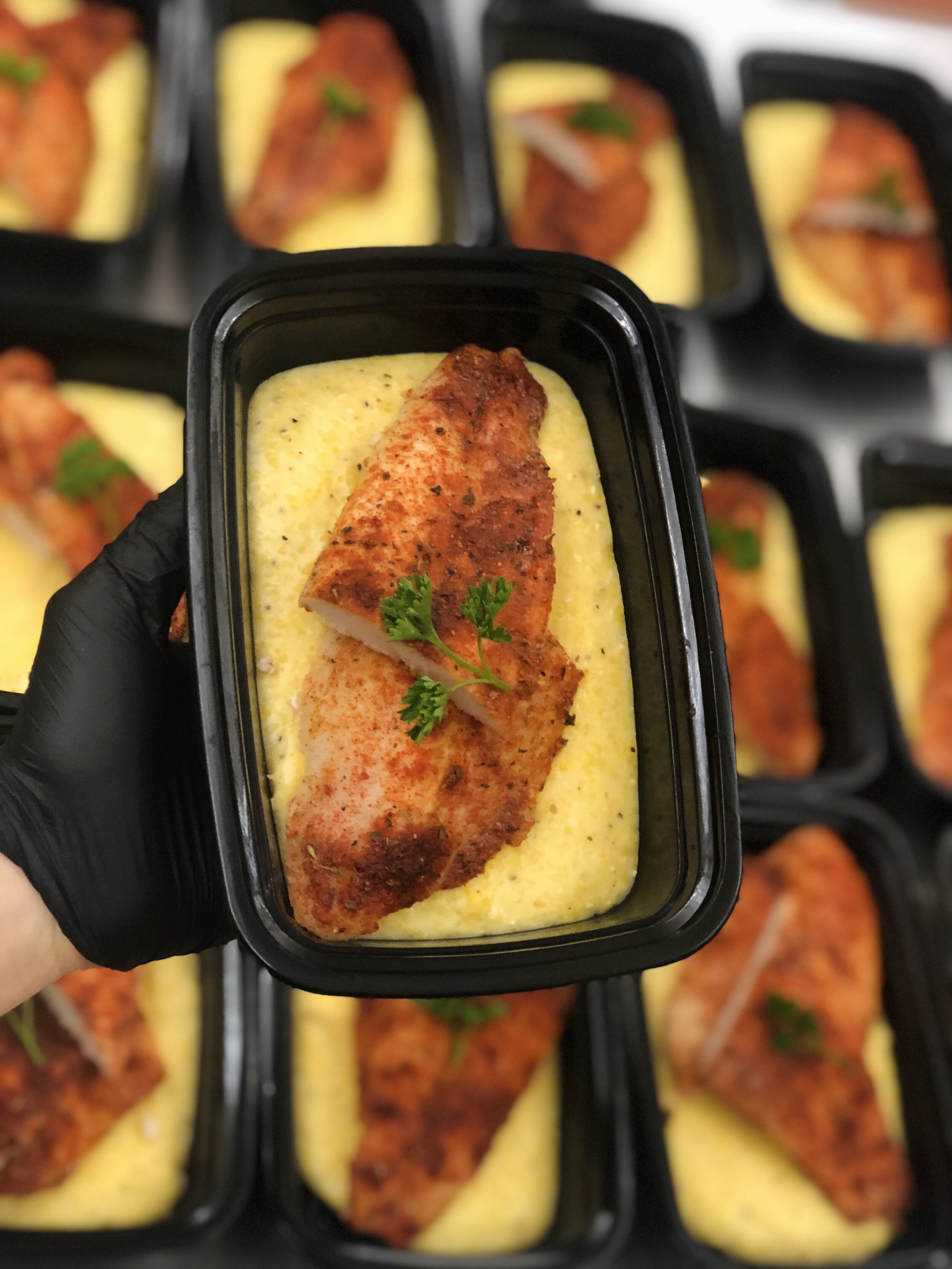
Meals by David and his team made with donated ingredients.
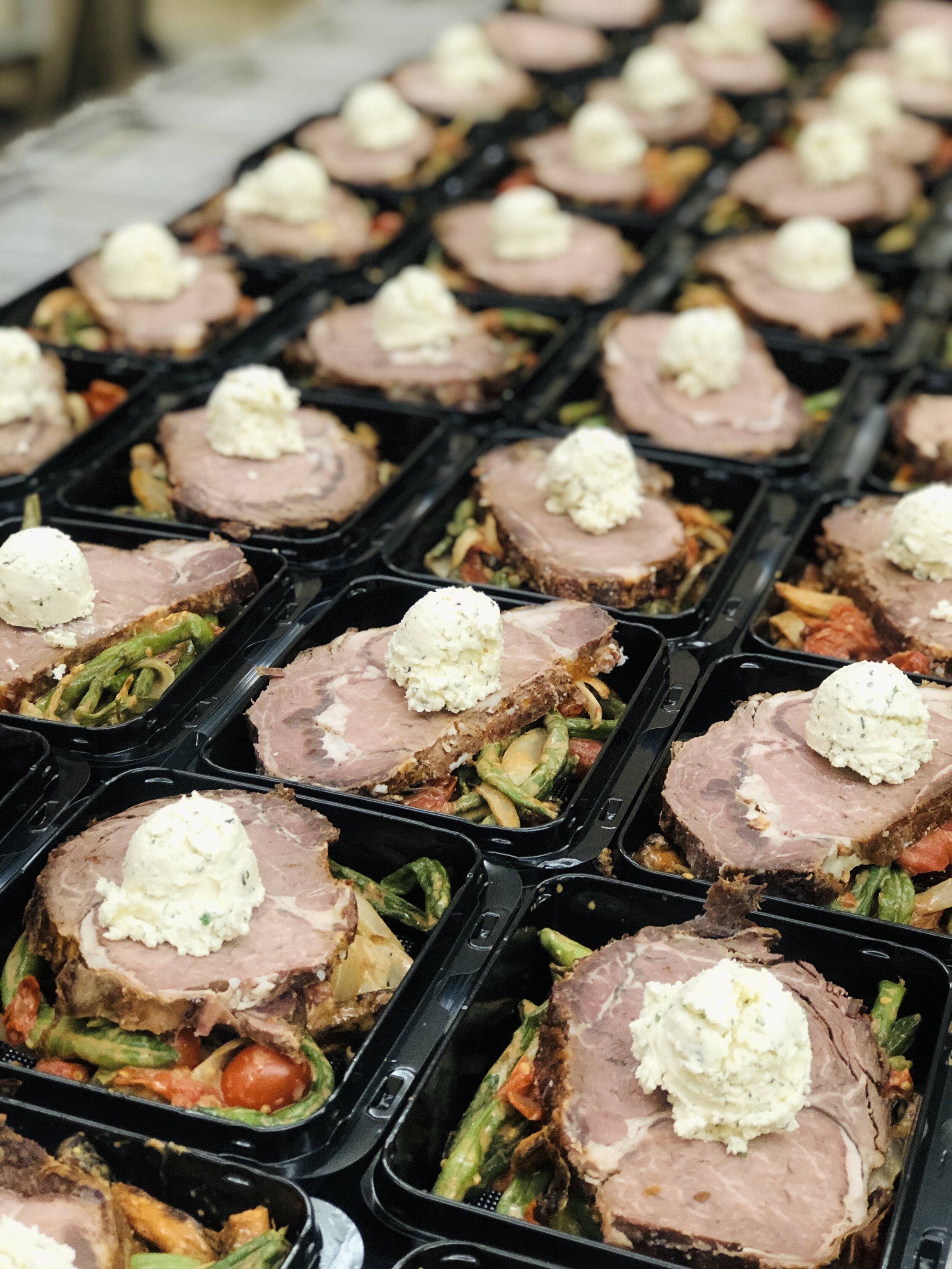
Today, we are constantly reimagining things we thought of as constants. In a million years I could have never imagined a world without the tremendous volunteer support we receive in the kitchen. I could never have imagined creating meals that were not regulated by certain guidelines for federal reimbursement. These days the meals come with fewer restrictions but they also come at a great cost. It becomes a very real challenge to enjoy the privilege that symbolizes the loss of another person’s livelihood. I’ve always hated the saying, “There is no such thing as a free lunch,” because most people use it to justify societal oppression, but I am uniquely aware that everything comes with a price tag these days. All too often it’s rarely the price you want to pay and more often than not it’s the person who least deserves it who foots the bill.
My deepest hope in all of this is that I can honor the people who paid the price for my new creative outlet, to serve others with that sacrifice, and in some Karmic way I can make the best of what’s shared with us to do good in this world. I deeply, and to the point of tears, believe that all ships rise in the tide together. I believe that all people deserve to eat amazing food and to share it together even if you don’t conventionally have access to it. So, I dedicate myself to becoming as good as the best chef turning out food in this city, country and world. I dedicate myself so that I can give delicious food to the people I serve. That is my small place in the universe and it’s the only place I want to live. I have a long way to go, and so much to learn— but that coat said I could do it.
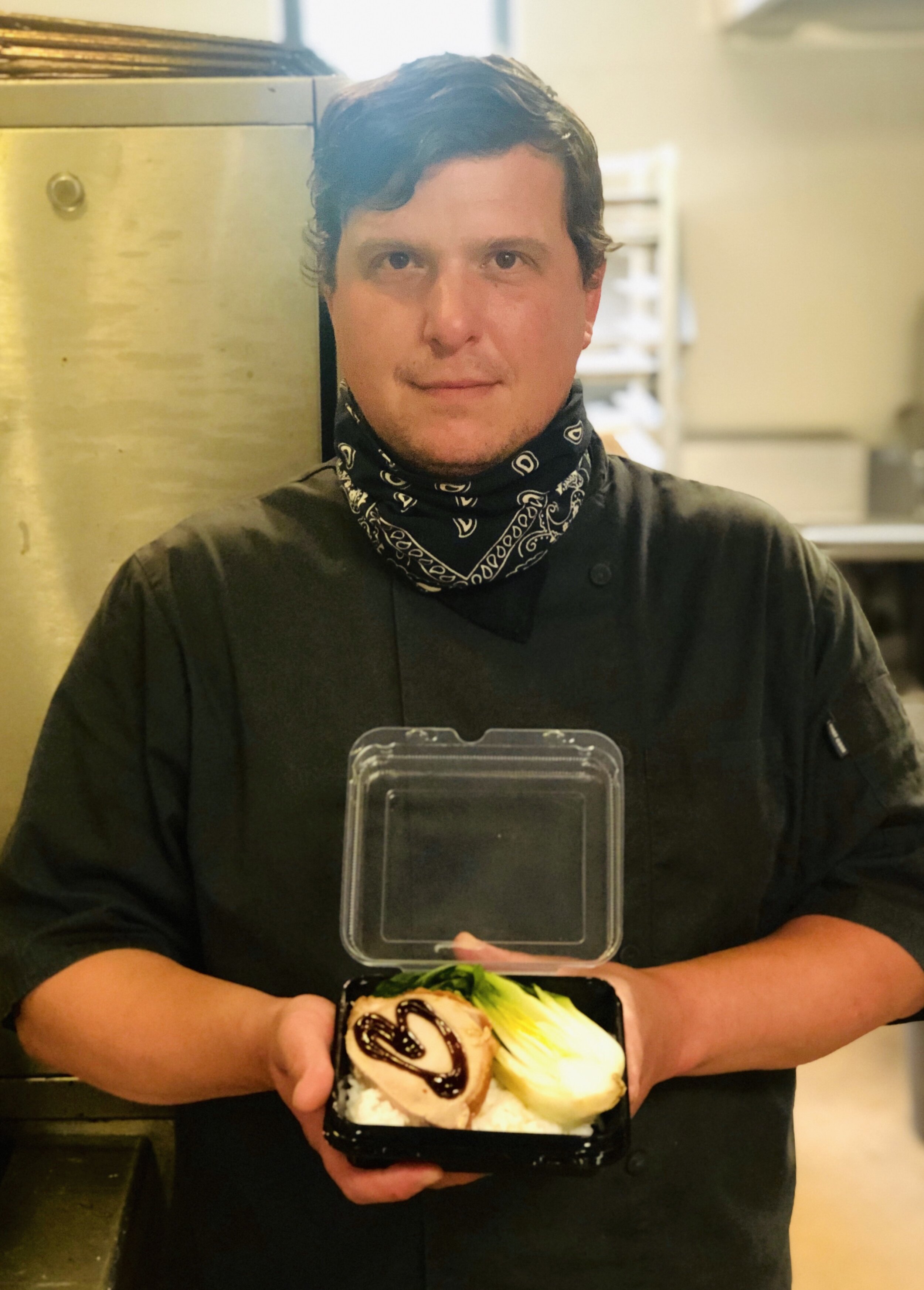

TNFP staff at the holiday party.
Nourish Nashville
“I must remind you that starving a child is violence. Neglecting school children is violence. Punishing a mother and her family is violence. Discrimination against a working man is violence. Ghetto housing is violence. Ignoring medical need is violence. Contempt for poverty is violence.”
— Coretta Scott King

““I must remind you that starving a child is violence. Neglecting school children is violence. Punishing a mother and her family is violence. Discrimination against a working man is violence. Ghetto housing is violence. Ignoring medical need is violence. Contempt for poverty is violence.” ”
The devastation caused by the pandemic has left millions of American households without adequate resources to put sufficient food on their tables. Families with young children are hardest hit, with more than 40% of them unable to afford enough food to meet their needs. The pandemic is not the cause of the gross inequity and economic distress that is pervasive across our nation. The crisis called poverty started long before the first COVID case was confirmed in our community. Decades of underfunding, oppressive policy, band-aid fixes, and neglect have resulted in a torn safety net that has left American families without the money, power and other resources they need to thrive.
As many Americans start or continue their journeys of learning and unlearning right now, we are all waking up to the many forms of institutional violence that are directed at BIPOC (Black, Indigenous, People of Color). Food aparteid, food insecurity, and land dispossession are forms of violence, and with renewed passion, we at The Nashville Food Project are digging into the healing work to make our vision a reality--that all Nashvillians have access to the food they want and need, through a just and sustainable food system.
“You have the duty to change what you have the power to change,” says author and activist Austin Channing Brown. We know that if we tried to do everything we would fail. But we also know we have a moral obligation and community responsibility to step in everywhere we can to uproot the violence of poverty. In this time of crisis that is not new but growing more complex, The Nashville Food Project is on the frontlines, growing food, cooking food, and sharing food in equitable ways throughout the city. We take seriously the clarion call from the late, great Mary "Mother" Jones who said while we "pray for the dead, we fight like hell for the living."
NOURISH NASHVILLE
As many of you already know, this year's Nourish fundraising dinner and auction event is cancelled. It’s not the year for a large, celebratory gathering, nor is it the year to pour our limited efforts of time and creativity into a special event when the critical needs of our neighbors continue to mount. But it is a time to Nourish Nashville more than ever. Nourish will be coming into your homes this year, and although virtual, we hope this makes for an intimate experience of connection with those in your household. Our team has enjoyed finding creative ways to raise the critical funds the Nourish event brings in, while engaging with you all virtually. We hope you enjoy these scrappy, behind-the-scenes snapshots at thenashvillefoodproject.org/nourish2020!
Sowing Seeds of Justice
It is past time to sow seeds that yield justice and a more equitable future. The profound impact of racism on life and death demands a full response from every single part of American society. At The Nashville Food Project we know we do not have all the answers, but we believe we can be part of the solution. We have learned and continue to learn that anti-racism work cannot be treated as side work, but it is the work of community food justice.

Greetings from my small corner of this city I love.
Emergency and urgency are all around us. Institutional violence, spiking unemployment, food insecurity, low-wage work without adequate protection, crippling debt, insufficient healthcare—all of these emergencies amplified by the weight of a global pandemic. The roots of these and other disparities are the result of legacies of white supremacy and systemic racism that have for centuries shaped policing, housing, food and land access, criminal justice, education, and healthcare.
So the turned up patches of dark, fertile soil in our gardens seem more urgent than ever. As we consider what we plant and how we plant, we’re mindful that we can’t expect a just yield without centering the work of equity and racial justice. The luminous Toni Morrison, in her novel The Bluest Eye, has me thinking about what soil can nurture and yield when she wrote, "the land of the entire country was hostile to marigolds that year. The soil is bad for certain kinds of flowers. Certain seeds it will not nurture, certain fruit, it will not bear, and when the land kills of its own volition, we acquiesce and say the victim had no right to live. We are wrong, of course, but it doesn't matter. It's too late."
It is past time to sow seeds that yield justice and a more equitable future. The profound impact of racism on life and death demands a full response from every single part of American society. At The Nashville Food Project we know we do not have all the answers, but we believe we can be part of the solution. We have learned and continue to learn that anti-racism work cannot be treated as side work, but it is the work of community food justice. The crucial nature of our mission to grow, cook, and share nutritious food must be paired with an active commitment to learn and unlearn, to listen, to deepen empathy, to name injustice, and to leverage every resource available to us—money, relationships, time, effort, ideas and more—to address and undo the systemic racism that permeates every aspect of American life.
In full transparency, in this time of COVID emergency and all the ensuing change, so much of what we at The Nashville Food Project want for our community has been relegated to the back burner. We are guilty of pausing our momentum towards fulfillment of our current equity goals, and we have work to do to re-center anti-racism as a crucial part of our daily work and identity. I want to share with you The Nashville Food Project’s Equity and Inclusion Plan, a true work in progress that we have been pulling together over the last few years. It is not perfect but neither is this work, and if these recommendations can amplify your own organization’s commitment to anti-racism, please feel free to lean on them and borrow freely! Our staff and board recommit to educating ourselves, amplifying voices of Black and brown leaders and communities, sharing resources and moving many of our equity and inclusion goals into actionable next steps. We recommit to making room for this work and funding our capacity to grow it. We will also be using our blog and social platforms to listen, share, respond, lead.
To the Black members of our community and other affected people of color—we mourn your pain, celebrate your joy, lift up your contributions, honor your experiences. We see you and are with you.
To the white members of our community, this work is lifelong. Start where you are and attend to it daily. Skip no days. Get in the conversation, do the work, listen deeply, make mistakes and own them, stay with it, and be transformed. Galvanize what you learn by turning your learning into action. It is our responsibility to bring our personal privileges into public life in support of real and lasting change.
Grace and peace,

Tallu Schuyler Quinn
Click here to read The Nashville Food Project’s Statement of Anti-Racism, as well as our other core organizational values that ground us to this work to which we are called and by which we are challenged.
I really appreciate this post by the brilliant nonprofit leader Vu Le about doing the daily work of flossing out racism.
Remembrance at the Community Farm at Mill Ridge
Let us first remember the trees.
If you can imagine 1,000 years ago, to when this hillside and all that our eyes could see was covered in a vast forest of maple, oak, chestnut, and hickory. A squirrel could travel for miles without touching the ground.
by Tallahassee May, Growing Together Education Manager, with information from the Southeast Davidson Regional Park Master Plan

Let us first remember the trees.
If you can imagine 1,000 years ago, to when this hillside and all that our eyes could see was covered in a vast forest of maple, oak, chestnut, and hickory. A squirrel could travel for miles without touching the ground.
Let us remember the indigenous people who lived here from time immemorial, who hunted the buffalo, elk, and deer that once roamed here. The Mississippian Indian Culture who created vast networks of agricultural communities and large cities, who raised the three sisters of corn, beans and squash and who built large ceremonial mounds throughout Tennessee and the Southeast.
Let us remember the Cherokee and the Shawnee, who thrived here for hundreds of years before European settlers arrived, who were forcibly removed by Andrew Jackson and his Indian Removal Act of 1830 and were marched on the Trail of Tears off of this land they had lived on for generations to new, unfamiliar, and unwelcoming territory.
European settlers started arriving in this area in the 1700’s. By 1850, the railroad had arrived, and this area of Mill Ridge supported a 400-acre, mixed-use vegetable and animal farm, owned by James Holloway. Twenty percent of Tennessee residents at that time were blacks living in slavery. Thirty-two enslaved people lived and worked on this nearby Holloway farm, and the graves of their descendants can now be found throughout this park property.
Let us remember that the conversion of these fields from forest to agricultural use—that the development of this community with a thriving agricultural economy—was dependent on the labor of black slaves.
The Moore Family bought this property in 1919. It was a dairy farm for many years, then converted to cattle only in 1950. In 1930, the house was built. It was one of the first in the area to have running water and an indoor bathroom. The house of the Moore Family Farm is now owned by Metro Parks, and it is hoped to be an integral part of this community farm development in the future.
Let us remember, and let us move forward in this remembering, giving thanks to those who came before and embracing the stewardship that is now our privilege to uphold.

Photo from the Grand Opening of the Community Farm at Mill Ridge, 2019.
Community Cupboard: a weekly grocery share
As part of our emergency response, we introduced a new initiative called Community Cupboard: a weekly grocery share. Through this program, we offer weekly grocery shares at no cost to those who have lost jobs and income as a result of COVID-19.
The Nashville Food Project believes that everyone deserves access to the food they want and need, but in the wake of the COVID-19 pandemic and recent tornadoes that devastated our community, so many are lacking that access right now. We have been hard at work shaping an effective community food response in this emergency time.
As part of that work, we introduced a new initiative in April called Community Cupboard: a weekly grocery share. Through this program, we offer weekly grocery shares at no cost to those who have lost jobs and income as a result of COVID-19.

With thanks to Fat Bottom Brewing, our on-the-ground partner in this endeavor, a good portion of those weekly shares will be distributed to out-of-work hospitality industry workers—a part of our community that has supported The Nashville Food Project in extraordinary ways over the years.

The grocery shares include a week’s worth of quality pantry staples, local vegetables, and fresh fruit, as well as local meats, dairy and eggs. With funding from sponsors and donors, we are able to focus on nourishing produce from local farms and producers, keeping dollars in our local economy. Just a few regional food businesses filling these bags include Noble Springs Dairy, Biscuit Love, KLD Farm, Bare Bones Butcher, Kenny’s Farmhouse Cheese, Just Love, Frothy Monkey, Charpier’s Bakery, and produce from our friends at Rally House Farms, HydroHouse Farms, Sweeter Days Farm, and our own Community Farm at Mill Ridge.

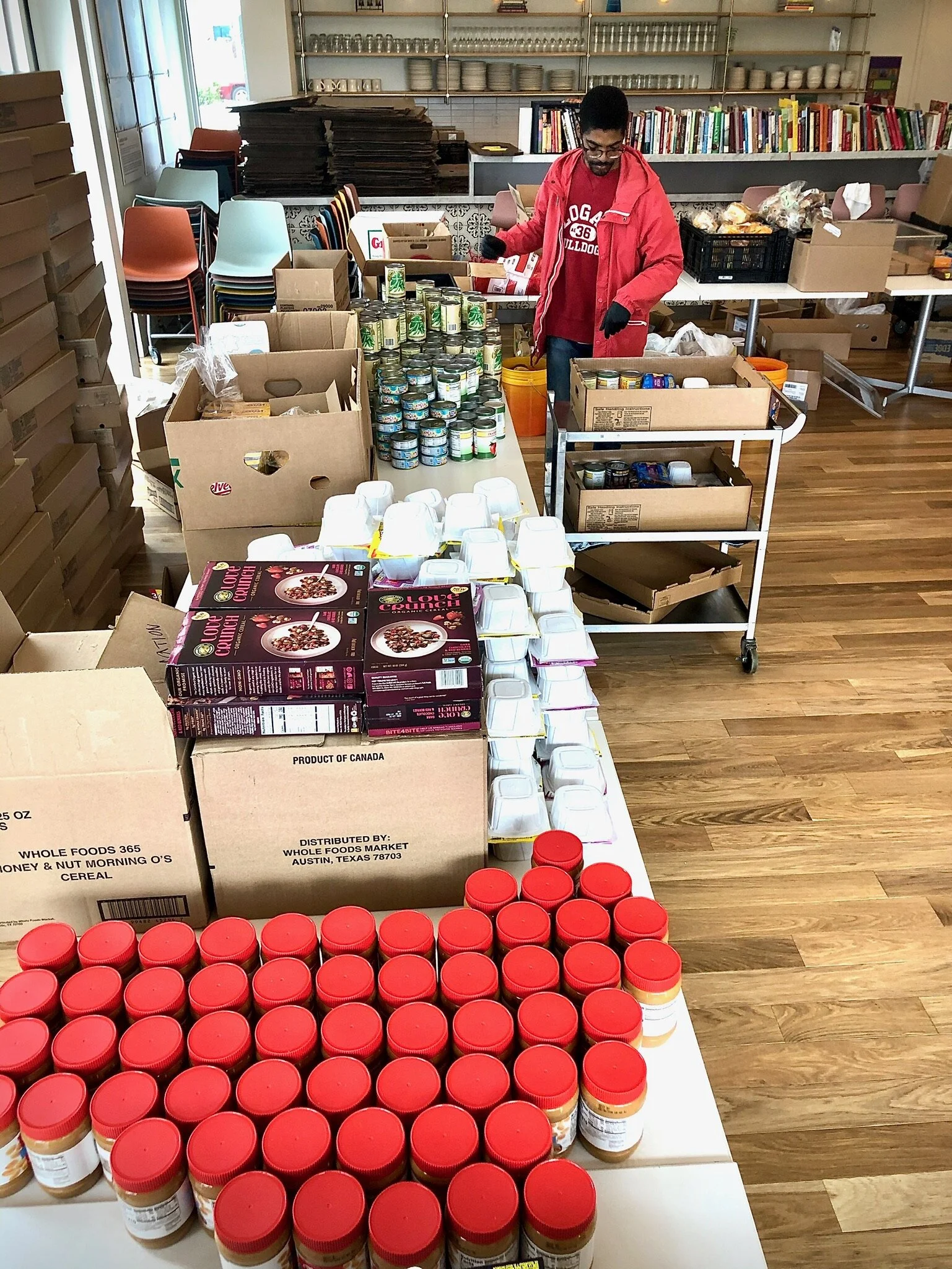

Grocery shares include microwavable, scratch-made meals from The Nashville Food Project kitchens too!

Many thanks to partners at Fat Bottom Brewery, Nashville SC and the sponsors who have made this possible, including Renasant Bank, 506 Lofts, the Russell, Captain Morgan and Piedmont Natural Gas.
Banana Bread for the Pandemic: Remembering a Loved One Lost to Coronavirus
In this time of unbelievable confusion and pain, we cling to the things that bring us comfort, and the most time tested ways of feeling better is to cook and eat a good meal, to bake a loaf of bread. We are reminded of the meals we have shared with the people we love. We ease the sting of separation with delicious memories of dinner parties past. We honor those we have lost by cooking something that they have loved.
by Nick Johnston, Sous Coordinator - St. Luke’s Kitchen
“Reach into your memory and look for what has restored you, what helps you recover from the sheer hellishness of life, what food actually regenerates your system, not so you can leap tall buildings but so you can turn off the alarm clock with vigor.” -- Jim Harrison, “Meals of Peace and Restoration”
“This is a hard place. God, it’s a hard place. But it wakes up every morning. No matter what you do to it the night before. It wakes up.” -- Jess Walter, “The Zero”

Photo by Airin Party
I was never very good at reading my grandmother’s handwriting. When I was a kid, her handwritten notes and postcards would arrive in the mail, and I would pass them along to my father to read them out loud. She wrote in a beautiful calligraphy — a dying art of sloping cursive letters that millennials like myself were ill-equipped to decipher. The one or two cursive lessons given in grade school were essentially useless. Some bang-up cursive seemed ineffective in impressing the young ladies of Ms. Lindsay’s 2nd grade class.
These letters from my grandma arrived in the brilliant dawn of the Email Age, when my love letters were more apt to be typed, thank you very much. So while I had trouble decrypting the lovely loops on the bird-themed stationary, I still hungered to hear what Grandma Ruth had to say, and my dad dutifully served as translator. She always wrote something about the weather, or her roses, or the approaching spring, or a visit she was looking forward to. I have a lot of these letters, recipes, and newspaper clippings stowed away.
The most valuable of the antediluvian artifacts my grandma had passed on to me was her recipe for banana bread. This recipe, along with a preserved and perfect loaf, I will perhaps one day submit to the Smithsonian. Its inclusion to the museum might tell Peoples Future a few things about the lives of Peoples Past. I imagine this loaf and recipe included in a large and fascinating exhibit devoted to explaining Life On Earth Before Covid-19. Students will hover about, notate on tablets, wonder about the coffee-stained recipe from a world where humans still shook hands and knew how to operate their own vehicles. They will also most certainly take pause to admire the graceful calligraphy of Grandma Ruth.
For me, now, waiting for a loaf of banana bread to finish in the oven, it is oddly comforting to imagine distant future school children gazing at my grandmother’s recipe. In a time of paralyzing uncertainty, there is comfort in knowing that this too will end, that history will do its thing, that the ache will dull with each generational wave. That the world will exhale this and that, spring will come again and we will rebuild tomorrow into something better. My grandma’s banana bread recipe calls for some seriously ripe bananas, or, in her words, “nearly rotten.” I’m also oddly comforted by easy metaphors and well-worn cliches these days, and it’s nice to think about something so warm, so profoundly simple and good, coming from something so rotten and dark.
In this time of unbelievable confusion and pain, we cling to the things that bring us comfort, and the most time-tested ways of feeling better is to cook and eat a good meal, to bake a loaf of bread. We are reminded of the meals we have shared with the people we love. We ease the sting of separation with delicious memories of dinner parties past. We honor those we have lost by cooking something that they have loved.
In this particular crisis, staying at home is in fact the heroic thing to do. While we are starved for connection in this time of isolation, it is nourishing to prepare the things that have been passed down to us on stained little pieces of paper, torn notebook pages, from our grandparents, our family, our friends. Our minds and bodies are fortified with the recipes of togetherness, and while we all have a little more time on our hands, we can hone these recipes for when we can cook and share them once again. When this is over the world will be hungry.
And for now we stay home. We clean up the backyard a little. We download Duo Lingo and give Italian another shot. We call our families and grieve the passing of our loved ones. We bake banana bread for our roommates. We turn up the John Prine. We rest inside stories of a world still breathing.
There is a letter from my grandmother I have been waiting to open. She passed away on April 2nd after a tragic battle with Covid-19. It has sat on my desk for a few weeks now. I have been waiting to open it for two reasons, the first being sort of morbidly practical, as this hellish virus can live on surfaces for a while. The other is just that it makes me sad still. I will open it soon, but not today.
Today it has been enough just to marvel at the cursive on the front of the envelope. The “J” in “Johnston” is particularly beautiful, two immaculate ovals that swoop bird-like into the o, h, and n, heading north to make the t, finishing off with an gracefully understated o, the n setting sail towards somewhere like the sun.


The Nashville Food Project Care Package: Part 2
We collected our inspirations, recommendations, motivations—all salve for the loneliness and fears this virus and social distancing can produce. These recommendations aren’t necessarily heavy or directly related to the pandemic or our work. Rather it's a collection intended to nourish and accompany our community as we all stay home together.
Cultivating community lies at the heart of our mission at The Nashville Food Project, but at this time of social distancing, we’re learning how community means much more than physical proximity.
We’re seeing inspiration for community everywhere — from living room concerts and “cloud clubbing” (for the ravers among us) to movie discussion groups and online home cooking forums. In David Byrne’s magazine “Reason to be Cheerful,” Nick Green, creator of the Social Distancing Festival, says this:.
“As long as we are sharing a space in which we can be present, provoke, inspire, promote kindness and compassion, and share ideas, then we are all together in one space, even if it’s in different places at different times.”
Along those lines, we recently found encouragement from On Being’s Care Package for Uncertain Times, a collection of interviews and poetry on topics ranging from grief to hope. It inspired us to make our own version for our friends and for each other. We collected our inspirations, recommendations, motivations—all salve for the loneliness and fears this virus and social distancing can produce. These recommendations aren’t necessarily heavy or directly related to the pandemic or our work. Rather it's a collection intended to nourish and accompany our community as we all stay home together.
This is Part 2 in a series. Find Part 1 HERE.
Lauren Bailey, Director of Garden Programs

Books: We've been reading Sweetest Kulu by Cellina Kalluk to our daughter Trudy before bed. I recommend checking it out, even if you don't have kids because it is a beautiful book with grounding poetry that speaks of our connectedness to other living beings in the world.
Podcast: Snap Judgement with Glen Washington

Article: I found this writing to be thought-provoking -- Social Justice in the Time of Social Distancing.
Music: Sharon Van Etten / Alzheimer’s Association Music Moments Project
Other inspirations or ways of coping through COVID-19:
This was a direct quote from a recent email I received from the organization Race Forward, "In the words of racial justice advocate and philosopher Grace Lee Boggs, 'the only way to survive is by taking care of one another.'"
Johnisha Levi, Development Manager

Book: Call me American: A Memoir by Abdi Nor Iftin. Achingly beautiful writing that somehow manages to capture the painful experiences of a Somali immigrant without losing a sense of wonder, humor, and hope.

Movie: The Last Black Man in San Francisco. A look at gentrification and the creativity it sometimes takes to reclaim your heritage and keep a firm hold on legacy.
TV: Unorthodox. I keep thinking about the haunting performances, and the way that the central character perseveres and finds a new and accepting community that supports her in literally discovering her own (singing) voice. It is triumphant!
Music: If anyone needs a beautiful soundtrack to listen to If Beale Street Could Talk (particularly the piece called Agape) makes you feel like something can go right again in the world.
Also, Roberta Flack, First Take, the whole.dang.thing!

Jeff Buckley, Live in Chicago, because he's got what someone said of Donny Hathaway, "a stained glass voice."
Sufjan Stevens, because he is built for troubled times.
David Frease, Procurement & Sustainability Manager

Music: Polaroid Piano by Akira Kosemura // When I was younger, I couldn't stand instrumental or ambient music of any kind. It always seemed so boring, and I didn't understand why an artist wouldn't want to more fully express their vision through the addition of vocals and lyrics. Now that more time has passed, I completely get the appeal and tend to gravitate towards it more and more each passing year.
With the endless amounts of distractions we're all bombarded with on a daily basis, there's something very meditative about instrumentals. You can let them hang out in the background of whatever you're doing or you can choose to engage more fully, discovering new layers and details with each listen.
The genre doesn't jump up and demand your attention like most other types of music but personally, I've often found it to be even more rewarding in many ways. The older I get, the more I find that the really important mysteries in life can't be expressed in words. One gets much closer with a perfectly timed photograph, an abstract painting or the right musician making magic with their instrument.
My favorite find of the past few months is the album "Polaroid Piano" by a Japanese artist named Akira Kosemura. Mainly known for his soundtrack work, most of his pieces are pristine recordings of solo piano pieces with the occasional orchestral flourish but the reason I love this album so much is because it's the opposite of that. It's completely unpolished and raw in the best way. You can hear every press of the piano pedals, his bench creaking, the sounds of the keys brushing against each other as he plays. Certain tracks are accompanied by birds outside his window chirping or children playing down the street. It's so sparse and intimate that it almost comes off as someone recording their neighbor practicing in the apartment next door without their knowing. It's not until you've listened to it a dozen times that you even notice the guitar gently being strummed in certain tracks, or the toy xylophone sneaking in from time to time. As one review of the album said, "It feels impossible to get tired of, circumscribed and boundless at once." On my off days, I'll often throw it on repeat, allowing it to become the soundtrack to my day. The pieces melt into each other in such a way...if it played forever, that would be ok with me.

Movie: Jojo Rabbit // My wife and I finally watched Jojo Rabbit, and it was just as moving as everyone said it would be. Taika Waititi somehow found a way to make the most tragic and disturbing event in history heart-warming, funny and cathartic. He touched the third rail and lived to tell about it.
Book: Autumn Light by Pico Iyer // I've been reading a lot of Pico Iyer lately for the same reasons I've been listening to more instrumental/ambient music. There's something very grounding about his work and travel writing in general is great for transporting me to another, less chaotic place.

Podcast: Behind the Bastards // I listen to a lot of podcasts in the truck but this is probably the one I look forward to the most. The host, Robert Evans, is incredibly well-researched, knowledgeable and hilarious. It always leaves me laughing and shaking my head in disbelief at the worst humans to ever live.
TV: Every season of Travel Man on Hulu // It's the hilarious and sarcastic travel show I never knew I needed. The perfect antidote to talking about coronavirus all day.
An Update from the Growing Together Farmers: "Believing in Tomorrow"
So many doors, businesses, and communities are closed and we are all feeling the impact and the collective suffering. And yet. We at the Nashville Food Project and within the Growing Together community have no choice but to use this as an opportunity to imagine, envision, and create new doors, new opportunities, and new pathways forward. We will continue on with our vision of community food security, where everyone has access to the food they want and need.

by Sally Rausch, Growing Together Market Manager
This is a scary and challenging time for so many in our community. The global pandemic is showing us the reality of things—that while we are much more connected and interdependent than we could have ever thought, the brokenness of our global systems is amplified in times of crises and therefore the impact is widespread. What is affecting us here in Nashville is affecting communities across the country and around the world. We are seeing this in our healthcare system and our economy, and it is and will continue to disproportionately exclude and exploit the most vulnerable among us, especially communities of color.
Still, it is spring, and the farmers in The Nashville Food Project’s Growing Together program are charting a path forward. These farmers, like so many farmers in our community and beyond, are continuing to plant seeds and transplants, tending the land with hope for what’s to come. These farmers are not exempt from the fallout of these times. Many of the farmers are elders in their communities and rely on support from their adult children—whose jobs are on hold or terminated altogether. Many have expressed concern and fear around the possibility of targeted racial violence—such as has been reported here and here. And, as many of us can relate, the farmers have loved ones who are more susceptible to the virus or are vulnerable themselves.
One of our values at The Nashville Food Project is interdependence, and we talk frequently about how healing happens in relationship. We know the path of healing from the impacts of this pandemic will be a long one, but we are committed as ever to working towards healing through relationship-building and connection, even if this looks different than ever before.

There are so many ways to rally around and support one another in this time—one way you can make a tangible impact within our community is by supporting local farmers like those in the Growing Together community. These farmers are facing income loss due to the closure of restaurants and farmers markets, but there are many ways to support Growing Together in this time. The first is by making an account on Growing Together’s newly updated online marketplace! Each week, Growing Together will send you an email with the fresh produce available that week. You can place an order based on exactly what items you and your family want and then pickup your order Saturday mornings from 9am – 12pm at The Nashville Food Project. You don’t have to worry about anything being out of stock or braving the grocery store, and everything will be bagged and ready for an easy pickup on Saturday morning. And of course, purchasing local produce means that it has traveled fewer miles and passed through fewer people, making it healthier for the planet and for your family.
Another way you can support Growing Together is by purchasing a Growing Together CSA (Community Supported Agriculture) share. While the Spring CSA is sold out, we still have several Fall season CSA shares available! CSA customers invest in a farmer by purchasing a “share” in their farm production at the beginning of the season and then receive a weekly share of vegetables throughout the CSA season. This model guarantees income for the farmers, provides an infusion of cash upfront, ensures a market for their produce, and cultivates relationships between customers and the local farmer. During this time of social distancing and isolation, the CSA model is a safe way to access high quality, locally grown vegetables every week. Even if you decide the Growing Together CSA isn’t the right fit for you, we urge you to consider checking out this list of CSAs available from our farmer friends in the Middle Tennessee area.
So many doors, businesses, and communities are closed and we are all feeling the impact and the collective suffering. And yet. We at the Nashville Food Project and within the Growing Together community have no choice but to use this as an opportunity to imagine, envision, and create new opportunities and new pathways forward. We will press on towards our vision of community food security, where everyone has access to the food they want and need. We are so grateful for your support.
To sign up for Growing Together’s online marketplace, click here.

Learning New Ways to Share
We talk a lot about the sharing at The Nashville Food Project. Many times that looks like fresh produce or local proteins generously shared by farmers or grocers that our team transforms into nourishing meals to be shared with our community. Other times sharing is the donated labor of our beloved volunteers who give us their time and talents to help us prep ingredients and cook meals. But in a recent turn of events in these unprecedented times, sharing also has involved wheels.
We talk a lot about the sharing at The Nashville Food Project. Many times that looks like fresh produce or local proteins generously shared by farmers or grocers that our team transforms into nourishing meals to be shared with our community. Other times sharing is the donated labor of our beloved volunteers who give us their time and talents to help us prep ingredients and cook meals. But in a recent turn of events in these unprecedented times, sharing also has involved wheels.


Immediately following the tornadoes on March 3rd, our community experienced an increased need for hot meals, and we needed more vehicles than we currently have in our fleet to add routes and deliver food support to affected Nashville neighborhoods. Our friends at a local Nissan dealership heard the call and acted quickly to donate two catering-style vans for temporary use to provide this emergency food support. We quickly outfitted each vehicle with cambros so we could safely transport meals at temp.

Two weeks and more than 10,000 tornado-relief meals later, our work abruptly took another detour when we had to suspend all volunteer activities due to COVID-19. Rather than host 375 volunteers each month, we would need to prepare meals with only our small but mighty staff. And yet, we wanted to remain committed to our goals of nourishing our community as best we can.

Similarly our partners at St. Luke’s Community House aimed to keep serving their clients -- homebound or food-insecure seniors in the Nations neighborhood -- also without the help of their volunteers drivers to support home deliveries. So we worked with St. Luke’s to pivot and hatch a plan that provided a workaround to the myriad challenges facing us all in this time of shelter in place. We developed a plan to deliver a five-day supply of meals, prepared fresh and then frozen, to nearly 50 homes one day a week, helping minimize contact with at-risk seniors while also reducing the number of routes to a manageable number for staff to execute alone. Furthermore, Nissan allowed us to share their vehicles to St. Luke’s staff--a crucial resource for effectively getting these meals out into the community!
Thank you, Nissan. And thank you to our partners at St. Luke’s Community House. It’s a privilege to be in community with you -- each of us sharing in every way we can.

#CommunityCooking: The Nashville Food Project Recipe Series
In an effort to help make social distancing less lonely, we’ve been sharing our favorite recipes and a bit about ourselves to help keep us cooking and connected as a community. We will continue adding to this list as recipe are posted.
In an effort to help make social distancing less lonely, we’ve been sharing our favorite recipes and a bit about ourselves to help keep us cooking and connected as a community.
We will continue adding to this list as recipe are posted. We’d love to see your favorites too! Please tag us @thenashvillefoodproject and #communitycooking!

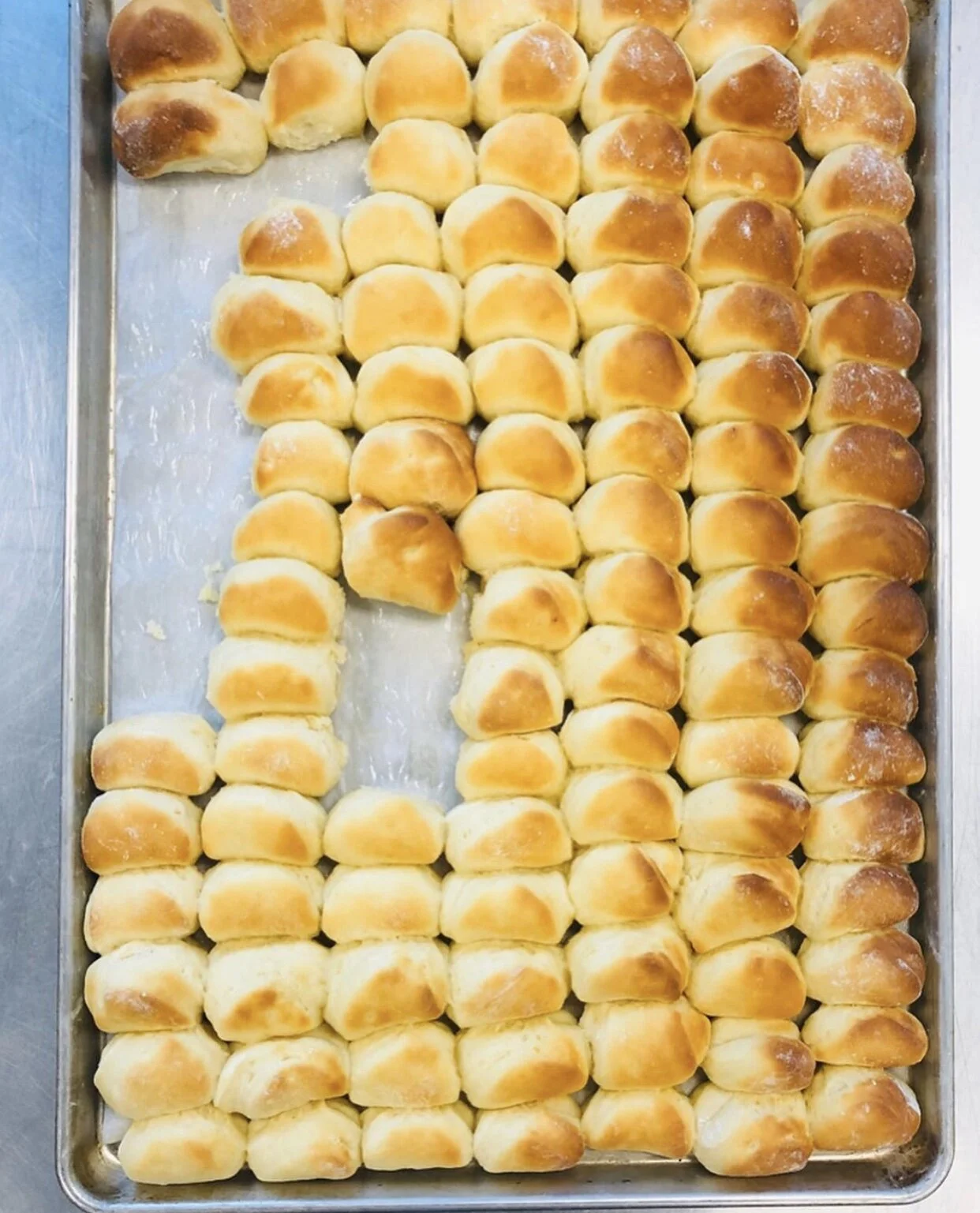
From Chef Director Bianca Morton: “Every holiday my grandfather brought fresh-baked, melt-in-your-mouth yeast rolls. He brought some for dinner and packaged some in gallon-sized Ziplock bags for each family to take home...After he died I kept trying to get the recipe right. This last Christmas, 18 years since he passed away, my family was like, ‘I think you got it.’” .
Bianca's Yeast Rolls
1/2 cup milk
1/2 cup water
1/2 ounce dry yeast (fast-rising)
1/3 cup butter (melted, plus more for brushing)
1 teaspoon salt
3 tablespoons sugar
2 eggs
4 1/2 to 5 cups all-purpose flour
Warm 1/3 milk and water. Mix in yeast and let sit until bubbly. Combine remaining milk/water mixture with butter, sugar and salt. Add eggs one at a time. Start adding flour 1 cup at a time to form dough mixture. Gently knead. Oil bowl and place dough inside it to rise and double in size. Punch down and allow it to rise again. Roll out dough and cut rounds. Fold over and pinch like a turnover. Bake at 350 degrees for 12 to 15 minutes until golden brown, brush with melted butter and sugar.

From Kitchen Manager Brent Peadro: “Every kitchen I’ve worked in has had some sort of collard green component, and this recipe is a culmination of all of them. For me, it’s about that balance of smokiness, sweetness, saltiness, spiciness and acidity. There’s something very comforting about a bowl of delicious collard greens. Eating these collards reminds me of all of the wonderful people I’ve worked with over the years. I hope you enjoy this recipe as much as I do and possibly have it bring you some peace and joy during these tough times.”
Brent Peadro’s Collard Greens
4 tbsp bacon fat
2 onions, julienned
1/2 pound raw bacon, chopped
5 cloves garlic, minced
4 tbsp salt
1 tbsp chili flake
1 tbsp smoked paprika
1/2 tsp cayenne
1/2 tbsp black pepper
1 1/2 cups cider vinegar
4 tbsp brown sugar
4 tbsp of honey
2 pounds collard greens, chopped
Heat bacon fat on medium-high heat. Add onion and bacon to pan and sweat until tender and a fond has developed. Add garlic and dry spices and cook for a minute stirring. Add cider vinegar and deglaze pan scraping up brown bits with a wooden spoon. Add brown sugar and honey.
Bring to simmer and then start adding greens in batches, covering to steam and then adding more as they cook down. Simmer, stirring every 30 minutes until tender and full of flavor.

A big welcome to the newest member of our team, Johnisha Levi, who joined The Nashville Food Project as Development Manager in the midst of tornado emergency response. A native of Washington, D.C., she also managed a community nutrition education program in Boston with a culturally competent curriculum to motivate at-risk populations to eat healthier. As for her chili recipe below, she says “it's a recipe that I have adapted over the years that includes my two favorite things— chocolate and spice!"
Johnisha’s Chipotle Chili ⠀
Serves 6 to 8⠀
1 large yellow onion, diced⠀
1 cup diced yellow, orange or red pepper⠀
2 cloves minced garlic⠀
2 pounds ground turkey or beef⠀
1 tbsp brown sugar (optional)⠀
2 tbsp ancho chili powder⠀
1 tbsp unsweetened cocoa powder⠀
1 tsp cumin⠀
1/2 tsp pepper (or to taste)⠀
1/4 tsp salt (or to taste)⠀
2 tbsp tomato paste⠀
2, 15-ounce cans of beans (I usually use all black beans or half black beans, half pinto)⠀
28 ounces crushed tomatoes (or diced)⠀
1/2 to 3/4 quarts of chicken broth⠀
2 canned chipotles, minced⠀
2 ounces bittersweet or unsweetened chocolate⠀
Suggested toppings: chips, sour cream, green onions⠀
Heat a dutch oven over medium high heat with 2 tbsp of oil. Saute the onion, bell pepper, garlic and meat until the meat is browned and onions are soft, about 8 minutes.
Add the dry ingredients (sugar through salt) and saute for 3 to 4 minutes until incorporated and aromatic.
Add the tomato paste and saute 2 to 3 minutes. ⠀
Add the beans through chipotle; stir and bring to a boil.
Reduce heat and simmer for 15-20 minutes uncovered until slightly thickened.
Add in the chocolate in small pieces and stir until melted. Serve with desired toppings.

The next recipe in our #communitycooking series comes from three housemates and staffers at The Nashville Food Project: Sally Rausch (Growing Together Market Manager), Hannah Duiven (Prep Coordinator, St. Luke’s Kitchen) and Katie Duiven (Catering & Events Manager).
Their “Clean Out the Fridge Pizza” is part of their home cooking repertoire. "We just look in our fridge, see what cheeses, toppings and sauces we have or could make do, and try to come up with something delicious," says Sally.

Sauce suggestions: red sauce, pesto, olive oil. Cheeses: mozzarella, goat cheese, parmesan, or a blend. Fridge toppings: peppers, mushrooms, arugula, any roasted veggies. Pantry toppings: olives, sun-dried tomatoes, nuts, quick caramelized onions, roasted garlic.
For the dough, they recommend this quick and easy version: https://www.food.com/…/pizza-dough-for-thin-crust-pizza-701….
These pizzas give us a tasty way to make creative use of what’s on hand!

Stay tuned for more favorite recipes from staff posted here!
Finding Hope in the Garden
“Working in gardens is hopeful work for me. I can only work with what’s available to me today. There is no way to know what the season will be like. Certainly some things will flourish and some will struggle. So, we plant the seeds…We rejoice in our relationship to the earth, to our commitment to this plot of ground and to the delicate but resilient plants growing in it.”

by Julia Reynolds Thompson, Director of Garden Operations
On a staff conference call this week, my garden coworker Sally reminded us that, through unpredictable weather and pests, gardening and growing food trains us to live with many unknowns. I thought to myself, “I have been growing food for a long time; why am I so bad at living with many unknowns?” We are all living in a time of uncertainty… about our jobs, our health, our leadership, our society. So, how can we lean in, live well, take care of ourselves, support our neighbors in the midst of this reality?
Working in gardens is hopeful work for me. I can only work with what’s available to me today. There is no way to know what the season will be like. Certainly some things will flourish and some will struggle. So, we plant the seeds. We worry over them and rejoice when they germinate. Or when they don’t germinate (I have been struggling with carrots for years), we sow again. We monitor the water they are getting. We crawl down the rows and pull up the weeds. We rejoice in our relationship to the earth, to our commitment to this plot of ground and to the delicate but resilient plants growing in it.

None of us knows what life will look like in the coming weeks and months. We can’t know yet what will return to normal, what will have been altered, who will flourish, who will struggle. So, we sow the seeds. We check on our neighbors, we call our coworkers, we video chat with our families. We worry about folks losing their jobs or not having enough to eat. We rejoice in our relationship to the people we love, in our commitment to our city and the delicate but resilient people growing within it.
I have seen my coworkers doing this work as I’m sure you have seen those around you cultivating community despite physical distance, rejoicing in the work before them, caring deeply about both neighbor and stranger. All of this cultivates hope in me. May it be so for you as well.

The Nashville Food Project Care Package for Uncertain Times (Part 1)
We collected our inspirations, recommendations, motivations—all salve for the loneliness and fears this virus and social distancing can produce. These recommendations aren’t necessarily heavy or directly related to the pandemic or our work. Rather it's a collection intended to nourish and accompany our community as we all stay home together.
Cultivating community lies at the heart of our mission at The Nashville Food Project, but at this time of social distancing, we’re learning how community means much more than physical proximity.
We’re seeing inspiration for community everywhere — from living room concerts and “cloud clubbing” (for the ravers among us) to movie discussion groups and online home cooking forums. In David Byrne’s magazine “Reason to be Cheerful,” Nick Green, creator of the Social Distancing Festival, says this:.
“As long as we are sharing a space in which we can be present, provoke, inspire, promote kindness and compassion, and share ideas, then we are all together in one space, even if it’s in different places at different times.”
Along those lines, we recently found encouragement from On Being’s Care Package for Uncertain Times, a collection of interviews and poetry on topics ranging from grief to hope. It inspired us to make our own version for our friends and for each other. We collected our inspirations, recommendations, motivations—all salve for the loneliness and fears this virus and social distancing can produce. These recommendations aren’t necessarily heavy or directly related to the pandemic or our work. Rather it's a collection intended to nourish and accompany our community as we all stay home together.
We’ll be sharing our care package in small digestible bites—five staffer reflections at a time. Please find Part 1 below with Part 2 coming soon!
Meg Schmalandt, Sous Coordinator - California Kitchen
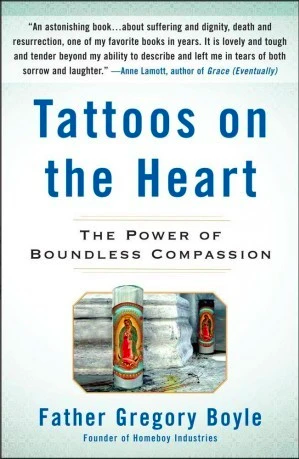
Book: Tattoos on the Heart by Fr. Greg Boyle. It’s kind of related to our work but also very related to being a human, trauma, healing, and spirituality.
Podcast: Dolly Parton's America. I'm. Obsessed. With. Her
Movie: JoJo Rabbit. It'll make you laugh and make you cry. A lot about what it means to grow up and joy as a state of being.
Article: TIME magazine’s 100 Women of the Year
TV: Honestly, Cheer on Netflix was so good.
Ways I'm Coping with COVID-19: Dance parties with my roommates, funny movies, going on walks, working out, and cooking soups + stews. Dreaming about the spring. Planning my wedding flowers :)

Sally Rausch, Growing Together Market Manager
Podcast: This American Life's episode called The Show of Delights made me chuckle out loud so many times, exactly what I've needed the past few weeks-to be reminded that we can find delight in the simplest things and also that someone else sharing their delight can in and of itself be delightful!

Book: Part of that podcast episode highlights poet Ross Gay and his recent book of "essayettes" about finding delight. It's called The Book of Delights: Essays. I've been trying to read one or two before bed instead of scrolling. He is so real and talks about real issues—racism, being black in America, grief—not escapist but about finding delight in our lives as they are. I'm finding it nourishing in the most grounded way.

Bianca Morton, Chef Director
Music: 90’s R&B. It takes me back to a simpler time—high school years when the biggest problem was schoolwork, graduation and fitting in. On Tuesday I let loose some steam and danced to Whitney Houston's Greatest Hits. I danced, sang and cooked. And just for a moment didn't have a care in the world. Just joy!

Tallahassee May, Growing Together Education Manager
Books: I am currently re-reading Gabriel Garcia Marquez's 100 Years of Solitude and Love in the Time of Cholera. Both seem so fitting and are perfect escape-reads in the age of quarantine.
Audio Book: Anne Patchett's The Dutch House. First, you are supporting a local author and small business heroine. And second, you’re supporting a coronavirus survivor, Tom Hanks, who reads it on audio and does an amazing job.

Podcast: Poetry Unbound, an offshoot of On Being with short poetry readings by Padraig O' Tuama.
Music: Nothing beats Beyonce's Homecoming, Live at Coachella! Amazing live music, festival vibe (for when you need to remember what it was like to share intimate space with thousands of people) complete with the best HBCU Marching Band! And when you are feeling quiet and introspective (and alone), Keith Jarrett's solo piano concert masterpiece The Kohl Concert.
Movie: The new movie adaption of Emma was recently released and since its time in theaters was cut short, it is now available for streaming! It’s a fun, gorgeous adaptation. The director, Autumn DeWilde, and I were hippy kids together on The Farm commune in L.A. in the early 70s, and I have loved watching her career blossom and evolve over the years.

Teri Sloan, Development Director
Podcast: I'm a big fan of the Armchair Expert Podcast with actor Dax Shepard and his friend Monica Padman. They do at least two episodes each week having long, deep-dive conversations with different folks from the entertainment industry as well as "experts" like writers, scientists, psychologists, etc. No matter who is being interviewed it always turns out some interesting conversations that make you laugh and make you think about something a little differently.
Article: Not that there's anyone in our city who hasn't read it yet, but Margaret Renkl's "What it Means to be #NashvilleStrong" article moved me to tears recently.

TV: I've been eagerly anticipating the release of Little Fires Everywhere on Hulu. It's Reese Witherspoon's and Kerry Washington's television adaptation of Celeste Ng's popular book of the same name. The first three episodes dropped last week, and I'm already hooked. I've also been taking the time at home to start binging some of the TV shows everyone else has been talking about over the years that I never watched: Schitt's Creek, The Wire, etc.
Other ways of coping through COVID-19: I've been cooking, and I've got a batch of homemade limoncello steeping in the cabinet. My next big idea is teaching myself the longtime TNFP pastime of knitting. Anyone got any good YouTube videos to check out?
When the Helpers Need our Help
Our restaurant friends have shown up for us in extraordinary ways over the years with their skilled hands, big hearts, expert knowledge, creativity and efficient work. They’ve taught us through action about service and heaped generosity upon us helping raise thousands to fund our twin goals of cultivating community and alleviating hunger in our beloved city Nashville. They’ve had our backs—and thus, the backs of so many across this city. They’ve shown us all hospitality and provided space for building community at their welcome tables. And now our restaurant friends need us.

Just five days after devastating storms swept through Nashville, our staff was feeling overwhelmed and verging on burnout. We had been in constant motion to add extra meal prep sessions, organize new distribution routes and increase production to share thousands of emergency meals over and above our typical run of partner meals.
But we knew we had to keep going in order to meet the needs of the marginalized neighbors across our city. We needed clutch help. And as they always have, the chefs and restaurateurs stepped up.
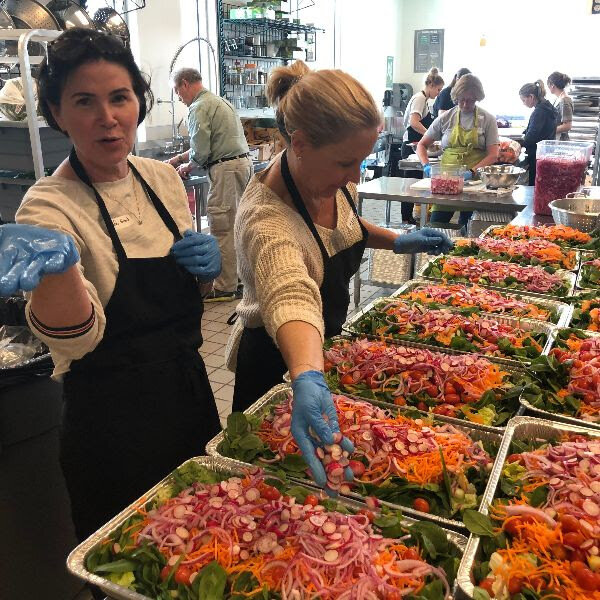
The first Sunday after the storm, a team of 14 professionals had assembled in our kitchen—sleeves rolled up, aprons tied on, ready to work. Some of their restaurants were still without power while others had worked busy shifts all week or been a part of enormous volunteer efforts around town. None of us knew at the time that just days later, they would be shutting their doors indefinitely and helplessly sending staff home amid COVID-19.
Our restaurant friends have shown up for us in extraordinary ways over the years with their skilled hands, big hearts, expert knowledge, creativity and efficient work. They’ve taught us through action about service and heaped generosity upon us at Simmer and Nourish dinners and donated packages to our silent and live auctions that help us raise thousands of dollars to fund our twin goals of cultivating community and alleviating hunger in our beloved city of Nashville.
They’ve had our backs—and thus, the backs of so many across this city. They’ve shown us all hospitality and provided space for building community at their welcome tables. And now our restaurant friends need us.
So how can we help? We can take part in the innovative measures they’ve had to put into place. We can order take-out, gift cards and merch. We can contribute to GoFundMe accounts for workers, many of whom were already living close to the margins. But we also can make our voices heard. A coalition of chefs and restaurant owners mobilized quickly this week to form Tennessee Action for Hospitality. We invite you to visit their site, read their requests and take action.
As we reflect on the past couple weeks, we’d also like to offer specific thanks.
Chef Lisa Marie White of Biscuit Love helped us quickly pull together that all-star team for Sunday prep including Pastry Chef Jaime Miller of Lockeland Table, Tandy Wilson of City House, Tandy’s wife Stephanie Melidis Wilson, Kate Redden of City House, as well as Biscuit Love staff and alums John and Emily Dyer and James Handy. Davis Reese from Sean Brock’s team joined us as well as longtime Dulce Dessert owner Juanita Lane, longtime chef Betsy Johnston and Scarlett Egan, and Chris DeJesus of M Street with his wife and Pastry Chef Brook Champagne and their soon Arlo.

In just a three-hour session, here’s a glimpse at what they accomplished:
15 gallons of chicken stock
20 gallons of marinara
Muffin batter to use all week (with streusel topping)
Scones, frozen on sheet pans with baking instructions
A 12-gallon Lexan pan of pasta salad
2 full Lexan pans of herbed croutons
450 sack lunches with wrapped home-baked cookies
Several pans of banana bread, portioned and labeled
Replenished mise en place and sliced deli turkey
And then without us asking—they washed dishes and mopped the floor!

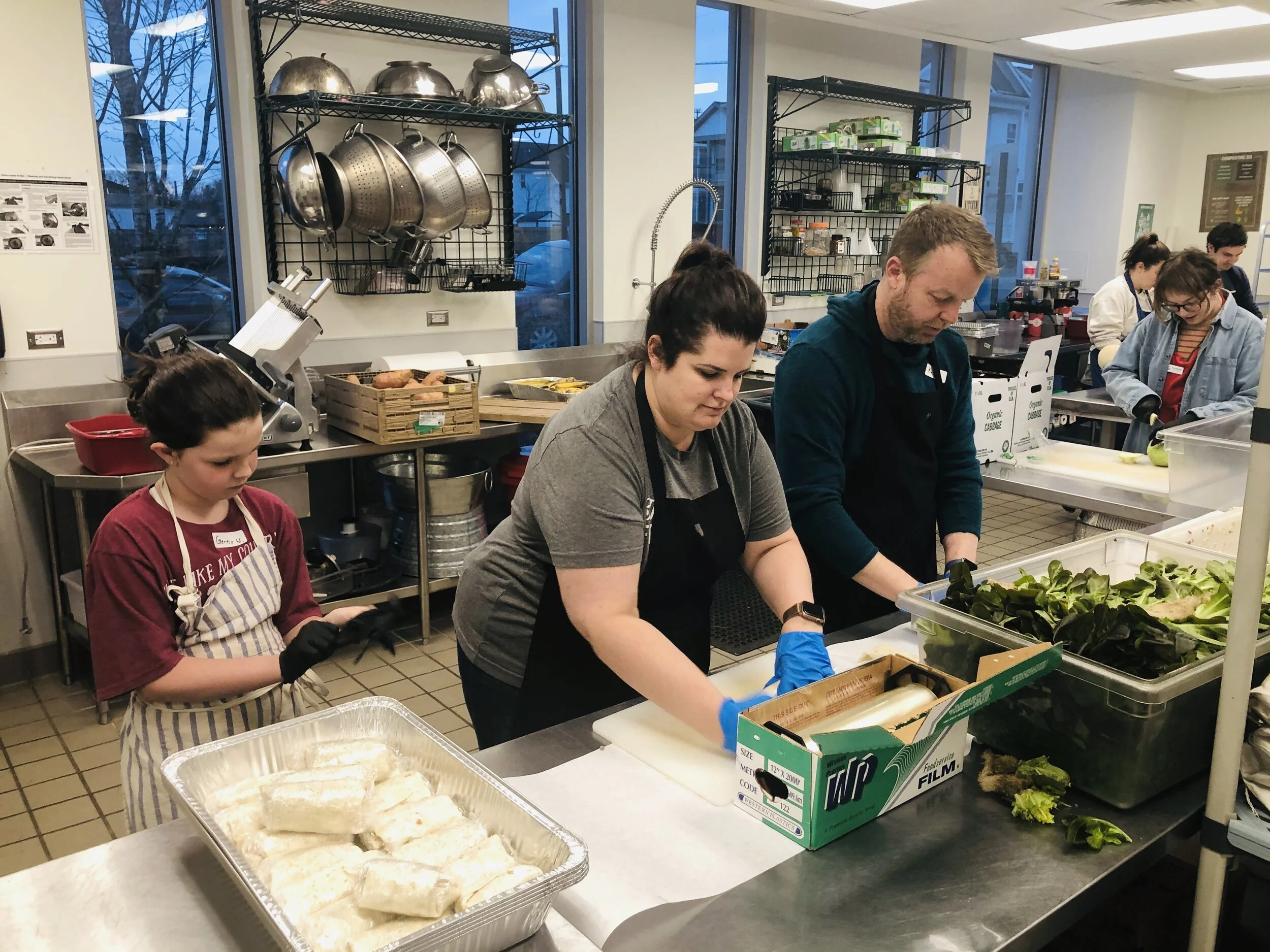
Restaurant friends showed up in other important ways too. With the power still out at his Germantown restaurant Tailor, Vivek Surti joined a regular prep session as did Tom Eckert from Maneet Chauhan’s restaurants (Maneet and team also delivered emergency meals!). Arnold Myint came in to break down whole chickens, make soup and stock and fry tenders. Despite running several busy restaurants Karl and Sarah Worley, co-owners of Biscuit Love and ‘za, came in for prep—rolling chicken salad wraps—with their daughter Gertie.
Katie Struzick and Lucie Bardone of Lockeland Table organized, labeled and inventoried a refrigerated truck donated by US Foods to World Central Kitchen. Jaime Miller also from Lockeland Table spent two days organizing our walk-in cooler and pantry—critically helpful as we received hundreds of donations of perishable product from dozens of generous donors.


Chef Julia Sullivan of Henrietta Red donated ingredients. Julia Jaksic of Cafe Roze helped deliver our meals on foot. Molly Martin of Juniper Green, Levon Wallace formerly of Strategic Hospitality, Trey Cioccia of The Farm House and Black Rabbit, and Tony and Caroline Galzin of Nicky’s Coal Fired also offered support. We could go on— and that’s in just two weeks time.
At The Nashville Food Project, we hold as a value the belief that every individual has the capacity to be both guest and host. In this time of need for Nashville’s hospitality community — and for so many Nashville neighbors — we hope for creativity and innovation in finding ways to help the helpers among us.
For those in the industry, please be in touch if you know folks with specific needs. You can reach out to me directly at jennifer@thenashvillefoodproject.org and I will take your confidential requests to our Leadership Team at The Nashville Food Project, and we will do our best to support you where you are.
Sharing Hope
The blows our Middle Tennessee neighbors have endured since the beginning of March have been enormous. Our local community is entering into this pandemic already tired, afraid, economically strapped, and needing each other’s physical presence more than ever. The calls for social distancing are in direct conflict with our mission “to bring people together,” but our staff are soldiering on to nourish our community in these changing times with our actions, inaction, love, and prayers.

The pictures above offer a glimpse of what our emergency food support looked like last week. And due to the disastrous pandemic in our midst and the necessary adjustments we are making to our mission delivery, the photos below are what our emergency support looks like this week. Our commitments to our twin goals of cultivating community and alleviating hunger are unwavering, even in such an uncertain time.


We know your news feed has been flooded with heartbreak and hard knocks this week —school closures, small business shutdowns, Covid-19 stats, and a tumbling economy. We also know information is important, and we’re grateful our community is taking social distancing seriously. Indeed, we announced last Friday that we have suspended volunteer activities in our kitchens and gardens for the health and safety of all involved.
The blows our Middle Tennessee neighbors have endured since the beginning of March have been enormous. Our local community is entering into the coronavirus pandemic already tired, afraid, economically strapped, and needing each other’s physical presence more than ever. The calls for social distancing are in direct conflict with our mission “to bring people together,” but our staff are soldiering on to nourish our community in these changing times with our actions, inaction, love, and prayers. Please keep them in your thoughts as they navigate ways to provide uninterrupted support to our partners and neighbors, while caring for their own families, and meeting what feels like urgent and growing need for the most basic of things - nutritious food.
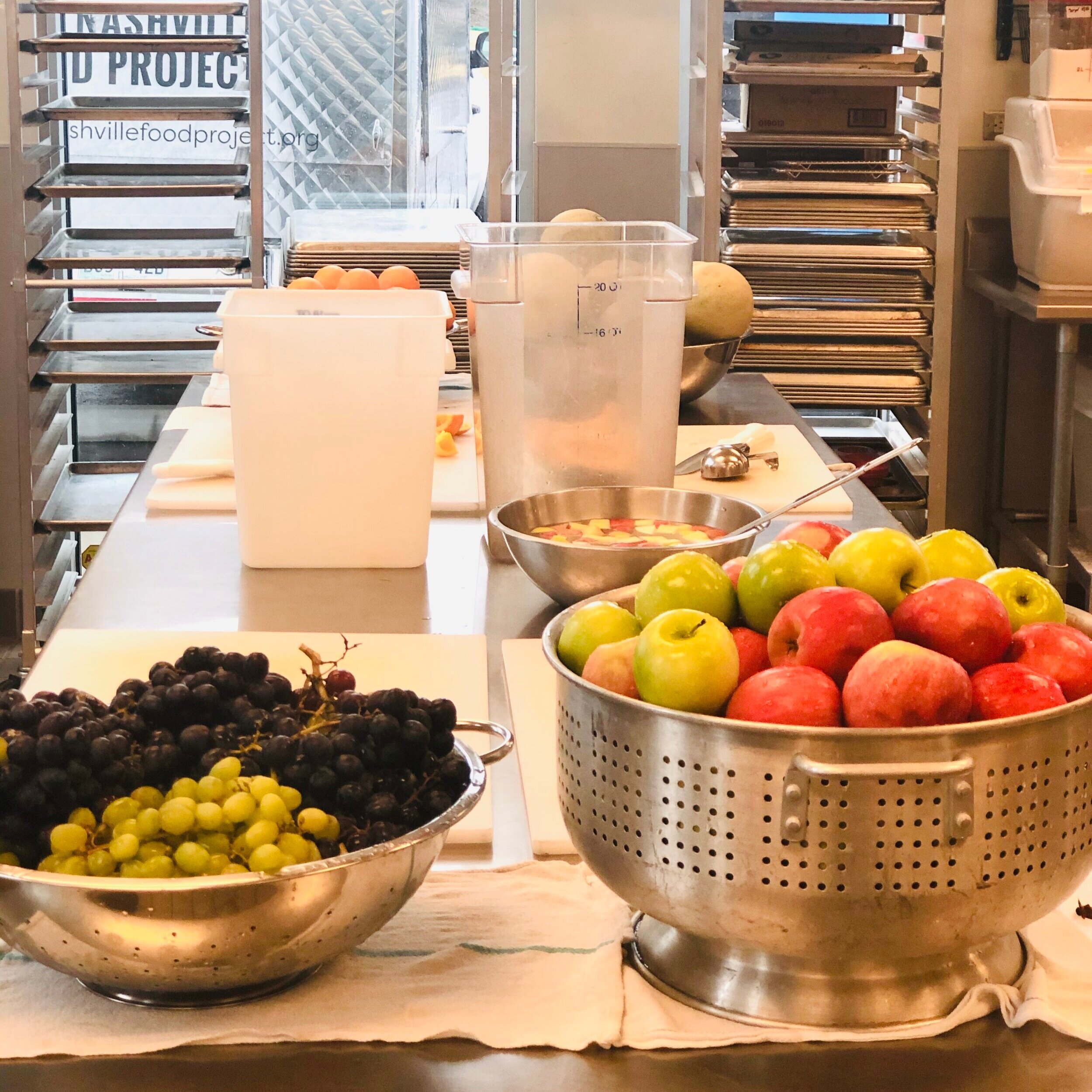
As we all feel our way into what the coming weeks and months look like, we want to share some of the relief and recovery work we continue to support after Nashville’s recent storms devastated vibrant pockets of our city.
As of today, The Nashville Food Project has prepared and shared a total of 15,636 nutritious meals since March 3rd, 2020. These meals were distributed to our regular partners who have remained open, and of that total number, 8,470 meals were emergency meals shared with recovery sites in North Nashville, Hermitage, Mt, Juliet, East Nashville, Donelson, American Red Cross' staging hub, and the NES substations around town. Check out this letter of love and thanks - that was delivered along with a generous cash donation - from a local NES crew. A member of the NES meter department came by the office to say, "Thank you all for making us feel seen and appreciated. It meant a lot to us. Thank you for all you do." Our Distribution Manager Elke, who received the card and donation said to us later, "He would've hugged me, but I got an elbow bump instead."

This week and weekend, our staff is preparing and sharing 125 daily, hot lunches to New Covenant Christian Church in North Nashville, a church who is serving as a resource distribution center in the neighborhood. We have also mobilized to prepare 50-100 weekly meals for Fifty Forward's Bordeaux location, 80 weekday meals to Martha O'Bryan Center serving the Cayce community, as well as 1,200 hot meals per weekend, for families each Saturday and Sunday in the coming month to support Gideon's Army's work in North Nashville, in conjunction with Hands on Nashville.
For so many of us - whether we are employees, volunteers, garden participants, or meal guests—the daily or weekly interactions we have at The Nashville Food Project are such an important part of the rhythm of our lives, a place to sow our hope, a place to belong. In the coming days and weeks let us know what you’re up to and reflecting on! Tag us as you wade through your pantry and freezers. Show us the seeds you are starting this Spring. Share your hope.
With love and gratitude for every expression of community,

WAYS YOU CAN HELP:
While we continue to respond to the changing needs of our community, financial donations are The Nashville Food Project's greatest need. DONATE NOW.

Cultivate Community
Help us share encouragement during this time of isolation by sending postcards for elderly neighbors to our office at 5904 California Avenue, Nashville, TN 37209. We'll get them out to meal guests as we share meals with our senior-serving partners.

Support Local Restaurants
Support our restaurant and farmer friends who have supported us so generously. This includes buying gift cards, ordering take-out meals, enrolling for CSA shares, and reaching out to senators and representatives to request aid for these industries.
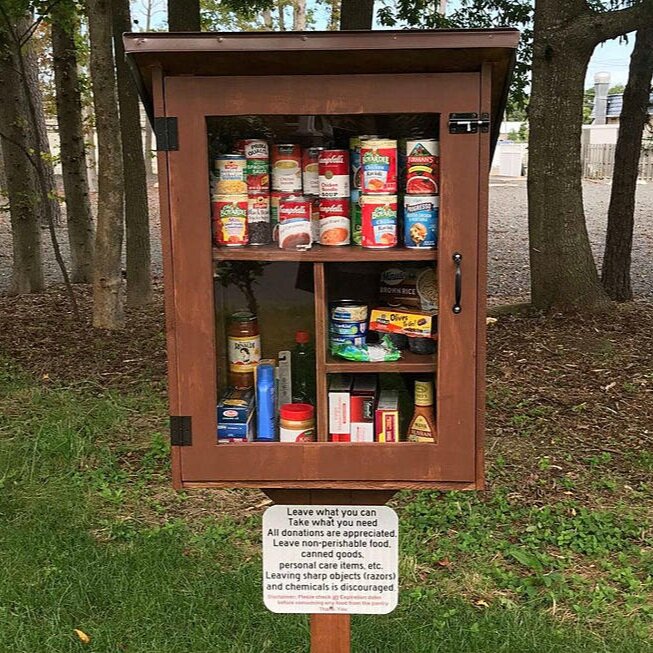
Create a Little Food Pantry
In the vein of "Little Libraries" consider building or converting your own to a "Little Food Pantry" with non-perishable foods to share with neighbors who may have need. Invite folks to add any of their excess non-perishable foods, and spread the word through social media and the Nextdoor app.
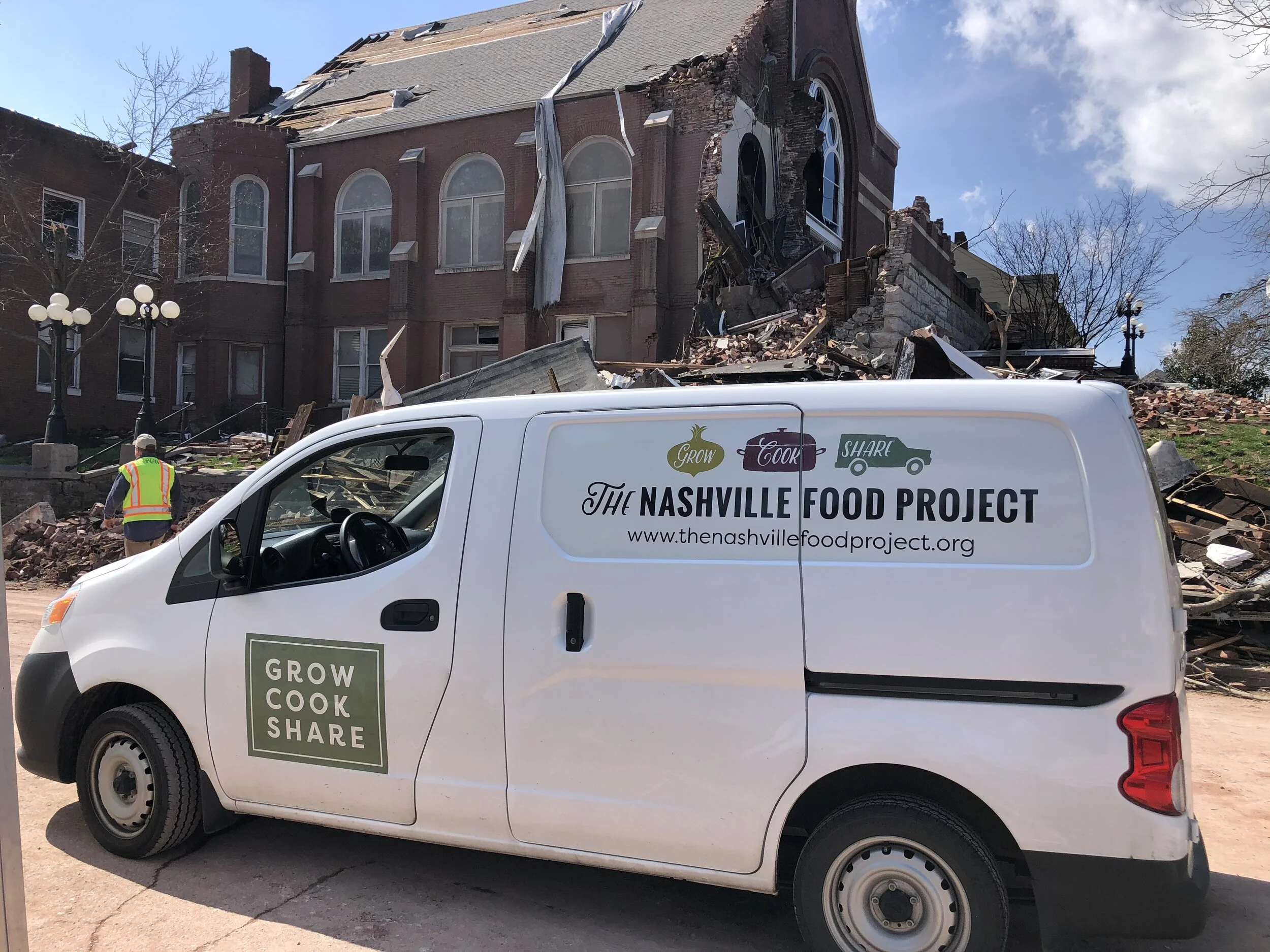
March 2020 Emergency Response
What a hard, sad, mixed-up time for our city. My heart breaks for so many in our community whose homes, neighborhoods, and favorite local places were devastated in the tornadoes this week. And yet... I swell with pride when I witness the ways neighbors are showing up for one another. Life often delivers both beauty and chaos together.
Dear Nashville,
What a hard, sad, mixed-up time for our city. My heart breaks for so many in our community whose homes, neighborhoods, and favorite local places were devastated in the tornadoes this week. And yet... I swell with pride when I witness the ways neighbors are showing up for one another. Life often delivers both beauty and chaos together. I do not understand why life unfolds this way, but stand in awe of the hope and love and connections that emerge when unexpected loss rips through our community.
As in other times when our city has found itself in the midst of an emergency (like the 2010 flood and the 2019 partial federal government shutdown), The Nashville Food Project is poised to respond. Our staff and vehicles have been on the streets today and yesterday sharing thousands of made-from-scratch meals to emergency shelters and neighborhood recovery hubs in North Nashville, East Nashville, and Donelson. We are listening to our partners and local emergency management services to coordinate and activate a sustained response effort that we expect to stretch long into the coming days and weeks. We will be keeping our social media and website up to date, so please check there for updates and specific ways to support and plug in. Scroll down for more.
As many of you know, a helpful, coordinated relief effort takes a bunch of layers of communication with many partners and key stakeholders, so thank you in advance for your patience and all your tremendous support.
With love,
If you know of a shelter or community hub in need of food support, let us know. We don’t have capacity to accommodate all requests, but we’re working with partners to fulfill as many as possible. This week we have routes serving the following locations:
Lunch:
New Covenant Christian Church, 3/16, 3/17
FiftyForward, 3/17
Lunch, Saturday/Sunday:
Now more than ever, financial contributions are needed to meet the needs of our city. We can put those to important use by helping us buy food and supplies, fuel our vehicles and run our kitchens to keep cooking high-quality meals. A donation of $5 buys food and supplies for five meals.
As we receive updates from our partners and learn more about how our partners, our volunteers and our team can get involved we will share that information here.
Additional resources we’re hearing about:
More resources collected by the Nashville Scene.
To volunteer your time, sign up with Hands on Nashville.
To donate everything EXCEPT clothing, stop by the Community Resource Center, located at 218 Omohundro Pl, Nashville, TN 37210.
Eater Nashville is collecting ways the hospitality industry is pulling together.
Partner sites and affected areas:
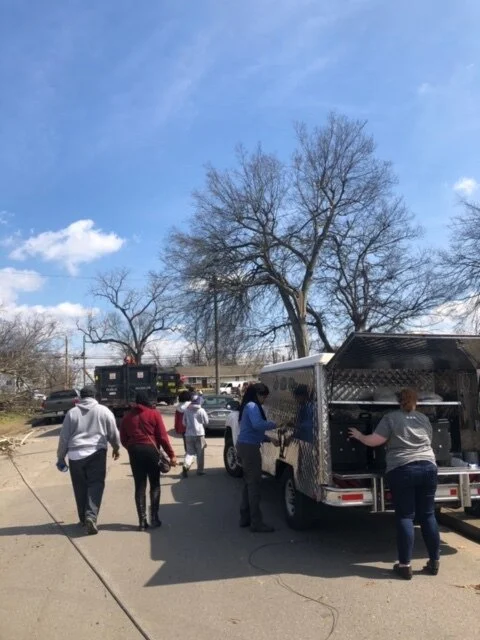
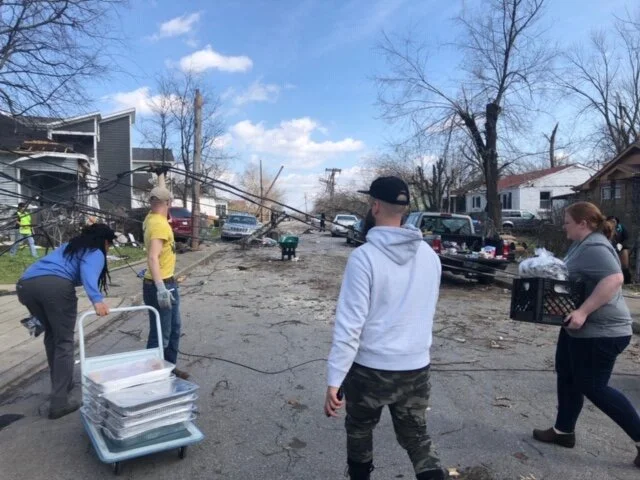
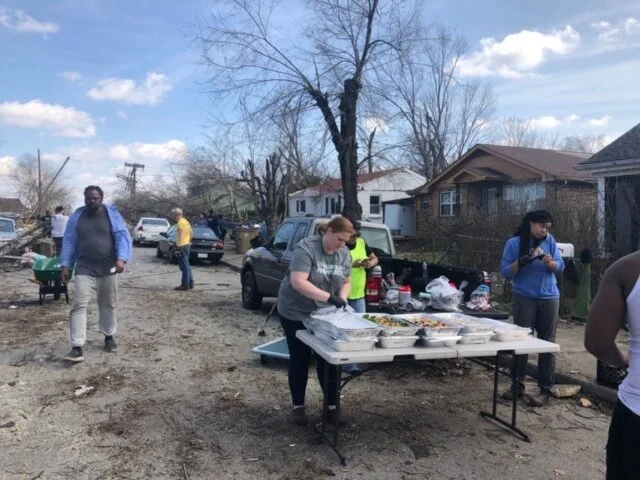
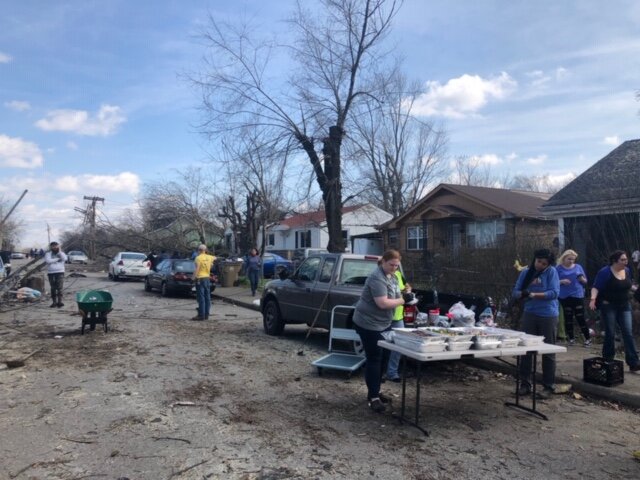
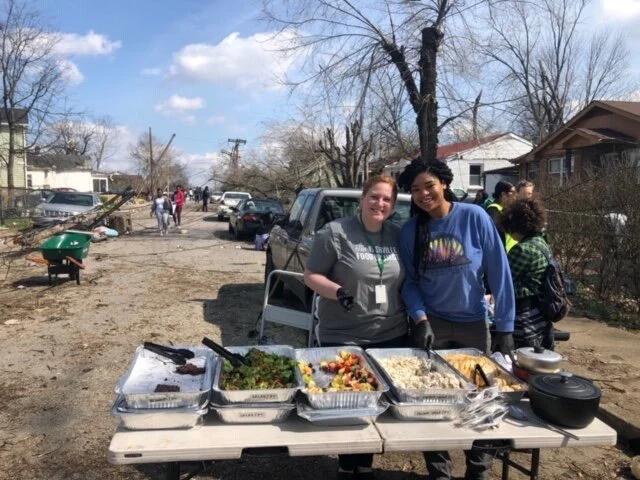
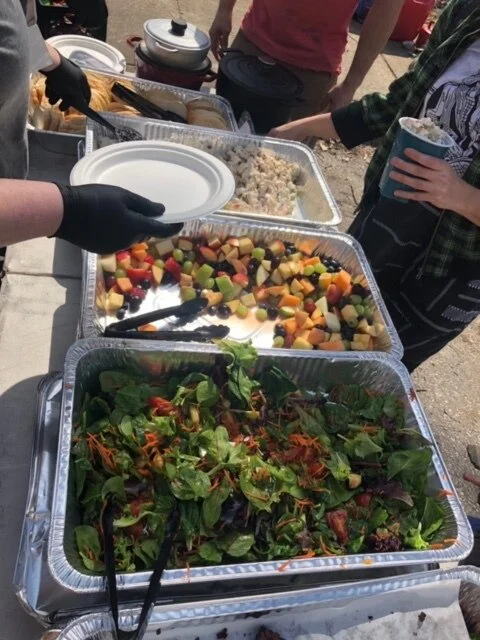
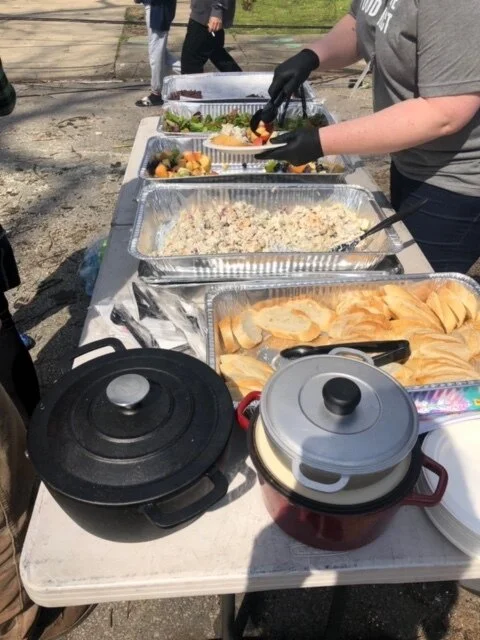
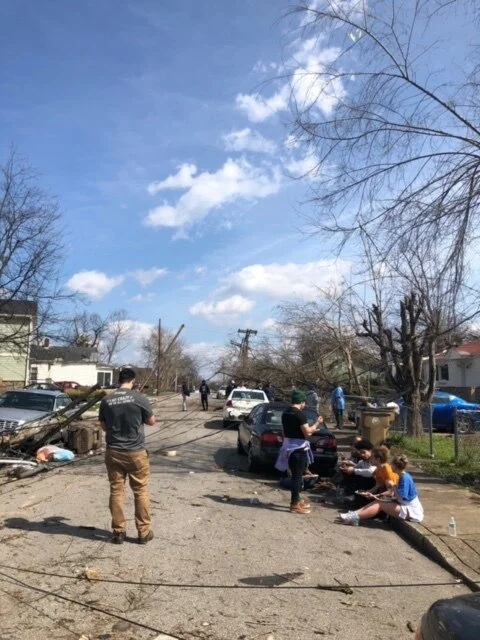
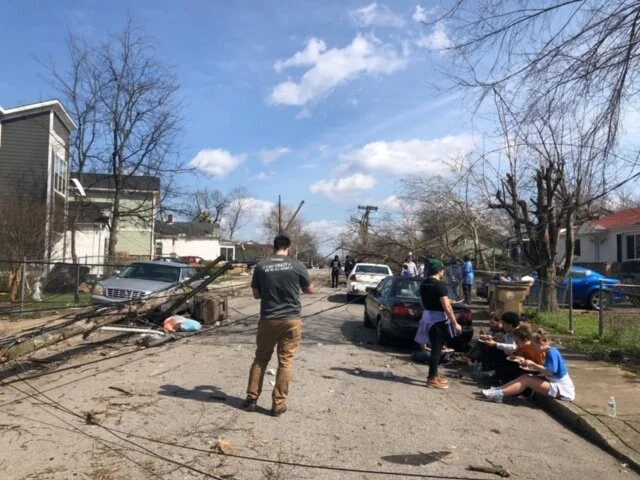
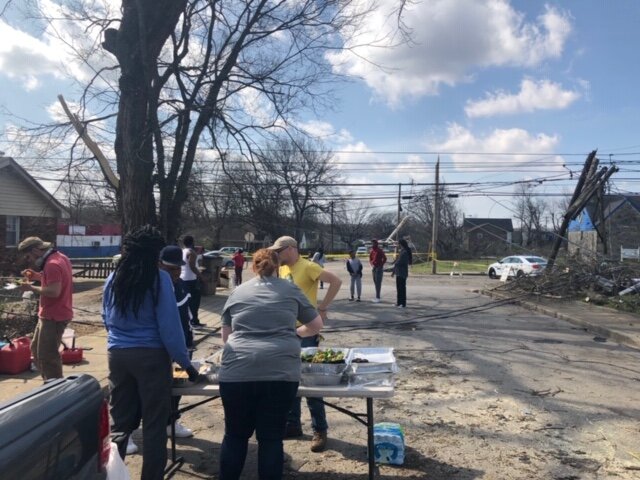
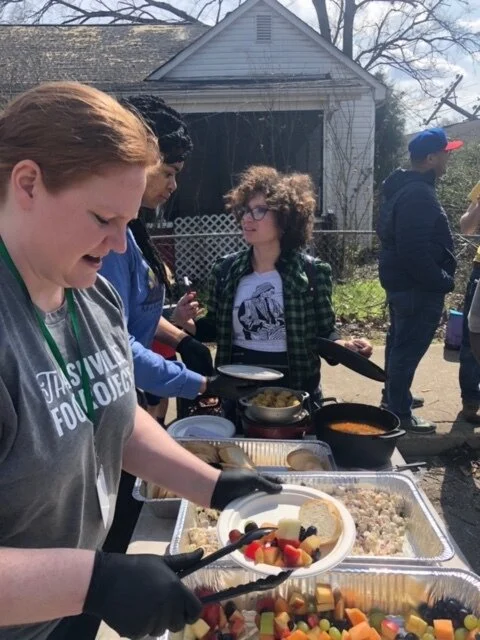
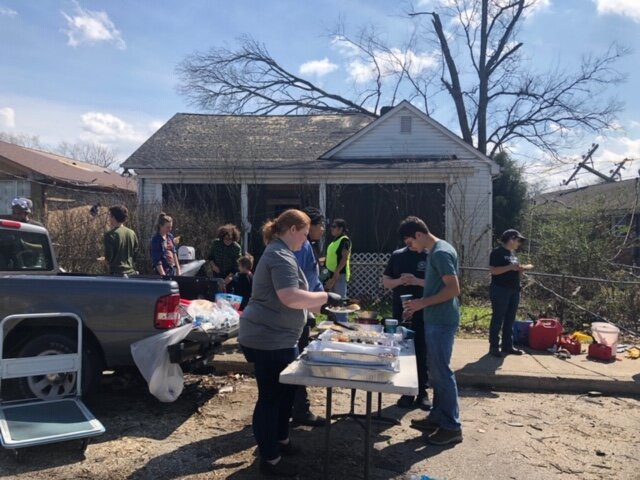
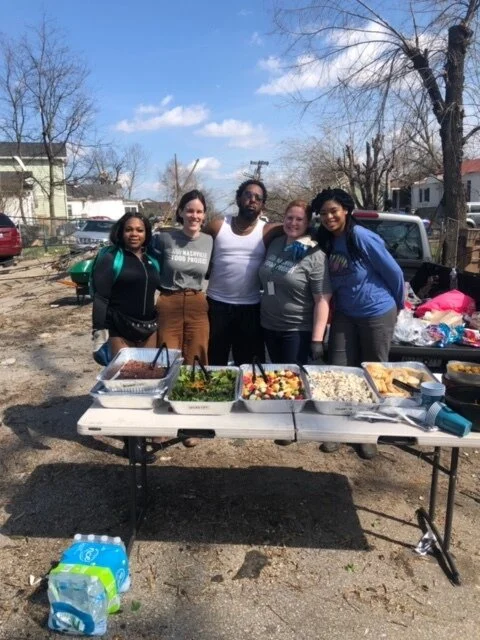
Update: 3/3/2020, 9 p.m:
In addition to restoring power at our headquarters, sharing food at emergency sites and working on a coordinated relief plan for the week, we were also committed to our largest food recovery project of the year tonight. We collected, sorted and packed 28,000 pounds of meat from the Meat Conference at Gaylord Opryland. It will help fuel our meals program going forward. Thank you to all the volunteers who helped make this happen on an already very busy day. More updates on our plan moving forward tomorrow.
Update: 3/3/2020, 4 p.m.:
Thanks to the kindness of our friends at R.C. Mathews and Dodd Electric, we now have a generator running our kitchen at limited power. Our staff and vehicles have been on the streets today sharing cold meals to emergency shelters and neighborhood recovery hubs in North and East Nashville. Now that partial power has been restored, we are working on a full relief effort plan for the remainder of the week and weekend. This will include volunteer opportunities in our kitchens to support emergency meal service in our community. Updates will be posted here as available.
Previously Posted:
Thank you to the many folks in our community who have reached out to support recovery efforts after last night’s devastating storms. Currently at The Nashville Food Project, our power is out, and we are working quickly to restore it and reallocate any cold meals we currently have prepared. Many of our partners are closed today so we are actively working to reallocate all planned meals to emergency shelters and community centers in the areas most affected. Sites that should receive support in the form of prepared meals today include:
North Nashville:
Lee Chapel AME Church (lunch meal)
East Nashville:
East End UMC (lunch meal)
We are in close communication with our partners and with the Metro Emergency Services to determine how we can continue to support efforts this week. We do hope to increase our volume, and will keep this site updated on how you can pitch in. Besides getting meals out to shelters today, our highest priority is restoring power to ensure no food on hand is lost.
Starting a Community Garden
Over the years, we’ve witnessed the benefits of community gardens firsthand. Participants tell us they experience improved physical and mental health as well as a stronger sense of belonging.
But in addition to participants in our own programs, we also hear from folks who want to start community gardens of their own. If you’re interested in assembling a group and inspiring change, as we are, then here are a few good places to start:
by Lauren Bailey, Director of Garden Programs
Over the years, we’ve witnessed the benefits of community gardens firsthand. Participants tell us they experience improved physical and mental health as well as a stronger sense of belonging. One of nearly 70 community garden participants in our programs last year told us this: “To know that I have the power to grow my own food if I want to is definitely life-changing.”
But in addition to participants in our own programs, we also hear from folks who want to start community gardens of their own. If you’re interested in assembling a group and inspiring change, as we are, then here are a few good places to start:
1) Get started by measuring interest and bringing people together. If you’re working to organize a new community garden, gathering folks together to understand common goals and motivations could be a great place to start. Much like gardening, there are different approaches and strategies that folks use. What has been helpful for our planning and implementation is to have an understanding of why we believe community gardens are important. After years of stewarding a few different community gardens, we’ve seen themes emerge as our “why”. Since the work involves stewardship of land and organizing people, we’ve found that in addition to knowing why you want to garden, having realistic expectations of what it takes to maintain the community garden is key to success.
2) Identifying land. Maybe you have your eye on a slice of land behind your church or school, or maybe you want to grow on government or private property? You’ll first want to assess the land and make sure it is suitable for growing (more about that later). Then you’ll want to learn the types of gardening allowed on the land by zoning codes. You can find more information about zoning in this guide: A Guide for Growing Food in Nashville- Nashvitality. This will determine whether (and what type of) permit is needed. If you don’t own the land, you’ll also want to draw up an agreement with the land owner that specifies what you’re allowed to do and for what duration. Examples of agreements can be found on this website: American Community Garden Association.
Having trouble identifying land for your garden? In Nashville, the Ag Extension is working closely with several other Metro Departments to help residents of Davidson County utilize some of the flood buy-back properties to start up community gardens, but know that gardening on these properties presents some challenges. Aside from the risk of flooding, there are restrictions on building structures on these properties. Contact the Ag Extension to learn more about what properties may be available.
3) Invest time up front in designing and planning your garden. While gardening can be as simple as starting a seed in the ground, the task can become more nuanced when you are sharing space, resources or have a collaborative effort to grow food.
Brene’ Brown says, “Clear is kind. Unclear is unkind.” Sometimes the planning process can be messy and ever-evolving. And the commitment to getting “clear” requires transparency and trust.

Here are some questions we encourage people to consider while planning a community garden:
Who will be involved? Who will lead?
Defining who is involved in this garden is key!
Who will be taking care of the garden? Do you have a committed individual or group of individuals who will take on the primary responsibility of gardening?
What tasks will be shared? Who will be responsible?
We recommend having a detailed list of responsibilities: watering, harvesting, and weeding being the main tasks involved.
How do you want to involve people in the work? What resources, events or education do you want to connect people to?
Do you want to have allotment style plots where folks grow on their own space? Or more of a communal effort where people contribute to one garden?
Where is the produce going?
We’d encourage you to create a plan for the produce. In our gardens, community gardeners take home the vegetables from their plots. At our McGruder Community Garden, we have a free stand where folks can share their excess produce.
How do you stay motivated?
We see a lot of excitement at the beginning of the season and then weeds and heat and pests happen. What is your plan to keep people excited? How do you stay motivated?
Determine how the garden will be funded. Will you apply for grants? Will it be underwritten by a company or individual? Will gardeners cover costs collectively, and if so, how will payment be collected?
4) Know your soil and land. Before even breaking ground, starting with an understanding of your soil and the health of it is important.
What is your land like? And who owns the land? Answering this ranges from the physical space that you have available to understanding the expectations for how the space needs to be kept.
Have you tested the soil? Make a plan for how to keep your soil healthy.
Do you want to do raised bed gardens or grow in the ground?
Do you have a water source available?
How much space do you want to start with?

5) Get Started! Sometimes the hardest part is getting started. Start small, rather than not starting at all. Maybe your vision or plan isn’t fully formed. Maybe you need more time to build raised beds or prepare the soil. If that’s the case, start with what you have where you have it. And keep up the momentum!
Here are some other resources and organizations that we’d recommend you check out:
American Community Garden Association is an invaluable resource!
The Denver Urban Gardens Club provides a Best Practices Handbook which can be downloaded here.
Nashville Foodscapes is an option if you are able to pay for the installation of beds designed to support edible landscaping and their team is seasoned at designing, installing, and maintaining edible plots.
For technical gardening education, you may be able to reach out to the Master Gardeners of Davidson County who maintain 5 demonstration gardens which may be a valuable learning tool!
A variety of seeds can be found through Nashville Public Library’s Seed Exchange and is accessible to any person with a library card!
Keep your eye out for local Seed and Plant Swaps. Richland Park Library is hosting a seed and plant swap on Saturday, April 18th, 10:30-11:30 am.
The Timber Press Guide to Vegetable Gardening in the Southeast by Ira Wallace

One of the best ways to learn about community gardens is to get your hands dirty. Sign up to volunteer in our gardens and learn first hand about growing in the community!