
The Nashville Food Project’s Blog




Food Crosses Cultural Boundaries
It’s a warm day in early October at the Nashville Farmer’s Market, I’m sitting at our table, assisting customers and rearranging the produce as the hours pass. The crowd has just picked up, and I observe some curious onlookers eye the assortment of unique vegetables on our table: from spikey bitter gourds to long, curling beans…

It’s a warm day in early October at the Nashville Farmer’s Market, I’m sitting at our table, assisting customers and rearranging the produce as the hours pass. The crowd has just picked up, and I observe some curious onlookers eye the assortment of unique vegetables on our table: from spikey bitter gourds to long, curling beans.
It’s just Thomas Piang and me; Thomas is a farmer originally from Myanmar working in the Growing Together program. We’ve so far spent our time talking about Burma/Myanmar in between helping customers. I curiously ask him about spiritual practices and the environment of his home country, he tells me briefly about the unrest in Burma/Myanmar, touching on military rule and government dysfunction.

We break in conversation as an enthusiastic regular customer approaches our table. Smiling, he shakes Thomas’ hand and looks at our selection before deciding on a bunch of red yardlong beans and bag of arugula. He turns back to Thomas, “So, you’re from Burma, right?” he pauses and looks down, “Ah, I’m so sorry! I meant Myanmar.” Thomas smiles and nods and the two engage in a short conversation. A few minutes later, the customer gathers his things and says goodbye to Thomas, “Well, so glad to see you. Again, thanks for everything”.
Thomas’ story of coming to America, although personally unique, reflects circumstances similar to those of our other farmers. As a program, we predominately work with individuals originally from Bhutan, Burma/Myanmar, and the Democratic Republic of the Congo, countries with histories of civil unrest and ethnic or religious persecution. Although all of the farmers we work with represent unique ethnic and cultural communities, they all share an agrarian background and passion for growing food. However, access to land and resources in an urban area with many neighborhoods relegated as “food deserts” can prove be difficult.

This is where Growing Together comes into the picture. It is our goal to not only provide technical assistance by offering land and tools for the families we work with, but also to help foster community and ultimately promote food sovereignty in those communities.
Food is culturally universal, and the ability to grow one’s food, and have access to items that are culturally relevant is of incredible importance. Having access to familiar produce can not only help to maintain the strength of cultural communities, especially to those engaged in the ongoing process of resettling in a new country, but it also invites others to learn more about people or cuisine they deem unfamiliar.


I realize now that the interaction between Thomas and the customer at the market was more than just a conversation. Rather, it was a metaphor for what we hope is born out of the Growing Together program: the building of community both within and outside of cultural boundaries. Food is more often than not the catalyst for these interactions, and, in my opinion, nothing breaks the ice better than discussing how to cook komatsuna.
This article was written by Krysten Cherkaski. Krysten has been with the Nashville Food Project since August 2016 supporting the Growing Together Program. She comes to us from Fresno, California and is currently a Belle H. Bennett fellow with the Scarritt Bennett Center.
Cookbook Shares Burmese Family Recipes
When Garden Intern Kate Patterson learned she would need to complete an oral history project for her Foodways class at Belmont University, she decided to compile a cookbook of traditional family recipes from Burmese immigrants growing food in the refugee agriculture program…

When Garden Intern Kate Patterson learned she would need to complete an oral history project for her Foodways class at Belmont University, she decided to compile a cookbook of traditional family recipes from Burmese immigrants growing food in the refugee agriculture program.
Over the past several months, she interviewed six women and two men with the help of an interpreter to learn about Burmese family dishes.
“They grow a lot of the things in the garden. Then they use it in the recipe,” she says. “So that was a cool aspect to tie into their stories.”
The recipes include a fish curry, soups and noodle dishes as well as sweet sticky rice wrapped in bamboo.
Unlike in American culture where recipes might be pulled from a book or a recipe box, Kate said all of the dishes shared were learned by watching and doing in the kitchen.
"A lot of the participants had trouble writing them, because they never had written them before,” she says. “It was neat that they still survived through generations."
But despite the differences in learning and sometimes unfamiliar ingredients involved, Kate said it was interesting to take note in the similarities across cultures as well.
“Their parents teach them to cook, and they cook with siblings. Even though it’s different dishes, it’s still the same concept that these recipes are passed down over generations. It is unifying."
As a junior at Belmont, Kate is considering a career that explores community development and the role that farming can play in creating solutions. She grew up with gardens in the backyard, and her father grew up on a farm.

Kate working in the Wedgewood Urban Garden.
If she had to choose a recipe from her life for a cookbook, she said she would choose one that has family significance, too.
“We always make this cookie at Christmastime that’s been passed down. Spritz cookies. It’s almond flavored cookies that we make with a cookie press. My dad grew up making them, and it’s a traditional Swedish thing to do.”
Kate gave us a sneak peek of her Burmese cookbook project by sharing the recipe and story below from Hpong, pictured here:
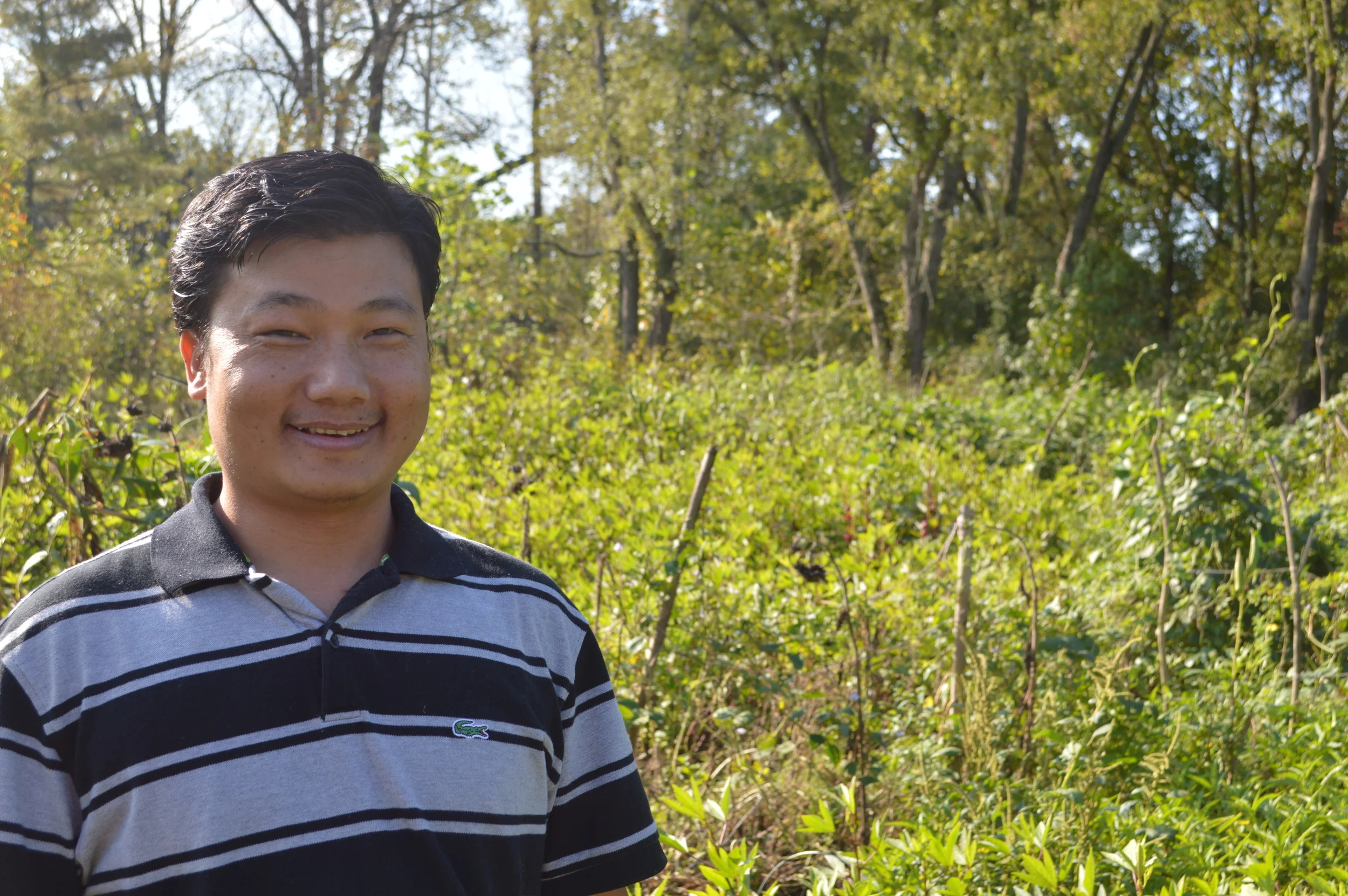
Hpong is from the Kachin state in Myanmar and he moved to the United States with his wife and two kids a year ago. He enjoys cooking a variety of dishes and he has many memories associated with this traditional Kachin recipe.
Hpong enjoys cooking the traditional Kachin recipe, Kachin Chet. He said that most Kachin people know how to make this dish and they make and eat it almost every day. He learned to make this dish by watching his parents and siblings cook it, and by cooking it with them. He said that the recipe was never written. It was passed down from generation to generation by showing others how to make it. This recipe is important to him because it has good flavor and is delicious and healthy.
The ingredients in this recipe are natural, meaning many come from the garden. Some items from this recipe that are grown in the garden are: chilies, garlic, and lemongrass. There are other ingredients that he has not been able to find in the United States so he has had to either modify the recipe or buy the ingredients elsewhere. He mentioned that he had to buy the light amber from Malaysia. Also, he was unable to find another ingredient that had a sour leaf, so he has had to replace that ingredient with a Roselle leaf, bamboo shoot, or lemongrass.
Hpong’s favorite meat to use in this dish is fish. When asked if he thinks pork is as good to use he said, “not as (good as) chicken, beef or fish, that’s good.” You can use any kind of fish-- small or big. He typically only uses river fish, but he says that you can also use fish from the sea.
When he lived in Myanmar, everyone in the village would have their own chicken, beef, and river fish and would cook them in their houses. They would then share them with each other. Sometimes they would buy the ingredients that they needed from the market. Now, living in the U.S., he buys the fish from the grocery store.
Hpong speaks of how the dish is also healthy for you, saying, “It’s kind of like medicine. It can prevent the stomach ache.” He said that the water he drank in Myanmar came directly from the ground and was dirty and that there was a lot of bacteria in each cup of water. He also mentioned how some foods are like a medicine, protecting you from getting sick, such as some beef and fruit. One ingredient in this recipe that has medicinal qualities is the cooked fish.
Hpong says that this dish is easy to make and that he will never forget how to make it. He enjoys serving it for guests when they come over for dinner. He still eats this dish just as often as he did when he lived in Myanmar.

Kachin Chet
This recipe has been passed down from generations by word of mouth and because of that there are not specific measurements for the ingredients.
- Meat: Fish, Pork, Beef, or Chicken.
- Sour leaf -- can use Roselle leaf or bamboo shoot
- Garlic flower
- Pepper
- Chili pepper
- Salt
- Sesame powder
- Water- 150ml
1. Place all ingredients in a large pot.
2. Place pot on stovetop over medium heat until all water is gone.
3. Serve hot.