
The Nashville Food Project’s Blog



Elevating Voices: Bridget Bryant
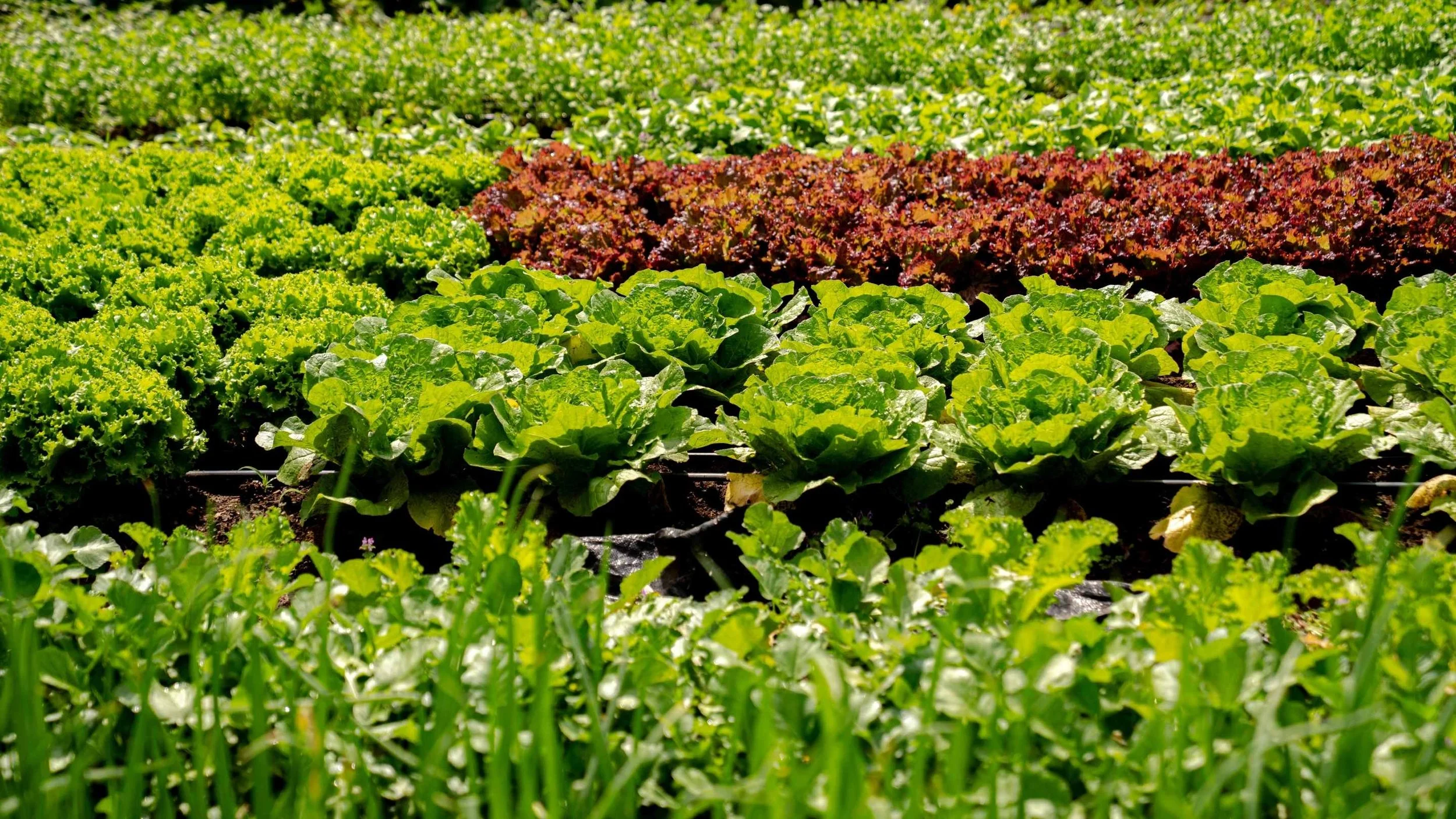
Through farming, she has been able to grow and share produce in ways that connect her more deeply to community. Food has opened doors. It has introduced her to people she might never have met otherwise. It has created opportunities to teach others about the importance of caring for the Earth with intention and respect.
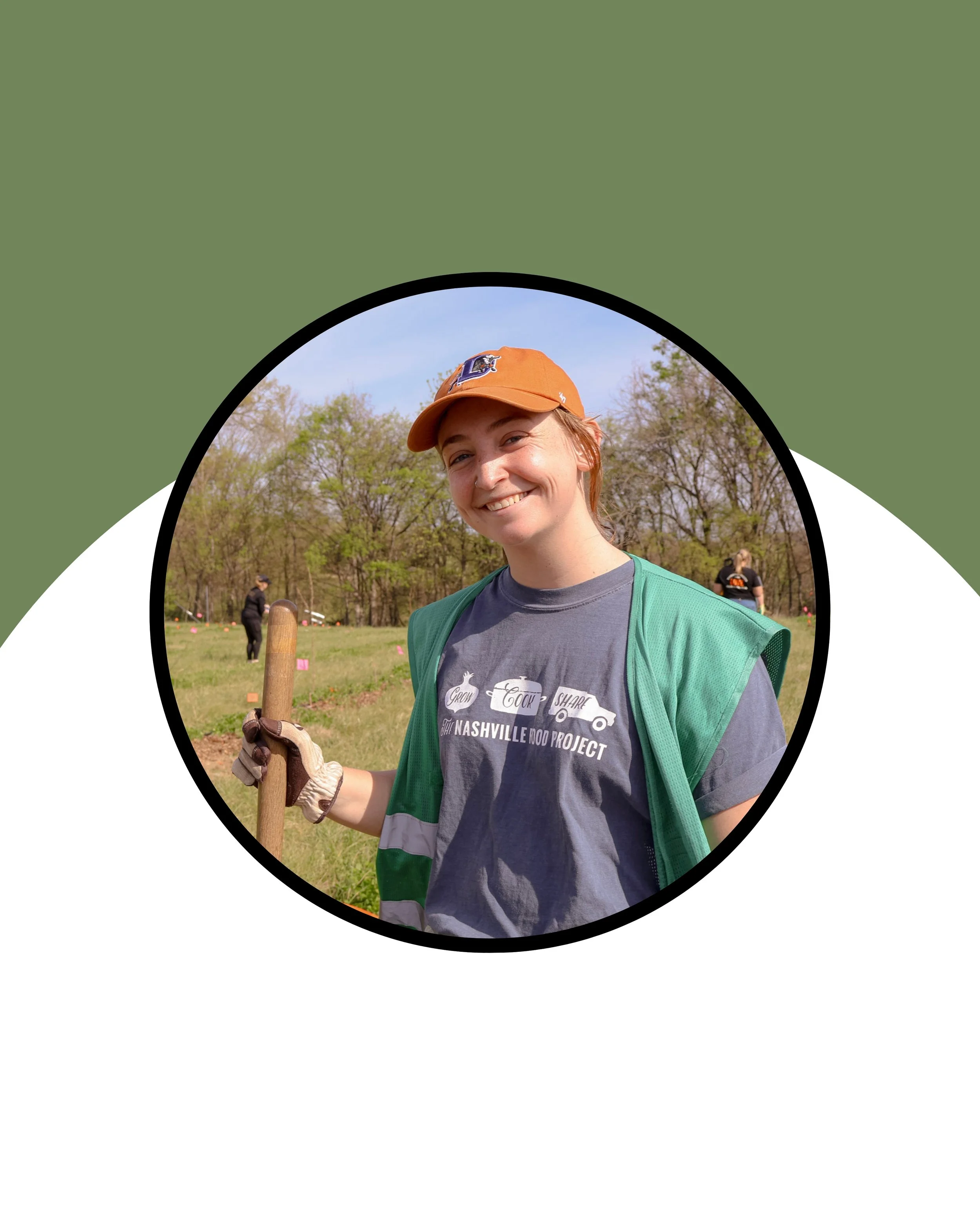
Bridget Bryant’s connection to The Nashville Food Project began at her son’s school.
The Nashville Food Project was there, inviting families to sign up for garden plots. Bridget added her name to the list. What began as a simple step into a shared garden space became something much deeper.
That relationship grew into a partnership. And that partnership helped her expand her work as a farmer.
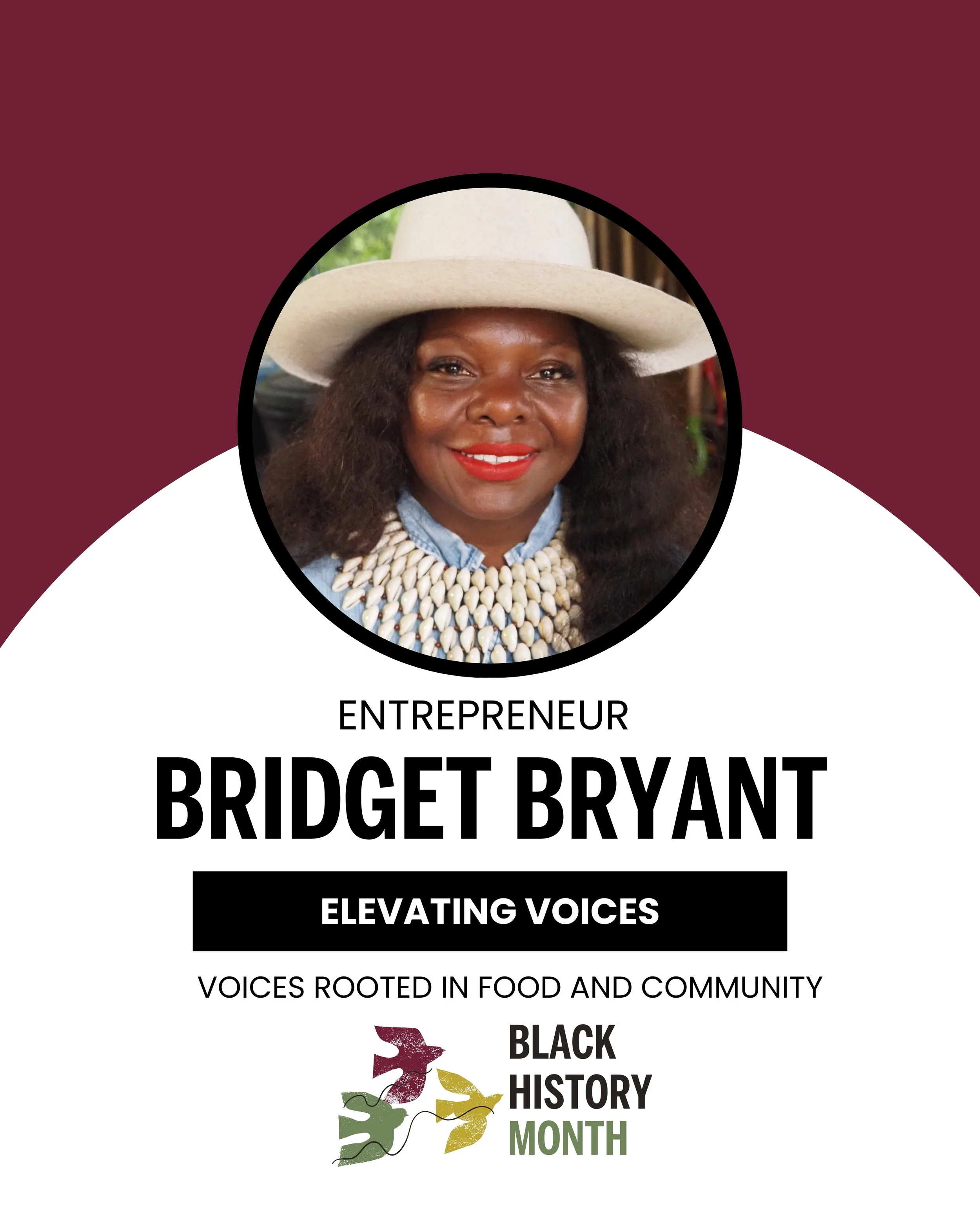
For Bridget, growing food is not just a business. It is alignment. It is calling. It is the work she was meant to do.
Through farming, she has been able to grow and share produce in ways that connect her more deeply to community. Food has opened doors. It has introduced her to people she might never have met otherwise. It has created opportunities to teach others about the importance of caring for the Earth with intention and respect.
Working with the soil, tending crops, harvesting what has been nurtured over time, she sees clearly that food is a bridge. It bonds people across difference. Regardless of background, belief, or circumstance, everyone shares one thing in common: we all eat.
That shared need creates shared ground.
Bridget carries her family with her in this work. Her grandparents, Ollie Hardaway, Mary Hardaway, Early and Frankie Bryant. Her parents, Eddie and Glenda Bryant. Her best friend, Lisa Hinton. Her brother, Edward Bryant. Their legacy of resilience and care lives in the way she shows up to her farm and her community.
She believes in representing herself fully through her work. The way she grows. The way she shares. The way she teaches. It is all an extension of who she is.
For Bridget, working with the Earth is not simply an occupation. It is vocation.
And through that calling, she is helping cultivate a community where food connects us, grounds us, and reminds us that we belong to one another.
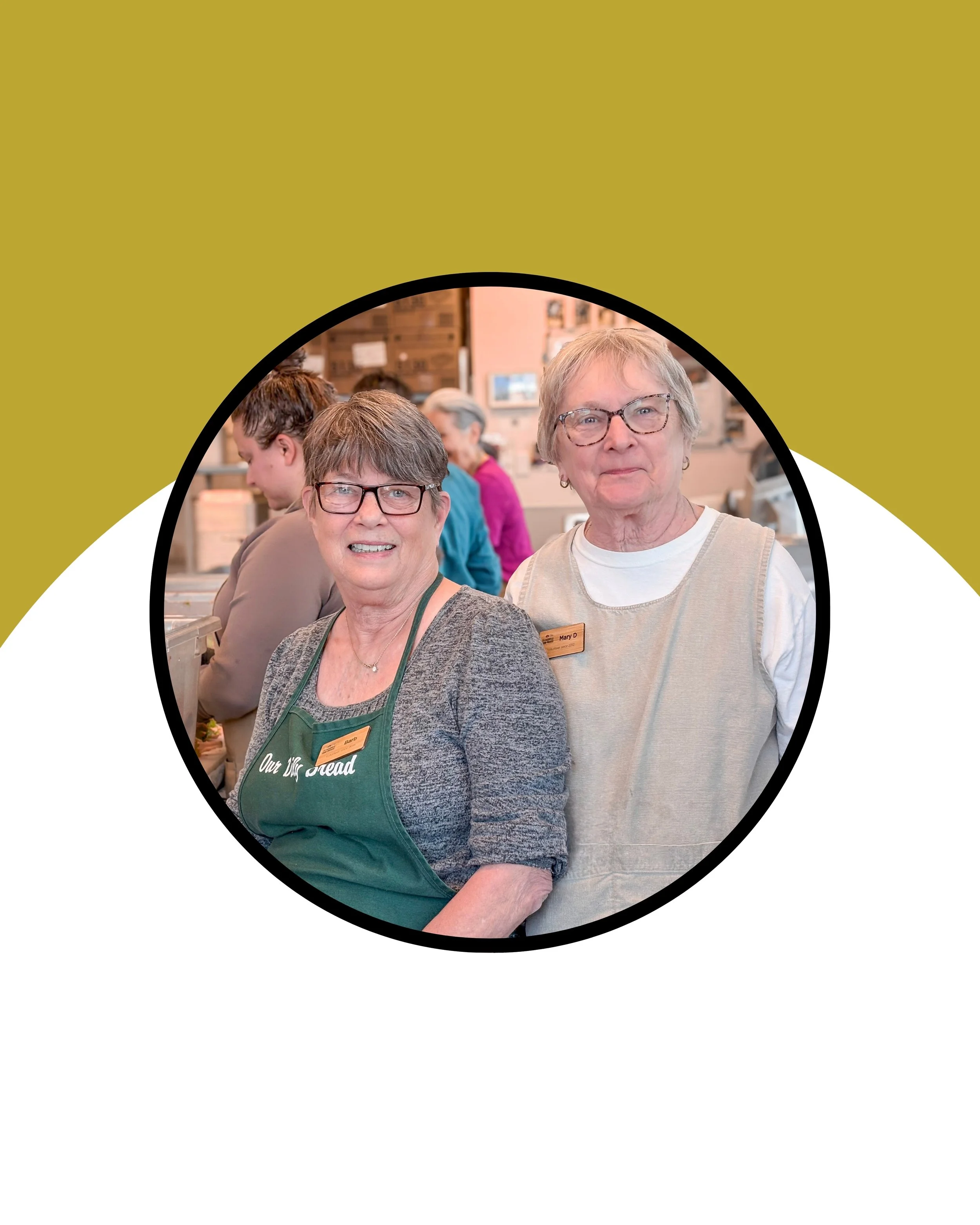
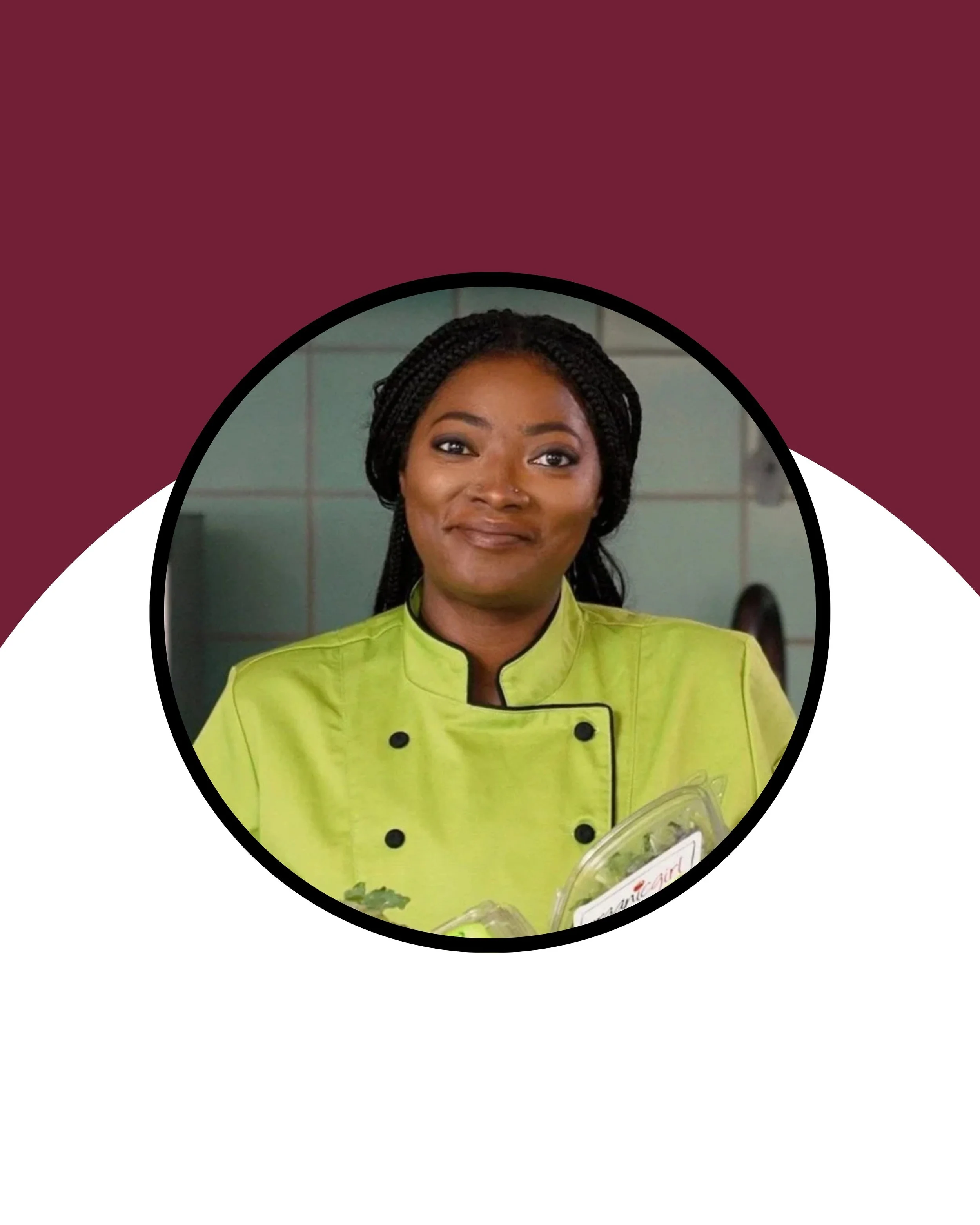
Elevating Voices: Bianca Morton
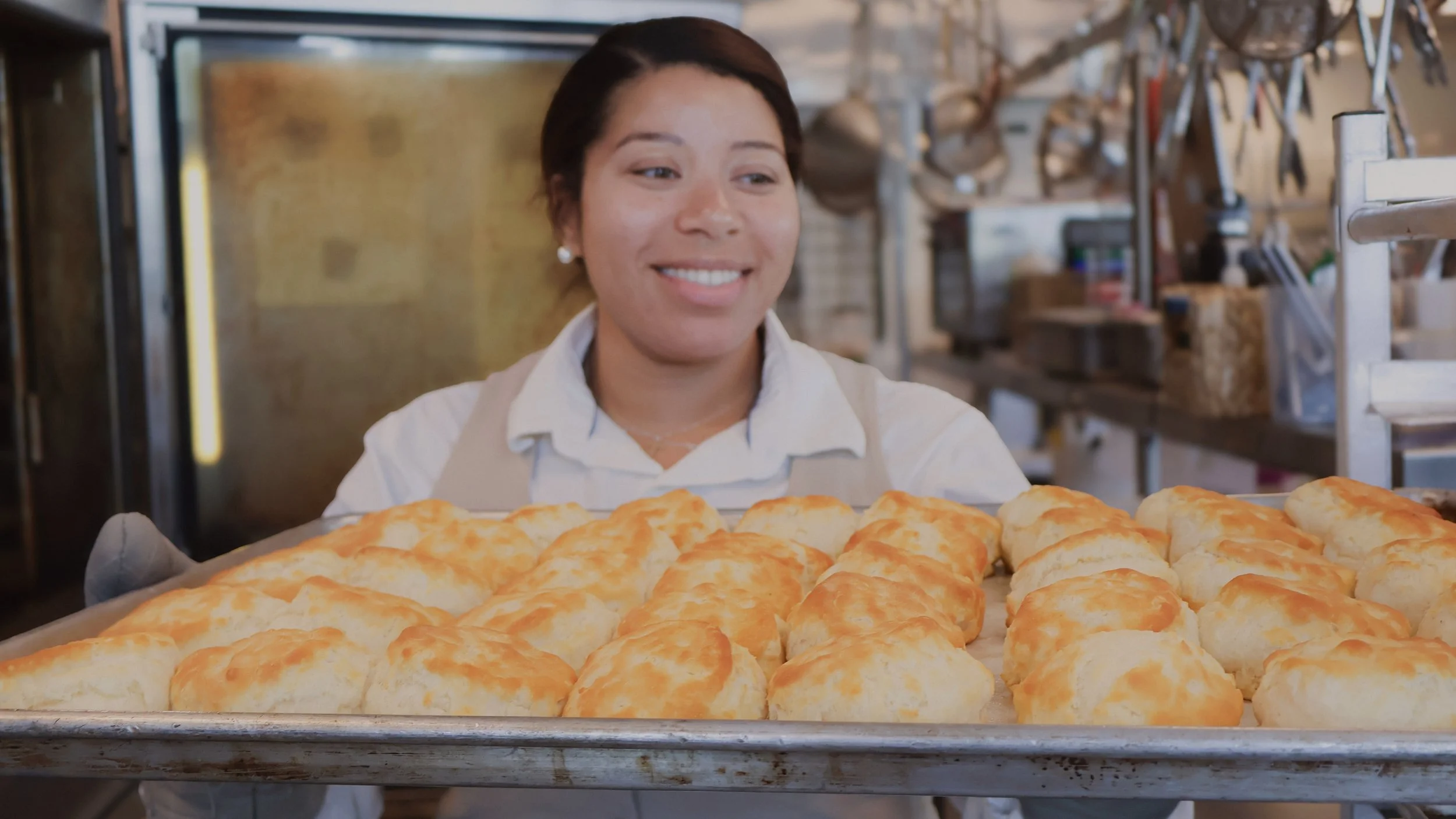
Food, for Bianca, has always been a connector. A way to show care. A way to build community. A way to express love when words fall short. Her life has been shaped by faith, purpose, and a deep belief that what we make with our hands can change what happens in the world.
Almost eight years ago, Bianca Morton was searching for work that felt purposeful.
As a chef, she had always loved food. But love alone was not enough. She was looking for mission. For meaning. For a place where food could be more than craft.
At The Nashville Food Project, she found it.
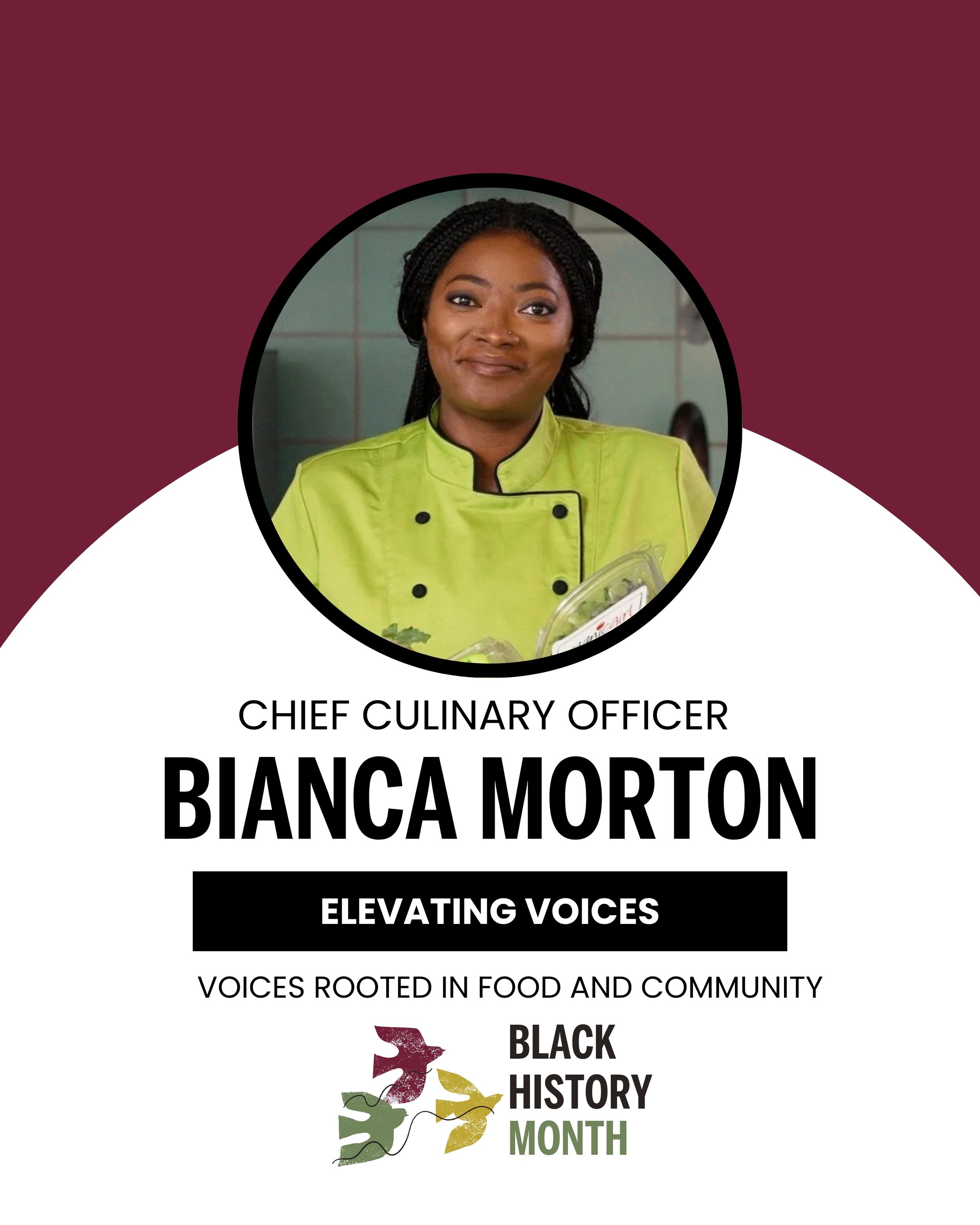
Food, for Bianca, has always been a connector. A way to show care. A way to build community. A way to express love when words fall short. Her life has been shaped by faith, purpose, and a deep belief that what we make with our hands can change what happens in the world.
She often speaks of “each one, teach one.” It is not simply a phrase. It is a way of living.
As a young person, Bianca was not exposed to the kinds of dishes she now curates and stewards. But she was formed by something more foundational: the act of breaking bread. Around her family’s table, she learned that food was not performance. It was presence. It was culture made visible. It was love made tangible.
Through her work, Bianca has built relationships with a network of neighbors she never imagined possible. She has supported individuals navigating barriers and helped create pathways into culinary skills through internships, volunteer experiences, food demonstrations, and hands-on training. Representation matters, she says. And in the kitchen, that representation becomes empowerment.
Food is not only nourishment. It is access. It is skill-building. It is dignity.
Bianca also shares openly about her own journey. Diagnosed with clinical depression in high school, she turned to food as a way to manage her emotions. At the time, she did not yet understand what that instinct meant. Now she sees it clearly. Food was not simply escape. It was medicine. It was a catalyst for healing and a pathway toward a healthier life.
That understanding shapes how she leads today.
Whether stewarding large-scale meal production or mentoring someone in their first culinary experience, Bianca approaches the kitchen as a space of care. A space where skill and compassion meet. A space where legacy is formed.
She speaks often of her grandfather. Of yeast rolls rising in the kitchen. Of recipes passed down not only as ingredients and measurements, but as memory and mission. She sees echoes of that same spirit in the founding vision of Tallu Schuyler Quinn: that food, shared with intention, can knit a community together.
For Bianca, this work is about the legacy of tomorrow.
It is about ensuring that the next generation experiences not only access to good food, but the power that comes from learning to prepare it, share it, and steward it well. It is about cultivating kitchens that do more than produce meals. They produce confidence. Connection. Care.
In every tray prepared, every intern mentored, every volunteer guided, Bianca is doing what she has always done.
She is breaking bread.
And in doing so, she is building a community where food is not simply eaten. It is shared as an expression of hope.
At The Table, Episode 1
This series is an invitation to slow down and pay attention. To notice what is showing up in our kitchens, our gardens, and our city. To reflect on how the simple, daily acts of growing, cooking, and sharing food are building community across Nashville.
Each month, you will hear directly from staff members about what they are seeing in their day-to-day work. What is shifting. What is needed. Where hope is emerging. And how you can join us in cultivating food security that is steady, relational, and rooted in care.
This month, we sat down with Maggie, our Volunteer Engagement Manager, and Brad, one of our Meals Coordinators.
What We Are Seeing
As the new year begins, we are already seeing an influx of support from volunteers and partners across the city. That encouragement matters. Community food security is not built alone. It is built together.
On the kitchen side, Brad shared that we are paying close attention to our dry storage. Pantry staples like oil, pasta, and rice remain essential to the meals we prepare each week. These foundational ingredients allow us to respond flexibly and consistently as needs shift.
Behind the scenes, we are also refining our donation sorting process to preserve more food on the front end. This helps us increase kitchen capacity and steward ingredients with greater care before they move into meal preparation. Thoughtful systems allow us to scale without sacrificing quality.
Partnership in Action
Maggie highlighted the strength of our long-standing partnerships with organizations on the front lines, including Open Table Nashville and Trinity Community Commons.
Recently, a group of dedicated volunteers fired up the smoker and prepared Hawaiian ribs served over pineapple rice. These meals were individually portioned and shared specifically with Open Table Nashville.
Moments like this remind us that hospitality is both practical and creative. It is planning and partnership. It is smoked ribs and rice. It is listening to what a partner needs and responding with care.
An Invitation
At the Table is not only about what we are doing. It is about who we are doing it with.
If you are already volunteering, giving, or partnering with us, thank you. Your presence strengthens this work.
If you are new and curious about how to get involved, we invite you to explore our upcoming events and volunteer opportunities on our website. Whether in the kitchen, in the gardens, or through financial support, there is a place for you here.
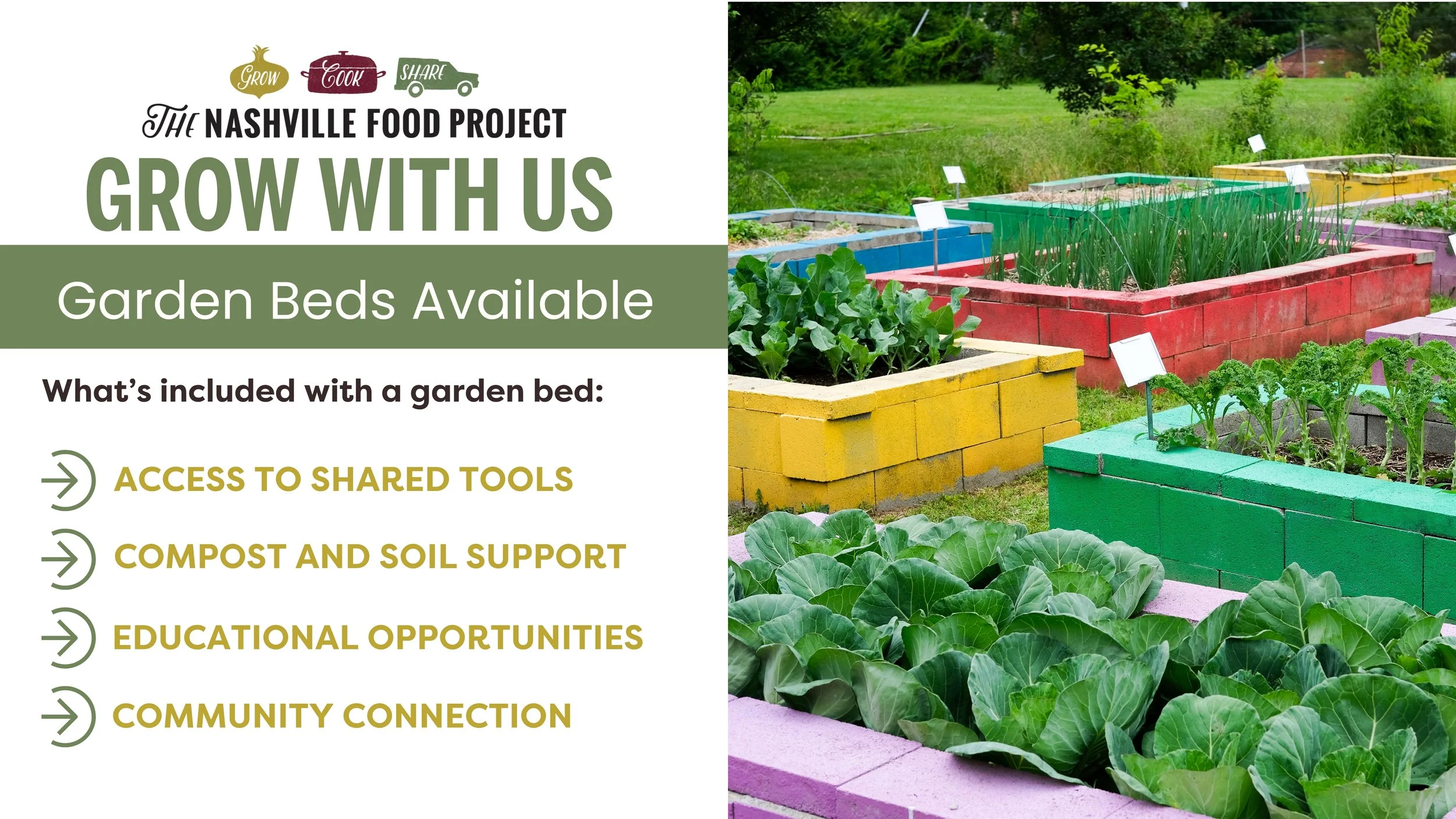
Grow With Us: Community Garden Beds Now Available
At The Nashville Food Project, growing food is about more than what ends up on the plate. It’s about stewardship, shared learning, and the relationships that form when neighbors come together around the land.
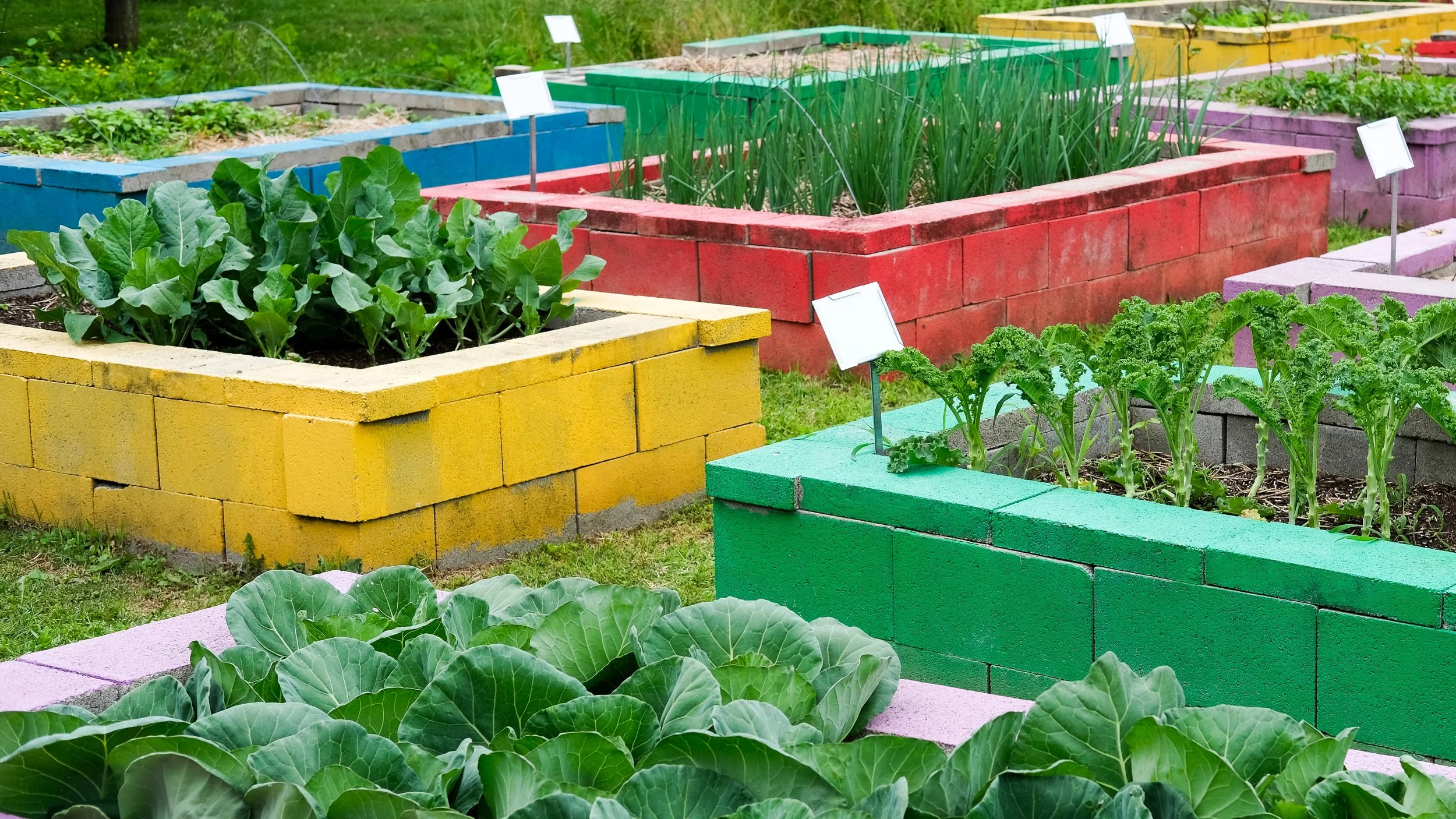
We’re excited to share that community garden beds are now available at McGruder Community Garden and Mill Ridge Community Farm for the upcoming season. These spaces are open to individuals and families who want to grow fresh food while being part of a supportive, connected gardening community.
Our community garden beds offer more than a place to plant. Gardeners receive access to shared tools, compost and soil support, educational opportunities throughout the season, and connection with other neighbors who are growing alongside them. Whether you’re a seasoned gardener or just getting started, these gardens are designed to meet people where they are.
At The Nashville Food Project, we believe growing food together strengthens both individual wellbeing and collective care. Our gardens are places where questions are welcome, learning is shared, and relationships deepen over time.
Garden beds are limited and available on a first-come basis. We encourage anyone interested in growing with us this season to register early to reserve a space.
What’s Included with a Garden Bed
Access to shared tools
Compost and soil support
Educational opportunities throughout the season
Community connection and shared learning
Garden Locations
Plots available: 500 square foot in-ground plots
Address: 12944 Old Hickory Blvd Antioch, TN 37013
Plots available: 4x8' raised garden beds
Address: 2013 25th Ave N Nashville, TN 37208
How to Register
Please fill out the application below.
Garden beds are limited, and spaces will be filled as registrations are received.
If you have questions about community gardens or the registration process, please reach out to gardens@thenashvillefoodproject.org.
We’re looking forward to another season of growing together and welcoming neighbors into these shared spaces.
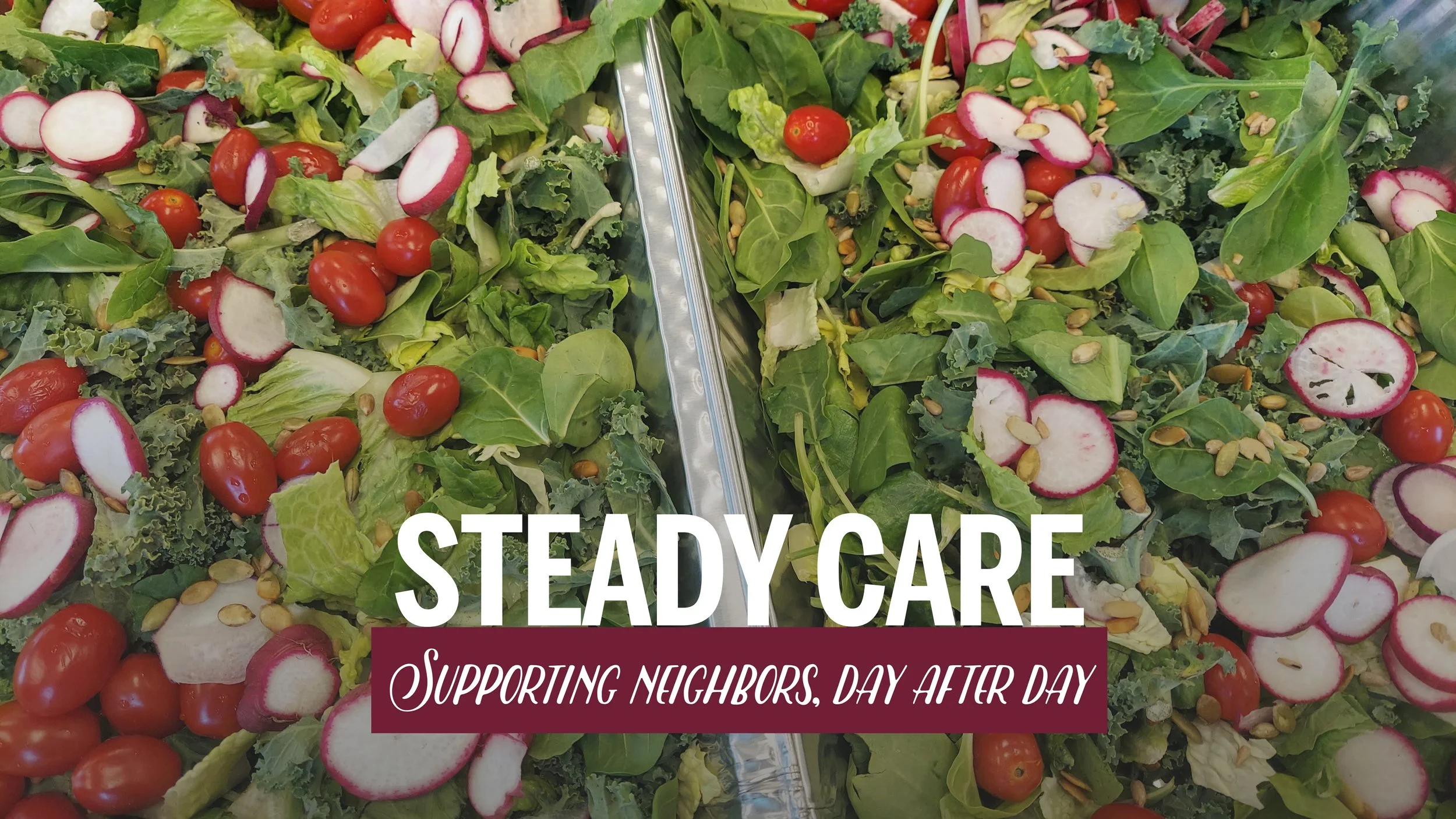
Steady Care
Care is rarely dramatic.
More often, it is steady. It looks like meals prepared on schedule. Routes driven again. Kitchens opened on cold mornings. Volunteers returning, not for recognition, but because someone is counting on them.
For many of our neighbors, especially seniors and those who rely on regular meals, care is not an occasional kindness. It is a necessity shaped by consistency. Hunger does not pause for weather or calendars. Nourishment must remain reliable if it is to be dignified.
For us, care takes the form of rhythm. Food is grown, recovered, prepared, and shared not only in moments of urgency, but day after day. Seniors living on fixed incomes. Neighbors managing chronic illness. People navigating isolation. For them, a steady meal is more than food. It is reassurance. It is stability. It is the quiet knowledge that someone remembered.
This kind of care is built over time. Through repetition. Through trust earned slowly. Through systems designed to endure and people willing to carry responsibility together. It is not flashy work. But it is faithful work.
We often measure impact in numbers, and those numbers matter. But the deeper story of care lives in consistency. In the volunteer who learns a delivery route by heart. In the cook who prepares each meal with the same attention, whether the room is full or nearly empty. In the neighbor who opens their door each week knowing that care will arrive as promised.
Caring community is not built only in moments of crisis. It is built through reliability. Through showing up even when it is cold. Especially then.
This is how nourishment becomes human. Not as charity, but as relationship. Not as a one time response, but as a shared practice. Some neighbors depend on this work, and that dependence is not a failure. It is a reflection of our shared life together.
As this work continues, we remain grateful for everyone who makes steady care possible. The volunteers who return. The partners who remain committed. The supporters who understand that consistency is its own form of generosity.
Supporting neighbors day after day is how caring community takes shape.
Supporting neighbors, day after day
Steady care
Get involved:
Volunteer | Give Food | Donate
Winter Storm Fern Resources
Many of our Nashville neighbors continue to navigate the impacts of Winter Storm Fern. In moments like this, access to clear, reliable information matters. Below are trusted local resources to help neighbors stay safe, warm, and supported as recovery continues.
Last updated on January 31, 2026
COMPILED RESOURCES:
Food & Nutrition
2-1-1 RESOURCE CONNECTION
United Way provides 2-1-1 as a vital community service to help you connect to the resources you need. Specialists are available Monday through Friday, 8:00 am – 5:00 pm CST.
•••
WARM MEALS BY MADISON COMMUNITY CO-OP
OPEN DAILY | 752 MADISON SQUARE MADISON, TN 37115
11:00 am - Warm breakfast and the community space is open with family friendly activities
1:00 pm - Warm lunch and resources
5:30 pm - 8:00 pm - Warm dinner *7:00 pm
Shuttle will pickup at bring people to the shelter
•••
Mobile Pantry by by One Generation Away
Centennial High School | 5050 Mallory Ln
Saturday, January 31 | Distribution begins around 8:45 a.m.
Note: This distribution includes fresh produce and shelf-stable dry goods. Warm meals are not available at this site.
Life & Safety
Medical Support
If you or someone with you is experiencing a medical emergency, please call 911 or go to the nearest emergency room.
For non-urgent medical needs, you may contact the Matthew Walker Comprehensive Health Center to speak with an on-call physician: 615-327-9400
•••
Transportation to Warming Stations
Call 615-401-1712
When calling, please be ready to share your name, location, number of people needing transportation, mobility needs, and whether you have pets.
•••
Transportation to Emergency Shelters
Call 615-844-3399
This line provides access to emergency shelter transportation, including Nashville Rescue Mission, Room In The Inn, and overflow shelter locations.
•••
Warming shelters
They are available in Davidson, Dickson, Hickman, Montgomery, Robertson, and Williamson Counties.
Travel & Cleanup
Road Conditions
For the most up-to-date information on road closures and driving conditions across Tennessee, visit Tennessee Department of Transportation SmartWay.
Please use caution when traveling and avoid unnecessary trips when possible.
•••
Power Outages in Davidson County
If you are experiencing a power outage or need updated information, contact Nashville Electric Service.
Report an outage by phone: 615-234-0000 (available 24/7)
Text “OUT” to 637797 (NESPWR)
View outage maps and updates: nespower.com
If you see a downed power line, please stay away and call 911 immediately. Even lines that appear inactive can be dangerous.
•••
Property cleanup assistance
The Crisis Cleanup Hotline connects residents with volunteer groups who may be able to help with storm-related cleanup.
Crisis Cleanup Hotline: 844-965-1386
Available through February 13th.
Recovery & Support
Replacement SNAP benefits
Neighbors who lost food due to power outages may be eligible for replacement SNAP benefits through the Tennessee Department of Human Services.
•••
HOTEL DISCOUNTS FOR RESIDENTS
Nashville Convention and Visitors Corp and local hospitality partners are offering discounted lodging for residents displaced by the storm. Rates typically range from $70–$200 and require proof of residency.
•••
Caring for One Another
Extreme weather reminds us how interconnected we are. If you are able, consider checking in on neighbors nearby, especially those who may have limited mobility, rely on refrigerated medications, or face barriers to staying warm and nourished.
We encourage partners, volunteers, and community members to share these resources with anyone who may need them. Care and safety matter deeply in moments like this, and small acts of attention can make a meaningful difference.
Our hearts are with our neighbors as the city recovers. We look forward to resuming our work as soon as conditions allow, and we remain grateful for the community that continues to show up for one another.
Please stay tuned for additional updates.
Anatomy of a Meal
Have you ever wondered what it takes to place a hot, nourishing meal in a neighbor’s hands? For us, a meal does not begin in the kitchen. It begins much earlier.
What follows is a careful, collective process shaped by stewardship, skill, and care. It is the work of turning surplus into nourishment, and nourishment into connection.
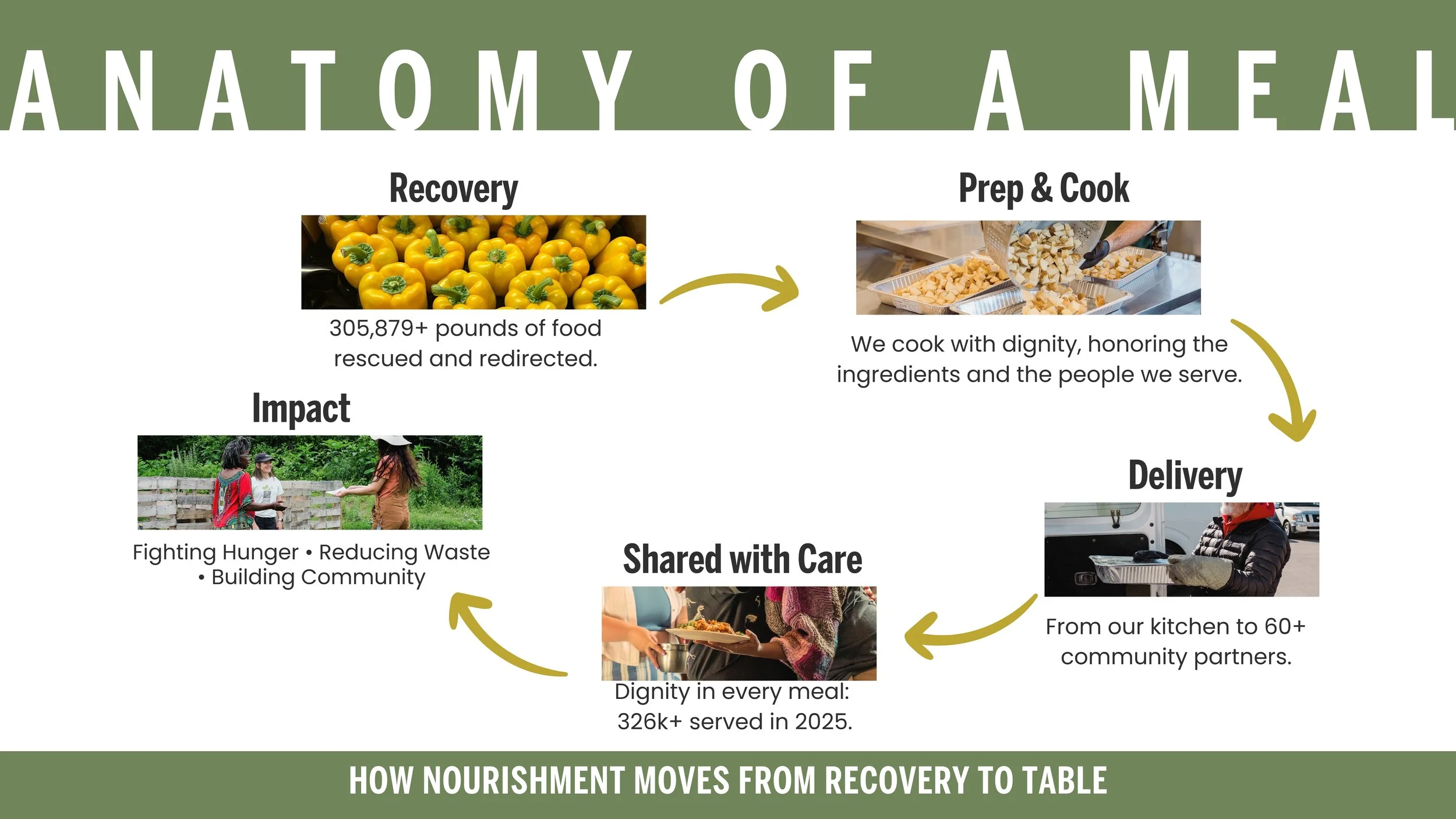
Recovery
The first step is recovery. Across Nashville, food that is still fresh and abundant is often left without a destination. We work alongside grocers, farmers, markets, restaurants, and individuals to recover food that would otherwise go to waste. This is not about scraps or leftovers. It is about recognizing the value of food that has already been grown, harvested, and prepared with care.
Recovering food is an act of responsibility. It acknowledges that hunger and waste exist side by side, and that abundance can be redirected toward justice when we choose to act.
Prep and Cook
Once recovered, food moves into our kitchens. Here, volunteers, cooks, and staff prepare meals from scratch, guided by skill and intention. Vegetables are washed and chopped. Recipes are tested and refined. Meals are prepared with the understanding that the people who will receive them deserve food that is nourishing, thoughtful, and well made.
Cooking is where transformation becomes visible. Ingredients become meals. Surplus becomes sustenance. And strangers become neighbors through shared effort.
Delivery
Meals do not remain in our kitchens. They travel outward, carried by partnerships and logistics that make access possible. Through coordination with nonprofit partners across the city, meals are delivered to places where they can be shared with care and dignity.
Delivery is not simply about transportation. It is about trust. It depends on relationships built over time and a shared commitment to meeting people where they are.
Shared with Care
The final step happens around tables, in community spaces, and through organizations doing vital work across Nashville. Meals are served alongside programs that support children, seniors, immigrants, and unhoused neighbors. In these moments, food becomes more than nutrition. It becomes an expression of hospitality and belonging.
A meal shared with care communicates something essential. You matter. You are welcome. You are not alone.
Impact
Every meal tells a larger story. It is a story of hunger addressed and waste reduced. It is a story of volunteers showing up, partners collaborating, and systems working together in service of the common good.
This work fights hunger by increasing access to consistent nourishment. It reduces waste by honoring the value of food already grown. And it builds community by creating spaces where people come together around a shared table.
Be Part of the Journey
The anatomy of a meal is a collective effort. It relies on people who believe that good food should not be wasted and that neighbors deserve to be nourished with dignity.
If you want to be part of this transformation, there are many ways to get involved. Whether through volunteering, donating food, or offering financial support, your participation helps keep this cycle of care moving forward.
Together, we turn what might be thrown away into meals that strengthen our community, one plate at a time.
Steady Care on the Ground: Community Mapping in North Nashville
Care shows up where people pay attention.
In North Nashville, the ordinary work of getting through the day often carries extra weight. A walk to the bus stop. A trip to the grocery store. A short stretch of sidewalk. Broken pavement, missing curb ramps, and poorly maintained bus stops shape how neighbors move and whether food, services, and community spaces are truly within reach.
For the people who live here, none of this is a surprise. Neighbors know where the gaps are. They know what is broken. They know which places feel safe and which do not. What is often missing is a way for that knowledge to be seen, recorded, and taken seriously when decisions are made about transportation, safety, and access.
This is where community mapping matters.
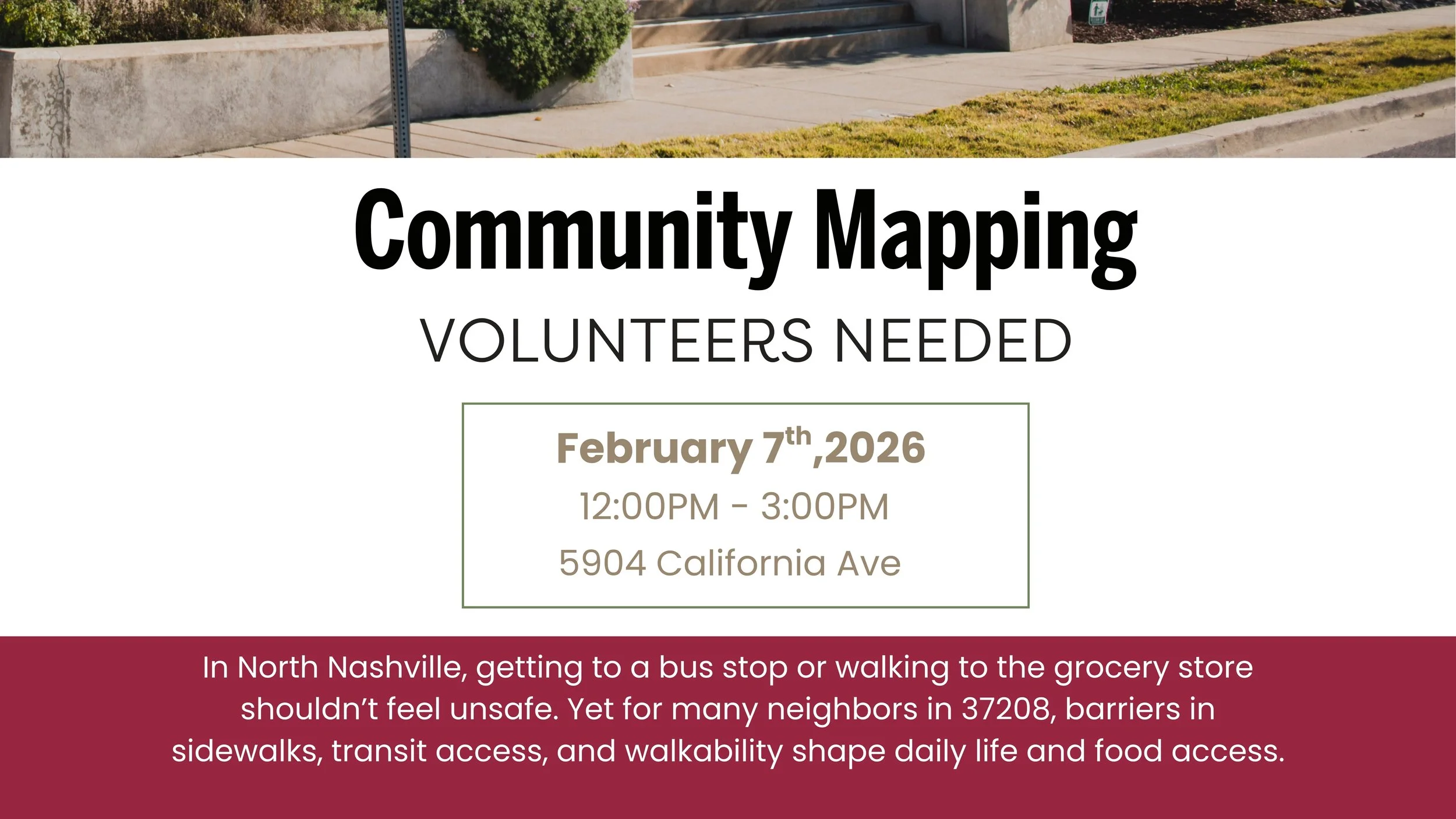
On Saturday, February 7, we will gather volunteers in North Nashville to serve as Community Mappers. Together, we will walk through ZIP code 37208, documenting sidewalk conditions, bus stop safety, and walkability. This work helps ensure that conversations about food access and transportation begin with lived experience rather than assumption.
Community mapping is a form of care. It is an act of attention. By walking alongside neighbors and recording what is already known on the ground, we help make visible the conditions that shape daily life. The information gathered will become resident verified data that can support advocacy with WeGo Public Transit and Metro Nashville, strengthening efforts to improve sidewalk safety, transit access, and food justice.
Reliable meals depend on reliable pathways. For seniors, families, and neighbors who rely on public transportation, safety and accessibility are part of nourishment itself. Food access cannot be separated from the systems that determine how people move through their community.
No technical experience is required. Volunteers are asked to wear comfortable walking shoes, dress for the weather, and be prepared to spend most of the time outdoors. The work is simple. Its impact lasts.
As we focus this month on Building a Caring Community, this event reflects what care looks like in practice. Showing up. Paying attention. Standing with neighbors. Doing the quiet work that makes shared life more possible.
If you are interested in becoming a Community Mapper and helping build safer, more accessible pathways in North Nashville, we invite you to join us.
Community Mapping Event
Saturday, February 7, 2026
12:00 to 3:00 PM CST
Starting at The Nashville Food Project: 5904 California Avenue, Nashville, TN 37209, US
Together, we can help ensure that care extends beyond the plate and into the pathways that shape daily life.
Beginning the Year Together
January offers a moment to pause and reflect on what we have built together.
At its core, food justice is a commitment to consistent access to nourishing food. Not only in moments of crisis, but every day. It asks us to look beyond emergency response and toward the systems that shape how food moves through a city, and who is able to access it.
In Nashville, food access is shaped by income, transportation, and geography. Some neighborhoods are close to grocery stores and fresh food outlets. Others face longer distances, limited transit options, or higher food costs. Over time, these differences affect health, stability, and dignity.
Over the past 15 years, our community responded together. Through food recovery, gardening, cooking, and partnerships, surplus food was redirected. Fresh produce was grown and shared. Meals were prepared with care and offered in collaboration with organizations across the city. This work reflects more than distribution. It reflects shared responsibility.
Food justice recognizes that hunger is not simply about a lack of food. It is about access, infrastructure, and the choices communities make to care for one another. When we invest in long-term solutions, we strengthen not only individual well-being, but the health of the entire community.
As we begin a new year, we do so grounded in what we have already accomplished and attentive to what is still possible. There is more to grow, more to learn, and more to build together.
Stay connected. Step into the year with us.
Building Inspired Community
The beginning of a year invites reflection. Not only on what lies ahead, but on what has already been built.
We start each new season grounded in memory, grateful for the work carried out by many hands, and attentive to the ways that shared effort becomes shared life.
Last year, we grew more than food. We grew relationships across gardens and kitchens, partnerships across neighborhoods, and trust across tables where strangers became neighbors. Together, we stewarded land, recovered food that might otherwise have gone to waste, prepared meals with care, and shared nourishment with dignity. These acts may seem ordinary on their own, but together they formed something meaningful. They formed community.
What we built together was not simply a response to need. It was a practice. A commitment to showing up consistently. To believing that food can be a tool for justice, connection, and belonging. To trusting that when people gather around shared work and shared meals, something larger than any one of us takes shape.
As we step into a new year, we do so inspired by that shared impact. The gardens will rest and then awaken again. Kitchens will continue to hum with quiet purpose. Volunteers will return, new faces will join, and partnerships will deepen. The work ahead is not separate from the work behind us. It grows directly from it.
The year ahead asks the same simple and demanding question it always has: how will we care for one another?
Our answer remains rooted in the daily practice of growing, cooking, and sharing food in community. We will keep learning. We will keep listening. We will keep building a food system that reflects abundance rather than scarcity, relationship rather than isolation.
This work is never finished, but it is always worth doing. And it is never done alone.
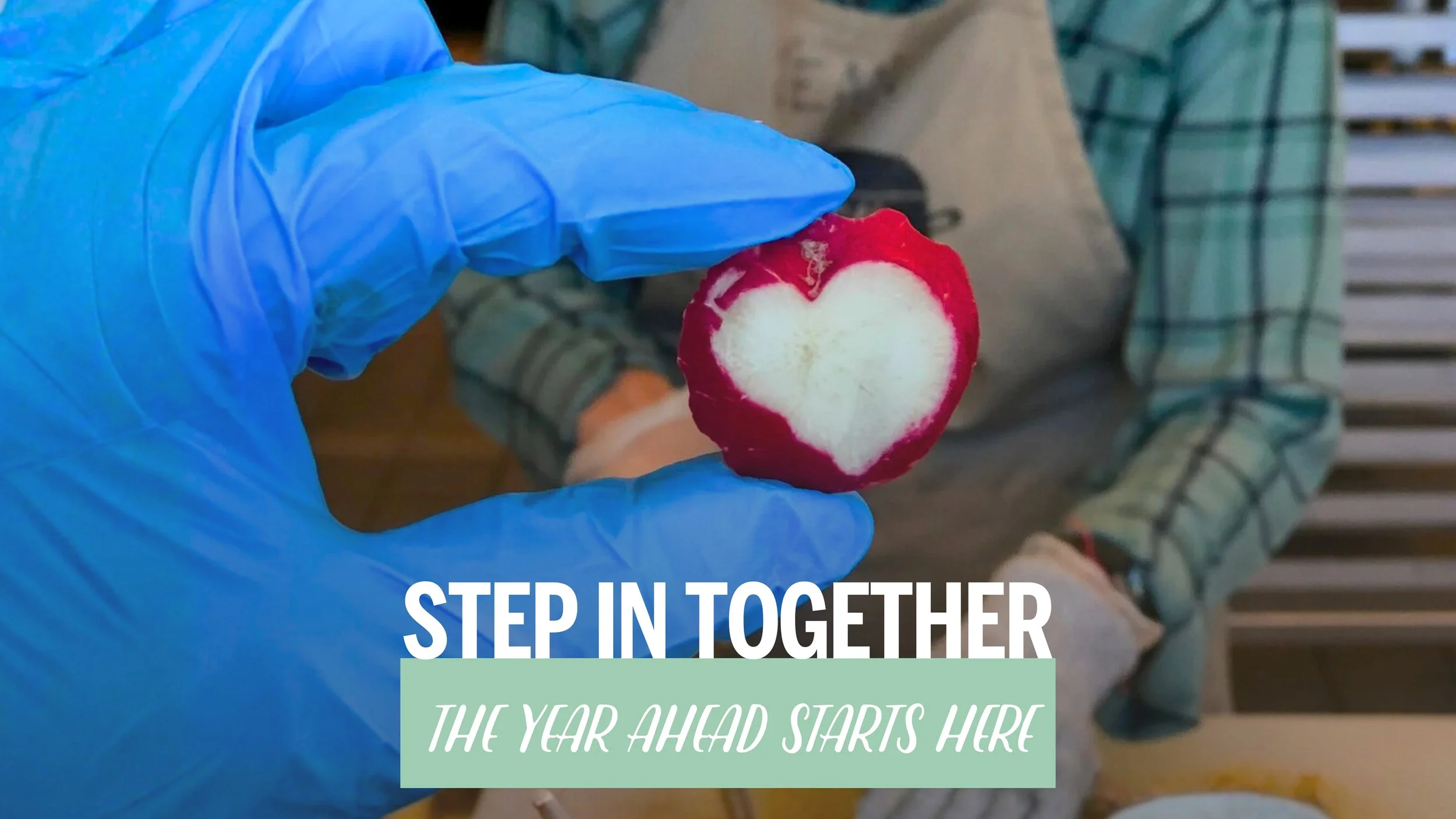
The year ahead starts here.
Step in together.
Get involved:
Volunteer | Give Food | Donate
Hands in the soil, heart in the community
Since May 2025, Mary Jess Holt has offered more than 200 hours of her time volunteering. In that time, she has tended both the soil and the shared life that grows around it. You might find her at the South End United Methodist Garden, hands deep in cucumber vines, or in our main kitchen, helping transform recovered food into nourishing meals. Wherever she is, Mary Jess brings curiosity, warmth, and a genuine desire to learn.
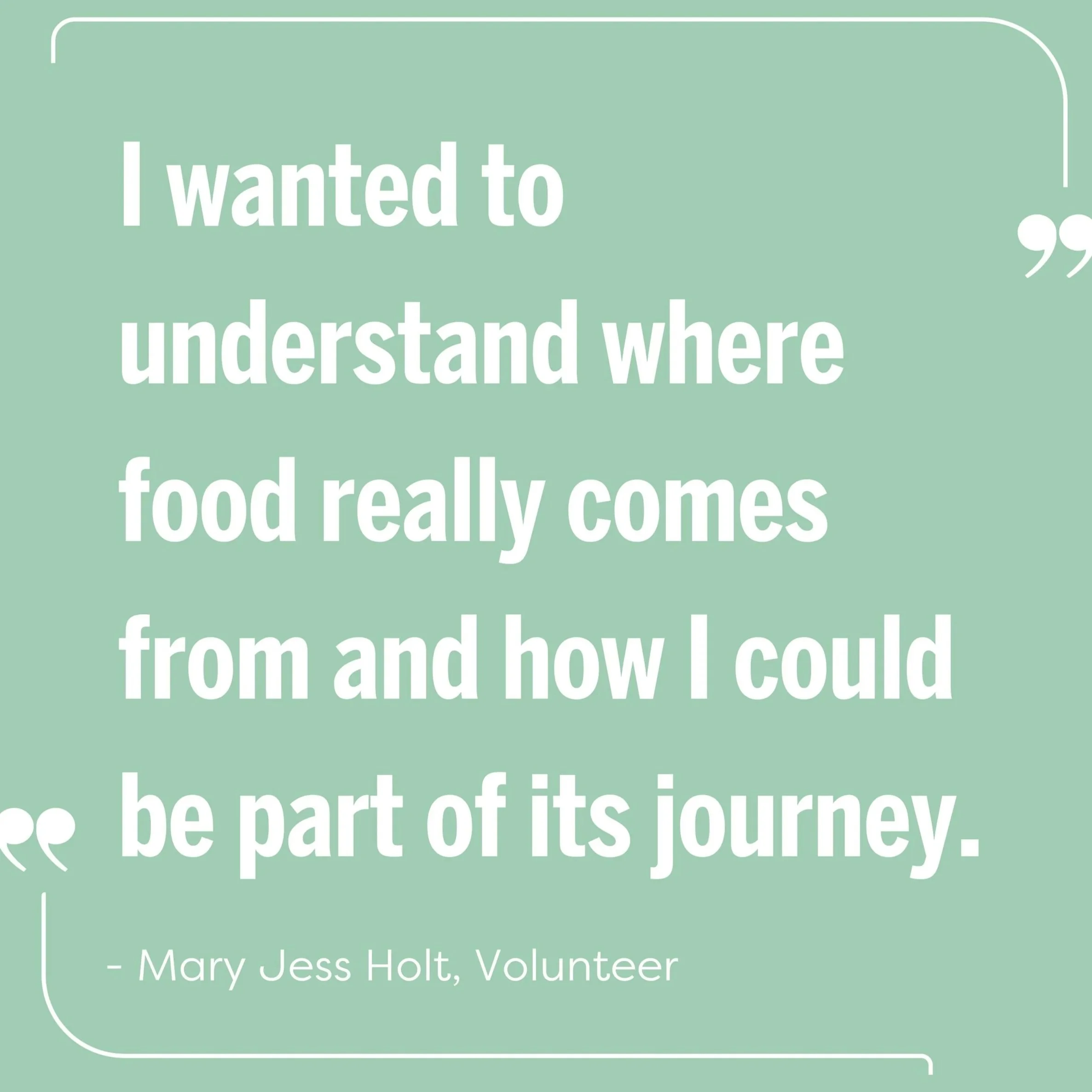
A student at Belmont University majoring in Economics and Chinese, Mary Jess first encountered our work through her church, where she once taught one of our founder Tallu Schuyler Quinn’s children in Sunday School. When she began thinking about how to spend her summer with intention, she remembered the stories her parents had shared about our work and decided to step into it herself. “I wanted to understand where food really comes from,” she said, “and how I could be part of its journey.”
Over 200 hours
offered in service to community since May 2025.
That curiosity carried her from garden to kitchen. At the South End United Methodist Garden, Mary Jess worked alongside long-time volunteers and growers like Joe Bowman and Linda Bodfish, asking thoughtful questions about why each practice mattered and what helped the garden thrive. Ann Cover, who has led the site for more than fourteen years, watched her grow into a confident presence. “Mary Jess became a skilled volunteer,” Ann shared. “She could teach others how to pick green beans or manage the cucumber vines. She often took on ‘cucumber rounds’ with good humor. Not everyone loved that task, but she made it her own.”
The garden was often filled with laughter. Joe Bowman would tease her by saying, “When you are in your thirties, you will start a garden.” She would laugh along, though it was clear to everyone that he might be right. Even after her semester began, she returned on October 1 simply because, as she put it, “I just missed the garden.”
What Mary Jess values most is seeing how small acts of care accumulate. Planting, watering, weeding, and harvesting are not isolated tasks. They are part of a larger movement that carries food from soil to table across the city. “It is inspiring,” she said, “to see how people show up with such consistency and conviction, in both the gardens and the kitchens.”
Whether she is harvesting heirloom tomatoes, sharing produce with neighbors, or searching for the last cucumber hidden among scratchy vines, Mary Jess embodies the values that guide this work. Stewardship. Hospitality. Transformation. She reminds us that community grows slowly, one faithful act at a time, and that tending the earth and one another is work that is both humble and deeply meaningful.
Thank you, Mary Jess, for your steady presence, your curiosity, and the quiet care you bring to every space you enter.
December's Seasonal Bounty: A Feast for the Senses
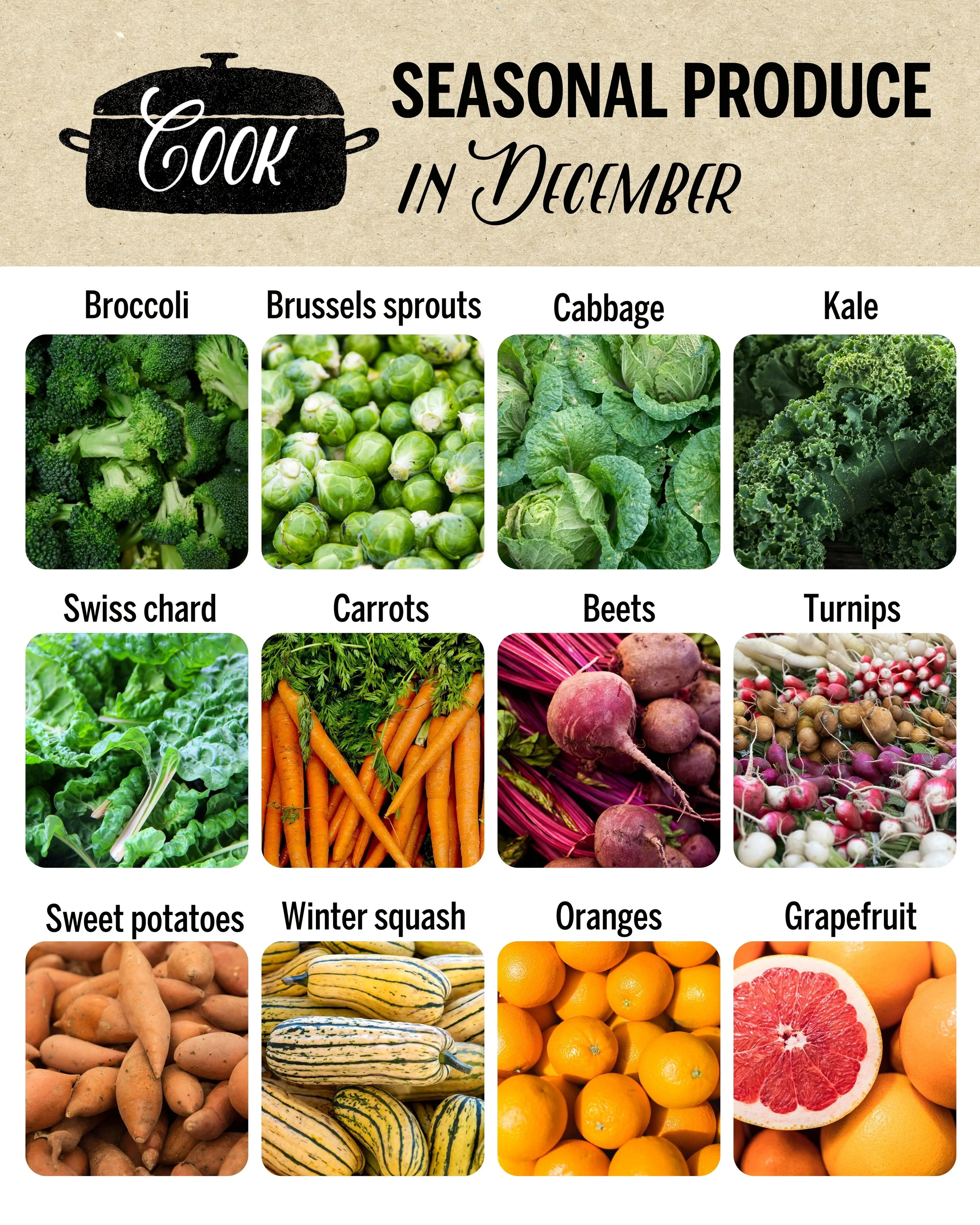
As the year draws to a close, December brings a generous offering of seasonal produce. These fruits and vegetables remind us that nourishment begins long before a meal reaches the table. It begins in the soil, in the hands that tend the land, and in the shared commitment to care for one another.
At The Nashville Food Project, we value the way seasonal food connects us. It honors local farmers. It strengthens our gardens. It brings fresh, healthy ingredients into our kitchens, where they become meals shared with partners across the city.
The Green Giants
Brussels sprouts, kale, and Swiss chard thrive this time of year. Brussels sprouts offer a deep, nutty flavor when roasted. Kale brings strength and color to warm salads, soups, and stews. Swiss chard, with its bright stems and tender leaves, cooks quickly and adds nourishment to any meal. These greens mirror our values of resilience and care.
Root Vegetables
Carrots, beets, and turnips grow quietly beneath the surface, storing sweetness and strength. They remind us that much of our community work happens out of sight, yet its impact is deeply felt. Carrots offer brightness, beets bring rich color, and turnips become tender when roasted.
The Sweet and Citrusy
Oranges and grapefruit reach their peak in December and bring a lift to winter days. Their brightness reflects the hospitality we aim to extend through every shared meal.
Winter Comforts
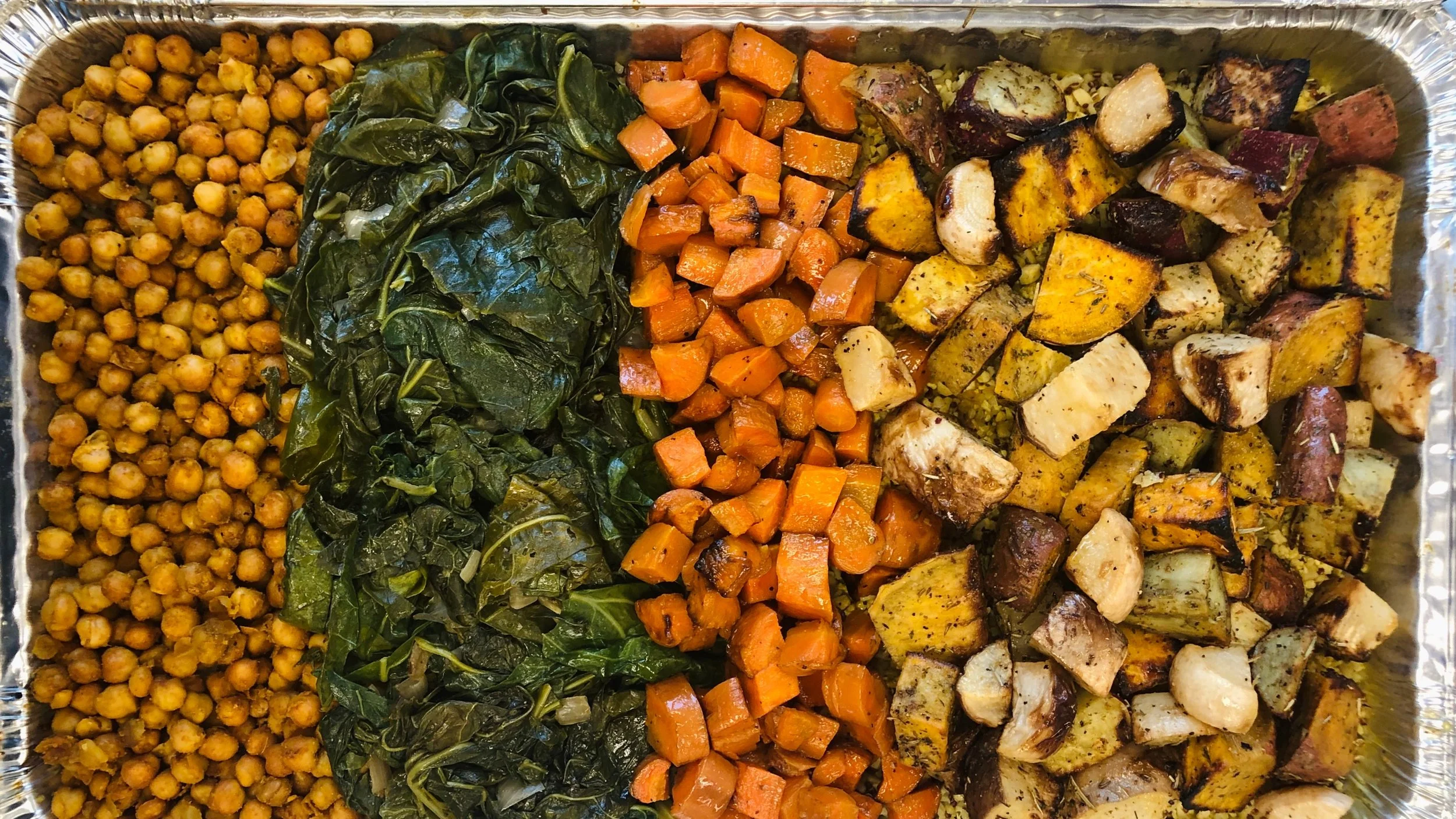
Winter squash and sweet potatoes offer warmth and steadiness. Their hearty nature mirrors the consistency our partners and neighbors rely on. These ingredients form the base of many scratch-made meals prepared in our kitchens.
Seasonal produce teaches us about stewardship, interdependence, and the generosity of the land. This December, may the bounty of the season inspire us to grow, cook, and share in ways that nourish both neighbor and community.

Holiday Helpings: when action nourishes community
Meals shape who we are and how we belong. This season, Holiday Helpings invites us to remember that nourishment, connection, and care are gifts meant to be shared.
Visit participating businesses during Holiday Helpings. Every contribution helps us grow, cook, and share nourishing food with neighbors across Nashville. Food brings us together. Your generosity keeps that work moving.
Holiday Helpings Partners
This season, we are grateful for the businesses who have opened their doors to support Holiday Helpings. Below, you will find all participating partners. Tap any business name to learn more about what they offer.
These partners remind us that food is one of the most powerful ways we show up for one another. When you dine, shop, or gather with them, you help nourish another neighbor in Nashville.
If your business is contributing to Holiday Helpings or would like to explore additional ways to support this work, we would love to connect with you. This includes businesses already participating in ways we may not yet know about, as well as those interested in joining the effort. Email us at: events@thenashvillefoodproject.org.
Your support helps nourish neighbors across Nashville in a season where care and connection matter more than ever.

Growing Together Farmer's Market: New Generations Award recipient
This week, we were honored to receive the New Generations Award at the Salute to Excellence celebration hosted by the Center for Nonprofit Excellence of Middle Tennessee.
This recognition celebrates our Growing Together Farmers Market, a cornerstone of The Nashville Food Project’s Community Agriculture Network and a living example of what it means to cultivate belonging through food.
For more than a decade, Growing Together has supported refugee and immigrant farmers in Nashville. These skilled agrarians from Burma, Bhutan, and beyond bring deep agricultural knowledge and rich food traditions to our shared city. With access to land, tools, training, interpretation, and markets, these farmers are reclaiming agricultural heritage, building economic independence, and nourishing their communities.
In 2024, seven farming families cultivated more than 30,000 pounds of produce on a single acre of land, earning nearly $92,000 in total income and growing their CSA program by 67 percent from the previous year. Each seed planted is more than a crop. It is a story of resilience, hope, and homecoming.
Launched in the spring of 2025, the Growing Together Farmers Market is the only market in Nashville located on an urban farm stewarded by immigrants and refugees. Nestled in the heart of the city’s International Corridor in Antioch, the market connects cultures through shared food traditions. Shoppers find familiar flavors from around the world, such as Nepali mustard greens, roselle, and long beans, alongside Southern staples like collards and kale.
The market also serves as a model of partnership and accessibility. The Nashville Food Project manages point-of-sale systems, provides multilingual signage, and promotes the market citywide so that farmers can focus on growing and connecting with their customers. Each week, this small corner of Antioch becomes a meeting place of stories, flavors, and futures, a vision of what a just and sustainable food system can look like.
We are deeply grateful to the Center for Nonprofit Excellence for this recognition and to our growers, partners, and volunteers who make this work possible. The New Generations Award honors their hands, hearts, and courage and reminds us that the next chapter of Nashville’s food story is already being written in the soil.
Because when we grow together, we do not just grow food.
We grow belonging.

There is enough when we work together
Updated: 11/7/2025 at 12:00 PM
Across the country, millions of families are waiting for clarity on November SNAP benefits. It has been announced that 50% of November benefits will be paid, but it is still unclear when those funds will be available.
Here in Nashville, that uncertainty is already being felt. Families who depend on SNAP to buy groceries have not received their benefits this month. Behind each number is a name, a home, and a story of resilience.
Our commitment does not waver. Every week, our team recovers food, prepares nourishing meals, and shares them across the city. No matter what, Nashville neighbors will continue to find care around a shared table.
To meet this moment, we have opened a second kitchen shift that will provide an additional 1,000 meals each week. This expanded capacity allows us to respond week by week as community needs evolve.
We have also updated our kitchen needs list to reflect the current situation. Right now, protein donations are most needed.
-
Current efforts in Nashville include:
Second Harvest Food Bank of Middle Tennessee: emergency food distribution and mobile pantries: Hunger Can’t Wait.
Open Table Nashville: outreach and connection to Food Boxes/Pantries and meals
YWCA Nashville & Middle Tennessee:family support and community care.
As more nonprofits and organizations share their plans, we will keep this space updated with new ways to connect, support, and give.
-
Give: Your support today helps us keep fresh ingredients moving where they are needed most. Every dollar helps turn recovered food into hot, healthy meals.
➜ [Donate here]Volunteer: From meal preparation to garden work to food distribution, your time makes a difference.
➜[Volunteer]Share: Tell others about the need. A simple post or conversation can connect someone to a meal or a way to help.
If you or someone you know is affected by the loss of SNAP benefits, please visit thenashvillefoodproject.org/together for updates, community resources, and ways to get involved.
This city has weathered hard seasons before. Each time, Nashville has shown that compassion is stronger than crisis. Together, we will show once again that care always finds its way to the table.
-
Healing Minds and Souls: 500 weekly community meals and medically tailored meal boxes to families and seniors across the 37208 zip code
We hold fast to a simple belief: there is enough. When we work together, we can make sure that good food continues to find its way to every table.

Each and every contribution makes a big impact.

Building a Healthier North Nashville, Together
In North Nashville, community means care.
Through Heart of Nashville: Operation Pulse, we are part of a growing network of people and organizations committed to helping neighbors manage hypertension through free rides, clinical care, and nourishing meals. This work is led by the Nashville Wellness Collaborative, a partnership of more than twenty local organizations that share one conviction: that health and hope are not luxuries, but basic conditions of human dignity.
Members of the Collaborative include NashvilleHealth, Matthew Walker Comprehensive Health Center, The Nashville Food Project, Belmont Data and AI Collaborative, Meharry Medical College, The Sycamore Institute, Urban League of Middle Tennessee, Center for Nonprofit Excellence, Transit Alliance of Middle Tennessee, Juice Analytics, STARS, American Heart Association, Senior Ride Nashville, AgeWell Middle Tennessee, Raphah Institute, Metro Parks Nashville, The Housing Fund, Metro Public Health Department, Metropolitan Development and Housing Agency, and Second Harvest Food Bank.
Matthew Walker Comprehensive Health Center serves as the anchor of this initiative, guiding patient care and connecting families to the resources they need. By sharing best practices and lessons learned, Heart of Nashville is nurturing an ethos of wellness that complements our city’s deep spirit of creativity and growth.
Together, we are working to show that where you live should never determine how healthy you can be.
This effort focuses first on reducing high blood pressure in North Nashville while learning from this work to inform how all of Nashville can be healthier. A recent countywide survey by the Belmont Data and AI Collaborative found that 31 percent of adults in Nashville live with high blood pressure. In North Nashville, that number is nearly half. Behind these figures are real lives, families, and neighborhoods where wellness is both a need and a hope.
At The Nashville Food Project, we see our city not as a grid of streets and buildings, but as a living table. A table where shortage meets possibility and where every plate carries a story of care. We believe that the heart of Nashville is not found in its skyline, but in the simple act of sharing food.
Each day, food that might have been lost is gathered, cooked, and shared. Vans leave our kitchens carrying more than ingredients. They carry care. They carry the belief that nothing good should go to waste. Our work affirms that abundance is possible when people come together. The work of food recovery is not only logistical. It is moral. It is a daily act of restoration.
The gardens, the kitchens, the vans, and the shared tables are all part of a system of care. Yet the most essential structure is the relationship between people. When transportation is limited or grocery stores are out of reach, the answers are not only technical. They are relational. We can improve roads and expand routes, but most of all, we must widen the circle of care.
We imagine a Nashville where abundance is not conditional. A city where everyone has access to fresh food, meaningful work, and true belonging. We are not only distributing meals. We are cultivating hope. We are making space at the table for everyone.
Every effort in Heart of Nashville is an act of gathering. It is a circle of people who choose to care for one another. That story continues each day, one meal, one neighbor, one act of love at a time.

Looking Back at Nourish 2025
Nourish 2025 was a powerful celebration of food, community, and connection. From a beautifully collaborative meal prepared by top chefs to stories that highlighted the heart of our mission, the evening brought people together around a shared table and a shared purpose—to nourish Nashville.

On July 17, 2025, we gathered for our 15th annual Nourish, presented by Kroger—and what a night it was. We're humbled and incredibly proud to share that Nourish 2025 brought together more than 300 guests and raised nearly $250,000 to support our mission of bringing people together to grow, cook, and share nourishing food.
But beyond the numbers, Nourish was once again a beautiful celebration of community, collaboration, and connection—a night where the table became a place for generosity, shared purpose, and joy.


An Unforgettable Meal
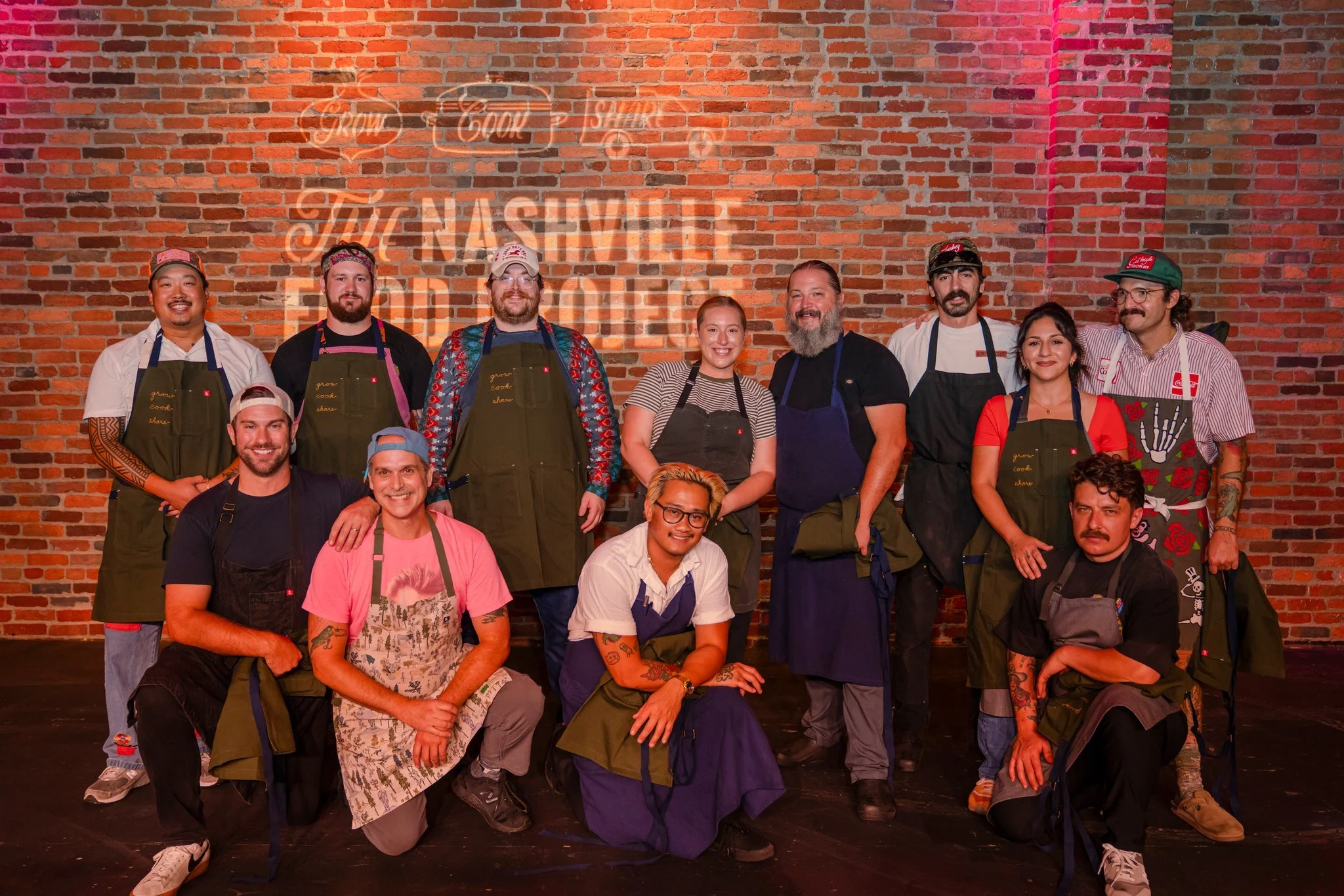
This year’s all-star chef lineup included teams from:
Bad Idea
Curry Boys BBQ
S.S. Gai
Tantísimo
Turkey and the Wolf Icehouse
Saap Saap BBQ (unable to attend due to a family emergency)
Each chef brought a distinctive voice and vision to the meal, creating a multi-course experience that reflected diverse cultures, techniques, and a shared love for food. One of the evening’s most inspiring moments was witnessing these chefs collaborate in real time—helping one another plate, prep, and bring each dish to life with care and camaraderie.

We also premiered a behind-the-scenes chef video, highlighting their visit to the Growing Together Farm—and what fuels their passion for food and community.
Honoring Our Volunteer Hero: Theresa McCurdy

One of the evening’s most heartfelt moments was the presentation of the Thomas Williams Golden Skillet Award, which honors an outstanding volunteer who embodies the spirit of our work. This year, we were thrilled to present the award to Theresa McCurdy, who has quietly and faithfully given over 440 volunteer hours since 2022.
Theresa’s steady presence, compassion, and commitment have made her an integral part of our kitchen community. Her story is a powerful reminder that it’s not just meals we’re making—it’s community, built one kind gesture at a time.
The Thomas Williams Golden Skillet Award, established in 2017, recognizes a volunteer who has shown deep dedication to the work of The Nashville Food Project. Its namesake Thomas Williams is the founder of Nourish.
Raising Paddles, Raising Hope
This year’s Night of Giving was especially impactful thanks to a $20,000 matching gift, which helped double the power of every contribution made that evening. From $5,000 pledges to $100 gifts, the generosity in the room was overwhelming and deeply inspiring.
Thanks to the support of individual donors and corporate partners, we’ll be able to share tens of thousands more nourishing meals with our neighbors in the months ahead.
With Gratitude to Our Sponsors
Nourish 2025 would not have been possible without our generous sponsors. We are deeply grateful to the following partners:

Looking Ahead
Nourish isn’t just an annual event—it’s a reflection of our ongoing work and the community that makes it possible. Whether you were with us in person or supporting from afar, thank you for helping us grow this movement.
Together, we’re building a more food-secure, connected, and resilient Nashville. One meal. One garden. One relationship at a time.

Fueling Potential: How Summer Meals Support Youth at the Boys & Girls Club
At the Andrew Jackson Clubhouse of the Boys & Girls Clubs of Middle Tennessee, kids are spending the summer learning, growing—and thanks to The Nashville Food Project’s made-from-scratch meals—staying nourished, too.
Through the Sweet Peas Summer Eats for Kids program, sponsored by Jackson®, hundreds of healthy meals are delivered each week to support youth during a time when access to regular food can drop off.
This partnership is part of The Nashville Food Project’s Community Meals program, which brings nutritious food directly to organizations already creating safe, supportive spaces for young people.
Now in its sixth year, the collaboration with Jackson is helping serve over 100,000 meals this summer—fueling not just plates, but potential across the city.
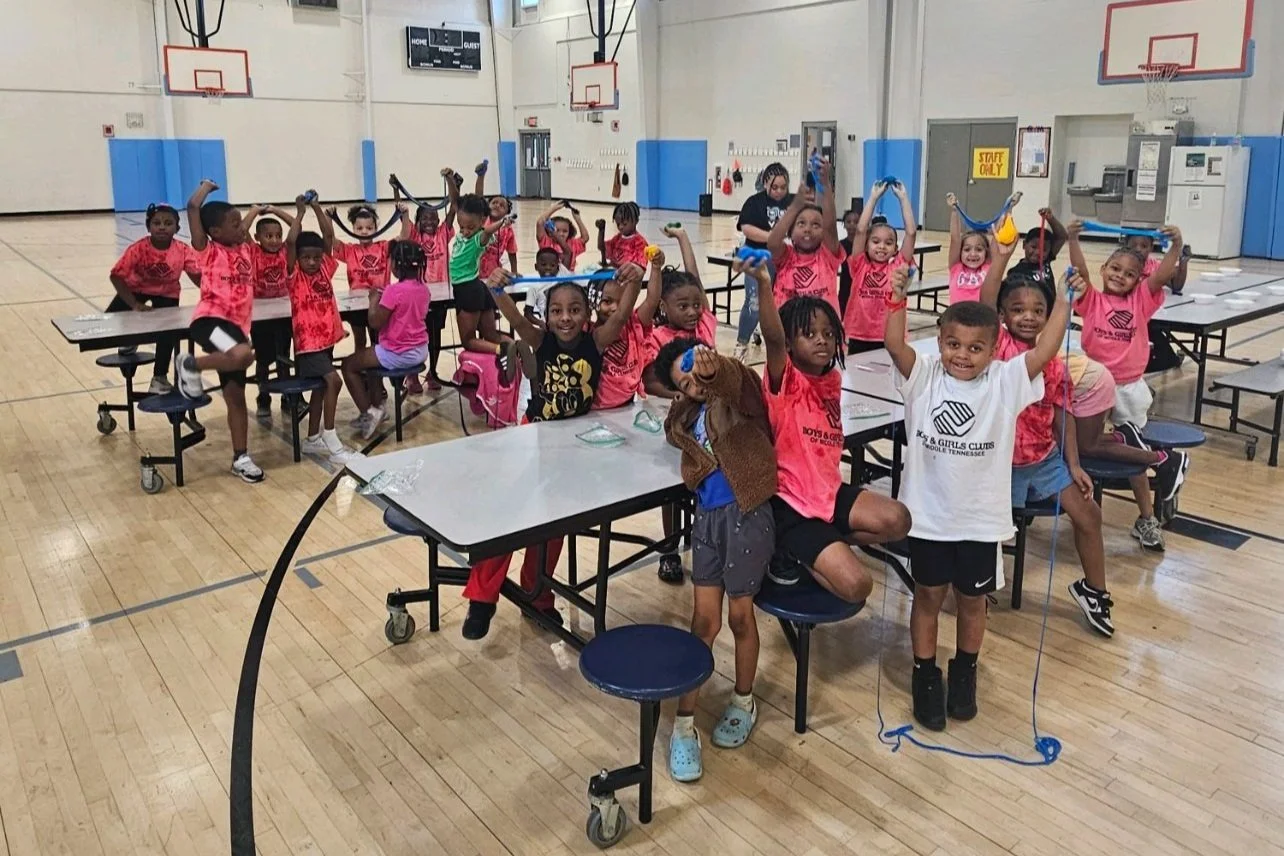
At the Boys & Girls Clubs of Middle Tennessee’s Andrew Jackson Clubhouse, every day is filled with opportunities for youth to learn, grow, and connect. And thanks to Sweet Peas Summer Eats for Kids—sponsored by Jackson National Life Insurance Company® (Jackson®)—those days are also fueled by healthy, made-from-scratch meals from The Nashville Food Project.
We handle the food so BGCMT can stay focused on its mission: to help all young people—especially those who need us most—reach their full potential as productive, caring, responsible citizens.
“When school is out, many children and teens lose access to regular meals,” says Denise Carothers with BGCMT. “The Nashville Food Project’s summer meals ensure that youth have access to healthy food even when school is out. These meals do more than fill plates—they strengthen support systems, create safe spaces, and help children and teens thrive.”
Each week this summer, the Andrew Jackson Clubhouse receives hundreds of meals packed with local produce and kid-friendly favorites like veggie pasta and chicken tacos. And they’re just one of many partners receiving meals through Sweet Peas this summer. With Jackson’s incredible support—now in its sixth consecutive year—we’ll serve more than 100,000 meals this summer to children across the city.

This partnership is part of our Community Meals program, which provides nutritious, made-from-scratch meals to organizations already gathering people in meaningful ways. Our meals help reduce barriers to food access by showing up where people already are—programs like BGCMT that offer stability, community, and a sense of belonging.
This work is only possible because of corporate partners like Jackson, who share our belief that good food is a powerful way to build stronger, healthier communities—one meal at a time.

TNFP Volunteers Honored at Hands On Nashville Strobel Volunteer Awards
Two volunteers from The Nashville Food Project received honors at the 2025 Mary Catherine Strobel Volunteer Awards. Marcie Smeck Bryant won the Social Justice Impact Award, and Cheri Ferrari was a top finalist for the Charles Strobel Legacy Award. Presented by Hands On Nashville/United Way, the awards are Middle Tennessee's largest annual celebration of volunteerism.

Each year, our friends at Hands On Nashville/United Way honor dedicated volunteers across Middle TN for their commitment to service through the Mary Catherine Strobel Volunteer Awards. Named after Mary Catherine Strobel, an activist and community leader. This May, The Nashville Food Project had the honor of two of our nominations being selected as finalists!
Marcie Smeck Bryant, a beloved board member and leader in fostering community meals across Nashville, took home the award for Social Justice Impact. Cheri Ferrari, a longtime kitchen volunteer, pie extraordinaire, and "pie-oneer" of our Volunteer Lead Program, was among the top three finalists for the Charles Strobel Legacy Award. Check out more of their stories below!

Marcie Smeck Bryant - Social Justice Impact Award Recipient
Since before we were officially known as The Nashville Food Project, Marcie Smeck Bryant has been a dedicated volunteer—sharing her time, heart, and energy to support our neighbors across Nashville. She plays a key role in our community meals program, showing up every Tuesday to deliver and share meals at Trinity Community Commons (TCC), where neighbors—housed and unhoused alike—gather to eat, connect, and support one another through daily challenges.
In addition to her on-the-ground work, Marcie has served on our board since 2023 and chairs our Strategy Committee, where she played a key role in shaping a new strategic communications plan designed to support and advance our broader organizational strategy.
Marcie is also a leader in Nashville's "community meals" movement, helping launch a weekly dinner at Belmont United Methodist Church that brings neighbors together around food and mutual support. Beyond the TCC and Belmont meals, she's contributed to FeedBack Nashville workshops—a collaborative effort to envision a more equitable and accessible food system in our city. Marcie's steadfast commitment to strengthening her community through food is not only inspiring—it's a model we strive to emulate at The Nashville Food Project.

Cheri Ferrari - Charles Strobel Legacy Award Finalist
Cheri Ferrari is the living "embodiment of hospitality," a quality that has defined her service since she began volunteering with The Nashville Food Project in 2015. With her warmth, generosity, and tireless commitment, Cheri invites every volunteer who comes through the doors to "be part of our joy." Her dedication to making everyone feel welcome and valued has not only enriched TNFP's culture but created a ripple effect of positivity that keeps volunteers returning time and time again.
As a Volunteer Prep Lead, Cheri is often the first person new volunteers meet, greeting everyone with her characteristic warmth and enthusiasm. On Monday mornings and Tuesday nights, when Cheri is leading, the energy is palpable—as laughter and chatter echo through the kitchen. From remembering everyone's favorite pie or dessert to staying hours after her scheduled shift to support our Meals Team, Cheri approaches every interaction with love and authenticity. Her ability to make volunteers feel connected and valued speaks to the core of our mission, demonstrating the transformative power of her service.
Want to hear more about Cheri and Marcie? Check out their stories—along with those of all the other inspiring finalists and winners on United Way of Greater Nashville's YouTube channel!
YouTube Links:
Marcie Smeck Bryant - 2025 Mary Catherine Strobel Volunteer Awards | Social Justice
Cheri Ferrari - 2025 Mary Catherine Strobel Volunteer Awards | Charles Strobel Legacy of Service
Hunger vs. Food Insecurity: Why the Difference Matters for Food Justice in Nashville
If we think only in terms of hunger, our response will be emergency food. This is important, but it’s reactive. If we frame the problem as food insecurity, we begin to think bigger. We move from charity to justice. In other words, you can end someone's hunger for a day. But ending food insecurity means making sure they don't face that hunger tomorrow, next week, or next year.
At The Nashville Food Project, we often find ourselves using the terms "hunger" and "food insecurity" side by side. They sound similar. They even seem interchangeable. But in truth, they point to very different challenges—and understanding the distinction is critical if we are to build a more just and sustainable food system for Nashville.
In simple terms, hunger is the physical sensation of not having enough to eat. It is immediate. It is urgent. It is visceral. On the other hand, food insecurity refers to a broader condition: the lack of consistent, reliable access to enough affordable, nutritious food. It is chronic. It is shaped by systems. And it is often invisible.
Hunger: A Symptom

When someone shows up at a food pantry or meal program, what they are experiencing is hunger. It is the tangible result of deeper structural forces, and it calls for an urgent response. In Nashville, we see this every day through our community meals program, which last year alone provided over 325,000 scratch-made meals to individuals and families experiencing hunger. We partner with more than 60 community organizations to make this possible, ensuring that food is delivered in dignified, culturally appropriate ways to those who need it most.
Many of our partners—from Second Harvest Food Bank to Catholic Charities’ Loaves and Fishes program—are on the frontlines of this hunger response. Their work is crucial. Without it, thousands of Nashvillians would go without their next meal.
But as essential as this work is, it is not enough to truly end hunger. Because hunger, while visible and immediate, is only the tip of the iceberg.
Food Insecurity: The System Beneath the Surface

Food insecurity looks deeper. It asks why that person was hungry in the first place.
It considers the mother who skips meals so her kids can eat, the senior choosing between medication and groceries, or the family living in a neighborhood without a nearby grocery store or affordable transit. It acknowledges how structural racism, disinvestment, gentrification, and economic inequality create ongoing barriers to food access.
Here in Nashville, food insecurity is often hidden. It is not always marked by empty stomachs, but by chronic tradeoffs, instability, and stress. It affects health outcomes, educational performance, and community well-being. And it disproportionately impacts Black and Latino households, single mothers, and the working poor.
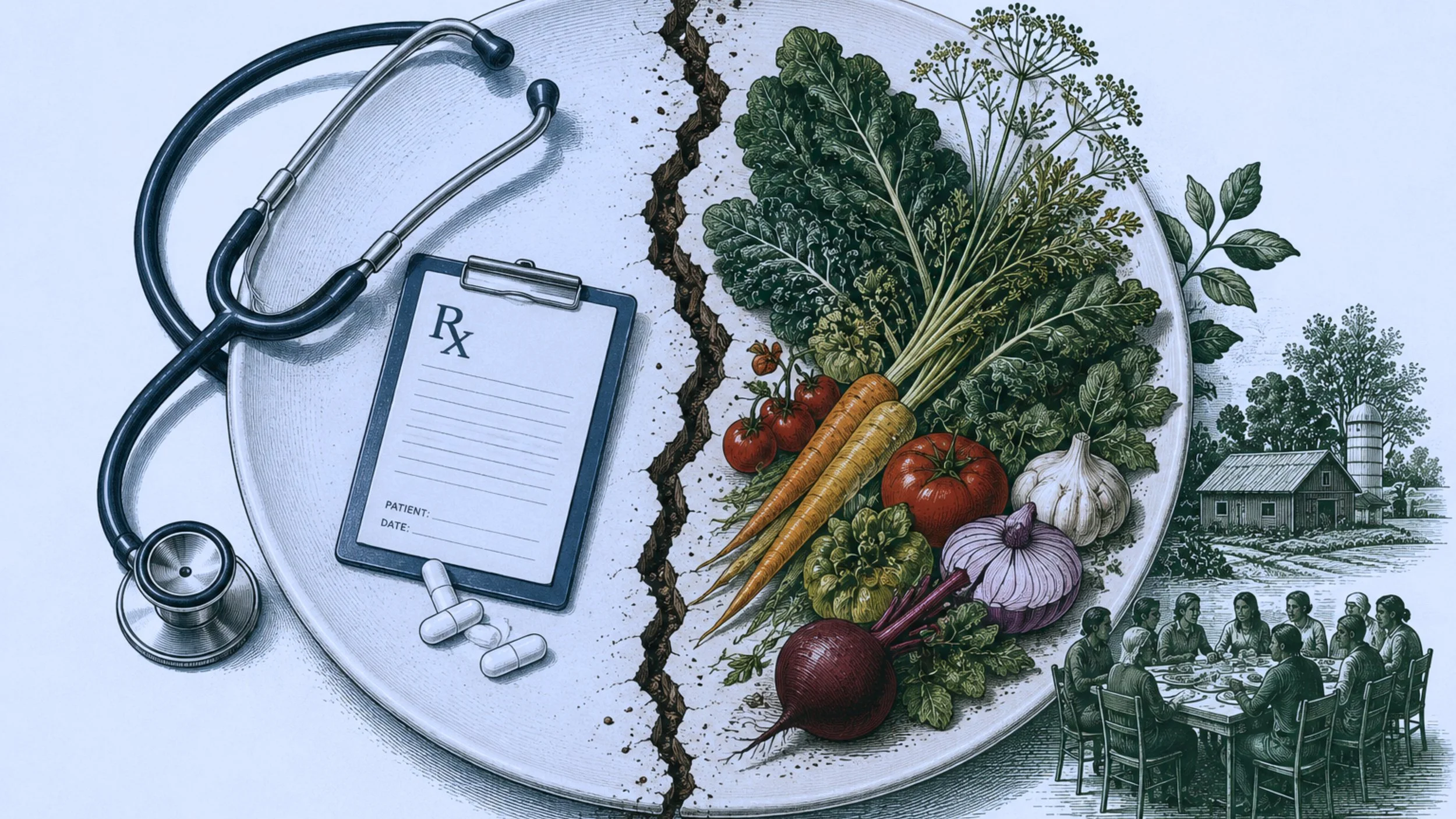
That’s why The Nashville Food Project is committed to not just feeding people, but transforming the systems that produce food insecurity. Through urban agriculture, culinary job training, food recovery, and partnerships with healthcare providers, we are building long-term pathways toward food security and food sovereignty.
Why the Difference Matters

Why does this distinction matter?
Because how we define the problem shapes how we solve it.
If we think only in terms of hunger, our response will be emergency food—meals, food boxes, donations. These are important, but they are reactive.
If we frame the problem as food insecurity, we begin to think bigger. We look at land access, wages, housing, healthcare, education, and transportation. We move from charity to justice.
In other words, you can end someone's hunger for a day. But ending food insecurity means making sure they don't face that hunger tomorrow, next week, or next year.
Both/And: Bridging the Immediate and the Transformative

At TNFP, we believe in a both/and approach. We will continue to provide nourishing meals—because hunger cannot wait. And we will continue to grow our work in food systems change—because food insecurity will not be solved with meals alone.
That means partnering with local growers and advocating for urban agriculture policies that increase land access. It means teaching cooking and nutrition skills using recovered food that would otherwise go to waste. It means collaborating with healthcare providers on food-as-medicine models. And it means participating in citywide coalitions like FeedBack Nashville to reimagine the future of food in our city.
What You Can Do

Understanding the difference between hunger and food insecurity helps us all become more effective advocates and allies in this work.
Here are a few ways you can take action:
Support both immediate relief and long-term change. Donate to organizations meeting urgent needs, but also invest in those changing the system.
Ask deeper questions. When you hear about hunger, ask what’s causing it. What barriers are upstream?
Talk about the difference. Help others understand that ending hunger is not the same as achieving food security.
Join the movement. Volunteer in a community garden, attend a food policy forum, or support policies that center equity in food access.
A Just and Nourishing Future

Hunger and food insecurity are connected, but they are not the same. At The Nashville Food Project, we are committed to addressing both—with urgency, compassion, and a systems lens.
Because in our vision of a just food future, everyone in Nashville not only has a meal today—they have reliable, dignified access to the foods they want and need for the long haul.
That’s the difference. And that’s the work.