
The Nashville Food Project’s Blog




Oven-Roasted Strawberry and Rosemary Jam
Today we've got a great post from loyal volunteer and board member, Judy Wright, on a TNFP recipe - oven-roasted strawberry and rosemary jam. Judy regularly shares her impressive knowledge through her blog at JudysChickens.org.
If you haven't met loyal TNFP volunteer and board member Judy Wright, then you are missing out! Judy cooks regularly in our kitchen and she shares with us so many great recipes (Judy's Mom's Meatloaf, anyone?) and tips for the kitchen and garden. Judy regularly shares her impressive knowledge through her blog at JudysChickens.org, and periodically we'll be sharing some of those posts. Today we've got a great post from Judy on a TNFP recipe - oven-roasted strawberry and rosemary jam.
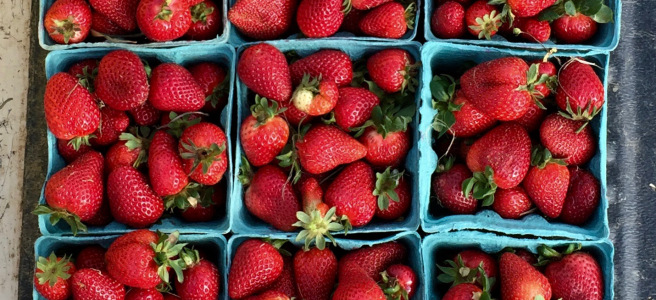
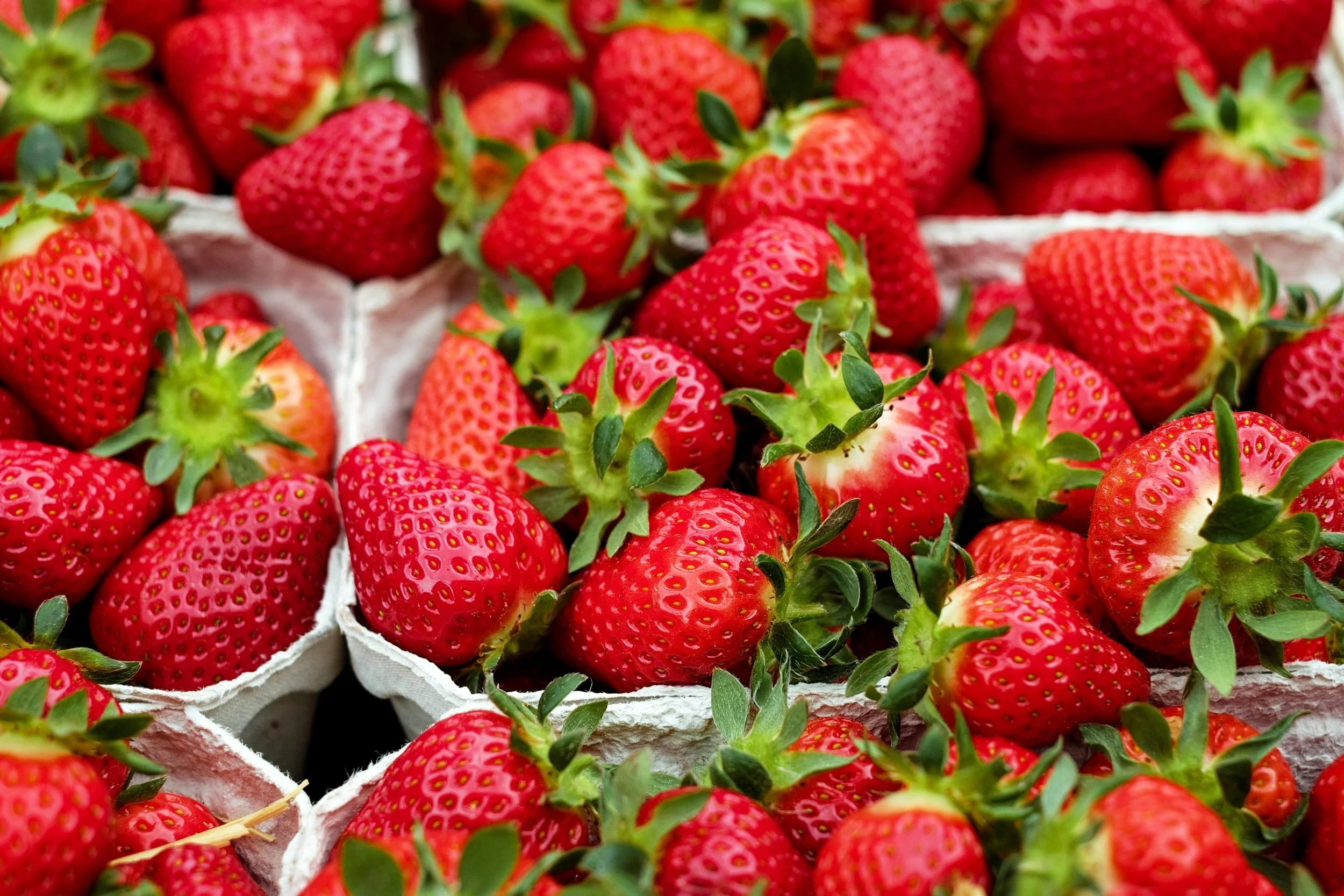
Summer. In. A. Jar. The local strawberry season is too short for many of us; just six weeks. Have you ever wanted to capture the smell and flavor of a just-picked, warm, lusciously ripe strawberry? If so, try making a jar of this oven-roasted strawberry and rosemary jam with a touch of lemon juice or balsamic vinegar. This recipe was given to me by my friend, Malinda Hersh, Associate Director at The Nashville Food Project, and it is easy to make.

Malinda made this jam three years ago, packaged in half-pint mason jars, for TNFP’s deluxe gift baskets prepared for attendees of the Nourish Patron’s Party held annually at the legendary Bluebird Cafe. Inspired by Malinda’s gift, I have been making my own small batch of this jam every year since, as soon as the venerable Tennessee strawberries come in. Nourish is a Nashville fundraiser which brings together the South’s most innovative chefs for an evening of delicious food and wine. This year the event will take place on July 28th at the Hutton.
The idea for this post started last week when I read in Edible Nashville, a gorgeous publication on local food trends, for which I am now a contributing writer on gardening(!!), that the first Tennessee strawberries were starting to come in. On a whim, I emailed Hank Delvin at Delvin Farms at 7:00 A.M. to tell him I had this fabulous recipe for roasted strawberry jam that I wanted to make and by-the-way, I was looking for ripe strawberries. He said they were getting ready to pick that morning and invited me to come along.

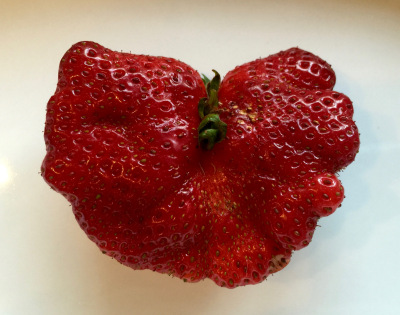
I love driving out to Delvin Farms in College Grove, Tennessee. It’s a beautiful drive, and I know I’ll always learn something new about botany and organic growing practices from Hank, and his dad if he’s around. Check out this post from last year when I chronicled a morning spent gleaning vegetables for TNFP at Delvin Farms. The most interesting tidbit I learned on my most recent trip was the concept of incomplete pollination. Like for many of you, I’ve seen the results of incomplete pollination, misshapen berries like the ones in the picture below, I just didn’t know there was a name or reason for it.

By the way, misshapen isn’t alway ugly. Look at this amazing strawberry I found in the field. My friend, Roberta, said it looks like an angel. Indeed.
Hank plants new June-bearing strawberry plants in long rows of plastic-covered raised beds every September. The plastic keeps the weeds out, since, as an organic farm, they do not use chemical weed-killers.

The plants go dormant in the winter and start growing again in the spring. Once the delicate flowers start blooming, it is imperative that the tender blooms be protected from frost.

To this end, whenever the temperature dips, Hank’s staff has to cover the rows of strawberries with agricultural cloth. This past spring there were six such frosts in the three weeks preceding their first harvest.
Strawberries are considered self-pollinators and as such, their male and female parts are on the same flower. It takes gravity, the wind, rain, and some insect pollinators to move the pollen across the flower to pollinate it. If the plants are covered, the wind and bees can’t do their part.
I was amazed to see the plants’ leaves waving in the wind, a wind I couldn’t even feel.
Pistils and stamens. Remember them?

The strawberry flower is not your typical flower. Yes, it has the male parts which are the yellow pollen coated anthers known as stamens. And it has the female part called an ovule that connects to an ovary and collectively is known as the pistil. However, whereas most flowers only have one pistil, the strawberry is an aggregate fruit and, as such, has as many as 500 spike-like ovules, each one an immature egg needing to be pollinated so it can produce seed. The more of those ovules that get pollinated, the bigger, puffier, and more perfect the strawberry.

The Recipe!
Yield: 4 cups of jam
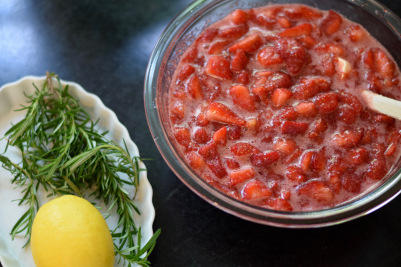
8 cups (2 quarts) strawberries, stems removed and berries quartered
4 cups granulated sugar
¼ cup lemon juice or balsamic vinegar
4 bushy sprigs fresh rosemary (1/2 ounce).
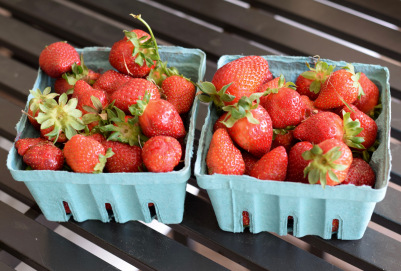
Clean and hull two quarts of strawberries. Figure on four cups of berries in each quart container.
Slice berries into lengthwise quarters.

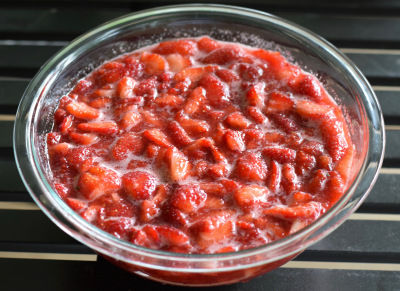
Add strawberries and sugar to a mixing bowl, stir and allow to macerate, which means to break down and soften.

Allow berries to macerate for two hours, or up to 24 hours, stirring regularly to re-incorporate the sugar that sinks to the bottom of the bowl into the mixture. Don’t skip this step. It’s what helps the berry chunks keep their shape.
Squeeze the juice out from one large lemon and set aside.

Pour the macerated strawberries and the lemon juice into a large saucepan. Bring to a rolling boil over high heat. Be careful not to let the juice boil over.

Once the mixture reaches a full boil, reduce the heat and continue cooking, uncovered, for ten minutes. About five minutes into the cooking time, add the rosemary sprigs to the pot, stir, and continue to cook.

Cooking the berries and sugar together helps release the naturally occurring pectin from the strawberries. Pectin is a gum-like substance that is needed to “set” jams and jellies. It occurs naturally in fruits, but more can be added in the form of powder if a faster set is desired. Adding an acid, such as lemon juice or vinegar, helps fruit release its natural pectin. For more on pectin, read my post about making grape jelly.
Now it is time to roast the berries.
Preheat oven to 150º. If your oven’s lowest temperature setting is a little higher than that, that is fine. You could even set the oven to convection roast and cook it in half the time, but I prefer the slow cook method.
Pour the mixture, including the rosemary, into a 13″ by 18″ baking pan. Place pan on the middle oven shelf and roast for 10 hours, or until the syrup is thickened and has a gel-like appearance. I often put it in the oven at bedtime and take it out the next morning.
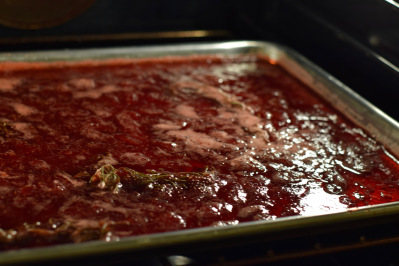
How to test hot jelly for gel formation: Use a chilled wooden spoon to scoop up some jam. Allow jam to cool and then tilt the spoon so jam drips off. If the drips form a triangle-shaped thick flake, it is ready. Don’t get too hung up here with the testing. After 10 hours, assume it is going to be great!

Ladle into four 8-ounce hot, clean jars using a large-holed funnel and either
- Process in a water bath for 10 minutes, using the appropriate two-part jar caps, aka “canning,” or
- Cover with lids, let cool, and store in the refrigerator until ready to use, or
- Freeze in plastic containers.
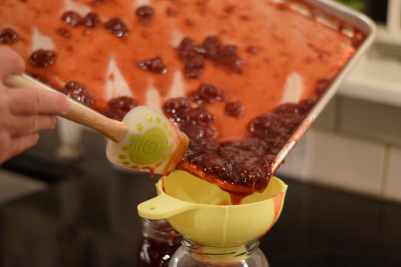
I love the combination of strawberries, a little sugar, and balsamic vinegar, so I often substitute four tablespoons of balsamic vinegar for the lemon juice. The balsamic vinegar not only flavors the jam, but it also gives it a smoother, earthier taste than the lemon juice. Having said that, my kids prefer the lemon juice version.

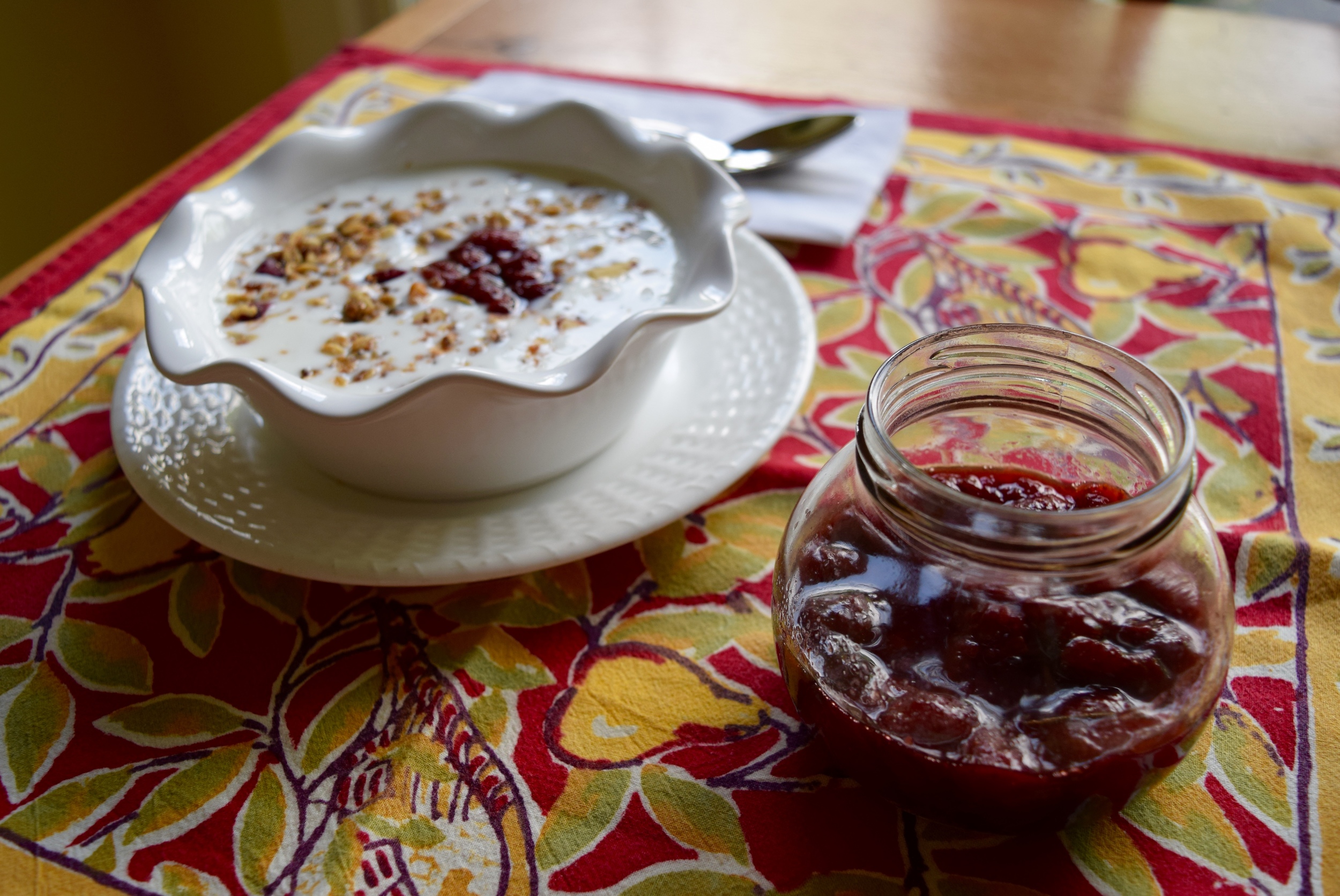
I love this jam spooned over @judyschickens granola and served with plain, low-fat kefir.
About The Nashville Food Project
The Nashville Food Project brings people together to grow, cook and share nourishing food, with the goals of cultivating community and alleviating hunger in our city. Their primary fundraising event, Nourish, will take place on July 28th this year instead of in June. The Patron’s Party for this event is at the legendary Bluebird Cafe and will take place on July 13th. Tickets go on sale May 20th.
© 2016 Judy Wright. All rights reserved.
Sharing the Abundance of Our City
Did you know that 40% of all the food in our city gets thrown away? For the average Nashville family, that’s 20 pounds of food waste per month and $1,500 of food thrown away each year…
Did you know that 40% of all the food in our city gets thrown away? For the average Nashville family, that’s 20 pounds of food waste per month and $1,500 of food thrown away each year.

But The Nashville Food Project is working to change that. Earlier this year, we became a lead agency partner in the National Resources Defense Council’s Nashville Food Waste Initiative. As part of this initiative to greatly reduce Nashville’s food waste, we’ve ramped up efforts to recover healthy surplus food from local farms, grocers and restaurants. This food is used in our meals to feed our city’s most vulnerable communities while greatly reducing the amount of food that enters our city’s waste stream. Already this year, we’ve recovered more than 20,000 pounds of food!
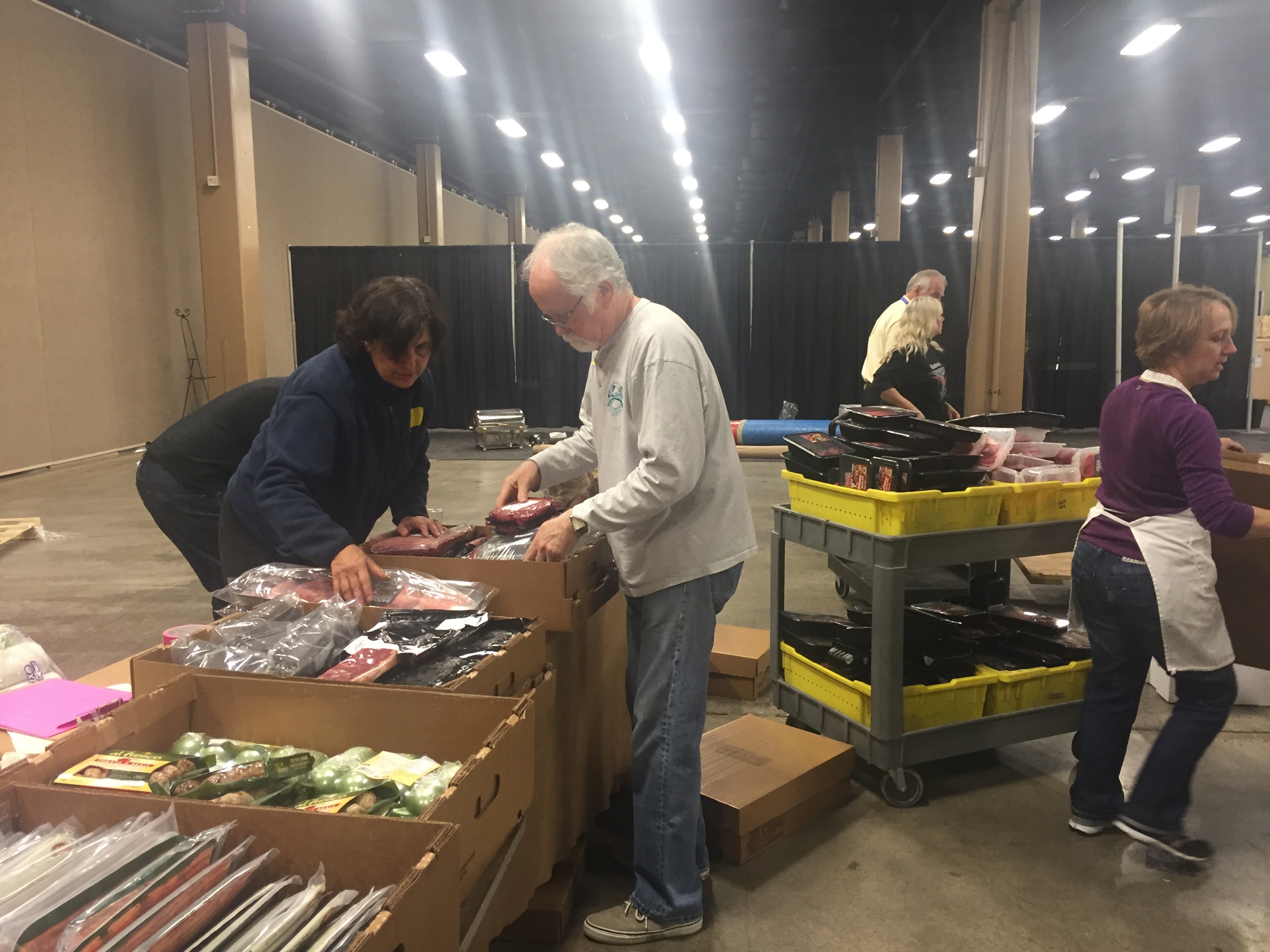
Our largest food donation this year - 11,000 pounds of meat recovered from a meat conference at Gaylord Opryland
This increase in donated food has allowed our staff and volunteers to work more creatively to produce our meals. As the amount of food coming in has skyrocketed, we’ve learned to really think on the fly, adapting menus for the food we’ve received and supplementing with gleaned food whenever possible. Here are a few examples of the fun menus we’ve put together recently using donated food:
- Southwest Chicken Salad sandwiches using chicken gleaned from Chipotle
- Hummus and veggie wraps using ingredients entirely gleaned from Whole Foods in Green Hills
- Chocolate bars topped with cream cheese frosting and strawberries using gleaned chess pie, gleaned cream cheese and sour cream from Iron Fork, Strawberries gleaned from Creation Gardens
- Breakfast Potato Fritatas using potatoes gleaned from Mitchell's Deli
- French Toast Sticks using items gleaned from Sinema
- Beef Stroganoff using Prime Rib gleaned from The Green Hills Grill
Increasing our food rescue efforts has also strengthened our community partnerships. We’ve added many new food donors and increased our work with several existing donors including Whole Foods Market, with whom we now glean three times each week at their Green Hills and Franklin locations. We’ve also strengthened our nonprofit partnerships as any food that we can’t use in our meals is shared with a nonprofit partner, ensuring all food goes to someone who is hungry rather than into a dumpster.
The great increase we’ve seen in donated food, has had a big impact on our meals program - decreasing food costs and increasing the amount of food we can share. Already this year, we’ve more than doubled our weekly meals production. To make this all happen, we’ve increased our meals team by two:

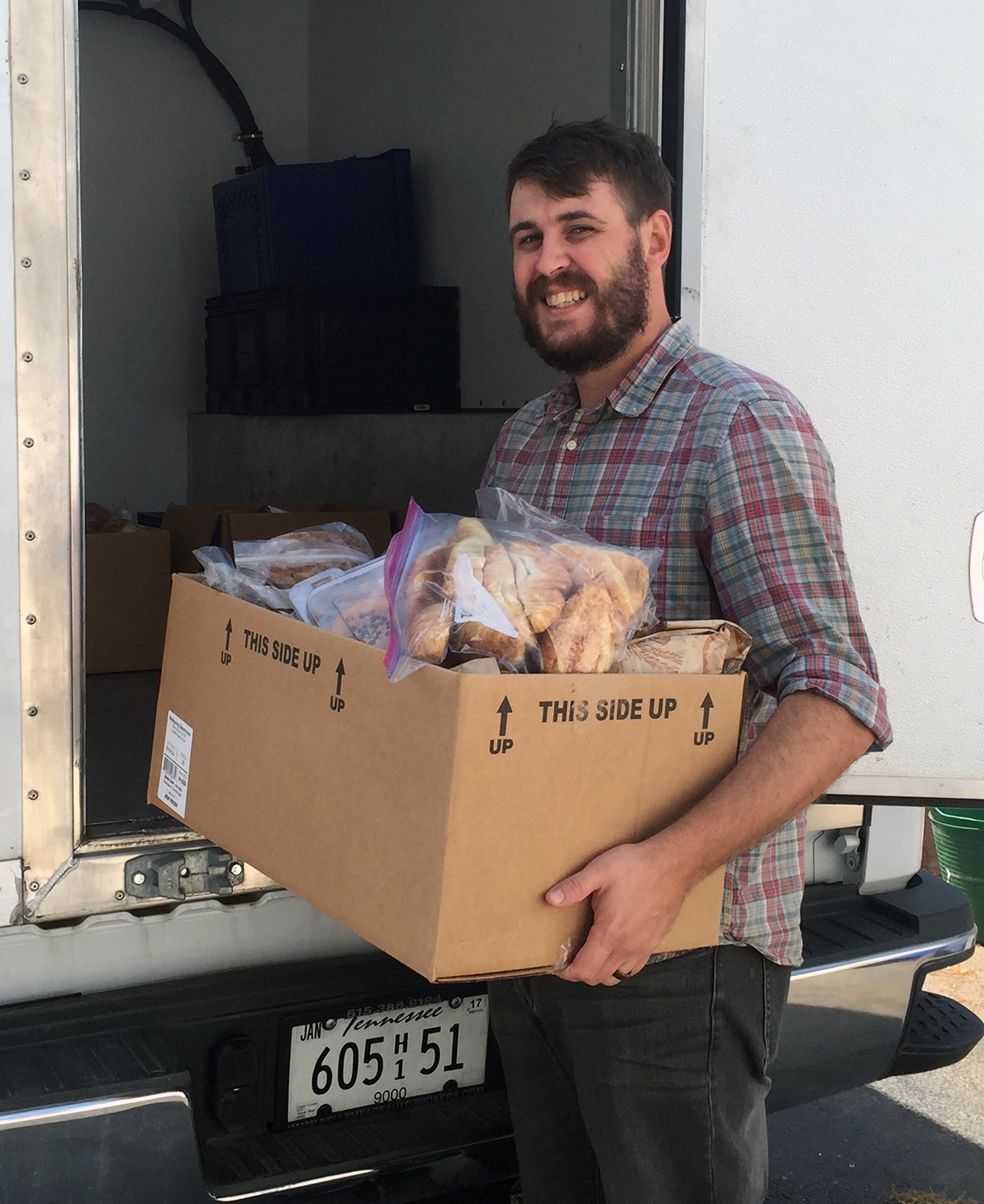
Booth Jewett
Food Donations Coordinator
Booth moved to Nashville in 2012 to attend Trevecca Nazarene University, where he earned a degree in Social Justice. He also received his Permaculture Design Certification (PDC) from the University of Vermont in 2015. He is a committed and passionate worker in the local food movement with experience in sustainable farming, community engagement, and speaking and teaching on food justice issues. Booth was born in Atlanta,GA and is an avid fan of all Atlanta sports teams. He and his wife Brittany live in South Nashville.
Christa Ross
Meals Manager - South Hall
A Nashville native, Christa received a degree in environmental policy from the University of Tennessee, Knoxville. She headed west after school and spent five years in Oregon and Northern California working on several organic farms and in catering -- developing a deep seeded love for food. After moving back to Nashville, Christa joined the staff of TNFP as Food Rescue Coordinator before moving into her current role of Meals Manager - South Hall. Outside of work, Christa spends as much time as possible outside, hiking, kayaking and growing good food!
For more information or to donate food, please contact Food Donations Coordinator Booth Jewett at booth@thenashvillefoodproject.org.
Refugee Growers Prepare for Nashville Farmers Market Season
We're so excited to continue our support of the Center for Refugees and Immigrants of Tennessee's Refugee Agricultural Program this growing season! This year, we have an exciting new aspect of the program, which will support a number of growers as they work to sell some of the produce that they grow. Below is a post from our partner CRIT on the progress thus far.
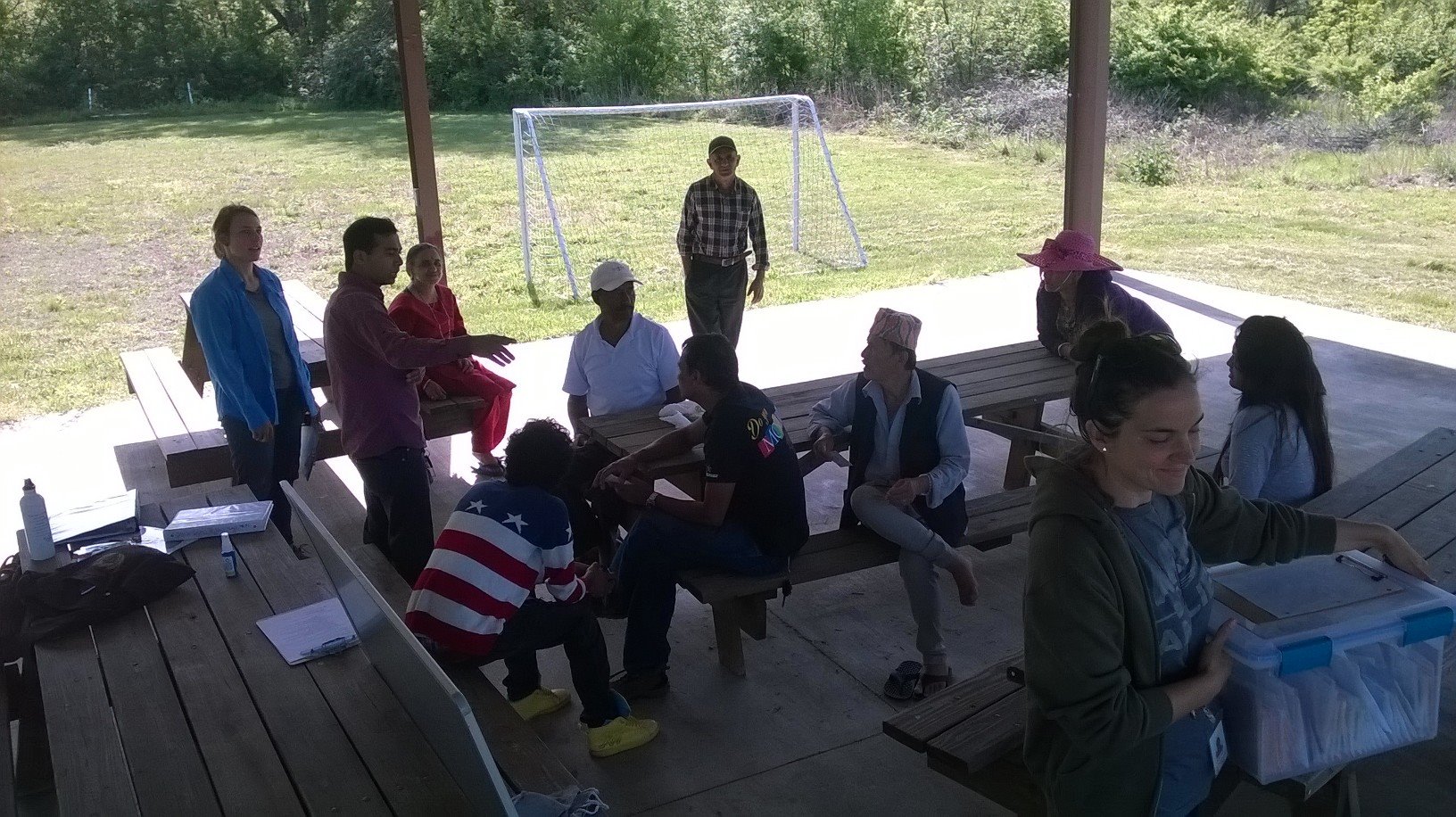
The farmers of the Refugee Agricultural Program of Middle Tennessee arrived early Monday morning at the Nashville Farmers’ Market to imagine their new space under the Farm Sheds.
Beginning in May, they’ll be selling the produce they have been working hard to grow off Haywood Lane in South Nashville to the thousands of customers who browse the downtown market on Saturdays.

“This is the first time this has ever happened at the Nashville Farmers’ Market,” said Tasha Kennard, the executive director of the market who spoke with the group. “You can inspire the community and teach the community that you want to be a part of it and inspire others to do what you’re doing.”

Many in the group have grown food or worked farmers markets in their native countries of Bhutan, Nepal and Burma. Here, they’ll join a group of about 150 merchants at the market from Tennessee and nearby states like Kentucky and Alabama.
Tasha offered tips to the group through translator Siddi Rimal about how to successfully sell at the market, but she also congratulated the group on opening doors and showing community members how to provide food, create jobs and support families.

“We are here to support you,” she said, “and our fellow farmers are here to support you and help you have a good time.”
We hope you’ll visit our farmers’ market booth on Saturdays from May through September. The Nashville Farmers’ Market is located at 900 Rosa L Parks Blvd.
Guest Chef Series: Hattie B's Hot Chicken
When we invite professionals to our kitchens each month for the Guest Chef Series, it often feels like a family affair with husband and wife teams or kitchen crews generously taking a break from their regular days to prepare a meal in our space. But it has never felt quite like the family reunion as when the clan of Hattie B's Hot Chicken pitched in to help…

When we invite professionals to our kitchens each month for the Guest Chef Series, it often feels like a family affair with husband and wife teams or kitchen crews generously taking a break from their regular days to prepare a meal in our space. But it has never felt quite like the family reunion as when the clan of Hattie B's Hot Chicken pitched in to help.
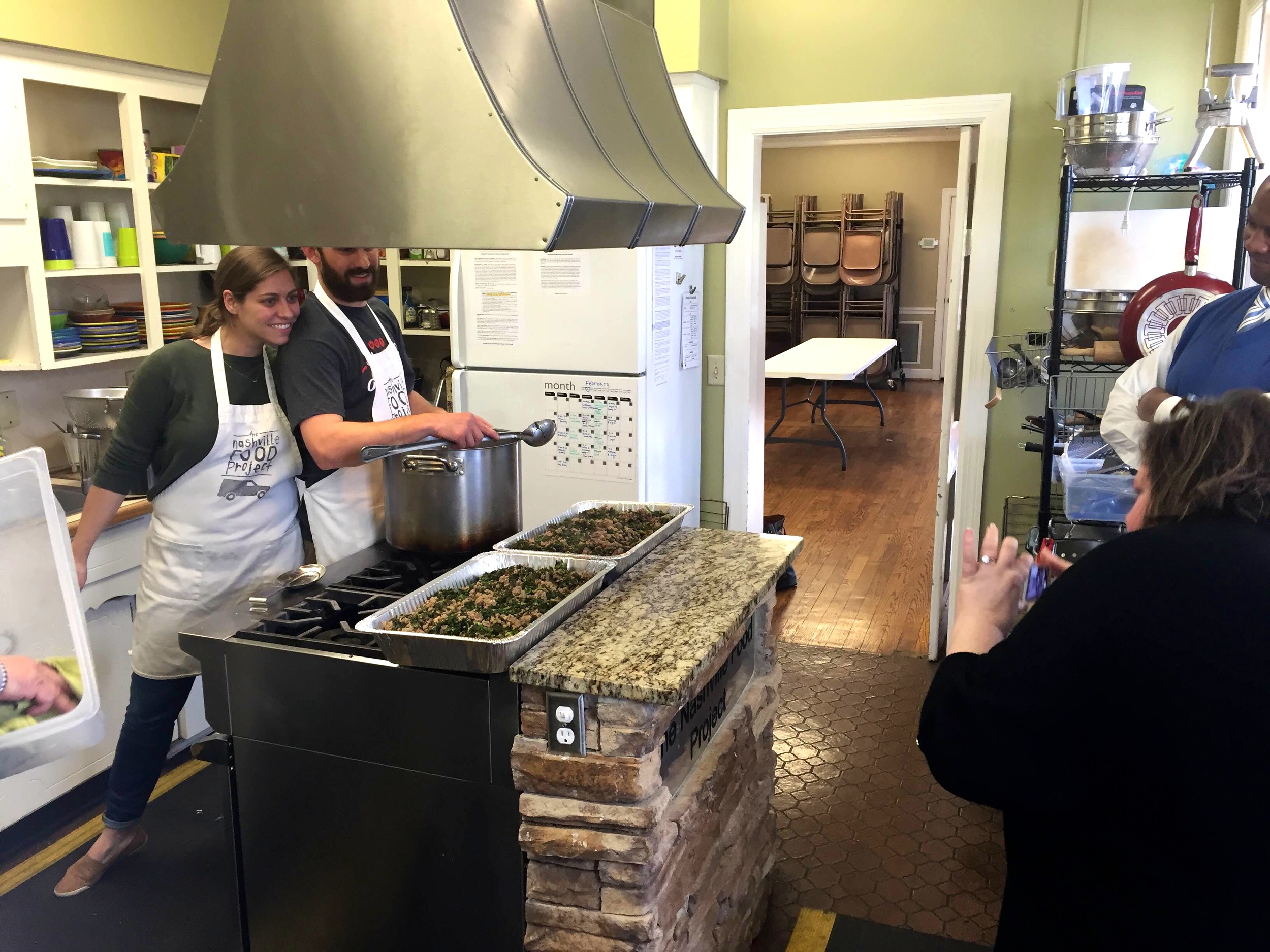
Executive Chef John Lasater and his wife Brittany Bishop Lasater arrived first to get started. The TNFP meals team had left them notes and a recipe to work from based on produce that had been gathered from the garden that week and donations gleaned from other farmers or partners like Whole Foods Market.
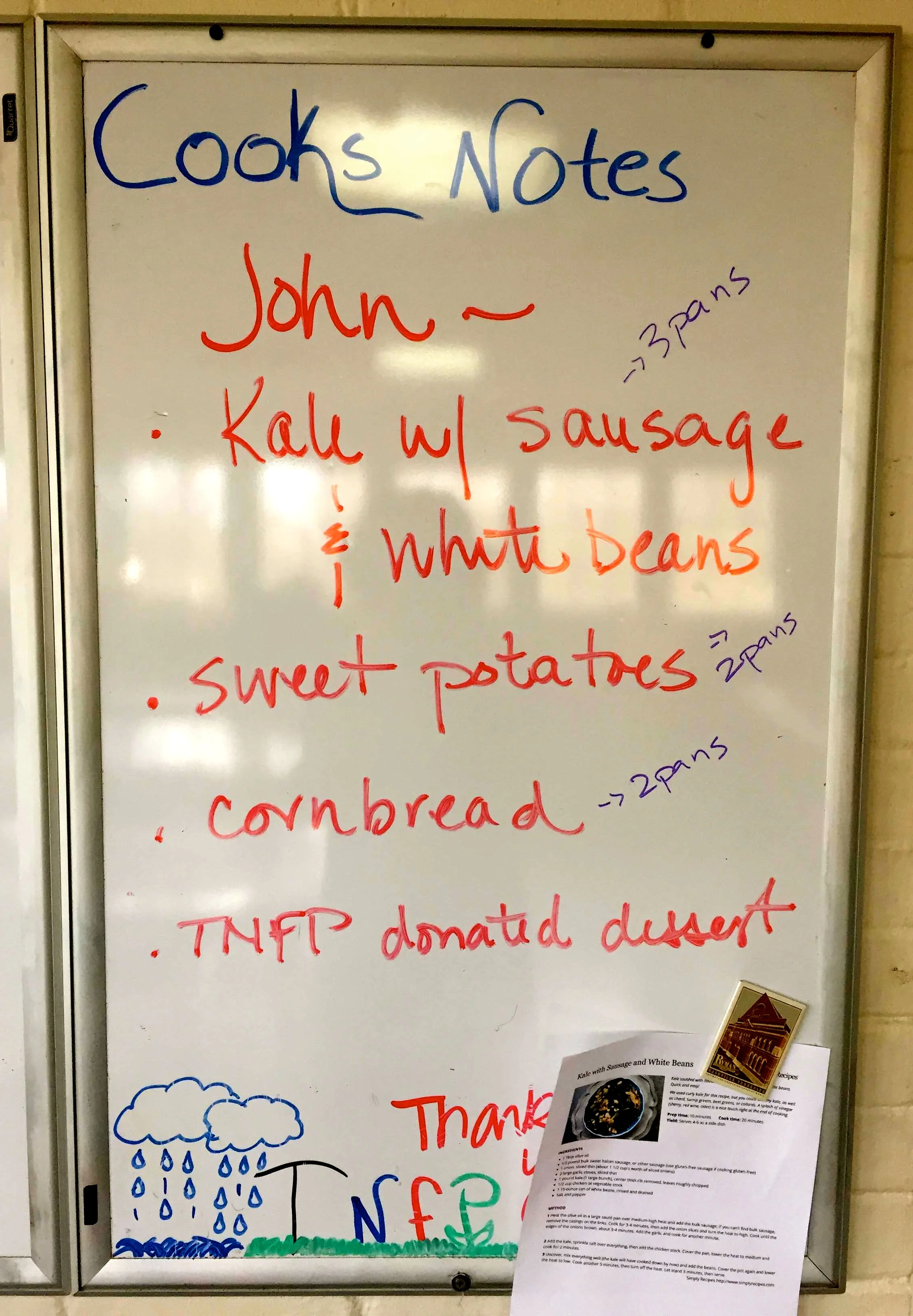
They pulled ingredients from the walk-in cooler labeled for the day and destination...
...and John headed for the greenhouse to clip fresh herbs.

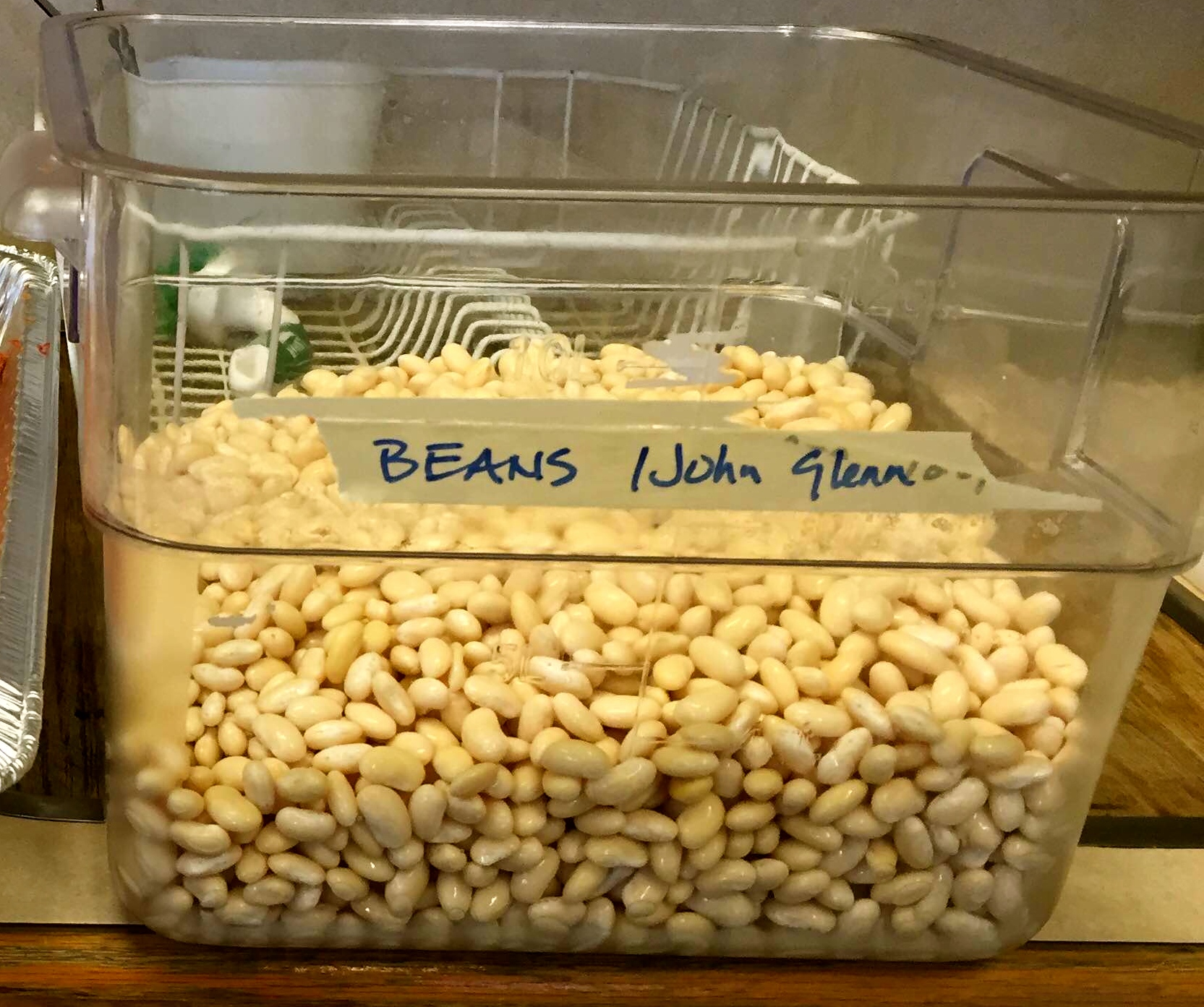
Back in the kitchen, Brittany began mixing the cornbread while John put the beans on to soak with aromatics alongside pans of sizzling sausage donated from KLD Farm. Even with their busy schedules, the couple keeps a garden of their own and has been renovating their East Nashville home kitchen. "We do enjoy cooking at home from time to time," Brittany says.
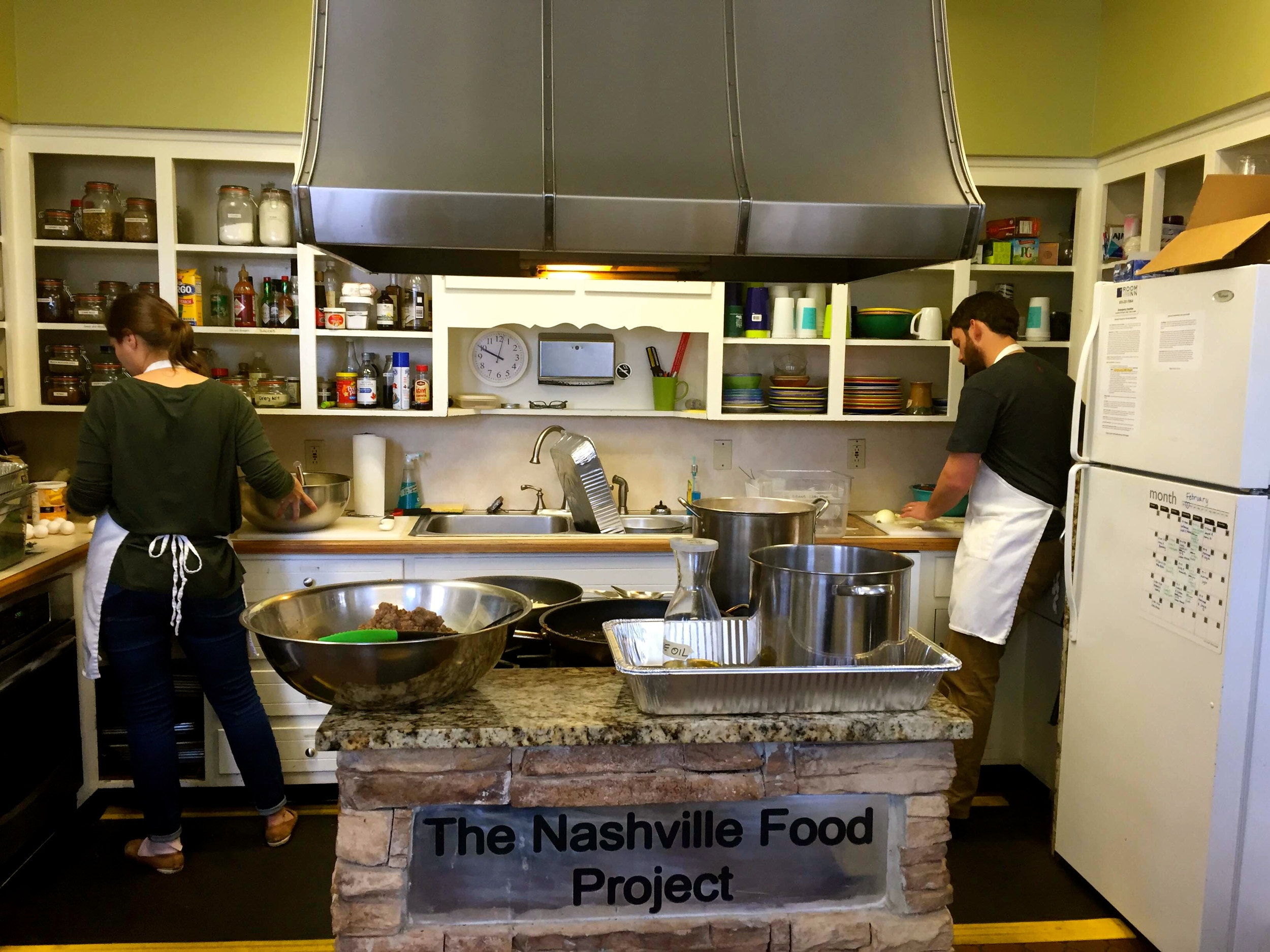
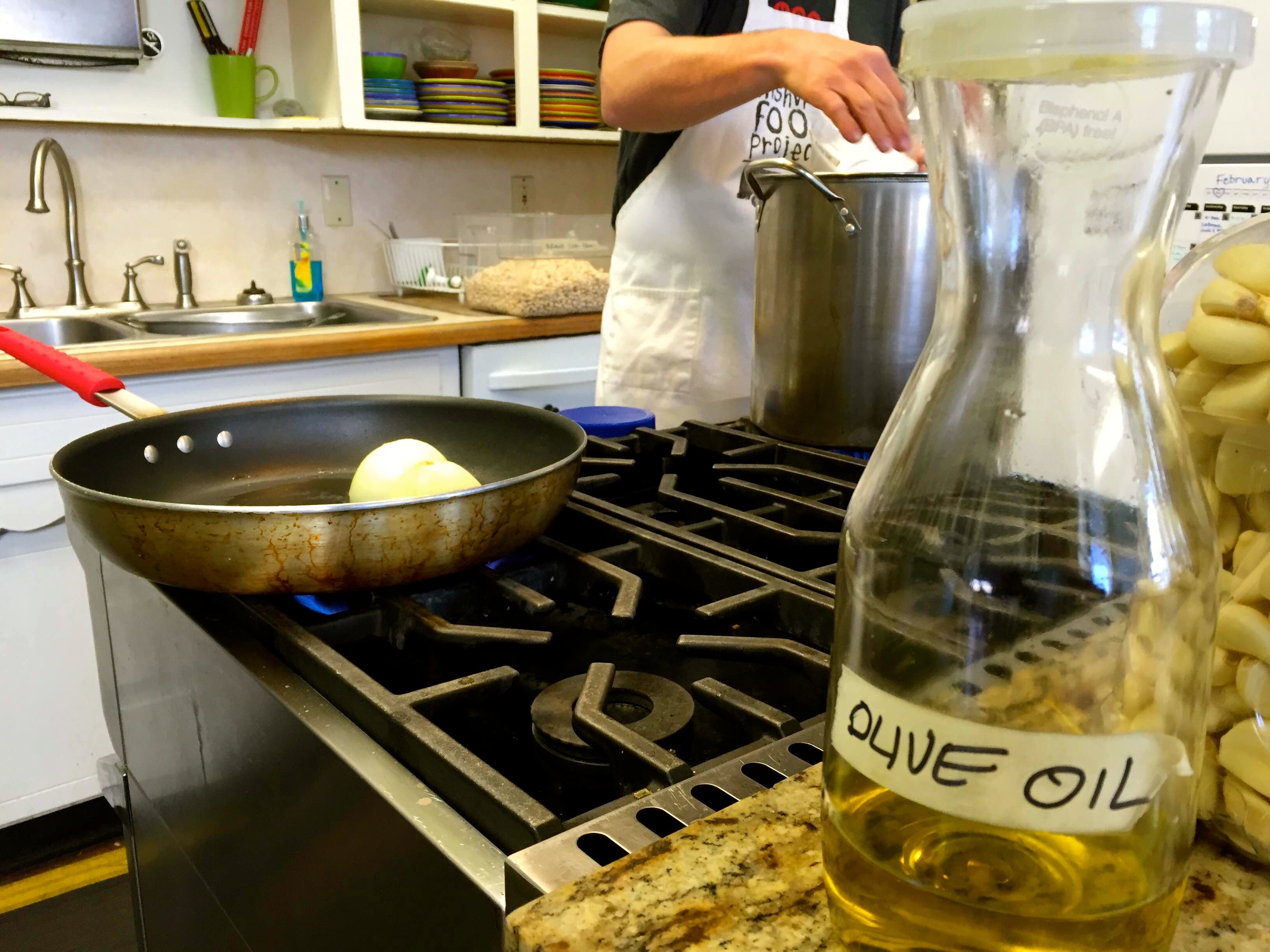
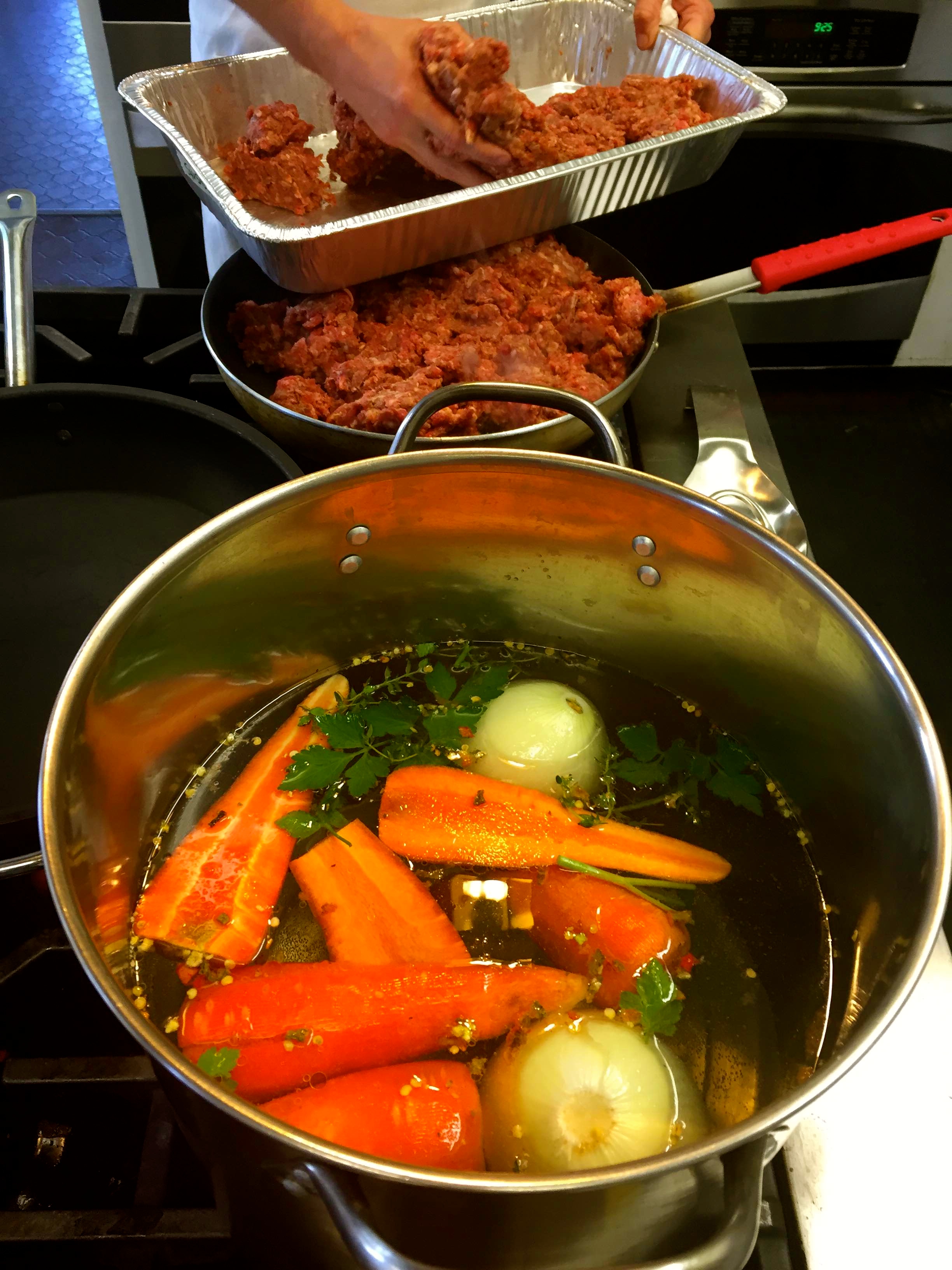
Both John and Brittany grew up in Middle Tennessee and attended Western Kentucky University. Then Brittany left for art school and John left for culinary school and work in New York City. They didn't officially meet until both moved back to Nashville and joined a kickball league.

"I've always enjoyed cooking," John says of his path in the business. "My mom started us cooking and would give me my budget for three course meals -- an appetizer, entree and dessert."
His aunt and grandmother also ran a catering company called An Affair to Remember cooking for the likes of Alan Jackson and George Strait. "Whenever family got together, the meal consisted of four meals, like 10 sides...food was always the focal point."
John says he loved working in New York City, too, at restaurants like Gramercy Tavern. But like others in the city, he had trouble affording the Big Apple on a chef's starting salary. He moved to Nashville and took a job at The Hermitage Hotel's Capitol Grille with Executive Chef Tyler Brown as well as friends Chris Carter and James Peisker, who went on to open Porter Road Butcher.
But of the career twists and turns, perhaps his biggest test came when cooking for Brittany's family. Her father, Nick Sr., has been in the restaurant business for 30 years.
"He made pimento cheese au gratin potatoes," Brittany says of a birthday dinner John cooked for her dad. "They were gone in lightening speed -- like, it evaporated."
Right on cue, Nick Sr. arrived at TNFP to help finish the meal. His son, business partner and Brittany's brother, Nick Jr., arrived too.

From left: John Lasater, Brittany Bishop Lasater, Nick Bishop Jr., and Nick Bishop Sr.
Nick Sr. grew up in the Morrison's Cafeteria family of restaurants. His father started in the business as a dishwasher in Savannah in the 1940s and retired as President and CEO of Morrison's. The group also bought Ruby Tuesday and grew the chain to 900 stores before selling it. Then, after Nick Sr. "retired" and opened Bishop's Meat and Three in Cool Springs, both Nicks began experimenting with hot chicken. The dish took off as a favorite, and they decided to open Hattie B's Hot Chicken with John stepping in as a consultant just for three to six months initially. Now about four years later, John still works with the company, and his pimento cheese gratin from that fateful family dinner made its way to the menu as pimento mac and cheese along with many other popular dishes.
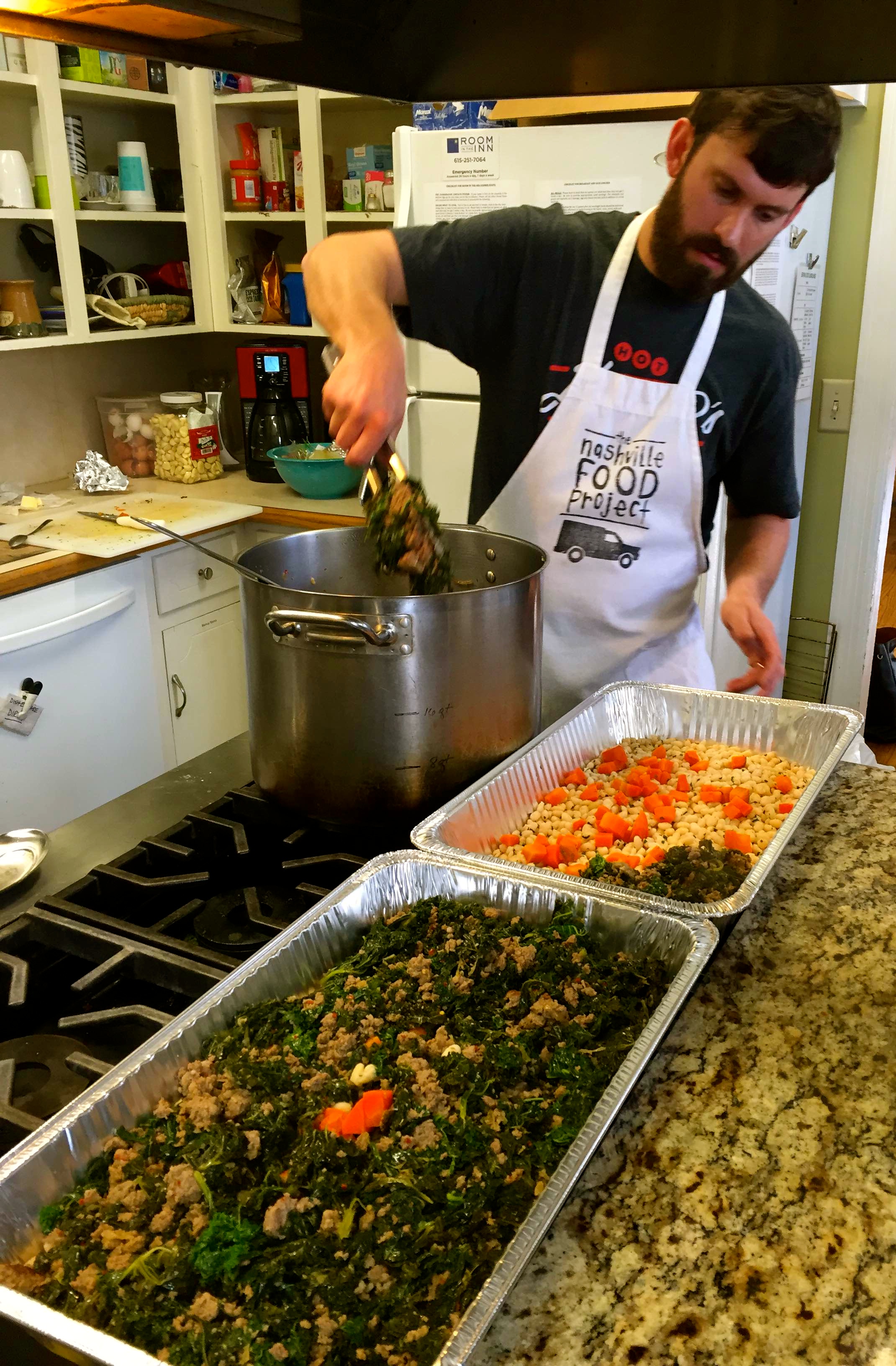
Back in the TNFP kitchen, Nick Sr., with his natural restaurant instincts, checked the Delvin Farms sweet potatoes roasting in the TNFP ovens before they headed for John Glenn residential center, and John finished the main course by layering white beans with sausage and TNFP-grown kale.
"I like the idea of using what you have on hand," John said.
"I want to do it again," Brittany added.
And maybe they'll bring even more family next time?
"I don't think you have a kitchen big enough," John teased, "for what we could bring."
A Day in a Dozen: Our First Day at St. Luke's in 12 Photos
Today's "Day in a Dozen" features a new, very exciting partnership with St. Luke's Community House. Last week we launched a new partnership with St. Luke's in West Nashville, serving 1,330 meals each week for St. Luke's preschool and mobile meals programs…
Today's "Day in a Dozen" features a new, very exciting partnership with St. Luke's Community House.
Last week we launched a new partnership with St. Luke's Community House in West Nashville, serving 1,330 meals each week for St. Luke's preschool and mobile meals programs. St. Luke's Community House has been meeting the needs of families in The Nations community for more than 100 years. St. Luke's is a United Way Family Resource Center, providing a comprehensive list of programs and services for children and youth, adults, seniors, and families as a whole. As part of this new partnership, The Nashville Food Project has taken over St. Luke's large commercial kitchen, giving TNFP a second kitchen from which we can produce even more meals to feed our city and bring communities together.
We began serving meals at St. Luke's on Monday, March 28. Longtime TNFP volunteer cook Ann Fundis, who is helping to launch the partnership as Kitchen Manager, arrived bright and early at 6:30 AM to begin prepping breakfast for the preschool and getting the kitchen ready for the day ahead.
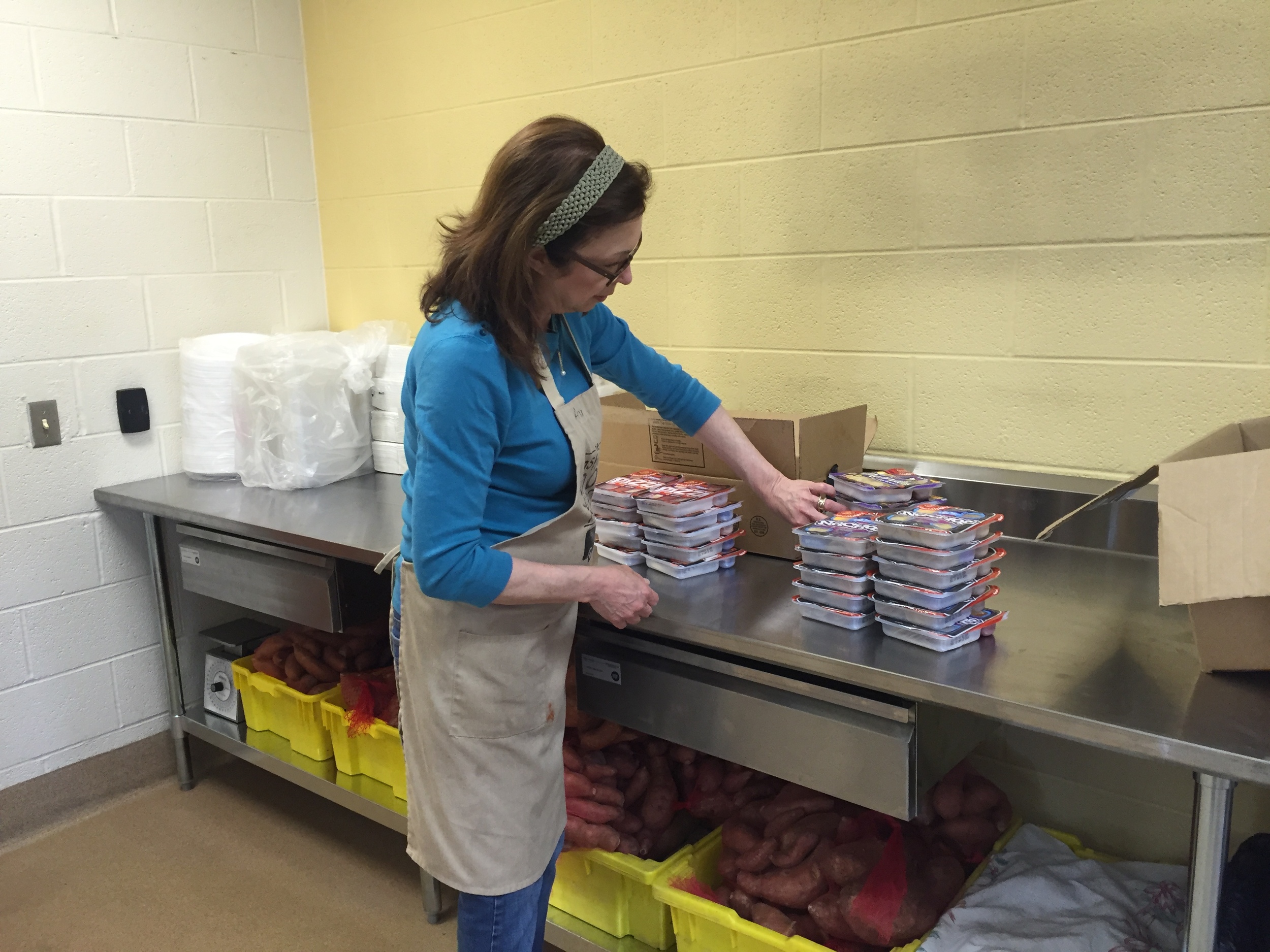
Here's Ann Fundis checking inventory of a donation of healthy snack packs.

Here are our meal counts for all of our St. Luke's meals.

We're in organizational heaven over here!
By 8:00 AM, Ann was joined by TNFP staffer Sarah Morgan who began serving breakfast in the preschool classrooms. Monday morning's breakfast was sausage biscuits with orange juice.
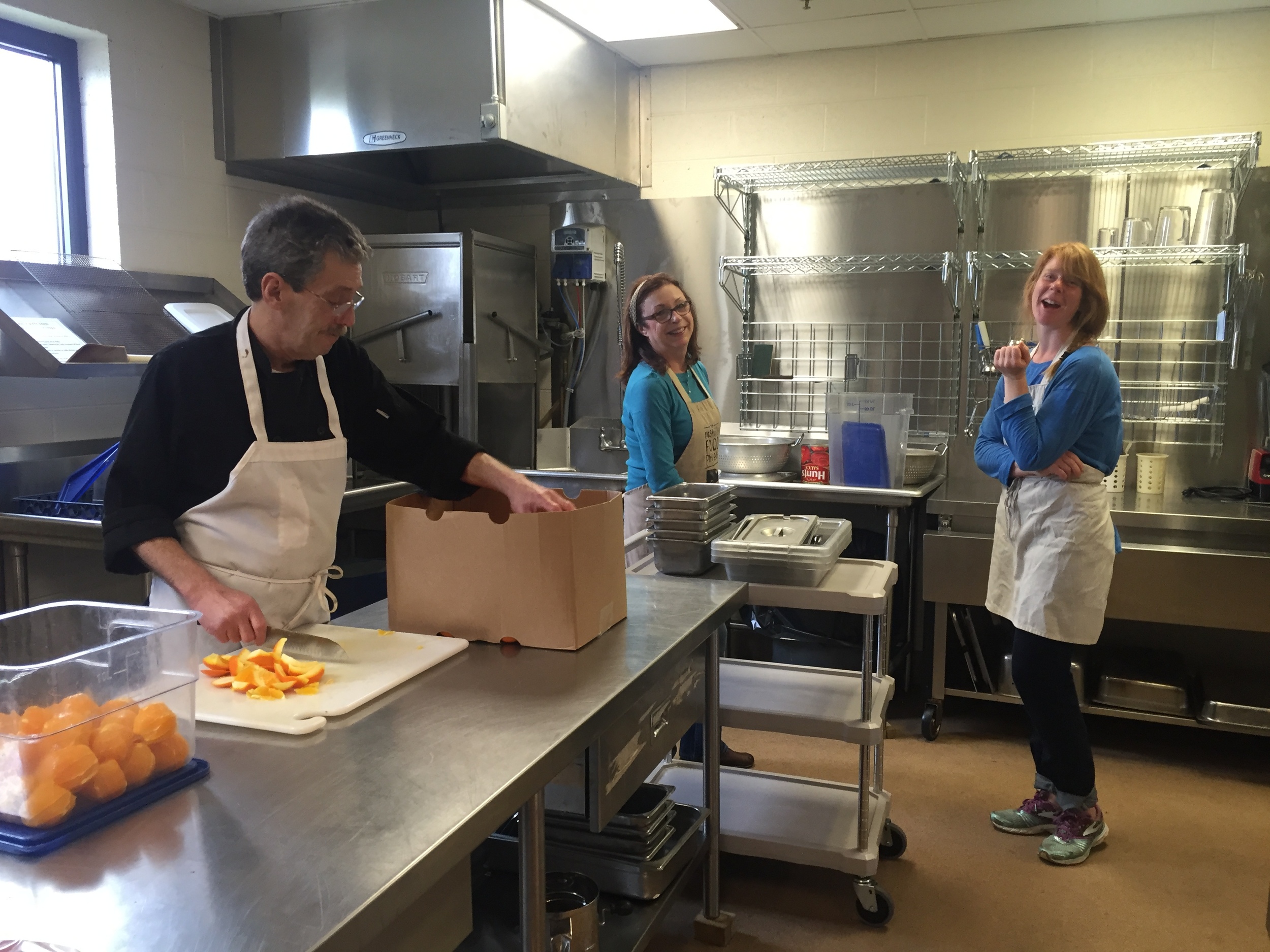
At 8:30 AM, the staff, joined by St. Luke's interim cook Mike, began prepping and cooking lunches for St. Luke's mobile meals program and the preschool. At 9:45 AM, volunteers Debbie Willis and Shellye Geske arrived to begin plating mobile meals lunches. The delicious lunch of baked ziti with meatballs, carrot and raisin salad and orange slices fed both the seniors receiving mobile meals and the preschoolers.

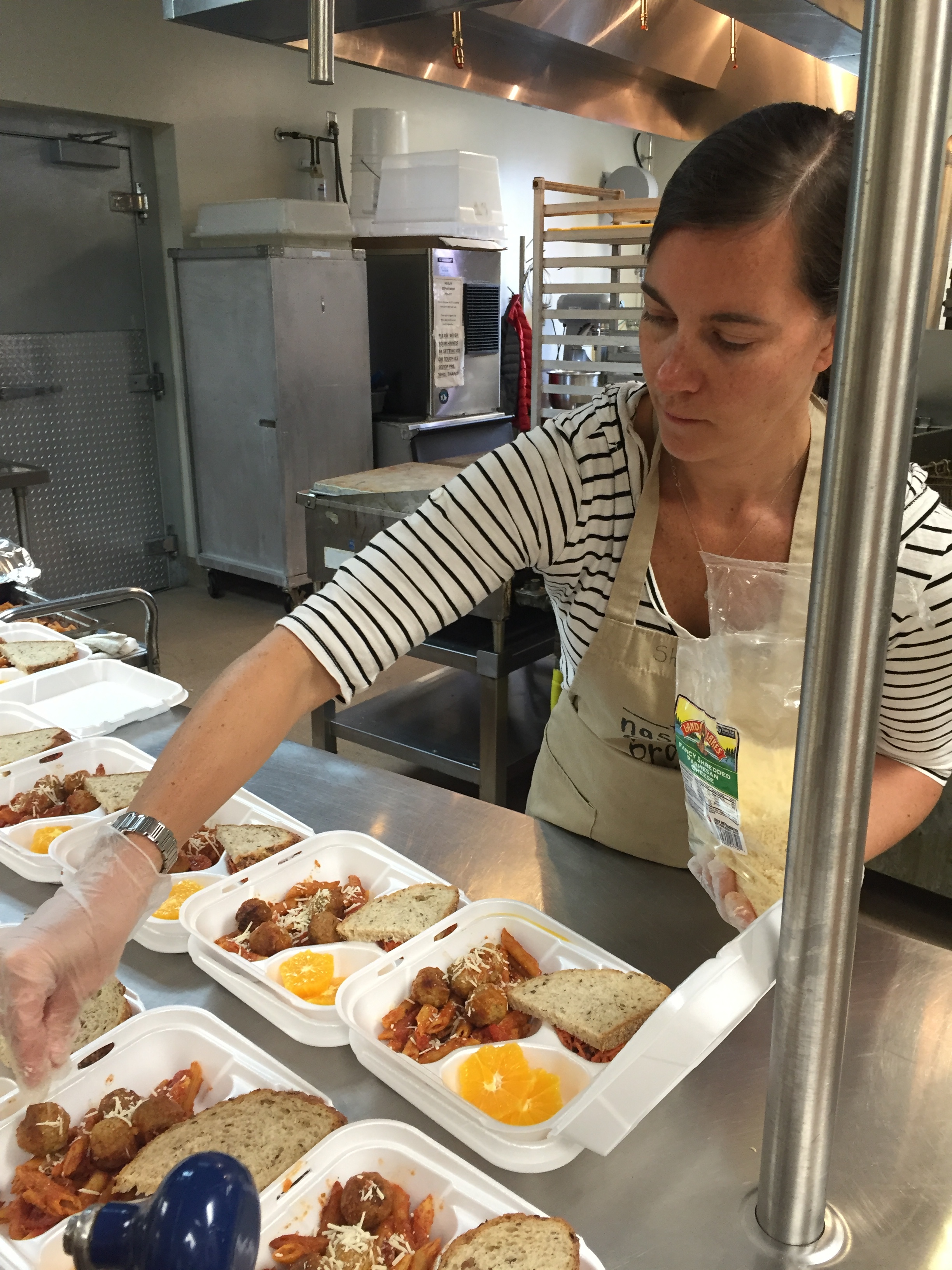
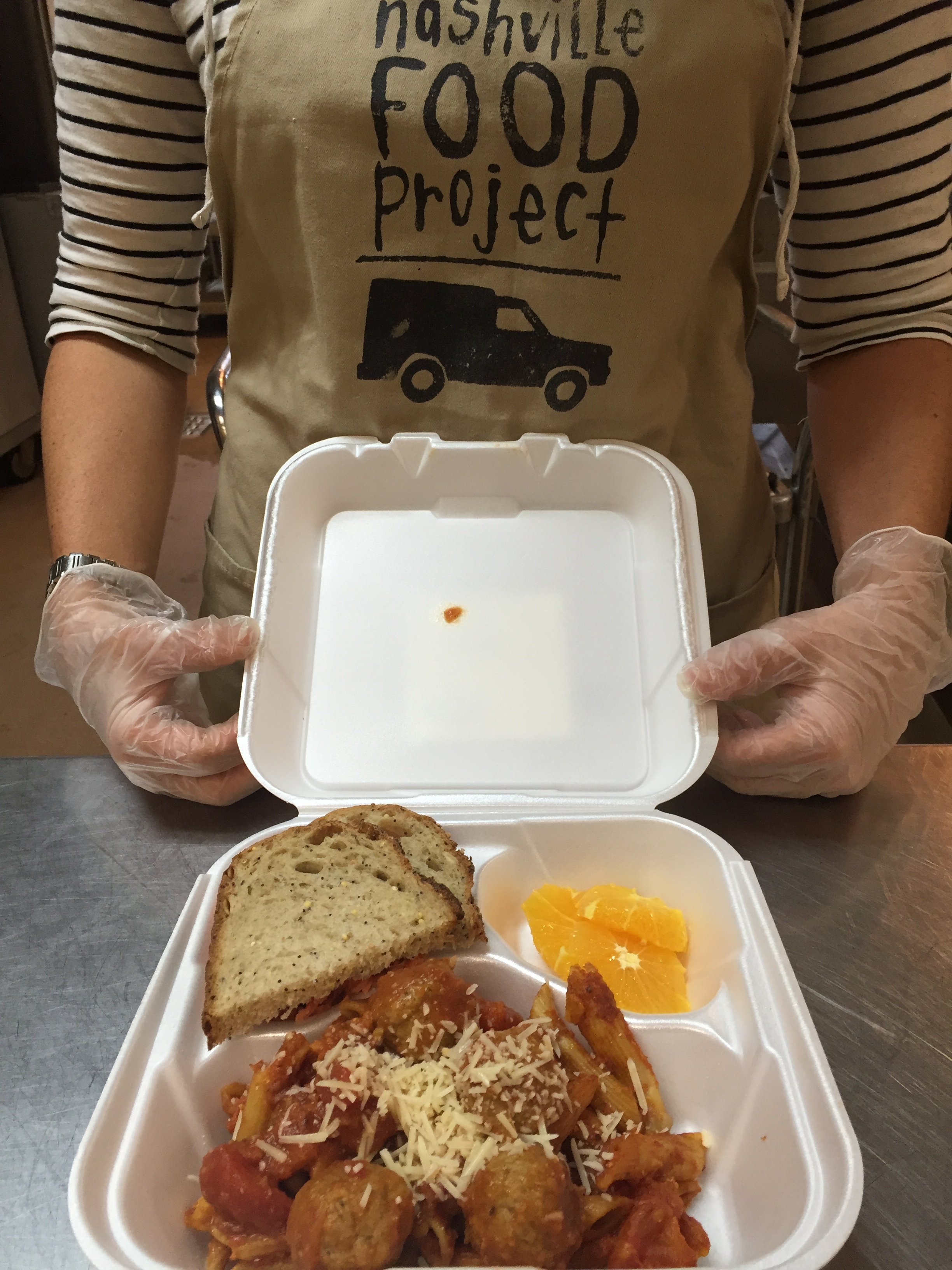
At 10:15 AM, St. Luke's mobile meals volunteers arrived to pack up the lunches and begin deliveries to seniors throughout the community. We loved sharing with these volunteers a bit about TNFP and learning more about why they give their time to this vital program at St. Luke's.
By 10:30 AM, all of the mobile meals were out for delivery, and our volunteers had some time to begin prepping for afternoon snacks for the preschool and other meals later in the week. Here's Shellye and Debbie prepping kale from our gardens for Thursday's meals.

At 11:00 AM, we begin serving lunches to the preschool classrooms. At this point, we've already served 200 meals, and it's not even noon yet!


Here's Sarah loading up a cart to deliver meals to classrooms.

And here she is setting up lunch in one of the preschool classrooms. There, the teachers will portion the food out and serve the kids this yummy lunch.
Once lunch is served, we clean up before the staff take a much-needed break. Then at 1:00, we begin prep for the last meal of the day - snacks! Today, the preschoolers are getting some of those healthy snack packs of cheese and crackers Ann prepped earlier along with some apples that Sarah slices before serving at 2:00 PM. Once snacks are served, the staff preps meals for the following day before cleaning up and heading home at 3:30 PM.

And that's a wrap! In our first day at St. Luke's we served 260 meals! We are so excited for this new partnership and how it will help us grow our reach in this community. We're honored to partner with an organization with a long history in the city of Nashville, and we can't wait to see all that this partnership will hold for the future of TNFP. For more information on this partnership, please contact us at info@thenashvillefoodproject.org. Be on the lookout for volunteer opportunities to open up shortly!
Unique New Meal with Friends
This February, TNFP began providing lunches to Friend’s Life Community, a nonprofit that empowers adults with intellectual and developmental disabilities, their Friends, to live as independently as possible as they age out of other support services…
This February, TNFP began providing lunches to Friend’s Life Community, a nonprofit that empowers adults with intellectual and developmental disabilities, their Friends, to live as independently as possible as they age out of other support services. Their mission is to create opportunities for teenagers and adults with disabilities to develop socially, grow personally, and enjoy community as they experience life together.
TNFP’s first question for any new, prospective meal partnership is “how can food support what’s going on in your community?” For Friend’s Life, this question had a unique answer.
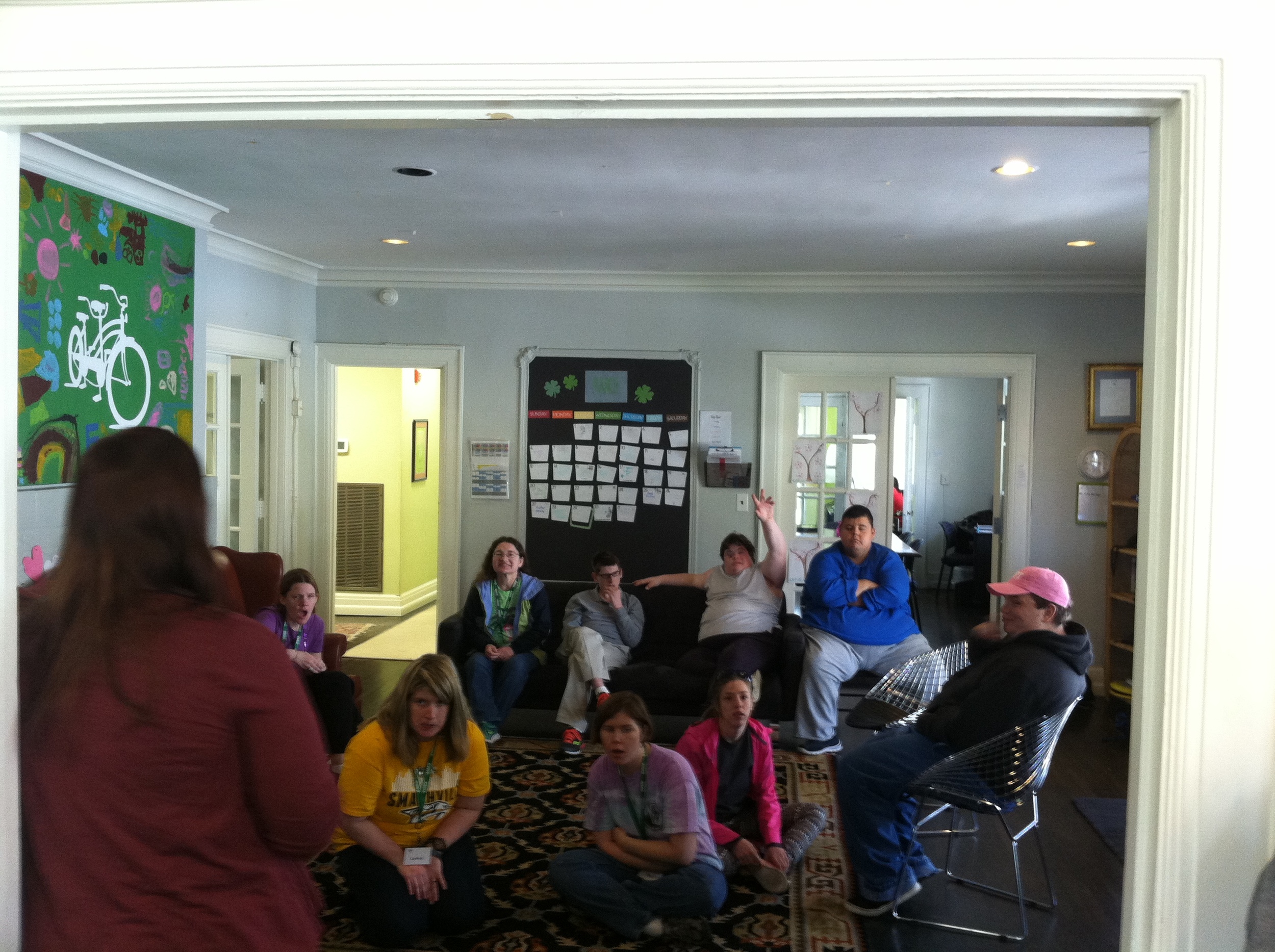
A big part of Friend’s Life programming is to get Friends out in the community to practice daily life skills. When the Friends were going out together to restaurants, the staff saw that ordering food was a big challenge. They had an idea to set up a simulation in their own facility that would allow the Friends to practice social and money math skills.

“We wanted to set up the cafe because we saw some deficits and places that we could grow our social skills and grow our manners. This simulation is giving them the chance to practice that here before we take it back out in the community and see how we learned,” said Jenna Sutter Brown.
“We’re taking things step by step,” she adds.
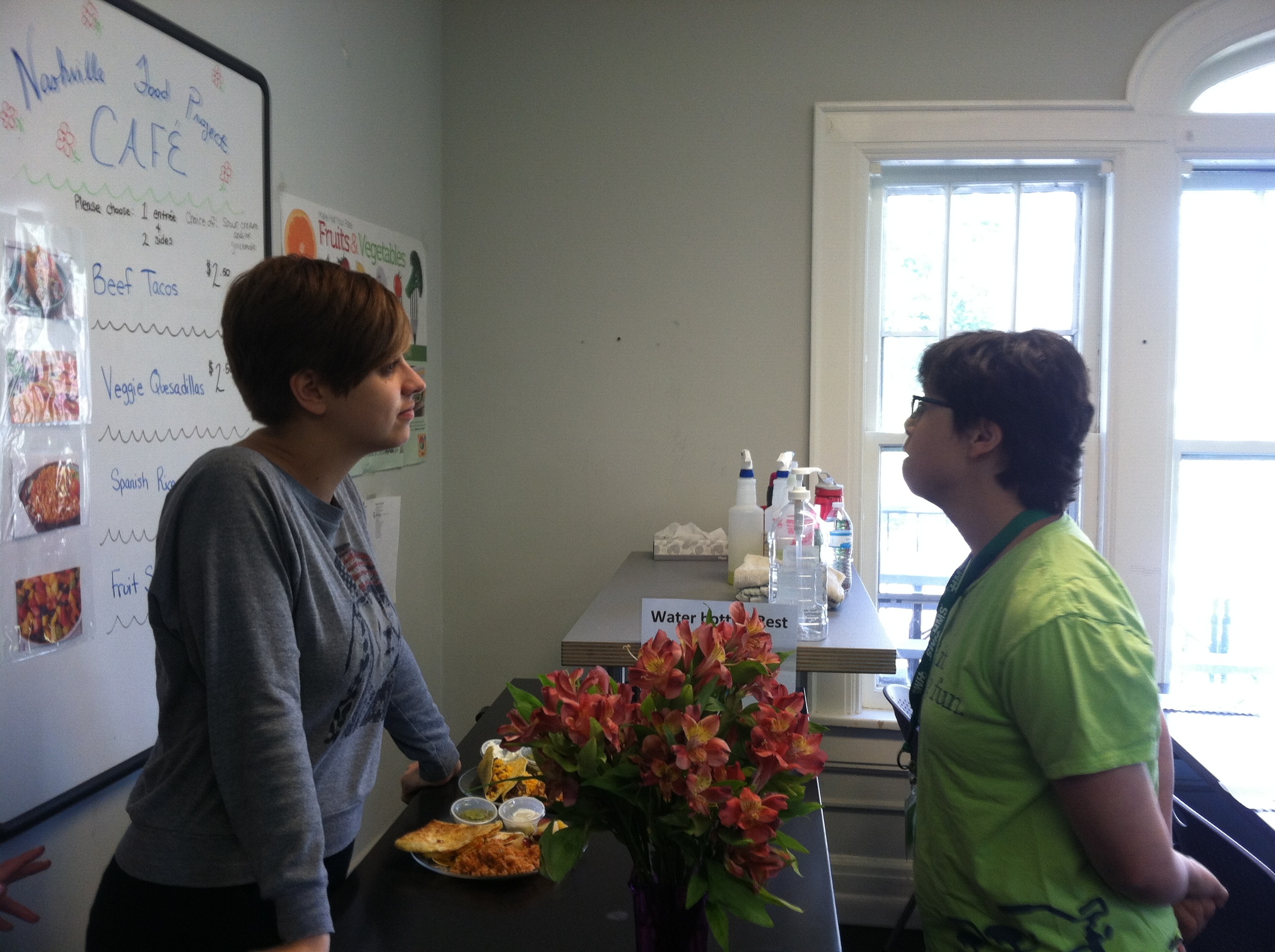
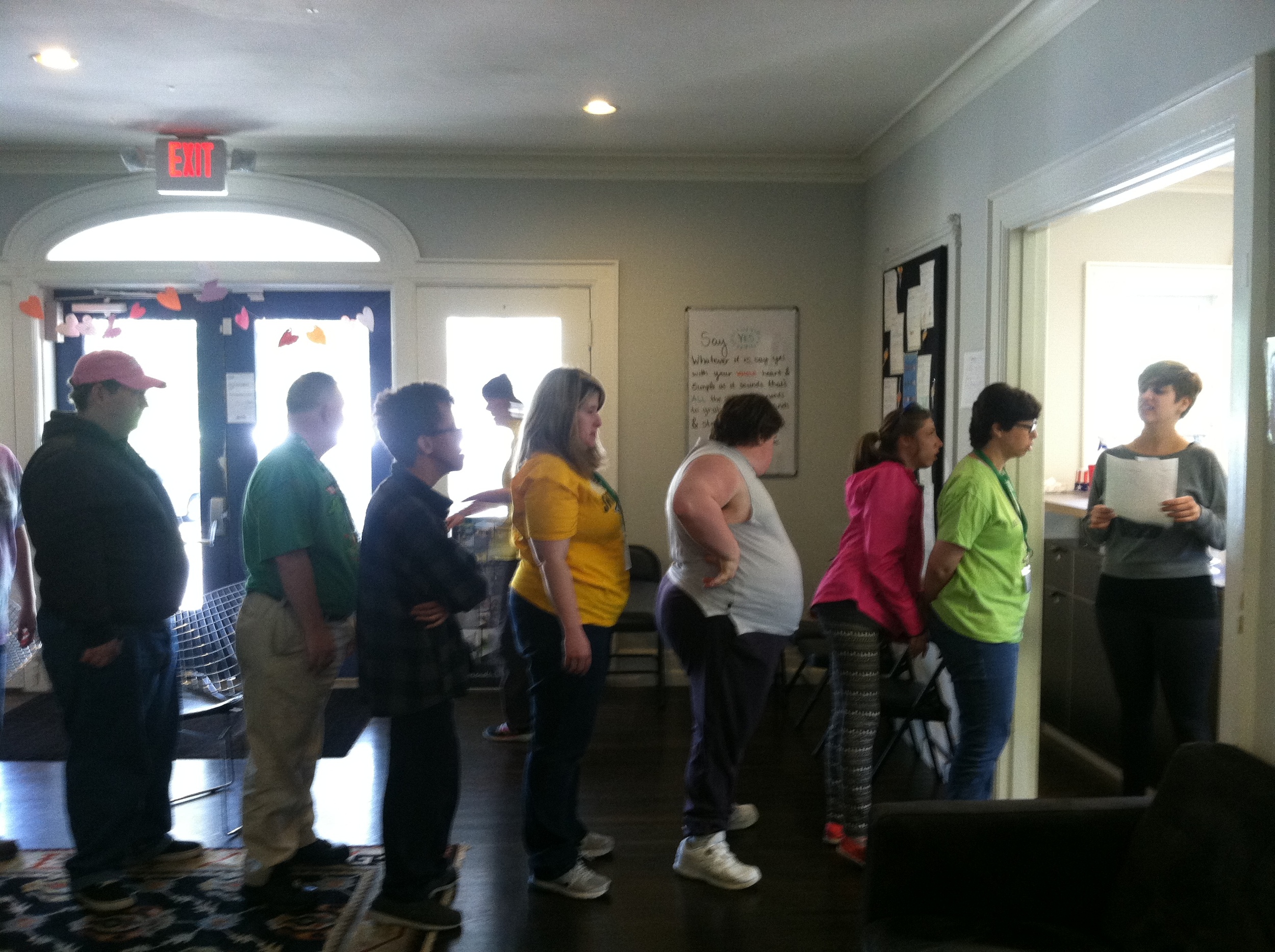
At first, Friends were asked to choose between two entree options for lunch at the cafe they set up in their facility. Now, the Friends are placing their order from a menu with a cashier. Friends line up and order one at a time, and then pick up their food from “the kitchen.” The next learning objective Friend’s Life staff plan to implement is to simulate payment by pre-loading debit cards for Friends to use at the counter. Eventually, they hope to help each Friend develop “go-to” orders for several restaurants in town, even making cards with pictures of food for those Friends with limited verbal skills.
TNFP’s relationship with Friend’s Life began with the Friends volunteering in our gardens. “Not being able to see the reward right away is tough…Now we have the connection between all the work to what actually ends up on their plate. It brings it full circle for them,” Jenna tells us. Much of the produce the Friends help grow in TNFP's gardens end up in their meals.

Health concerns can be a challenge for those with intellectual and developmental disabilities, so encouraging nutrient-dense foods is a priority at Friend’s Life. Staff have long emphasized healthy choices, but since Friends would bring their food from home they weren’t able to introduce new foods.

Jenna explains, “This gives us a little bit of control, knowing that (TNFP) is going to provide us with something that is filled with colorful, rich, vitamin-filled good food. That gives us peace of mind. We’re seeing that if we give them the option, they’re willing to try new things and actually like it.”
The ability to provide a nutritious meal is part of our mission, but knowing that Friends Life takes it further within their community by linking the meal to skill development is immensely gratifying.

Holy Canola Oil!
If you haven't met loyal TNFP volunteer and board member Judy Wright, then you are missing out! Judy cooks regularly in our kitchen and she shares with us so many great recipes (Judy's Mom's Meatloaf, anyone?) and tips for the kitchen and garden. Judy regularly shares her impressive knowledge through her blog at JudysChickens.org, and periodically we'll be sharing some of those posts. Today we've got a great post on how canola oil is made, featuring one of TNFP's newest food donation partners Solio.
Last April, I wrote a story about the gorgeous yellow fields of canola that were growing along I-24 in Cadiz, Kentucky. You can read all about it and see the photos here.

This is Part 2 of that story. The part where after seeing a dramatic increase in the number of yellow fields from the year before, I called the plant manager at the AgStrong Canola and Sunflower Seed Processing Plant in Trenton, Kentucky and asked, What gives? Why are we suddenly seeing yellow everywhere? When he started to explain, I realized I had a lot to learn and asked if I could drive over to meet him and get a tour of the plant. An hour later Mark Dallas was giving my husband and me a tour. Not exactly the way I thought my day would turn out, but I do love a good backroads detour.
As background information, can-o-l-a oil, or “Canada-oil-low-acid,” is made from crushed canola seeds. These seeds are about the size of poppy seeds. Even having seen how canola oil is extracted from the seeds, I still shake my head in disbelief that anything that small could produce so much of something as useful as cooking oil.
A very short botany lesson about plant reproduction:
Flowers have one job, and one job only: to induce reproduction. To that end, flowers that are fertilized will make seeds. Those seeds will make new plants. That the plants grow and produce tasty fruits, vegetables, and kitchen staples like canola oil, is bonus. Those fruits of the plants are just ripened ovaries full of seeds. Their flesh is sweet so animals will eat them and disperse the seeds in their travels. Tree nuts work in the same way; Mother Nature is counting on squirrels to bury the nuts and thereby assure there will be more trees in the future.
Back to canola flowers and seeds. Like winter wheat, canola is planted in the fall, sprouts then go dormant in the winter and perk up again in early spring. It flowers in mid-April, and the seed pods are harvested in mid-June. Farmers like to grow winter wheat and canola because then they can double-crop their fields, meaning there is time left in the warm months to raise another crop, such as soybeans, in that same field. By comparison, in most northern climates, there’s only time to grow one crop like wheat or canola.
The photo on the left was taken from a stem of canola flowers on April 17th. The photo on the right was taken on June 12th, just a few days before the pods were harvested by the combines I wrote about in this article.


You may have seen similar seed pods develop in your own gardens if you ever let broccoli or bok choi plants flower and “go to seed.” If you look closely at the flowers below, you can see the early development of seed pods. They look like little spikes. Canola is in the same Brassica family as bok choi and broccoli.

The next photos are of fully mature canola seed pods that I dissected at home to release the seeds within. You can see how small these seeds are. It’s amazing to think cooking oil is extracted from them.


AgStrong contracts with local, family-owned, farms to plant nonGMO canola seeds in their fields. NonGMO means the seed’s genetic material has not been manipulated in a laboratory through genetic engineering to make it more disease or insect resistant. A few other tidbits I learned about growing canola: canola has a 5-6 inch tap route which acts as a natural tiller in the soil, and canola brings in $8.10/bushel compared to wheat’s $5.25/bushel.


Here is a photo of the canola oil processing plant in Trenton, KY.
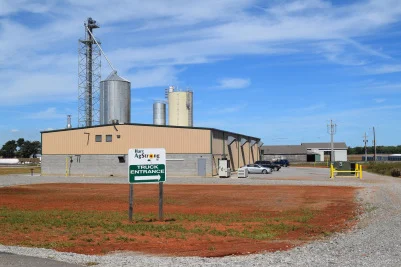
It takes a lot of seeds to make canola oil and these fifty-foot silos are full of them.

This is what the inside of one of those silos looks like.
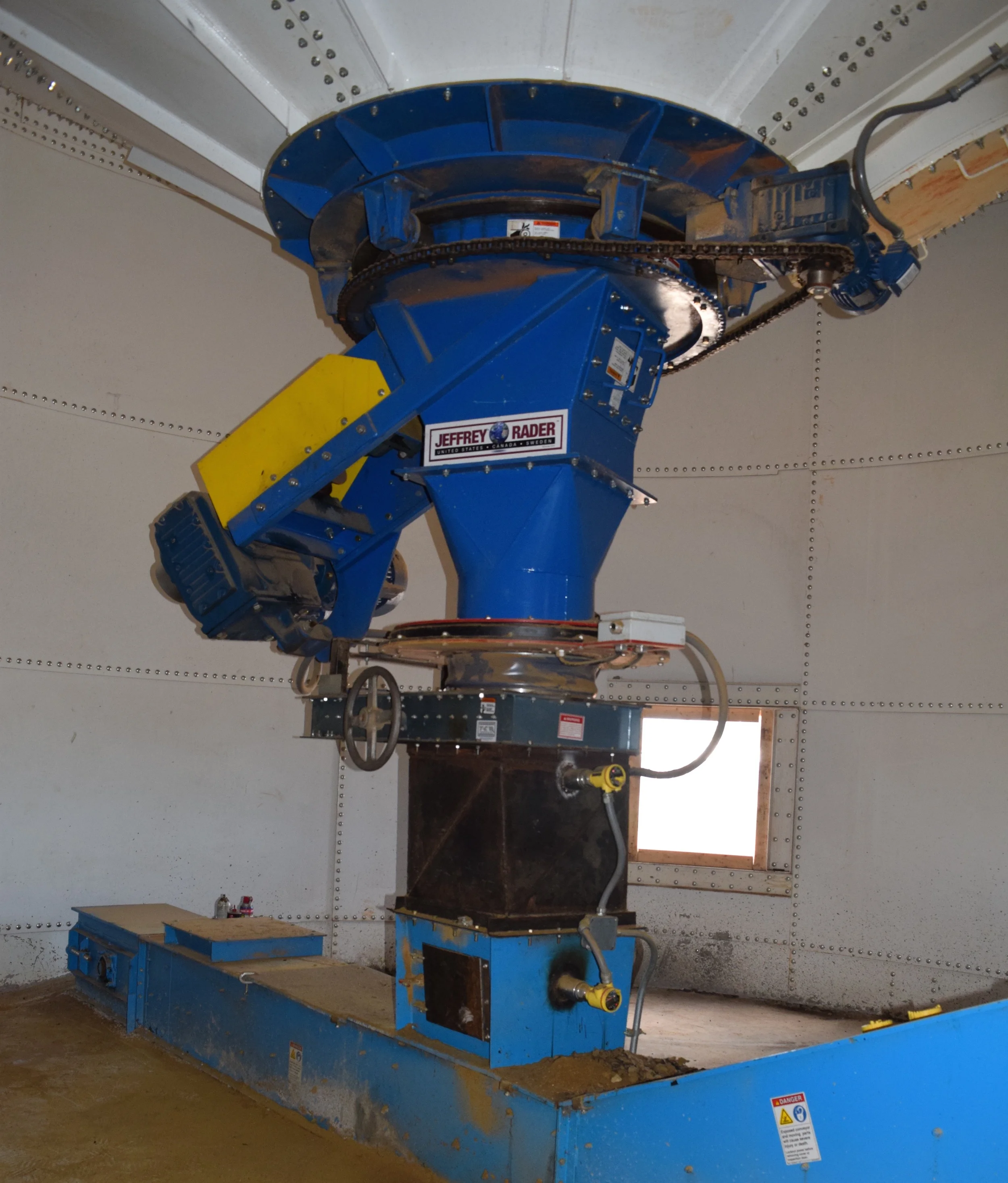
The first stop on the tour was the long silver cylindrical oven used to warm the seeds to no more than 120º. Warming the seeds made them easier to press. The low oven temperature kept the process in the category of cold-pressed. The blue conveyor belt brought the warmed seeds to a machine that cracked the hard outer shells.

Next stop was the seed crusher. This was where the magic happened. This machine crushed the seeds and expelled the golden canola oil into the blue well. The oil will still need to go to an offsite refinery before it can be bottled.
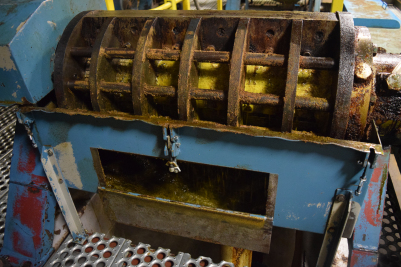
Here was the residual seed meal as it dropped onto a conveyor belt.

This meal was delivered to the green machine for a second pressing to remove the last traces of oil. At this plant, there are no chemical solvents, like hexane, used to extract these last drops of oil. That’s where the expression “all natural expeller press” comes from.
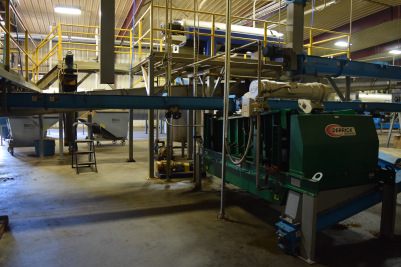
Here’s the residual meal as it came off the conveyor belt after the last of the oil had been pressed from it. The meal is used to feed livestock.

This is the transport room. It’s where the seeds, collected from farmers, are gathered and delivered to the silos for storage. And later, after pressing, where the extracted oil is weighed and distributed, via trucks, to be delivered to Georgia for the final refining process and …

bottling. You can find Agstrong’s Solio Canola Oil at Whole Foods stores.

But the story doesn’t end there. As a volunteer chef and Board member of The Nashville Food Project my antennae is always up for opportunities for food donation and food recovery. Canola and olive oil are two expensive staples we use in abundance at TNFP. I asked if Agstrong would consider partnering with us and donating their locally grown and manufactured Solio oil to TNFP, which they have graciously done. Here was the Plant Manger, Mark Dallas, donating a 35-pound container of oil to TNFP, on the spot.

And that’s how this one little detour ended up providing cooking oil for TNFP whose mission is “Bringing people together to grow, cook, and share nourishing food with the goals of cultivating community and alleviating hunger in our city.”
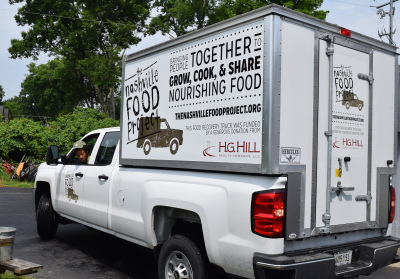
The story, however, didn’t end there, either. I happened to “pull” a few young canola plants from the side of the road last April to plant in my vegetable garden, so I could watch and learn how these plants matured to the seed stage. Once the plants produced seed pods and dried out, I was pleasantly surprised to walk out to my garden one day and see my chickens poking their heads through the chicken wire and eating the canola seeds.


Looks like Agstrong’s byproduct of meal for livestock was a winner.
Thanks to Mark for the tour and to Mike McAdaragh, Agstrong’s Crop Development Specialist, for personally delivering canola oil to The Nashville Food Project.
A note to readers:
Thank you for reading my blog! Please consider subscribing by pushing the FOLLOW button. If you are reading this post on a laptop, the FOLLOW button can be found in the sidebar on the right side of the page. If you are following on a mobile device, you’ll need to scroll down a few posts to get to the FOLLOW button. If you do sign up, please be sure to complete the next step of checking your email for a confirmation letter that requires you to push one more button.
You can also follow me on Instagram: @JudysChickens
The best way to show any blogger you enjoy their posts is to write comments, share their posts and become a follower.
Thanks for following my blog! Judy
Reblogged from JudysChickens.org © 2016 Judy Wright. All rights reserved.
Guest Chef Series: Owen Clark of Rolf and Daughters
Owen Clark came to Rolf and Daughters as Chef de Cuisine a year and a half ago after a cross-country road trip led him through Music City. The Colorado native had been working in New York City for the past several years and wanted a change…
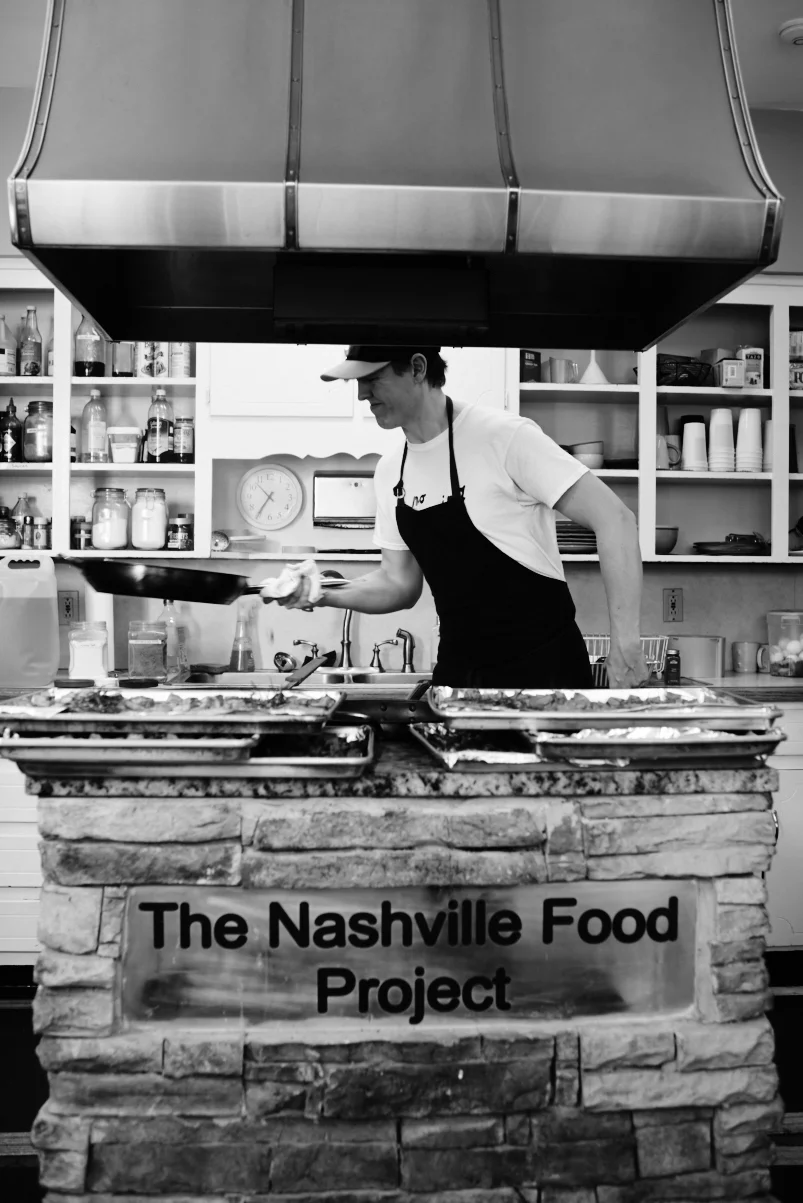
Chef Owen Clark of Rolf and Daughters working in The Nashville Food Project kitchens. Photo by Danielle Atkins.
Owen Clark came to Rolf and Daughters as Chef de Cuisine a year and a half ago after a cross-country road trip led him through Music City. The Colorado native had been working in New York City for the past several years and wanted a change.
These days, he's certainly found it. He can go two-stepping when he wants. He bought a kayak. He even started tooling leather, a hobby that’s more related to his profession than might initially appear.
“Growing up with horses on a horse ranch and being around that as a functional art form is a lot of what speaks to me about cooking,” he says. “It has to be functional. But it also has to be exciting and delicious and appealing. And I think leather is the same thing. You’re working with your hands, so you get to zone-out and focus and make something that’s really beautiful. But if it doesn’t fit, it’s pretty useless.”
Attention to function and flavor might be part of why he rocked it as part of our Guest Chef Series at TNFP. When he visited with his girlfriend and photographer Danielle Atkins to make a meal during one of the volunteer cook shifts, he transformed donated, garden-grown and gleaned ingredients into a dish of chicken, sweet potatoes, apples and curry. He spotted the greenhouse out back and clipped parsley and leaves from a lime tree. “That’s one of things that inspired me to change up what I thought I was going to make when I looked at the ingredients available,” he said.
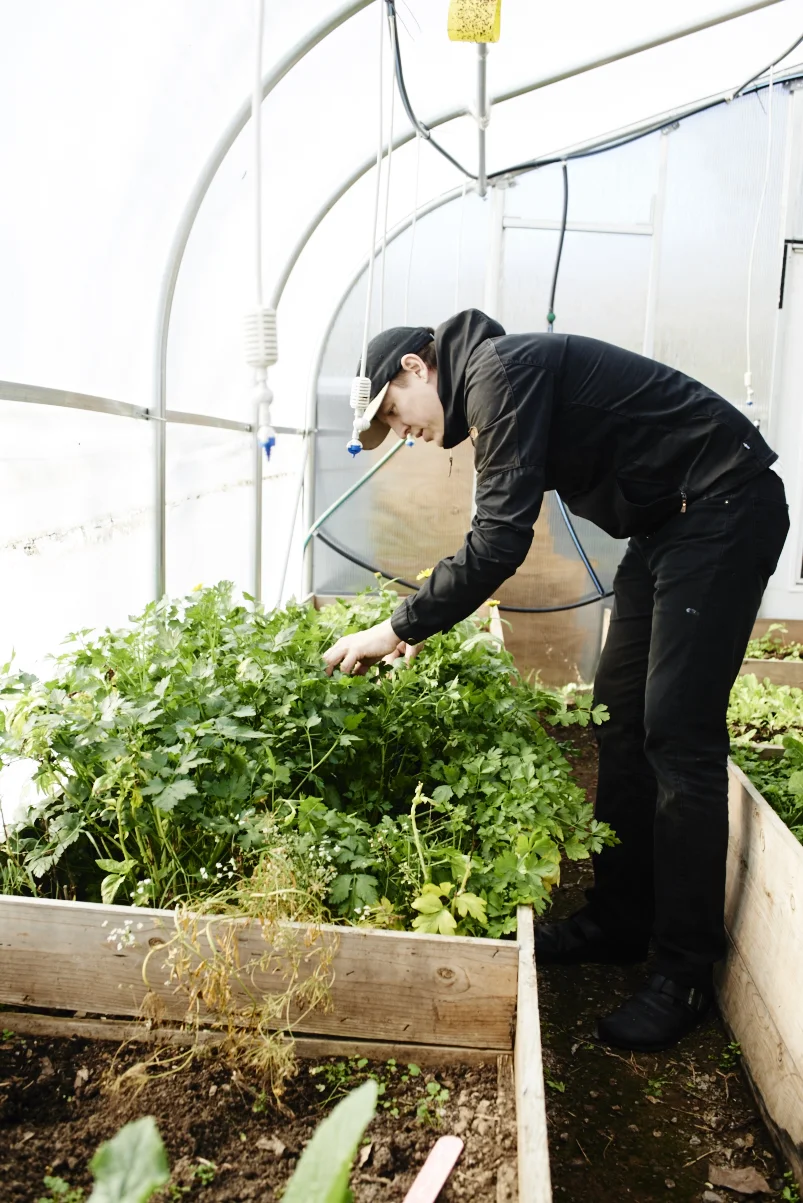
Owen in TNFP's greenhouse. Photo by Danielle Atkins.
With the leaves, he made a lime, garlic, balsamic and soy vinaigrette for charred broccoli.
For wilted curly kale salad he added the chopped flat-leaf Italian parsley with the stalks folded in, too, that were large enough to be “like their own vegetable.”
Using all parts of the parsley from the garden helps demonstrate Owen's commitment to not wasting food.
“Every day I’m trying to find ways to use everything,” he says. “From a business standpoint it’s like, ‘Okay, that’s money in the garbage,’ and that’s one way to look at it. But also it’s heartbreaking to see something go in the trash. The more you know about farming and what you can do with certain things, the more you see it as a wasted opportunity and wasted work. So many hours and heart and hard-ass work went into taking this from dirt to product to what could be food. Along the way if you haven’t done your best to make it something better then you’re really doing a disservice.”
Also from a professional standpoint, Owen said he has spent much of his time hidden in a kitchen and cooking for a more exclusive clientele at places like wd-50, A Voce and Blue Hill in New York as well as Rolf and Daughters. Stepping out to cook at The Nashville Food Project gave him an opportunity to use his skills and talents for a different audience of about 70 low-income residents at John Glenn retirement home.
“It gets to a point where you want to make food for the people who need it in a way that’s still delicious and good for you,” he says. “And it’s nourishing for your soul to do that as well. That’s what I’ve been looking to do in some facet."
“That’s one of the reasons The Nashville Food Project appealed to me the most. I want to do that and feel good about what I’m making for the people who need it.”
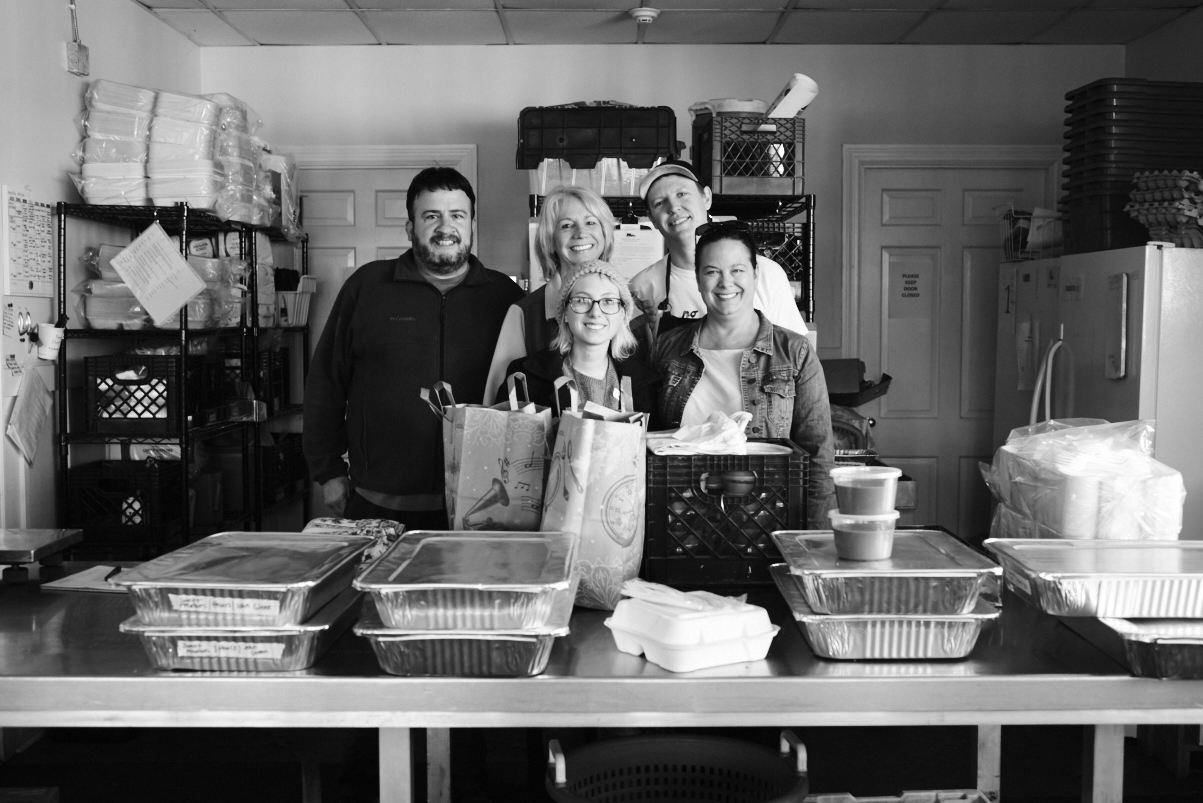
Owen handing off his meal to the truck delivery team. Photo by Danielle Atkins.
The Seed is in the Ground
Good morning, friends!
Those of you who have spent some time at The Nashville Food Project know there are a lot of moving parts to our programs. Navigating the year-over-year growth of our organization and the day-to-day operations takes both planning and improvisation.
I was recently introduced to an internal food project document maintained by our indomitable meals team - The Meals Worksheet. This is a planning spreadsheet shared between six people with columns for rescued food coming in, menus going out, hiccups during volunteer meal prep, last minute ingredient switches, and the like. Here is a snapshot of what this document looks like in action:

Likewise, our garden team keeps a massive spreadsheet of plans for the various gardens we steward across the city, with columns for seed variety, greenhouse start dates for succession planting, row feet per crop, numbers related to yield, and more. Our garden team manages to this document with an impressive level of geeked-out detail. Here's a look:

These are just a couple of the tools we use daily to help us plan, communicate, and document the many changes that affect our work flow, our programming, and the good food going out into the community.
When you're growing, cooking, and sharing food for and with the masses, it's essential to make plans. Of course, our growing edge is not learning how to plan better, it's how to let go of the plan when a Pyrex measuring cup shatters into the tomato sauce 20 minutes before meal service or a group of volunteers pulls the strawberry plants from a garden bed instead of pulling the weeds. It seems like life’s best lessons are usually learned when things don’t go as planned.
I'm in awe of our devoted staff who keep well-managed plans and yet stay flexible to the inevitable curve ball, whether it's a bushel of fresh quince to be incorporated into a meal or a hailstorm in March. This work reminds us that we can usher our plans only so far before we must let go of the reins. Or as the poet Wendell Berry, who is so-often quoted in my columns, reminds us:
“The seed is in the ground.
Now may we rest in hope,
while darkness does its work.”
Grace and peace,

Meatopia is a Wrap!
Last week we had one of our largest gleaning opportunities of the year -- a meat conference at the Gaylord Opryland Convention Center -- an event we have fondly been referring to as “MEATOPIA”. We rescued a grand total of 11,000 lbs of meat from this event -- what will be used for many months to feed our community…
by Food Rescue Coordinator Christa Ross
I am generally amazed at the amount of time it takes to put out just one of our many meals. Of course there’s the prep time, the cook time, the drive time, and all of the logistics. All of these things, in themselves, take time, planning, and implementation.
But upwards and above all of these basic things that make up a meal, our mission incorporates the use of rescued and donated food as a central ingredient. Keeping down costs means more, high quality meals going out to our communities. It also means less food waste heading to the landfill. I love this idea -- in the midst of our societies abundance, as we are surrounded, out of sight, by the hungry and under represented, all food should play a part in feeding our community.
Last week we had one of our largest gleaning opportunities of the year -- a meat conference at the Gaylord Opryland Convention Center -- an event we have fondly been referring to as “MEATOPIA”. We rescued a grand total of 11,000 lbs of meat from this event -- what will be used for many months to feed our community. What an amazing gift.
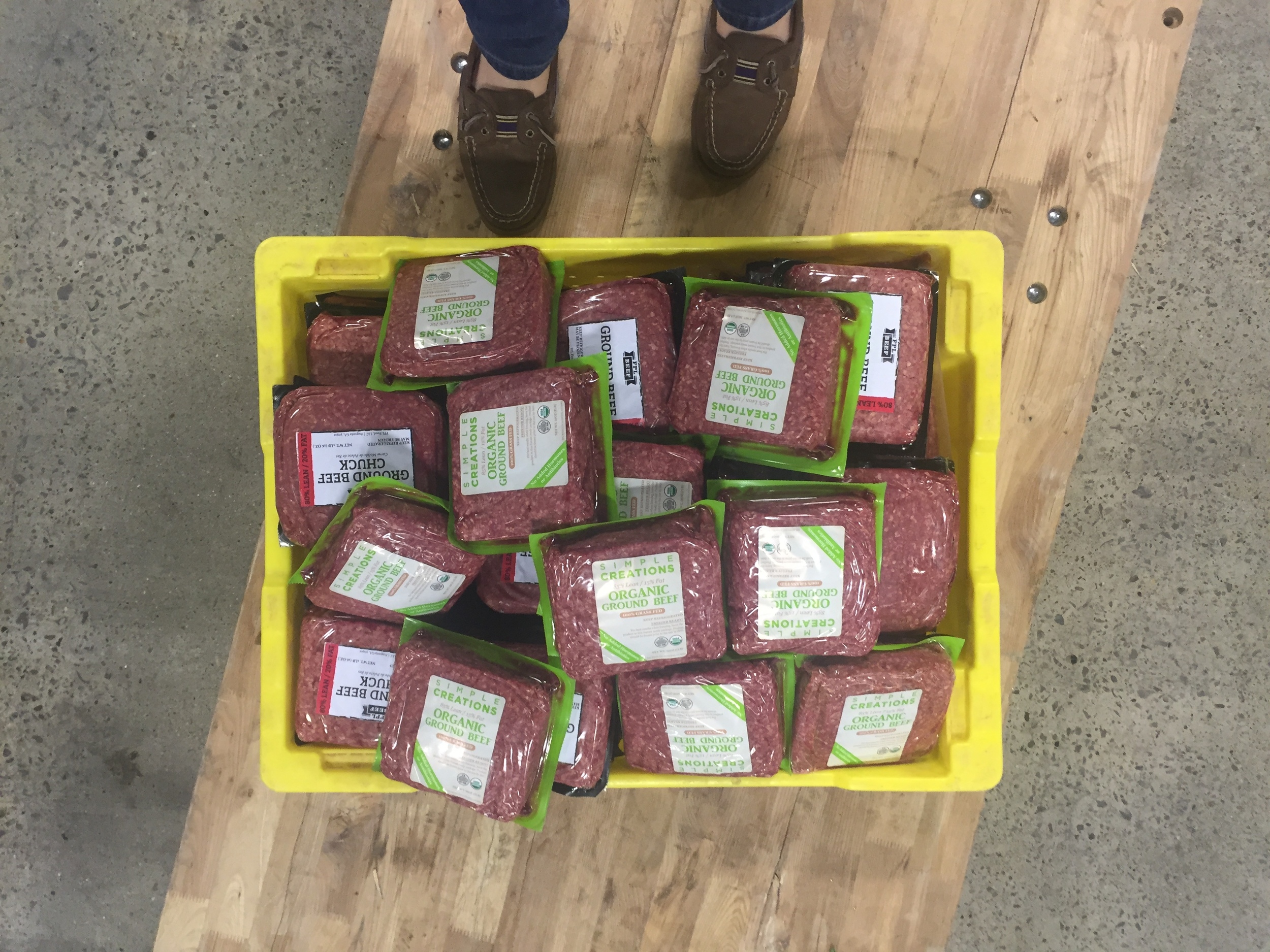
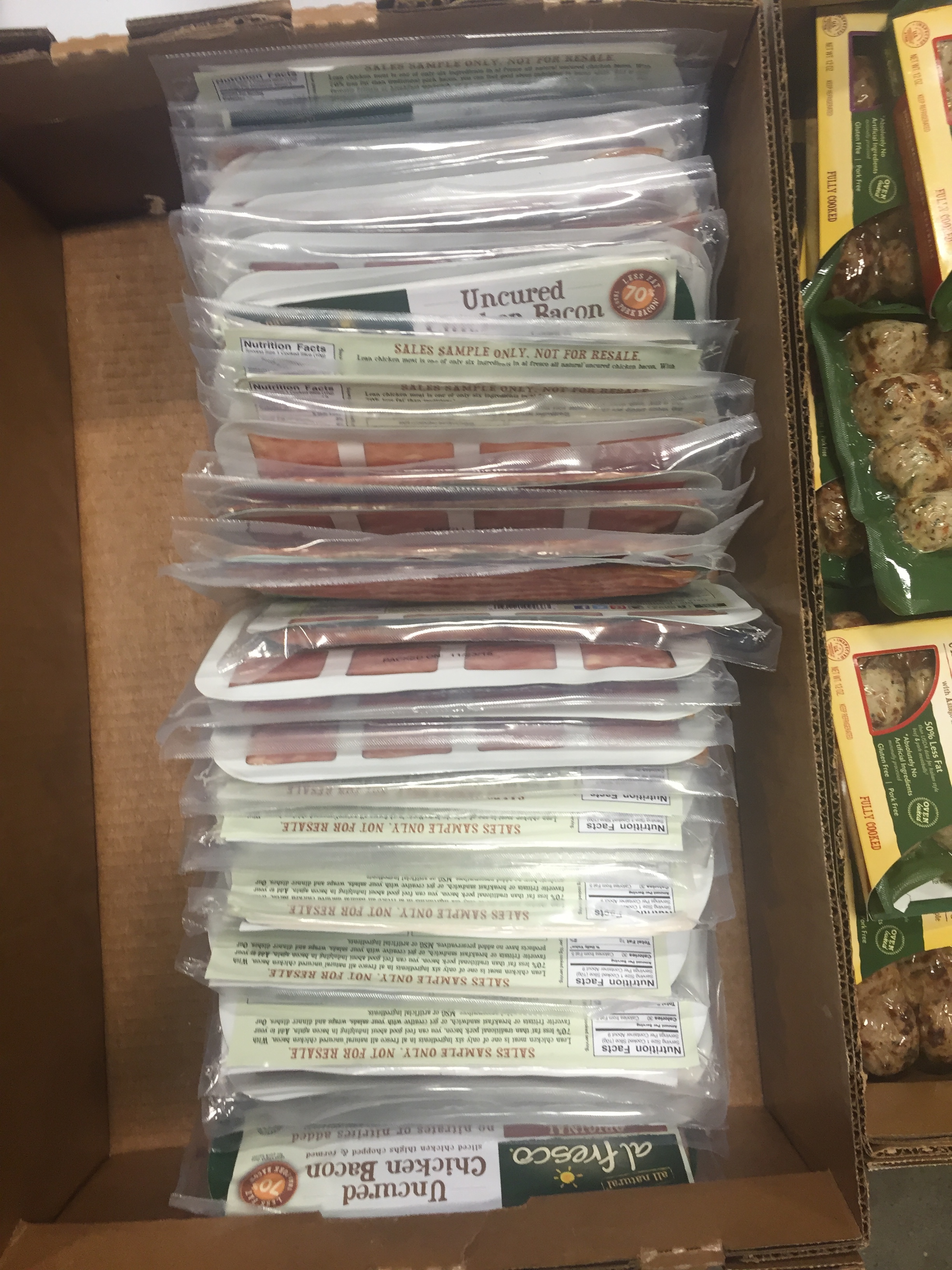
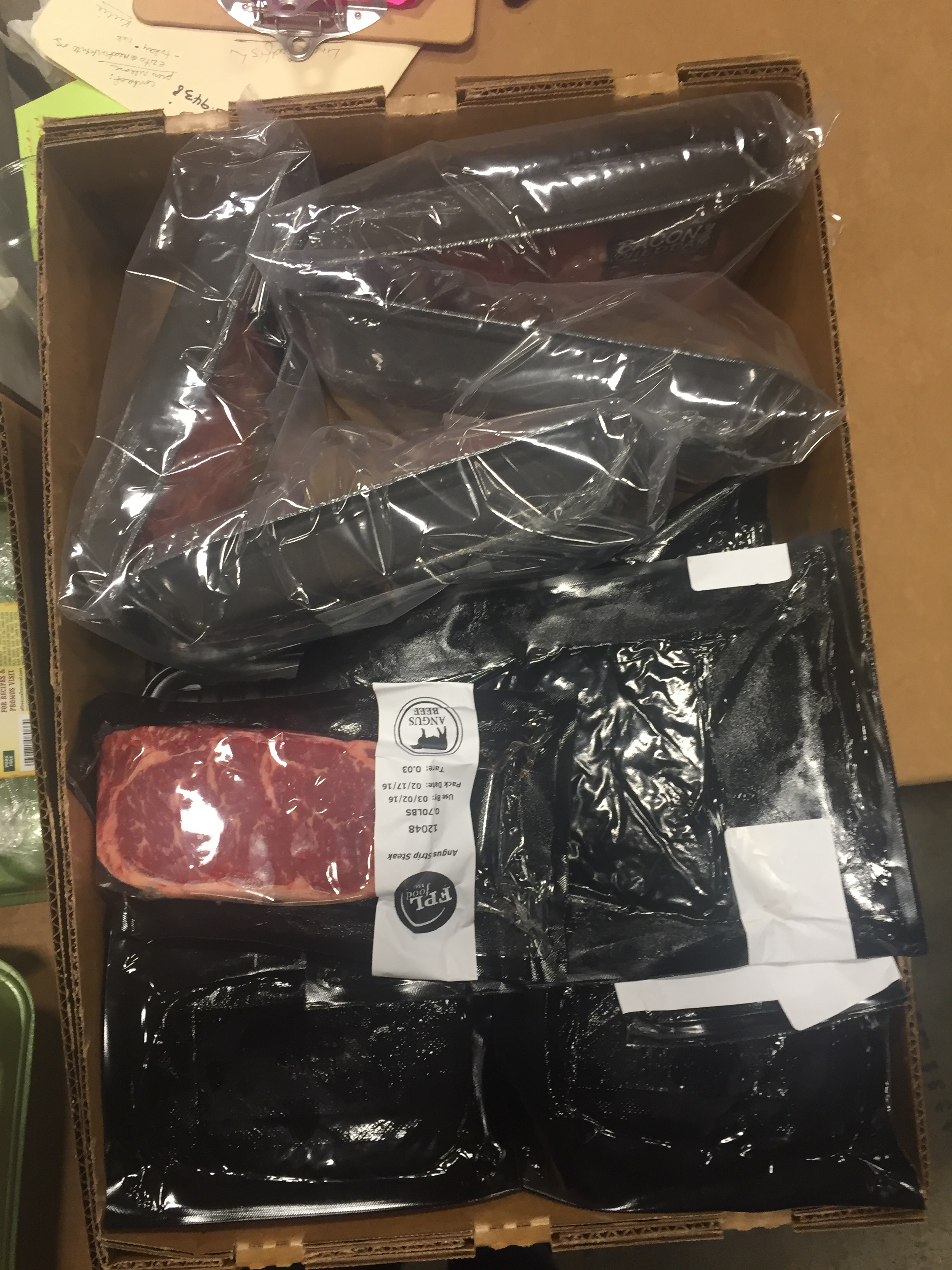
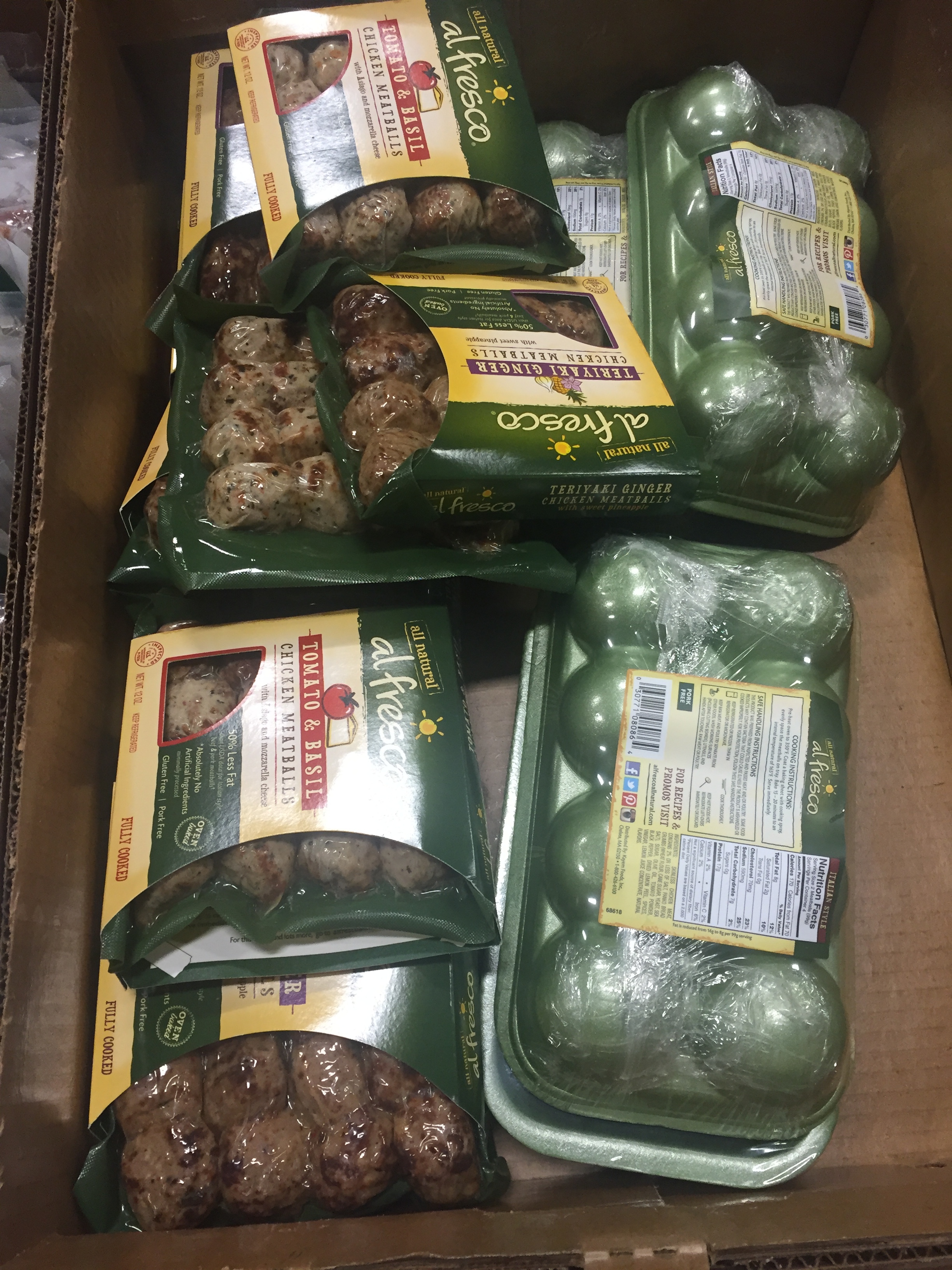
The planning for this event included many meetings and emails, volunteer wrangling, one of the most intricate colored duct-tape inventory systems I’ve ever seen, and a truck load of wax boxes. We also pulled together 5 trucks for hauling the meat and ended up filling two walk in freezers (stacks of boxes everywhere) and three pallets full stored in a warehouse freezer.

The evening starts with a massive room full of displays like this one. We send teams around the room collecting all of the meat and bringing it back to our staging area to be sorted and transported to our kitchen.

Here's where the duct-tape comes in. All of the meat gets sorted - chicken with chicken, beef with beef, bacon with bacon (and there's a LOT of bacon) - and then loaded up in our refrigerated truck and other volunteer vehicles to be taken back to our kitche.
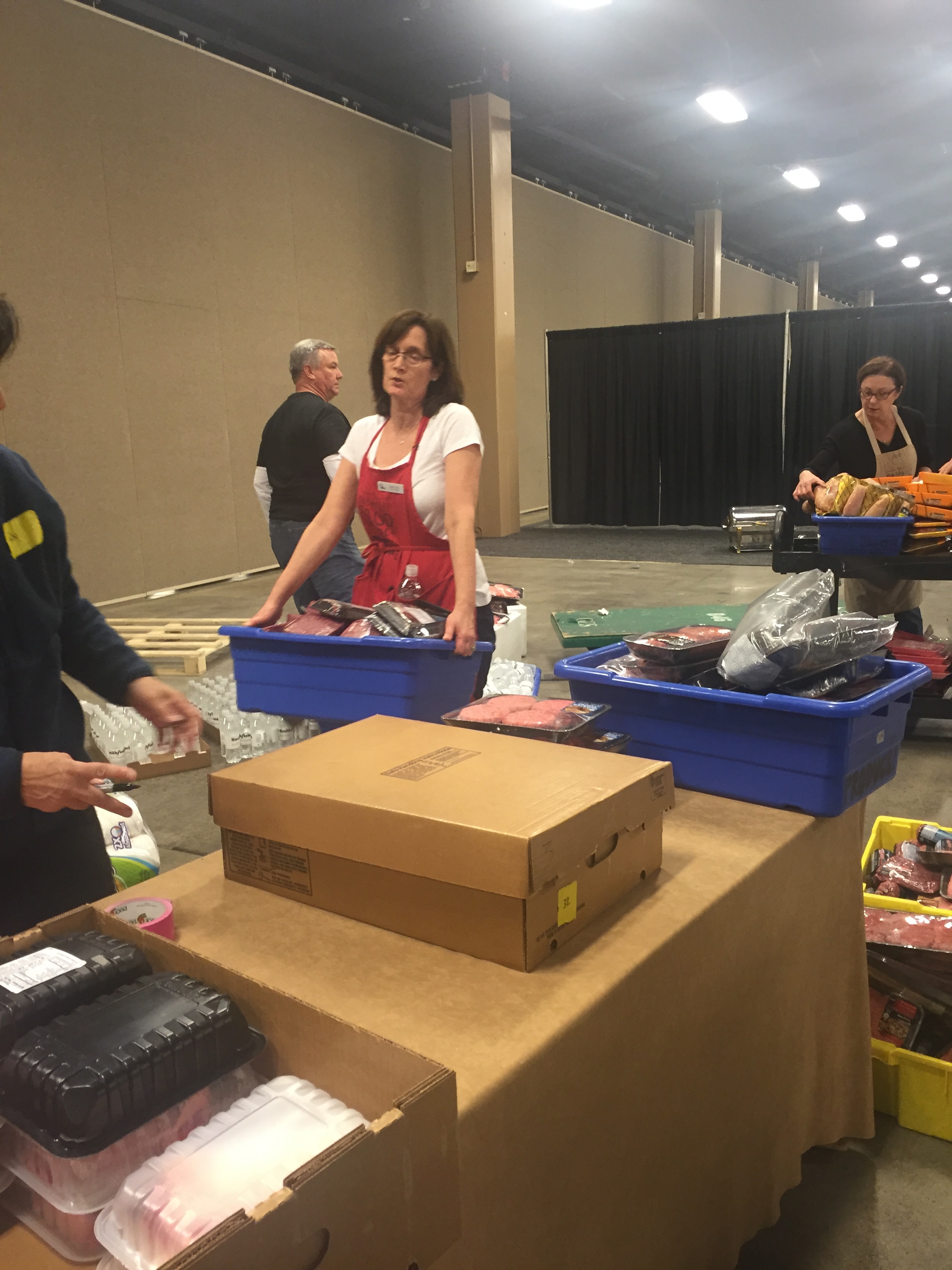
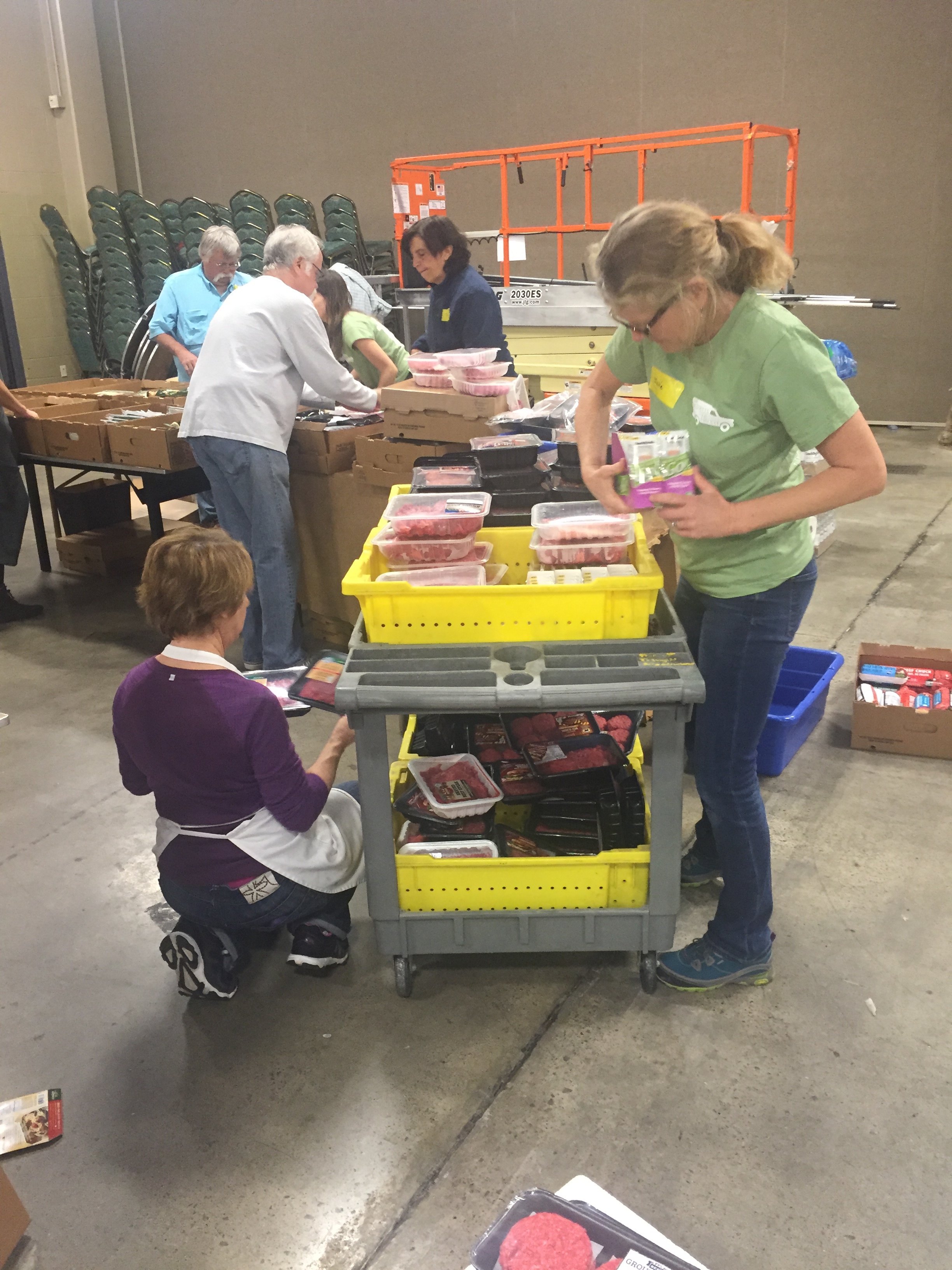
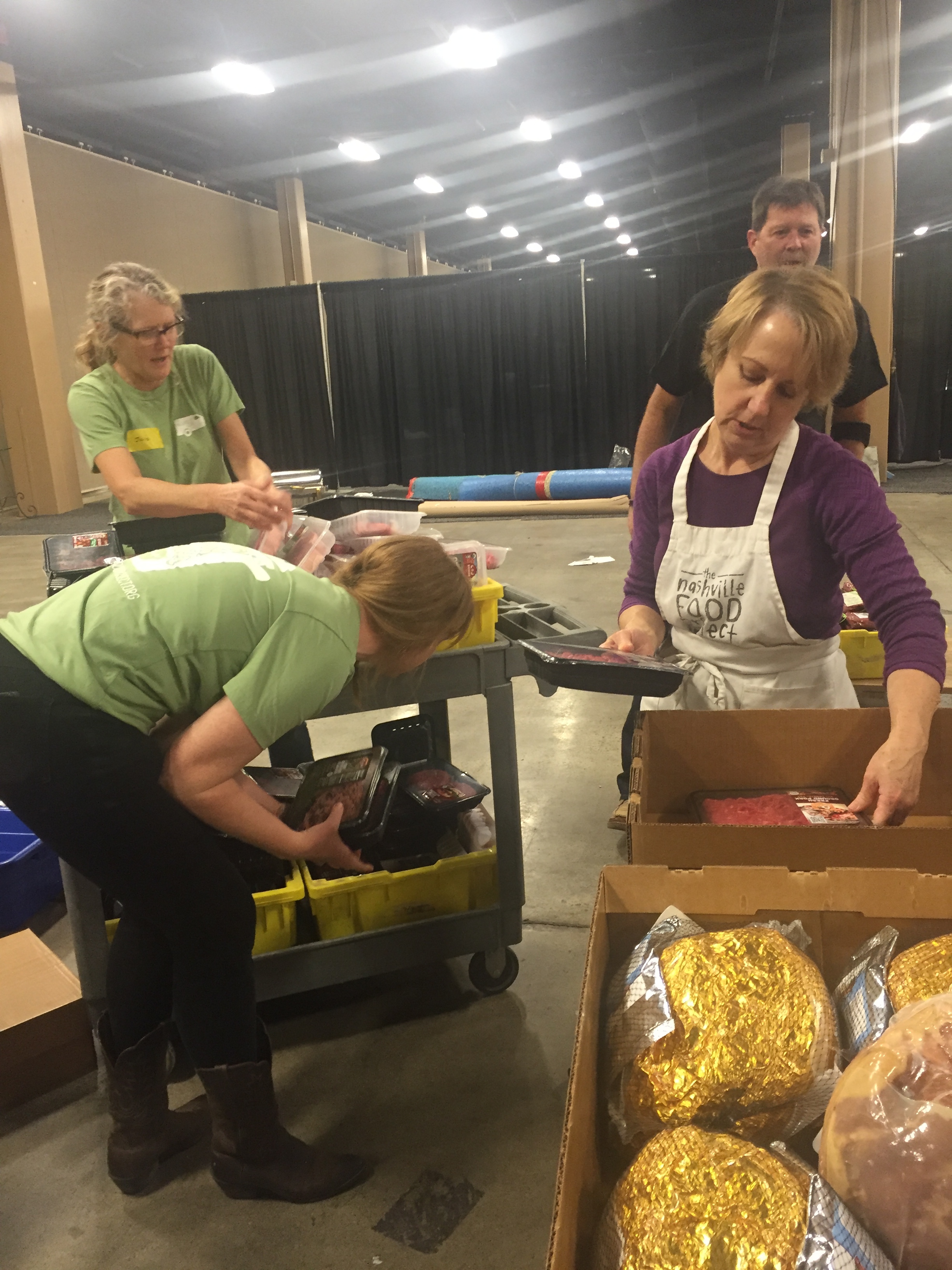
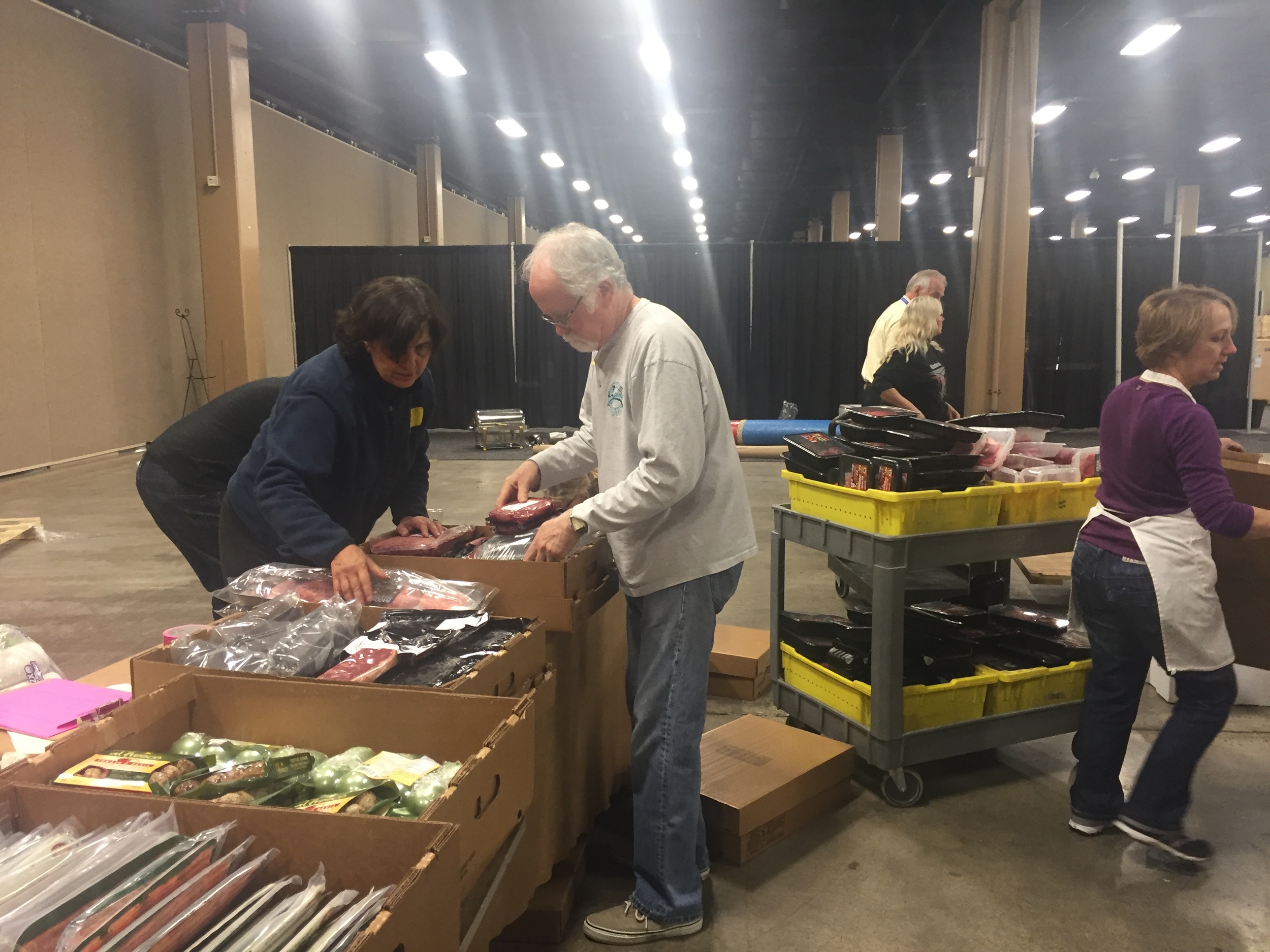
We are forever grateful to all of the donors at the convention, to Gaylord Opryland for letting us use their loading dock, to Nashville Grown for his wonderful refrigerated truck, and to Triumph and all other volunteers, without whom we could never have pulled it off. You all are amazing!

Just a few hours earlier, this room was full of meat. Thank you to the convention and Gaylord Opryland for allowing us to recover all of this great food for our meals!
A February Snapshot of Our Gardens
It’s starting to look like spring, a favorite time of year for all of us on the garden team. This is a time of year when all of our planning over the winter can finally start taking shape. Here’s a look at what we’re up to in the TNFP gardens this month written by our Garden Manager Christina...

“We are here to awaken from the illusion of our separateness.”
It’s starting to look like spring, a favorite time of year for all of us on the garden team. This is a time of year when all of our planning over the winter can finally start taking shape. Here’s a look at what we’re up to in the TNFP gardens this month written by our Garden Manager Christina...
In February in The Nashville Food Project gardens we try to remember that it is still winter. Our garden crop plan for the year has hopefully been made and checked twice. Seeds have been ordered. Machines and tools are clean and tuned. Winter cover crops are growing slowly in the field along with beds of overwintering greens like kale and spinach. Potting soil and other garden supplies are stockpiled waiting for the signal to start planting. We do the essential February tasks of pruning fruit trees and brambles, direct seeding flowers that require cold weather to germinate (poppies and bachelor buttons), check on the bees’ honey stores and, if necessary, feed them. Spring is surely close at hand but we try to remember that we risk doing more damage than good by trying to work soils that are still cold and wet.

We anxiously await the end of the month, when we can start our first seeds in the greenhouse and begin preparing a few beds for our earliest vegetable plantings in March. The first crop we plant outdoors is the onion transplants that we’ve started in our greenhouse the previous November. Onions are soon followed by peas, lettuce and other leafy greens, and root crops that love the cool weather of early spring. By the end of the month, the greenhouse is full of crops that we begin indoors to get a head-start on the growing season - leafy crops like kale and chard and fruiting crops like tomatoes and peppers.
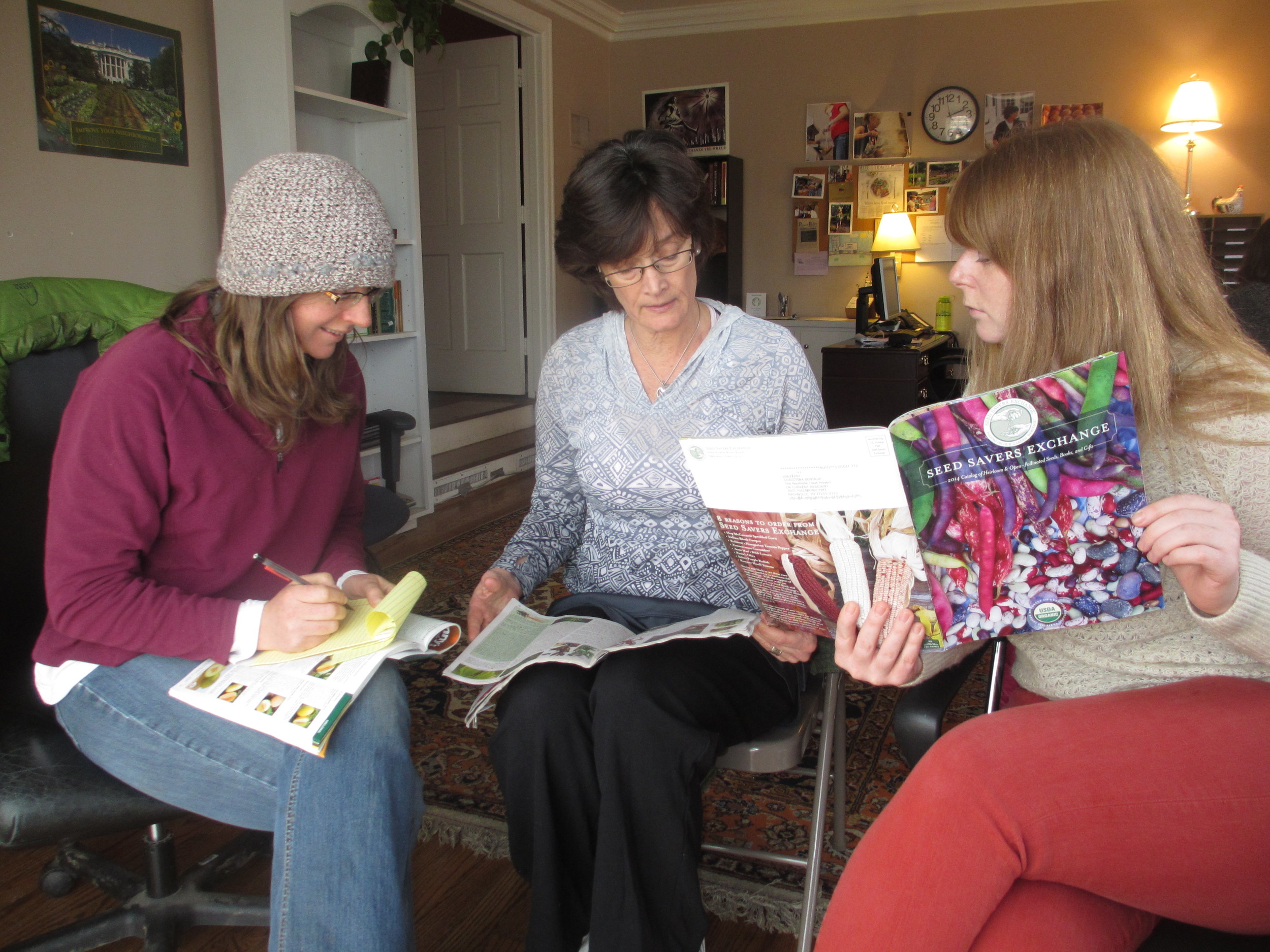
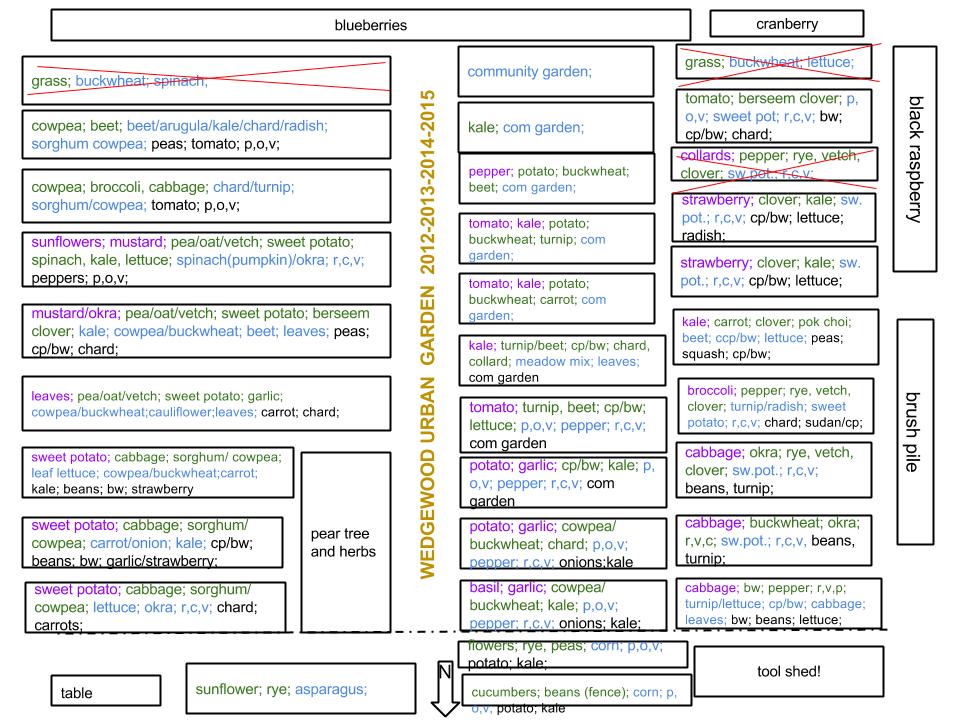
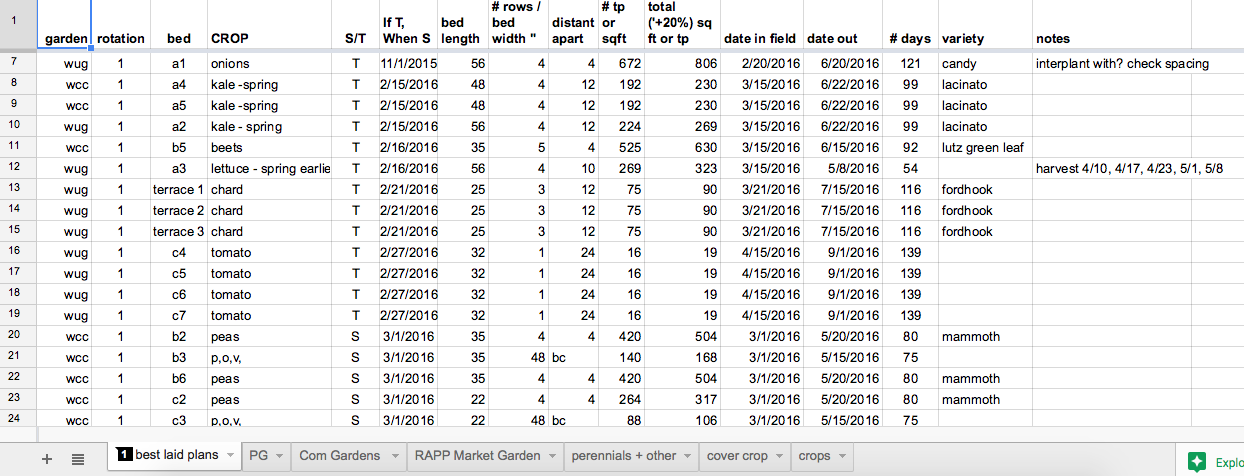
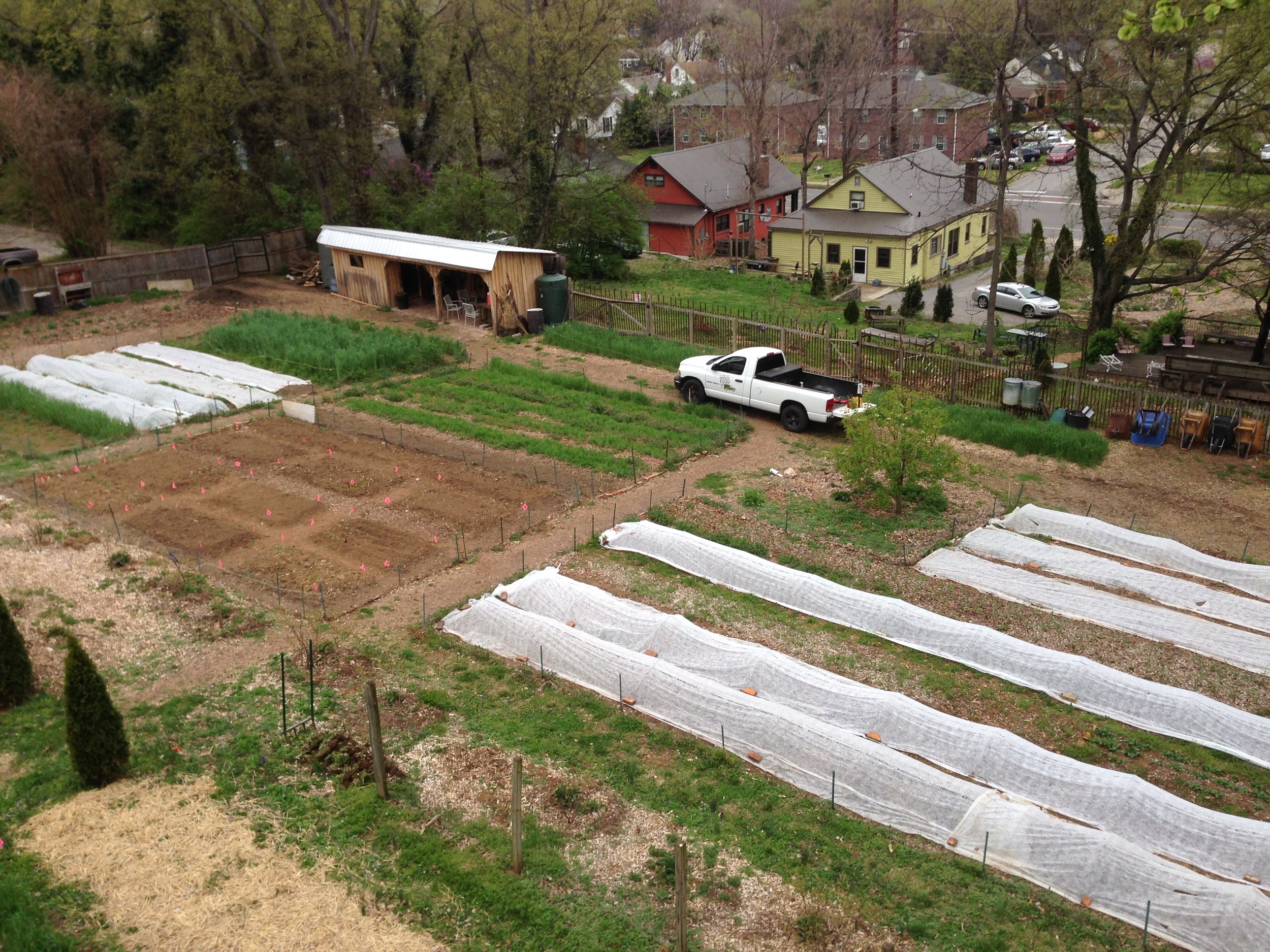
We try hard to follow the garden plan that we made over the winter. We start this garden plan begins with a list of crops that we are excited to grow for our meals program with a rough idea of how many beds should be planted in each. We map out where each crop should go in our permanent bed system and ask whether another crop can be planted in the same space before or after the main crop during our long growing season. We aim to have at least one-fourth of the garden resting at all times in cover crops so that we can maintain productive and healthy soils for many years to come.
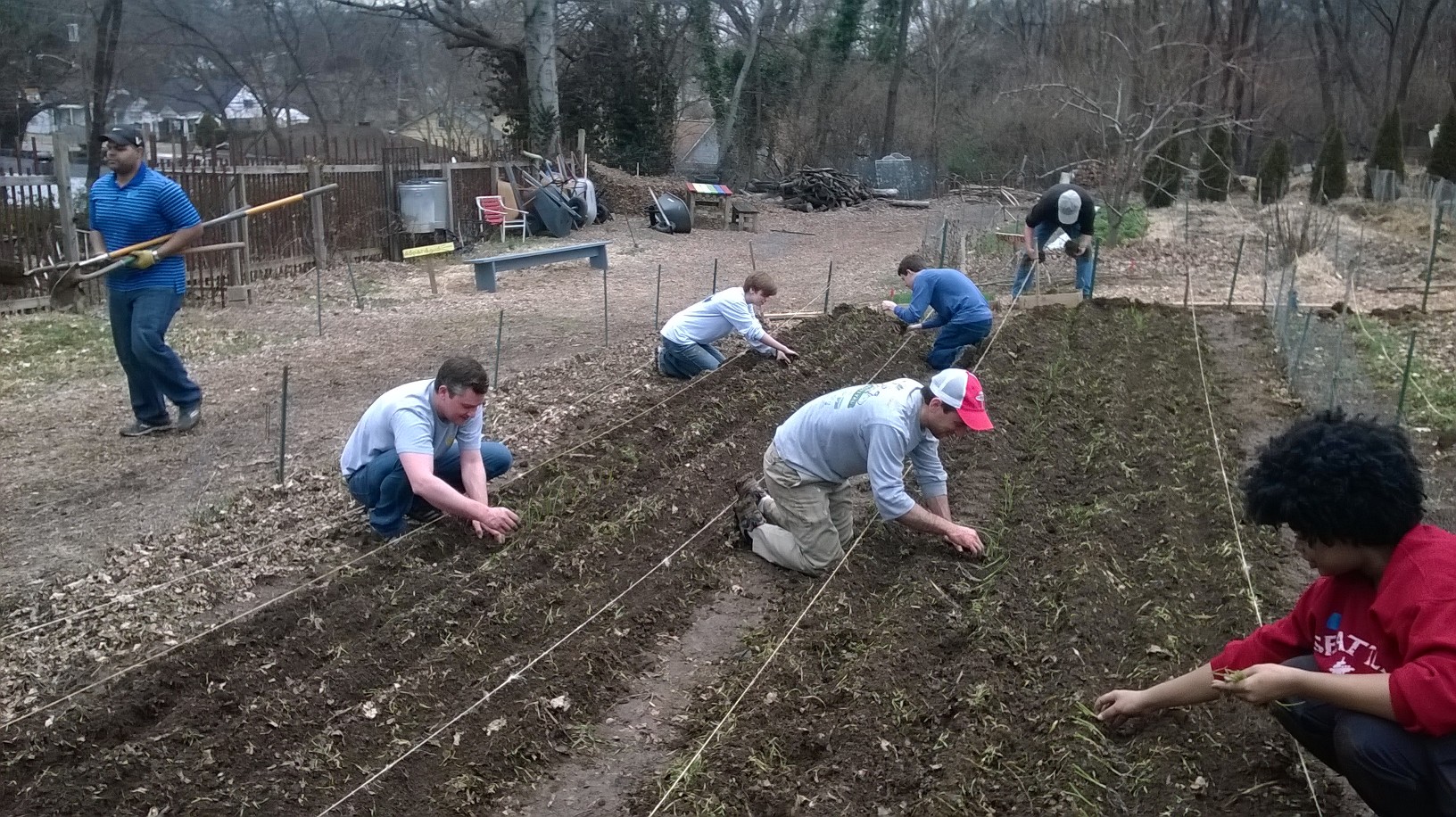
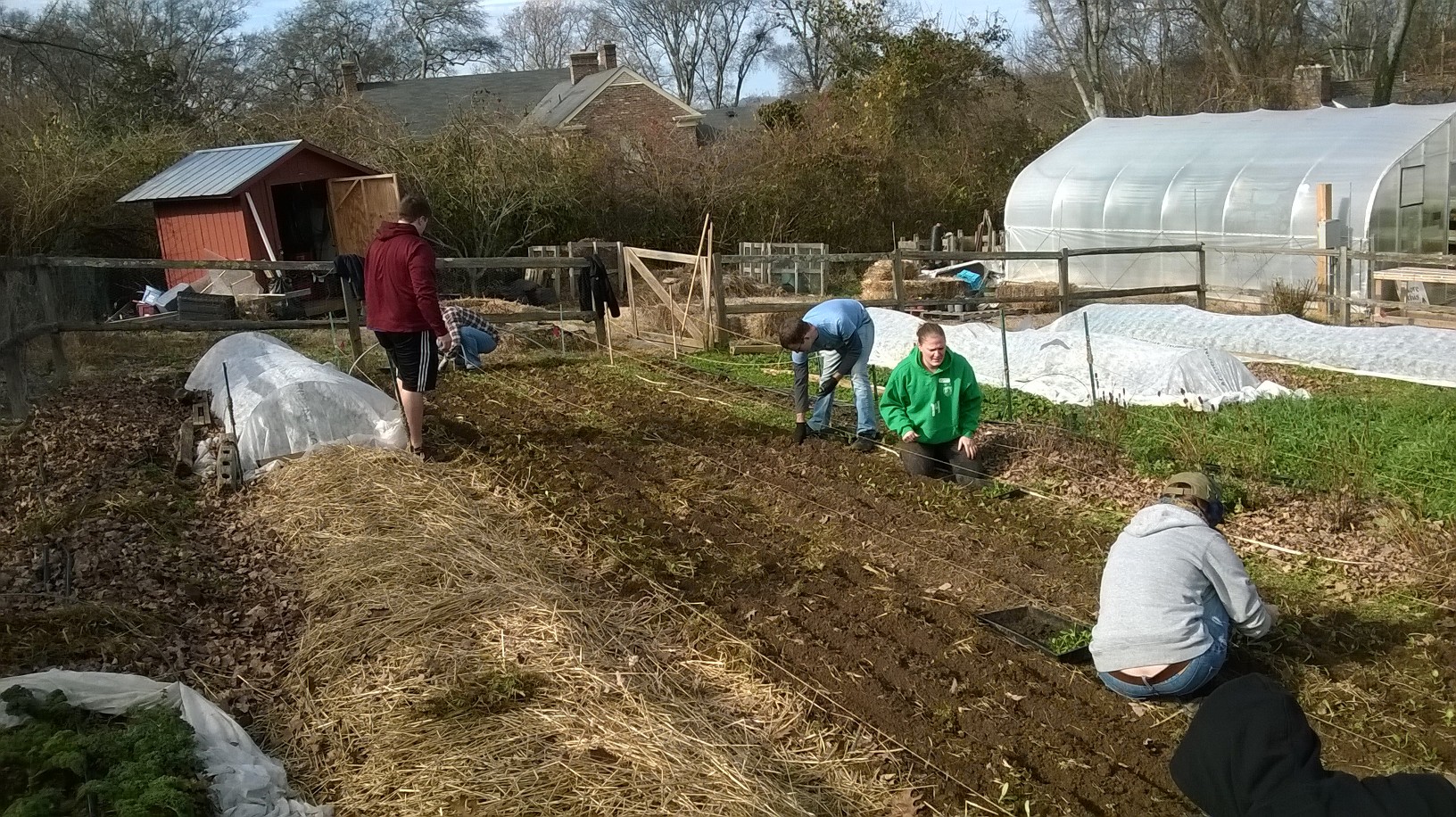
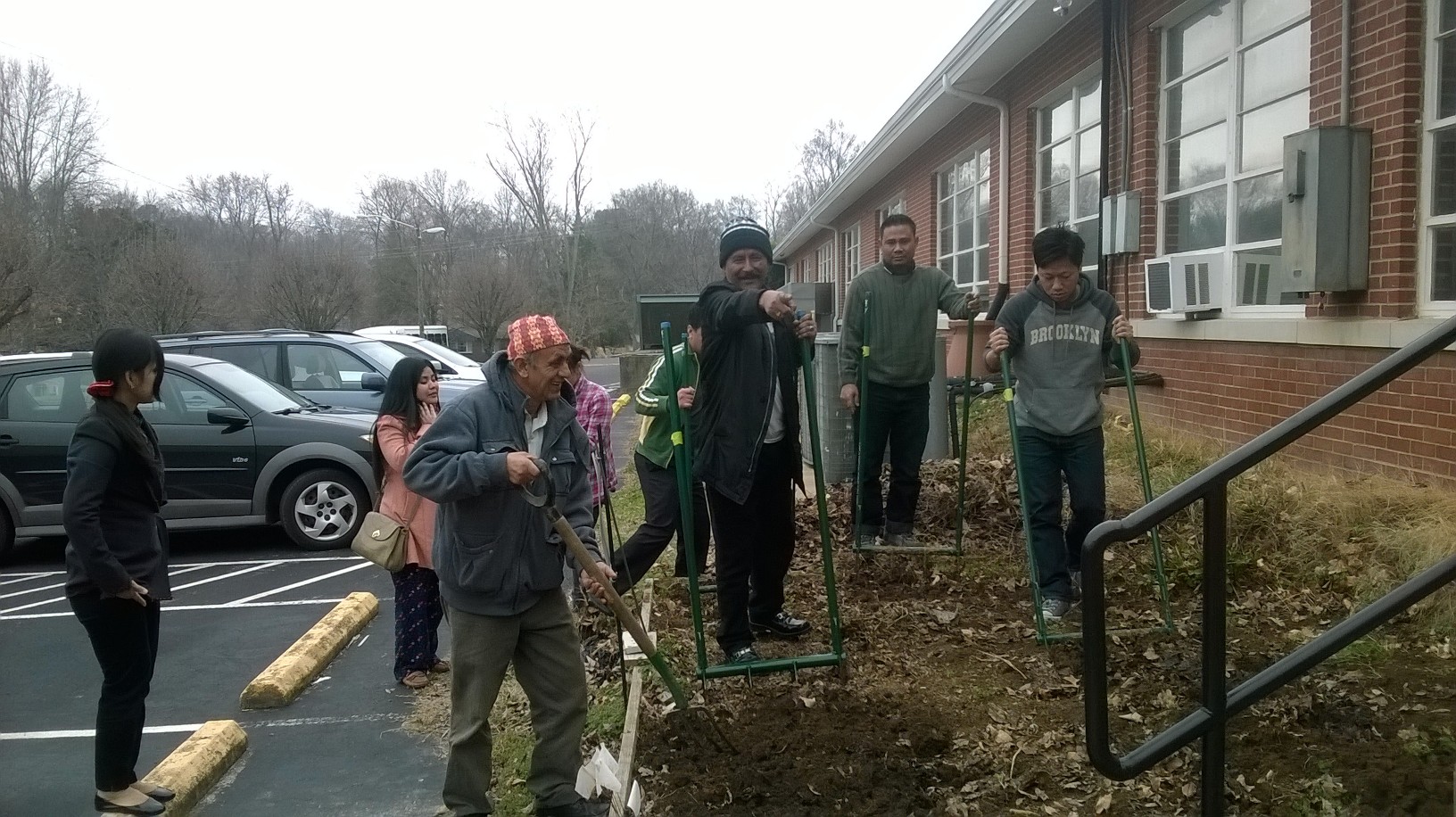
This time of year, we love the broadfork - a garden tool that lifts and aerates the soil while maintaining good soil structure. Where we can, we begin to broadfork the beds that will grow our earliest crops - the lifting and aeration action warms up the cold winter soils and allows them to breathe out excess moisture. Volunteers love the aerobic work-out of it, too.
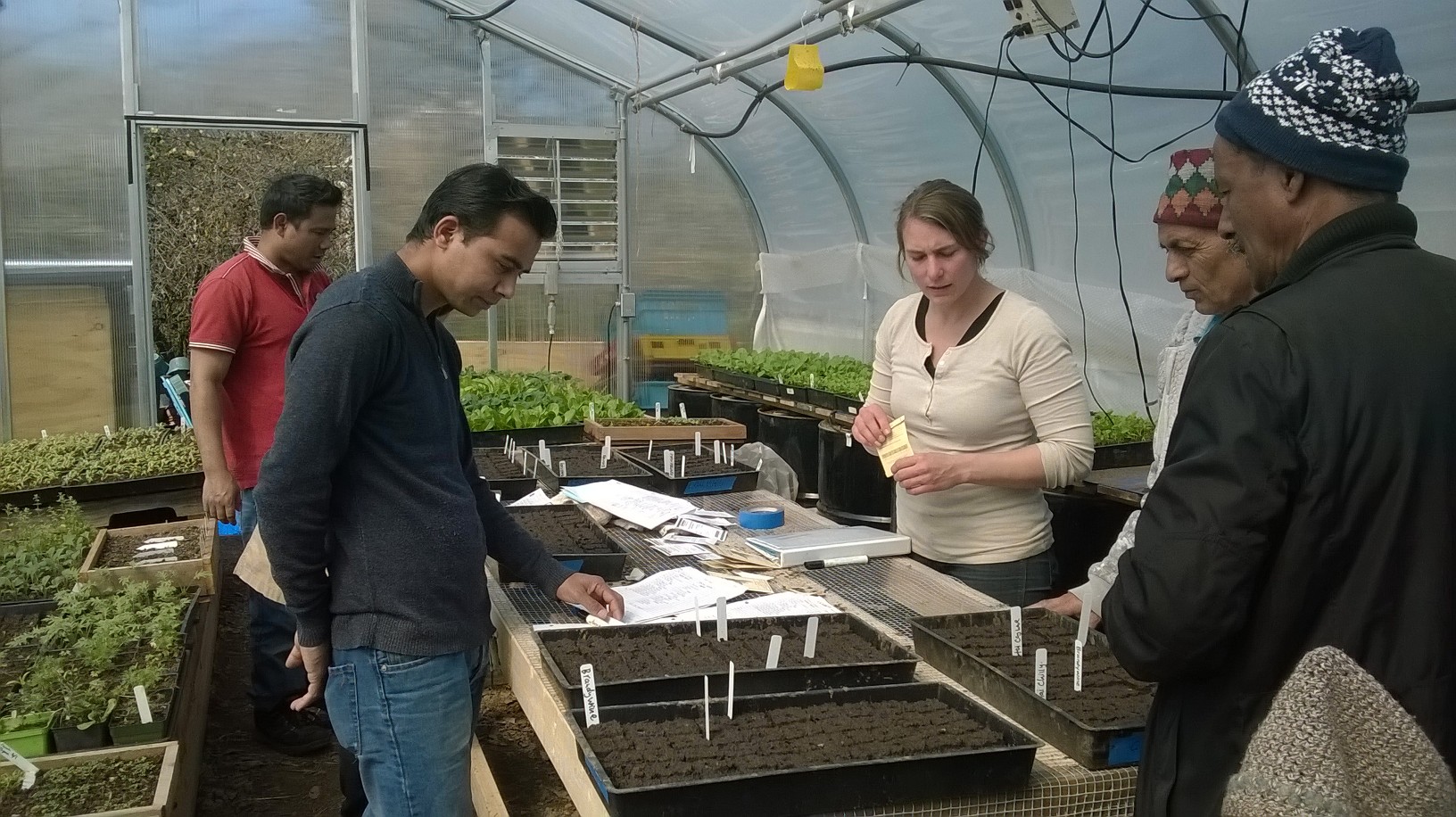
Another exciting thing happening this month is the start of a new year with all of the community members growing in our gardens! This month we’ve begun meeting with participants in the Middle TN Refugee Agriculture Partnership Program, a group of farmers from Burma and Bhutan, with whom we share our best practices for growing production-focused urban gardens in Nashville. We help them with creating their own garden production plans for growing and selling their vegetable crops to restaurants and at local farmers markets. We’re also recruiting other community members for our neighborhood-based community gardens in North and South Nashville.
And don’t forget about Project Grow! We’ve started planting for our annual subscription vegetable plant sale. Sales will open soon so be on the lookout for emails from us!

This truly is one of our favorite times of the year, a time when we breathe with anticipation, because the busy time is almost upon us.
Check out some of our favorite resources for specific information about growing vegetables in the South:
- Ira Wallace’s excellent Vegetable Gardening in the Southeast with month-by-month checklists of garden activity
- Pam Dawling’s spreadsheet-heavy but full of years of hard-won details book: Sustainable Market Farming, from her experience growing in our same zone in VA.
I am because we are.

This week, some of our staff had the privilege of hearing Duke Divinity School professor Norman Wirzba speak at Vanderbilt University Medical Center of the relationship between sustainable agriculture and human health. Wirzba reminded us of what we already know—that life only happens in relationship, that life is what happensbetween things, and that life does not exist within a single thing. He asked us questions, like “How can we nourish the contexts in which we live, so all life can flourish?” I left his talk reminded that if I want to work for a healthy person, I must work for a healthy world.
At The Nashville Food Project, food is the tool we use to create change in Nashville. There are lots of people working in this food “space,” many with different goals. Our goals are to work for a healthy community—to awaken ourselves and others to the suffering within us and around us—by growing, cooking, and sharing food in ways that acknowledge what’s broken and celebrate what’s held in common. What happens here is community food, where choice is extended, high-quality meals are shared. Our work is cooperative, rooted in relationships. The nourishing food we grow, cook, and share supports the critical work being carried out by our partners who work daily to ease the enormous burdens of poverty and a broken world.
Community food is not convenient or tidy, but it is joyous. Our hope is that the meals we share and the gardens we grow celebrate abundance. We ask people to get involved with a spirit of deep hospitality—the kind of kindness that welcomes the “other" and invites them to move more fully into their own human potential.
Some of you may be familiar with the South African word ubuntu, which has been translated to mean “I am because we are.” And this is what I am daily learning. Thank you for helping me.
Grace and peace,

Growing Together: The Refugee Ag Program
In January, Tennessee gardens tend to offer more frozen patches than green, but growth in the TNFP gardens continues in the cooler months in different ways—with preparation, trainings and relationship building…

In January, Tennessee gardens tend to offer more frozen patches than green, but growth in the TNFP gardens continues in the cooler months in different ways—with preparation, trainings and relationship building.
At Hillcrest United Methodist Church on a recent Monday, the Nashville Food Project’s Garden Manager Christina Bentrup stood before a group of refugee growers from Bhutan and Nepal to talk about opportunities to sell crops at farmers’ markets and restaurants through the Refugee Agriculture Partnership Program (RAPP).
Speaking through translator Siddi Rimal, two farmers named Chhabi and Chandra shared their successes selling popular mustard greens at a negotiated price within their community. But beyond learning ways to market and work together—and hearing how the growing seasons differ in Tennessee than their home countries—the trainings help make deeper connections.
“Participants build stronger relationships with each other, with the physical land, with neighbors and members of their community and with other communities through selling their food,” Christina says.
Lauren Bailey, the Agricultural Programs Director at the Center for Refugees and Immigrants of Tennessee, the agency partner on the RAPP program, also participates in the trainings where lessons go beyond the soil.
“Sometimes farmers come to us with other issues that they are facing in life, such as the complicated nature of obtaining citizenship,” she says. “In these moments, we're faced with the opportunity to listen and to find ways to connect and advocate with our farmers. As our relationships grow, our understanding of our farmers' lives grows.”
A few days later at the Woodmont garden at The Nashville Food Project, a group of volunteers sifted compost to make potting soil for starting crops in the greenhouse.

“See how pretty that is?” said volunteer Linda Bodfish. “It started off as melons and rotten tomatoes.”

They worked together over a hands-on process that couldn’t be rushed. Among discussion about the compost, they shared stories about family pets, jobs and hometowns.

“Growing food, even if you and your family are the only ones eating it, is a communal activity,” Christina says. “It brings us into contact with the earth we all share, with the traditions of agriculture that have kept our species alive, and spirit of abundance that pervades all well-cared for gardens.”
Linda, a long-time volunteer in TNFP gardens, says she’s learned over the years about irrigation and overwatering and companion planting: “I feel like I get out of it more than I give."
Lauren, too, said preparing for the trainings reminds her of the power that garden programming has to build community and foster existing community leaders.
“People seem really happy at the field trainings, both in the RAPP program and in our neighborhood-based community gardens," Christina says. "I am privileged to be a witness to the joy and pride people seem to feel when working in their gardens. This joy reminds me that isolation is one of the biggest cofactors of hunger. When we work in a garden, even if we happen to be by ourselves, we become deeply rooted to a place. This connection alone can bring people from isolation to integration.”
Sharing More in Partnership with United Way
Did you know that The Nashville Food Project nearly doubled our meals program last year? Thanks to a new partnership with the United Way’s SPARK we provided 36 youth and families at the Salvation Army and Bethlehem Center with more than 10,000 healthy meals and snacks in 2015…

Did you know that The Nashville Food Project nearly doubled our meals program last year? Thanks to a new partnership with the United Way’s SPARK we provided 36 youth and families at the Salvation Army and Bethlehem Center with more than 10,000 healthy meals and snacks in 2015!
The mission of the United Way’s SPARK program is to engage youth in consistent, structured physical activity; to promote movement; to advocate basic nutrition through education; and to provide accessible, cost-effective meals and snacks for youth and their families.

In addition to nearly doubling the number of meals we were able to share in our community, this partnership also allowed us to involve even more incredible volunteers in preparing and cooking these 300 delicious, nutritious meals and snacks each week. These meals and snacks were served alongside fun exercise programs and nutrition education, helping children get healthy and fit in a fun way.

We’re excited to announce that this program with further expand in 2016 with the addition of snacks shared with children at the South Nashville Family Resource Center and the St. Luke’s Community House Family Resource Center! Through this expansion, we will share 120 more snacks each week with children in our city, furthering our reach in our efforts to alleviate hunger and cultivate community.
We thank the United Way of Metropolitan Nashville for continuing this vital partnership, and we can’t wait to see how it continues to grow in 2016!
Guest Chef Series: Kayla and Derek May
Pastry Chefs Derek and Kayla May began their courtship in the kitchen at The Hermitage Hotel when their shifts overlapped by one hour…

Pastry Chefs Derek and Kayla May began their courtship in the kitchen at The Hermitage Hotel when their shifts overlapped by one hour.
Kayla arrived at 5 a.m. to make breads and banquet sweets, and Derek arrived later to make plated desserts. Everyone on the crew had individual plastic bins to keep their tools, but Derek noticed that Kayla’s was broken. So when she came in one morning, she found the tools missing in her bin and a treasure map instead sending her to find the new one Derek had purchased for her.
“I was pretty smitten after that,” she said.
Still, she resisted a romantic relationship knowing that she would soon head to New York City to work. The two would meet before dawn at Café Coco, the 24-hour coffee shop, after he ended his shift and she headed into hers. When she left the hotel job, Derek ended up going to New York with her where they shared a room in an apartment with two other roommates.
“If you opened the dresser you had to climb over the bed," Kayla said of their tiny space. But she added that the experience in New York proved invaluable.
With Valentine’s Day around the corner, the chefs -- both owners of Blushing Berry Chocolates and Kayla the pastry chef at Josephine -- made the perfect pair to feature in our Guest Chef Series. We were delighted to get to know them at our first RISE event in December, and they agreed to return to the kitchen for a volunteer shift.

“They don’t usually let me make meatloaf at Josephine,” Kayla said as they both joked about cooking on the savory side rather than the sweet. “If you want me to cook stuff on the hot line, I need a lot of instruction.”
But of course they handled the meal for 75 people at John Glenn retirement home with ease. Kayla cracked eggs, one in each hand, for a mixture of donated venison from Hunters for the Hungry and blend of spices as Derek chopped bacon for a pot of green beans. Sweet potatoes softened in a pot of boiling water and would soon be whipped with molasses. “I have to add a little sugar,” she said.

Kayla grew up in Alabama and took an interest in pastry while on a trip to Paris. When her sister and traveling companion caught a case of the flu, Kayla spent her days wandering into pastry shops marveling at the beauty and the detail behind the glass cases. Despite a family in medicine (her mother is a doctor and her sister will soon begin her residency), she promptly changed course from a scholarship to study pre-med at Auburn University to the French Culinary Institute in New York.
“She was super-supportive,” Kayla said of her mother. “I really haven’t thought about much else (but pastry) since.”
Derek grew up in Indiana and attended Connecticut Culinary Institute and worked in Chicago before coming to Nashville. Both chefs are happy to be back in Music City after their time in New York. They’re preparing for a busy Valentine's season and scouting new locations for their Blushing Berry business. And after marrying in 2014, they’ve been putting down roots here, which thankfully means giving back by helping at The Nashville Food Project, too.
"It's always nice," Kayla said, "to help out with something you do as your career in the community."
Pro Tips from Kayla and Derek:
- Pastries and breads freeze nicely for serving later, which helps cut down on food waste.
- Be prepared. “Panicking never helps,” Derek says. They both like to stay ahead of the game throughout the week. “If you’re not ahead, you’re probably behind,” Kayla says.
- It’s okay if every dish at home doesn't turn out perfectly. Experimentation leads to improvement. “It doesn’t always have to taste good,” Derek said. “Next time you’ll know how to do it better.”
- Learn to think on your feet and improvise in the kitchen. It’s another way to keep from wasting food.
- Knowing the purpose of ingredients helps reduce waste and makes a better cook. Knowing that eggs stabilize and add volume, for example, makes it easier to substitute with what’s on hand.
- And on keeping a trim figure as a pastry chef? “Work in a kitchen,” Kayla says, where employees stay busy. “I think that’s why I love vegetables so much. It’s what our body needs and wants at the end of a long day.”
--------
On the Menu:
Kayla and Derek prepared meatloaf with mashed sweet potatoes and green beans flavored with pork. To replicate their meal, try these recipes.
Molasses Whipped Sweet Potatoes
--------
Kayla and Derek will be holding a sweetheart special during Valentine's week at Blushing Berry Chocolates. Any gentleman who visits the shop to buy a 12-piece or 24-piece chocolate box for a special someone will get two free Bourbon truffles for the purchase.
Valentine's truffle flavors available now and through the holiday include the following:
Milk Chocolate
Dark Chocolate
Salted Caramel
Vanilla Bean
Strawberry
Raspberry
Rose
Passion Fruit
Champagne
Hazelnut
Amaretto
Bailey's Irish Cream
For more information, click here or call 615.852.8128.
For reservations at Josephine, visit here or call 615.292.7766.
The Weight of a Snowflake

Happy New Year, all. I do hope yours is Happy, but I want to say that it feels like there is a deep feeling of despair among my circle of friends this winter. We all seem to be juggling work stress, caring for sick people we love, battling the often co-occurring illnesses of addiction and depression. We are stretching our resources of time, attention, patience, and money further than it seems they want to go, and then we turn on the news and listen to story after story about the violence, injustice, greed, scarcity and environmental degradation that plague our world. And all the bad news quickly paralyzes us into a dark fit of despair, and we decide our hands are tied; we can't do anything to alleviate the suffering of this world.
I give thanks for a professor and mentor I had in seminary who encouraged me to let the world and its enormous problems in just enough to galvanize me to work towards their solutions. I used to think that big problems required big solutions. But in my almost seven years of doing this work at The Nashville Food Project, I have learned that answers cannot be imposed, they must come from within. I have learned that small work in a small place with small groups of people can have enormous impact on the health and well-being of an entire community. I have learned that solutions cannot be hurried, that hard questions need for patience, and that relationships and making common cause with others are the keys to making lasting change – no matter how big or small.
Maybe some of you know this small story – someone told it to me when I was a teenager at church camp (talk about a small thing having a big impact), and it has honestly never left me. I hope you will take one minute of your day to read this winter tale, and find yourself encouraged.
Grace and peace,


Best of the Blog: 2015
Read the five most popular blogs from 2015.
2015 has been quite a year for the TNFP blog! We've launched a fun, new Guest Chef series, shared tons of delicious recipes and shared incredible stories of our meals, gardens and volunteers. In case you missed them, here are our top five blogs from 2015:
1. Guest Chef Series: Vivek Surti


Waste Not, Want Not
Putting a dent in those numbers could feel daunting, but it’s an issue that we hope to continue working on in 2016. In addition to gleaning from farms, restaurants and grocery stores each week for meals, we’ll be partnering with Zero Percent, a Chicago-based organization that has developed a mobile app and online platform to maximize our food recovery efforts…

Almond milk that could have headed for the dumpster after a food conference at Music City Center. But thankfully, a volunteer brought it to TNFP instead for including in bread puddings and other uses.
Earlier this month, The Tennessean included The Nashville Food Project in a story about food waste.
“Forty percent of the food produced in this country doesn’t make it from farm to mouth,” writes Jim Myers. That’s about $165 billion or $2,225 per family per year of wasted food.
Putting a dent in those numbers could feel daunting, but it’s an issue that we hope to continue working on in 2016. In addition to gleaning from farms, restaurants and grocery stores each week for meals, we’ll be partnering with Zero Percent, a Chicago-based organization that has developed a mobile app and online platform to maximize our food recovery efforts.
But what else can we do at home? Meals Manager Anne Sale shared some inspiration and hope for making small changes that add up. Here are three ways she helps reduce food waste at TNFP:
1) Dehydrating over ripe fruit – By using a dehydrator, she makes raspberry or banana powder to include as a flavoring in granola bars or truffles.
2) Using "day old" croissants and pastries as a base for bread puddings. Adding an egg and milk mixture to stale bread helps breathe new life into it.
3) Re-purposing day old fruit pies – Anne and volunteers often break pies into pieces and give them a fresh oatmeal streusel topping.
To read more tips on eliminating food waste at home, click here.
You can find the full Tennessean story here.
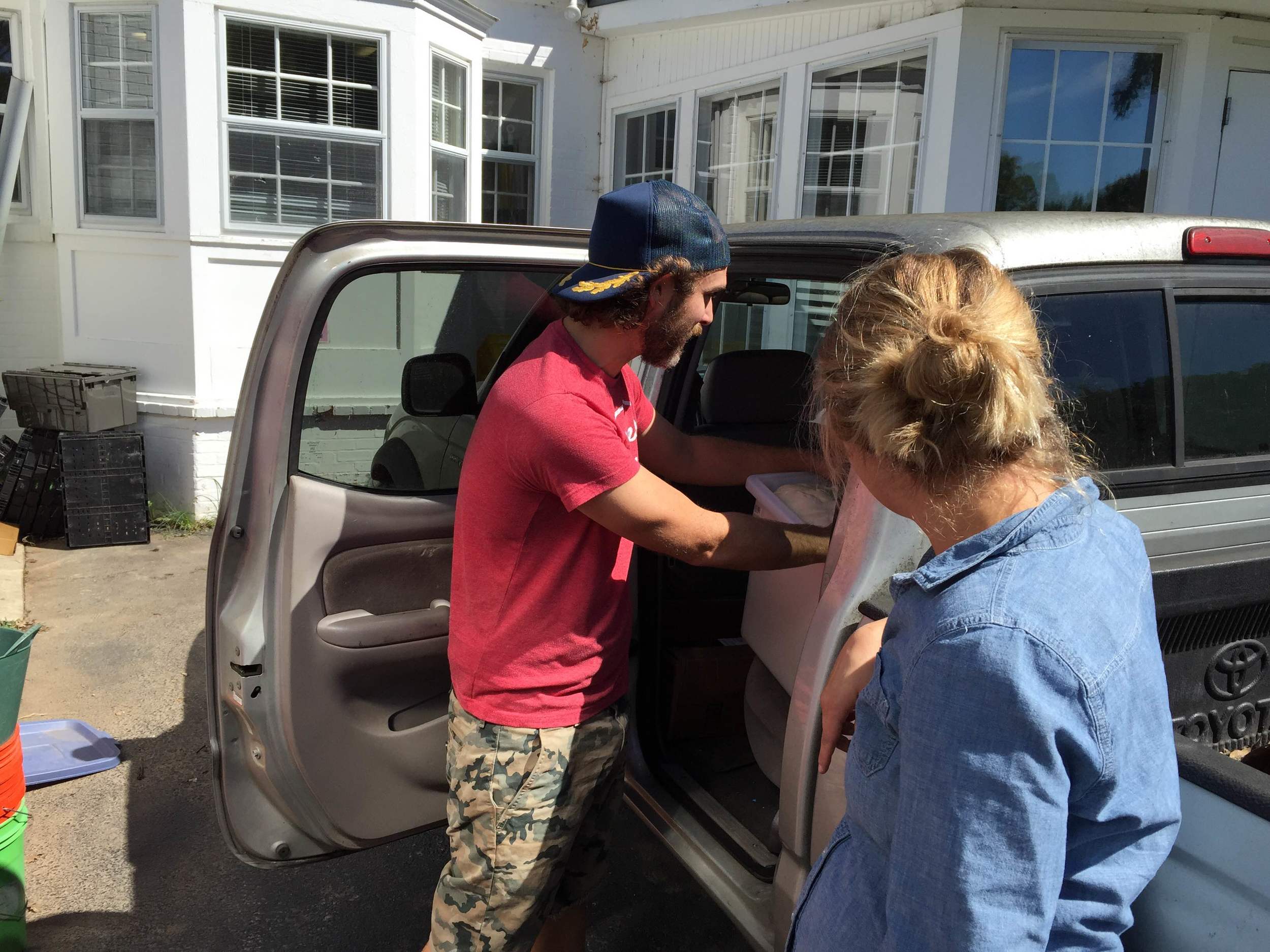
Rather than waste food, we're grateful that Tandy Wilson of City House brings leftover dough to The Nashville Food Project.

The Society of St. Andrew, a ministry that salvages food from local farms, makes a delivery of butternut squash to TNFP.
Planting Seeds of Change
As we reflect on 2015 and look forward to 2016, we’ve been talking and thinking about “hope.” Rather than feeling discouraged about the problems of poverty and food waste, we’re focusing on the small changes we can make in the community…

Garden Coordinator Kia writes garden inspiration on a chalkboard.
As we reflect on 2015 and look forward to 2016, we’ve been talking and thinking about “hope.” Rather than feeling discouraged about the problems of poverty and food waste, we’re focusing on the small changes we can make in the community.
In the garden specifically, here are a few ways we’re planting small seeds of change:
1.) Educating students at veggie tastings.
We might not be able to solve all the issues related to farm-to-school, but we can introduce children to great-tasting vegetables.
Students from Fall-Hamilton Elementary School visit the McGruder Community Garden on occasion for activities that range from observation journals to lessons on seeds and compost to planting vegetables. We also donate food and cooking time to the school in twice-per-semester “veggie tastings,” where students sample colorful roasted root vegetables, kale salads, or sweet potato fries. "The idea is to introduce kids to vegetables they might not opt for at home or have access to at all," says Garden Manager Christina Bentrup.

Students from Fall-Hamilton help out in the Wedgewood Urban Garden.
2.) Making good use of land.
Through our gardens, we’re using land that might otherwise be overlooked to increase access to healthy food. We’ve harvested 4,250 pounds of produce this year for 50,100 meals.
3.) Teaching others about growing food.
Through our community garden plots, education and volunteer sessions, we’re hoping to empower those in the community to grow their own food in our gardens or at their homes.

Volunteers from Whole Food Market help out at the Wedgewood Urban Garden.
4.) Sharing land to create spaces for others.
With the community garden plots and the Refugee Agriculture Program, we want growers to feel as if they have a place of their own.

Tika Adikhari, a Bhutanese gardener at the Wedgewood Urban Garden, proudly shows off his plot.

Siddi Rimal interprets during a training session with refugee gardeners.
5.) Keeping bees and chickens.
Beyond the plants, we’re keeping bees and chickens at our gardens, which provide vital functions in an ecosystem. They also serve as educational tools for students and volunteers.
Through small steps forward, we can maintain hope. Hope is contagious. We hope you’ll continue to help us spread it in 2016.

Guest Chef Series: Chef Dale Levitski and Brenda Reed of Sinema with Debbi Fields of Mrs. Fields
The cook team had under two hours to finish dinner for 75 people, but Chef Dale Levitski of Sinema calmly mixed meatloaf like a pro…

Brenda Reed (left) with Debbi Fields and Dale Levitski.
The cook team had under two hours to finish dinner for 75 people, but Chef Dale Levitski of Sinema calmly mixed meatloaf like a pro.

He combined donated ground beef, pork and venison. Then he added seasoning, eggs, parsley from the garden and oatmeal, which had been donated after a warehouse ordering mistake.
“Meatloaf is something you don’t really measure, you just make it,” he said. ““My mom always did oatmeal in meatloaf. I grew up eating it. It was the 70's. I’ve always loved my mom’s meatloaf."
Brenda Reed, one of the Sinema owners and a regular volunteer at The Nashville Food Project, joined Chef Dale to cook as well as Brenda’s friend Debbi Fields, the woman behind the famous Mrs. Field’s cookies.

While Dale worked on the main course, Brenda and Debbi looked after the sizzling bacon for a batch of kale cooked with brown sugar, vinegar and a touch of cayenne.
“Is that bacon done?” Dale asked.
“Yes, Chef,” Brenda replied.
But even if it hadn't been, easy-going Dale said he doesn’t get too worked up under pressure.
“I think if you’re going to be a leader in the kitchen, and you’re losing your temper, you’re not leader." He jokes with his cooks that he can yell only once a year.
Chef Dale Levitski moved to Nashville two years ago in March from Chicago. He brought celebrity status with him from his time on Top Chef, but his experience goes much deeper.
After finishing the meatloaf, he moved on to a dressing for lettuce from the garden that Meals Manager Anne Sale had cleaned and prepped.

“Salad dressing is one of the first things I learned to make,” he said, whirling together a mixture of extra virgin olive oil, vinegars, dry mustard, sugar and salt.

Dale skipped culinary school and worked his way up in the business instead. In addition to Sinema, he's planning on opening a fast-casual restaurant called The Hook in 2016.
As he whisked the dressing, Debbi quizzed him for tips.
“I usually use grape seed oil because it’s super-light and olive oil tastes more heavy,” he said. But of course he rolls with the nature of using what's on hand at TNFP. “We’ll make it work,” he says.
“That’s the right answer,” Anne says.

Just before 11 a.m., the prep room began to buzz with activity as volunteers showed up to take the food to John Glenn retirement home.
Volunteer Marilyn Lane poked her head into the kitchen to pass along praise. She delivers to John Glenn weekly. “They love this food and would have a hard time without it,” she said.
Intern Noelle Brown also stopped in to meet Debbi.
“I didn’t have an Easy-Bake Oven growing up," she said. "I had a Mrs. Fields Oven."

The chefs gave their dishes a final taste and volunteers plated the food to show how it would be served – meatloaf, green salad, kale and carrots with Mrs. Fields cookies for dessert.
“It was a lot easier than I thought it would be,” Dale said. “I haven’t made meatloaf in years.”
