
The Nashville Food Project’s Blog




We are only just beginning
On November 3, many of us across the nation donned our masks—or sealed our envelopes—and submitted our votes with a deep conviction about which candidates will best set us up to move the needle in the direction of our values…However, countless unknowns, rising COVID numbers, and the brokenness of centuries of injustice continue to gnaw at us. The same convictions that surround the way we voted in this presidential election have shallow roots if they end when a POTUS is announced.

Photo of illustration as part of the book Peaceful Fights for Human Rights by Rob Sanders and Illustrated by Jared Andrew Schorr.
by Elizabeth Langgle-Martin, Community Engagement Manager
On November 3, many of us across the nation donned our masks—or sealed our envelopes—and submitted our votes with a deep conviction about which candidates will best set us up to move the needle in the direction of our values. After several tumultuous days (and if we are honest, the remainder of the Halloween candy), we now have a better picture of how our nation’s next season will look. However, countless unknowns, rising COVID numbers, and the brokenness of centuries of injustice continue to gnaw at us. The same convictions that surround the way we voted in this presidential election have shallow roots if they end when a POTUS is announced.
As I anxiously worked and waited for election day to come to a close, sourdough loaves resting on the counter and a mason jar filled with fresh water as my chosen methods of self-care, I listed the things I know to be true regardless of the outcome of this election. A couple weeks later, I offer those here.
1. Our systems were not designed to protect and value Black and brown bodies, much less the hearts, minds, joys, sorrows, wealth, and health of Black and brown people. My work and the work of other white folks is to continue dismantling oppressive systems (even those we may benefit from) and center the voices of leaders within Black and brown communities.
2. For those of us who are able to vote, local elections equal local power. When those of us who are able to vote choose not to vote in district, city, and state elections, we are giving away that power. In addition, we have access to city council meetings, oversight board committee gatherings, and so many more levels of local decision making that impact the care of our neighbors. If this election inspired you into new levels of action, there are spaces for you to move that work into a deep, localized, impactful presence.
3. We are all wrong. At some point, we have all been taught, internalized, and acted out of misinformation about ourselves and about others. It is our life’s work to identify, root out, and mitigate the harm we have caused because of that misinformation. When our intersections are clear of election signs and our junk mail returns to credit card offers, this is still the work for which we are responsible.
4. For every moment of injustice throughout history, there have been movements of resistance. How many names have I not known, how many faces of inspiration have I missed out on because they aren’t part of a standardized narrative, omitted from glossy grade-school textbooks? I’ll keep learning about those who used their bodies, minds, resources, and lives. This is the legacy I want to root myself in, the standard I want to hold myself to.
5. All systems of power must have checks and balances. Even those we cast a vote for. A healthy democracy means holding leaders accountable for the work they do (or don’t do) and the harm or good done by policies that are implemented under their leadership. May we be loyal to justice, equity, the dismantling of white supremacy, the health of our communities, and the care of all people above a single person or party.
6. “With fiercest hope, we believe that people and situations can change”. Part of The Nashville Food Project’s core values, I must admit that on certain days this statement feels more aspirational to me than something I know to be true. And yet, when torn between embracing fierce hope or paralyzing despair, I look at my tiny, vibrant daughter, think about good bones, and know that only hope will challenge me to be a part of creating a world I so deeply desire.
Fill up your water glass, get a moment in the sunshine, listen to this song, light a candle, and dig in. This work is far from over. There is still so much good trouble to be had. We are only just beginning.
P.S. Speaking of voting, did you know that The Nashville Food Project collaborated with Conexion Americas, the Margaret Maddox YMCA in East Nashville and the Southeast Nashville polling site to provide snacks during a few peak early voting times?

Waiting in line is a little sweeter with one of Joe Hodgson’s Pink Lady Apples or from-scratch pumpkin-banana bread! Whip up a little fall goodness with the recipe below:
Banana Pumpkin Bread
For the batter:
1 can pumpkin
2 cups mashed banana (about 5 bananas)
4 eggs
1 cup oil
1/2 cup sour cream
4 cups flour
1 1/4 tablespoon baking soda
1/2 to 1 tablespoon cinnamon
1/2 to 1 tablespoon nutmeg
2 1/2 cup sugar
1 1/4 cup brown sugar
1 tablespoon vanilla
1/2 tablespoon salt
For the topping:
1/3 cup oats
1/3 cup flour
2/3 cup sugar
Preheat the oven to 350 degrees.
In a large bowl, combine batter ingredients and pour into a shallow baking dish. In a separate bowl, combine topping ingredients and sprinkle over batter. Bake for about 20-25 minutes.
Partner Spotlight: Trap Garden
We love collaborating with and supporting the vibrant, creative work of community building-organizations in our city. And this fall, we have been especially pleased to work with Trap Garden. Farmers from the Growing Together program have been providing vegetables through Trap Garden and Preston Taylor Ministries.
We love collaborating with and supporting the vibrant, creative work of community building-organizations in our city.
And this fall, we have been especially pleased to work with Trap Garden.

A Friday morning Trap Garden team getting ready to deliver vegetables from the Johnson Alternative Learning Center garden location.
Urban Farmer and Community Health Activist Rob Horton founded Trap Garden in 2014 inspired by his experiences growing up in a St. Louis, Missouri neighborhood with few fresh, healthy food options. After relocating to Nashville to attend Tennessee State University, he became frustrated again with the distance he needed to drive for grocery stores that supplied quality fresh produce. That’s when he took matters into his own hands by growing his own vegetables and herbs. He also wanted to provide assistance to others who needed better access to fresh and healthy foods.
Nowadays his Trap colleague Kanita Hutchinson says this: “Our community garden is like our grocery store without it being a grocery store.”


Trap Garden currently stewards two plots of land—one at Johnson Alternative Learning Center in South Nashville and Bordeaux Elementary School in North Nashville—spaces for growing vegetables, education and community gathering. When the pandemic hit, the folks at Trap wanted to continue to have a way to support families through distribution of vegetables. TNFP was connect to Trap by Marie Holzer, a Masters of Social Work intern with our organization. Marie obtained a grant from Slow Food’s Resilient Fund so that Trap and The Nashville Food Project could compensate Growing Together farmers for produce to distribute in the community. Beginning in September, Growing Together and TNFP's Production Gardens supplied produce for 25 families a week, which will continue for nine weeks.

A Growing Together farmer harvests “toori,” a type of mustard green beloved by the farmers who came to the United States from Bhutan.

Growing Together farmers washing and packing their harvest.
To identify families in need of vegetables, Trap partnered with Preston Taylor Ministries, and Trap organized distribution of the food—entirely through a team of community volunteer support.
Along with the bags of produce, organizers include an instructional guide to help community members learn how to grow the fresh produce they receive and prepare quick and easy meals from recipes.
And, the Growing Together farmers have been sending videos from the garden, so that those receiving the produce can feel connected to the farmers
Apple Season Keeps Kitchen Buzzing
Even imperfect apples get put to the highest, best use in our kitchen. The meals team often makes apple sauce— sometimes tossing in other fruits such as berries from the weekly Whole Foods donations or pears from a recent food drive. Fruits like plums even give it a pink hue. We try to make our applesauce as low in sugar as possible (or no sugar when using the sweetest varieties like Fuji). See recipe here.

“If you wish to make an apple pie from scratch, you must first invent the universe.” - Carl Sagan
We love apple season. And we’re especially blessed to have a source who keeps us in apples throughout the fall.
As some of you know, Joe “Apple Joe” Hodgson started planting apples four years ago. He now has about 575 trees. “When I retired, we thought growing apples would be a good second occupation,” he said.
Mostly, though, he gives the apples away to us for our meals program, and we are so grateful!
Here are 3,200 Gala apples headed for our kitchens!

Other times, we happily receive Yellow Delicious, Pink Lady or Fujis.

We share many of Joe’s apples with meals as whole fruit, which means Joe often picks and culls them by asking himself this question: “If I were a 4th grader, would I want to bite into this apple?”

But even the imperfect ones get put to the highest, best use. The kitchen team often makes apple sauce— sometimes tossing in other fruits such as berries from the weekly Whole Foods donations or pears from a recent food drive. Fruits like plums even give it a pink hue.
We try to make our applesauce as low sugar as possible (or no sugar when using the sweetest varieties like Fuji). See recipe below.
Other times, though, apples give us reason for little something extra— like a cobbler for our friends at The Ark, apple cider or caramel apples.


Thank you for sharing your harvest with us, Joe!

Easy, Adaptable Applesauce (No Sugar Added)
Makes 8 servings
4 medium Fuji or Honeycrisp apples, peeled, cored, and chopped in bite-size pieces (or a mix of apples with other fruits such as berries, peaches, plums or pears)
1/2 teaspoon ground cinnamon (more to taste)
2 teaspoon lemon juice (for preserving and keeping fresh longer)
In a medium saucepan combine apples and cinnamon. Cover and cook over medium heat until it simmers, then reduce heat to low, medium-low and continue cooking until the apples are tender and very slightly caramelized — about 15-20 minutes, stirring occasionally.
Once cooked, add lemon juice and stir. Then use an immersion blender or the back of your spoon or a potato masher to mash into a loose sauce.
Serve fresh (warm or cooled) as a healthy side or spoon over ice cream, pancakes, yogurt or granola. Store leftovers, cooled, in the refrigerator up to 4-5 days, or in the freezer up to 1 month.
Recipe adapted from minimalistbaker.com.
Hard things and simmering soups
Garden volunteer extraordinaire, Linda Bodfish once said that when the needs change, we change with them. And as we’ve been in the fields, passing bags along (metaphorically and for some staff, quite literally), there have been moments of clarity when we see the opportunity of these moments of crisis. We are challenged to recenter our work around TNFP’s core values and move in a common rhythm to meet the ever-changing needs of our neighbors.

Photo by Abigail Bobo, abigailbobo.com.
Post by Elizabeth Langgle-Martin, Community Engagement Manager
“I want to be with people who submerge
in the task, who go into the fields to harvest
and work in a row and pass the bags along,
who are not parlor generals and field deserters
but move in a common rhythm
when the food must come in or the fire be put out.”
-Marge Piercy from “To Be of Use”
As the weather cools and we enter into this new season, I am thinking back on the “fires” our community has faced over these last six months and the storms that we are still navigating. There are many. Devastating local tornados, the uncharted imposition globally of COVID-19, nationwide police brutality highlighting deep-seated systemic racism, our beloved Tallu’s glioblastoma diagnosis… the list is long and daunting.
However, when I think of this TNFP family, I think of Bianca creating beautiful meals from recovered ingredients other chefs would turn away. I remember Julia last year calmly explaining that cows broke into Mill Ridge’s fields and destroyed crops that represented months of hard work. Without missing a beat, she began to implement a plan to move forward. I think of Tallu writing powerful words of comfort and reflection hours after taxing cancer treatments. I think of Elke and Jake squeegeeing inches of water out of the flooded kitchen in the wee hours of the morning to make sure the meals team could stay on schedule. I think of countless hands that showed up the evening of March 3rd to recover thousands of pounds of meat even while much of the city was still without power. I think of the endless, faithful donations that keep the lights on, the trucks running, the walk-in full, and our team cared for.
I think of a group of people who knows how to do hard things.
Garden volunteer extraordinaire, Linda Bodfish once said that when the needs change, we change with them. And as we’ve been in the fields, passing bags along (metaphorically and for some staff, quite literally), there have been moments of clarity when we see the opportunity of these moments of crisis. We are challenged to recenter our work around TNFP’s core values and move in a common rhythm to meet the ever-changing needs of our neighbors.
We are grateful for those of you who have loved and joined us “in the fields” in so many different seasons. You’ve shown up to unload food donations, broadfork unbroken ground, and stuff envelopes. You’ve organized pantries, chopped onions, hauled compost, and shared stories.
As we are stretched in new ways to meet new needs and root more deeply to who we have chosen to be, we feel comfort in the steadfast support of this vibrant community.
As we slowly prepare to reintroduce volunteers into TNFP spaces as part of our phased plan, this season is calling for shift to a smaller and more intentional volunteer presence, a rebirth of our dedication to the best use of donated and recovered food, and a continued, steadfast commitment to supporting increasing the accessibility of agricultural space and high-quality food. Towards the end of October, we will be entering into a trial period to workshop new volunteer roles and systems with a handful of long-term volunteers. We’ll keep you all in the loop as we decide how and when our spaces will be accessible for more hands!
What’s simmering… from our home kitchens to yours!
If the TNFP crew is passionate about one thing in the home kitchen during the fall, it’s probably soups. Here are some of our faves that are easily adaptable to your own tastes!

Alice Water’s Fall Minestrone (Christa’s Go-To… can you imagine this with veggies right from the fields of Sweeter Days?)
Flavors of Morocco-Inspired Vegetable and Chickpea Stew (David Frease says this is his first soup of the season every year)
Skinny Taste’s No Beans Sweet Potato Chili (a favorite of Meg and myself—though we make it vegetarian by subbing black beans for the ground turkey, so you do you)
Green Soup with Ginger (JJ’s pick for times when you may be feeling under the weather and need a kick)
Carrot Soup with Chermoula (Elke’s been loving this one recently!)
Recipes Carry the Stories and Lessons of Our Volunteers
Even with a smaller crew of staff these days in a quieter kitchen working to make meals for our partners, we feel the presence of volunteers all the time.
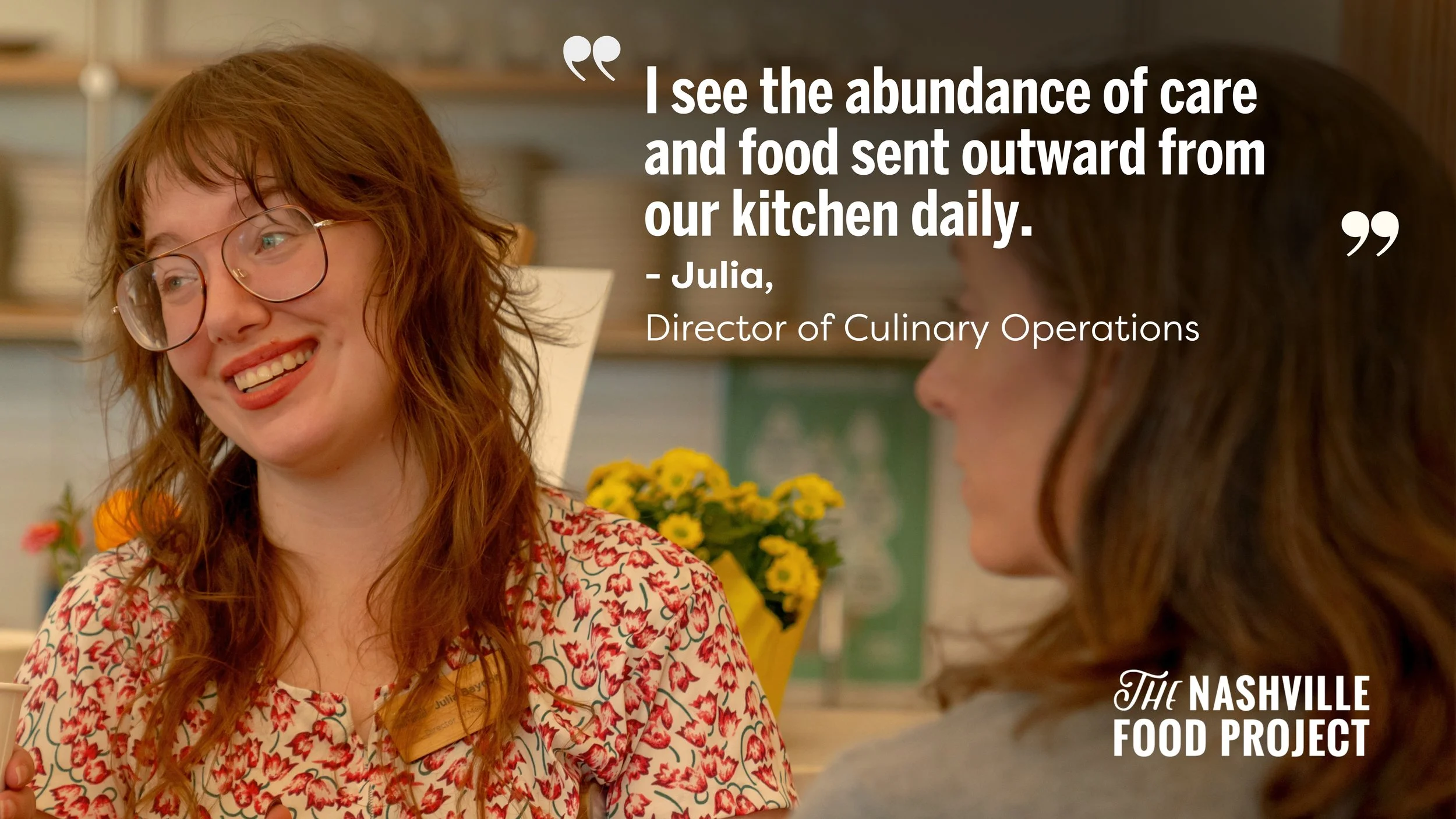
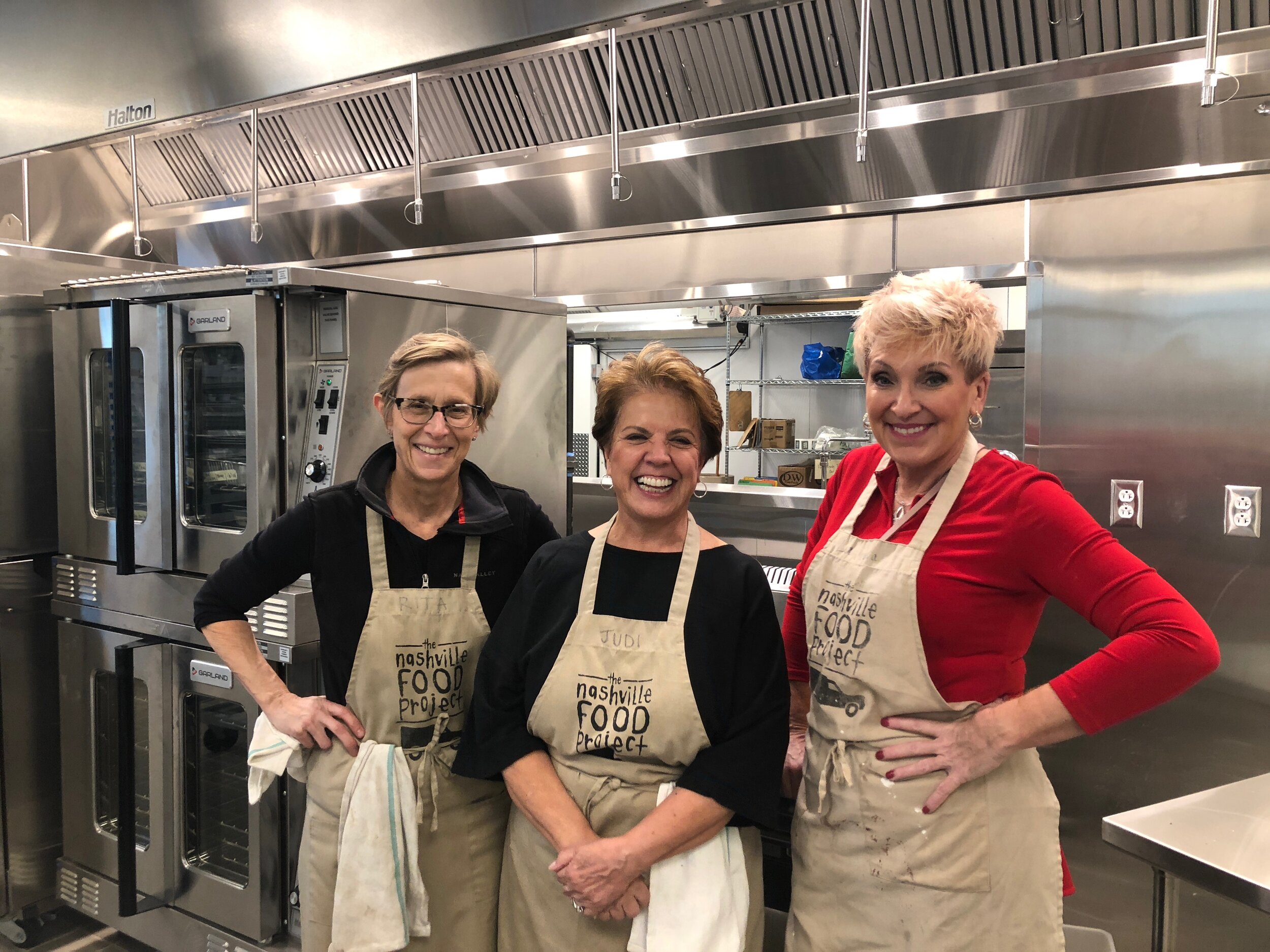
“They’re still here through the recipes,” says Julia Baynor, Prep Coordinator at the California Avenue kitchen.
It’s hard to believe that five months have passed since we could welcome volunteers into our kitchen. We long for those bustling days when cutting boards covered every inch of stainless work surface and folks from varied walks of life stood elbow to elbow as they chopped bell peppers or portioned banana bread into squares. Laughing and talking to kitchen tunes along with the rhythmic thud of knives and hiss of vegetables hitting hot tilt skillets.
Those were the days.
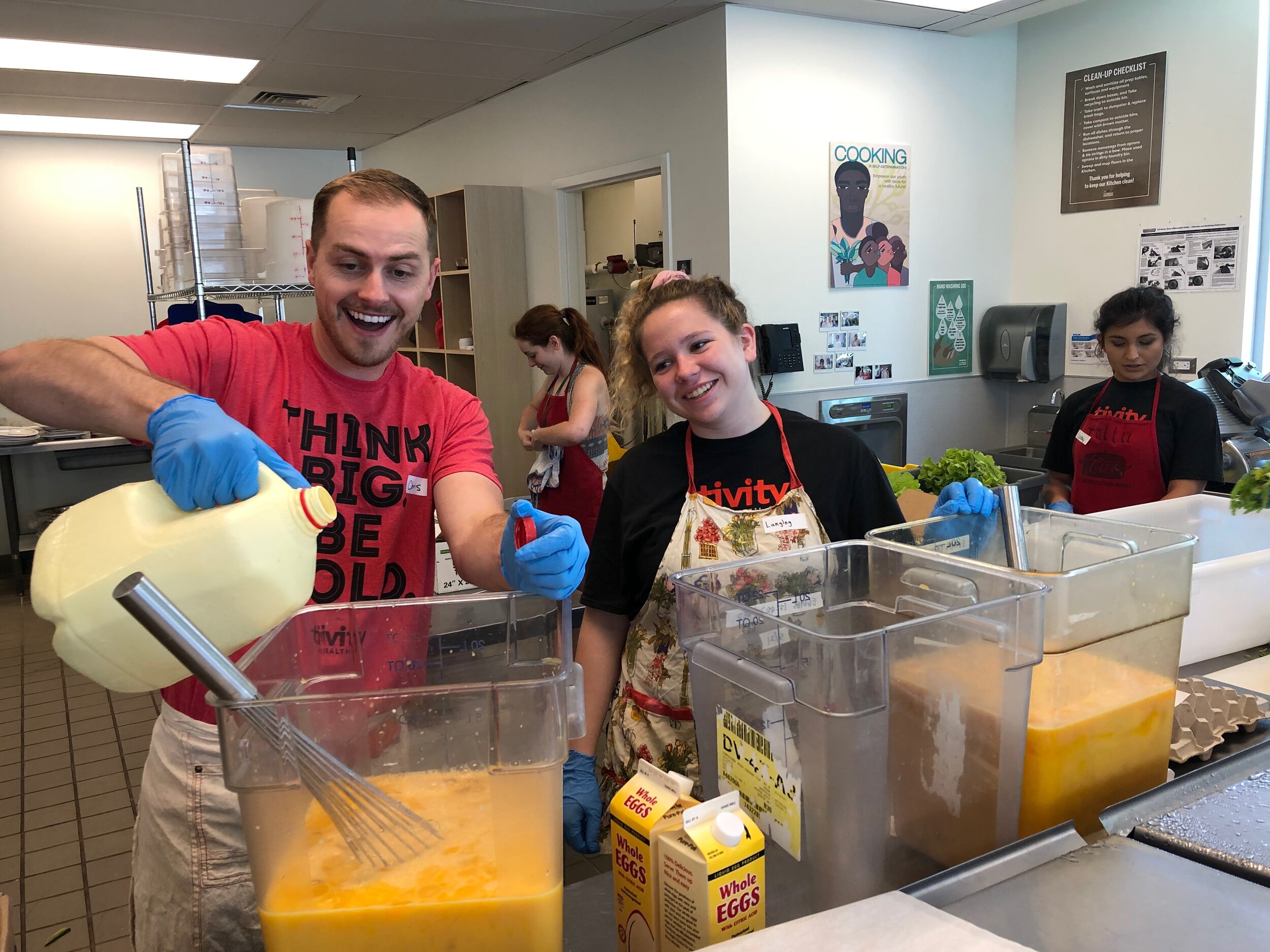

But even with a smaller crew of staff these days in a quieter kitchen working to make meals for our partners, we feel the presence of volunteers all the time.
“They’re still here through the recipes,” says Julia Baynor, Prep Coordinator at the California Avenue kitchen.
For example, the Meal Teams recently made chicken satay with sauteed summer vegetables and rice. The sauce for the dish is legendary around here—a staple in our repertoire for partner meals as well as catering jobs (in the days of such). It comes from longtime, trusted volunteer Judi Hardy.
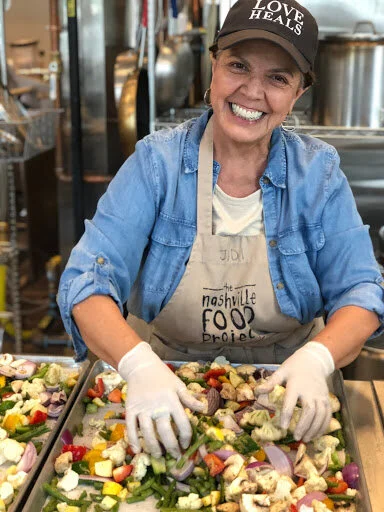
During a recent kitchen chat, Meg recalled the first time Judi introduced it to her about three years ago. “It was one of my first days at the Food Project, and I had never had satay sauce before,” Meg said.

These moments remind us of our value of Learning: “We are at-once students and teachers...We make time to listen to each other learning from the wealth of life experience and skills others bring to this work.”
We are thankful for the exchange of ideas, learning and creativity that happen in these spaces, and we look forward to the day we can be physically close again. Until then, the memories, lessons and recipes carry us through.
Spicy Szechwan Peanut Sauce
Makes 1 ½ cups
10 cloves garlic, minced (should equal about 2 tablespoons)
about 2/3 bunch of cilantro leaves and upper stems, minced (should equal about 3 tablespoons)
1/2 cup peanut butter (natural or unseasoned is best)
1/2 cup plus 1 tablespoon soy sauce
1/2 cup sugar
1 tablespoon rice vinegar
1–2 tablespoons hot chili oil
In a food processor fitted with a steel blade, pulse together the garlic and cilantro. Then add remaining ingredients and process for about a minute until ingredients are combined.
We most often serve this sauce with chicken skewers.
Note: Sauce can be stored, covered, in the refrigerator for several days.
This recipe shared with us by Judi Hardy is adapted from The Modern Art of Chinese Cooking by Barbara Tropp.
Partner Spotlight: Legacy Mission Village
As a people of fierce hope that believe in intersectionality and interdependence, we’ve also seen generous creativity implemented to help neighbors care for each other. We found this type of resistant and persistent care in the work and community fostered by Legacy Mission Village.
by Elizabeth Langgle-Martin, Community Engagement Manager
The introduction of COVID-19 to our world and our city has created devastation for so many. And while COVID-19 did not break our systems, it has exposed and deepened our country’s existing inequalities, gaps in care, and further alienated some of our most vulnerable members.
As a people of fierce hope who believe in intersectionality and interdependence, we’ve also seen generous creativity implemented to help neighbors care for each other. We found this type of resistant and persistent care in the work and community fostered by Legacy Mission Village.
Legacy Mission Village (LMV), as explained by their Director of Operations, Tim Mwizerwa, “was founded by refugees to serve refugees in Middle Tennessee.”
“Traditionally, we are an educational organization that works towards workforce stability and economic stability for families,” he says. LMV typically provides English learning, financial literacy, digital literacy, citizenship test preparation, and children’s education support. Tim notes that their goal is to support every member of the family “from cradle to grave.” He explains that seemingly standard programming, such as after-school support for teens, can be drastically different for refugee families. Often a teen or child may be the only person fluent in English within a household, leaving them to navigate complex situations like insurance claims, tax documents, and other elements that lead LMV’s team to provide intensive support that spans beyond traditional homework help.
With the risk of COVID-19 continually looming, LMV’s community is unable to meet in any kind of classroom setting so their team has been challenged to imagine how to support the families they serve in relevant ways that span beyond their core programming.
Earlier in the summer, LMV began to purchase pantry goods in bulk to help their participants experiencing food access struggles. Staff soon wondered how they could offer their clients a more balanced COVID-19 relief box beyond the non-perishable items they had secured.

The Nashville Food Project was able to support LMV’s existing efforts by sourcing local, fresh foods to enhance the dry food items that LMV was offering the families they serve. Each week TNFP was able to leverage our resources and relationships to source locally raised proteins from TN Grassfed, eggs through KLD Farms, milk from Hatcher Family Dairy, and robust quantities of fresh produce from our Growing Together farmers, Sweeter Days Farm, West Glow Farms, Green Door Gourmet, and others. Throughout the summer approximately 80 families had access to fresh, local, high-quality food through this vibrant collaboration. In addition, through TNFP’s relationship with Henley Nashville, which acted as a satellite TNFP kitchen during the early days of COVID-19 shutdowns, LMV was able to receive culturally appropriate family-sized, scratch-made meals. Over the course of a month and a half, through Henley, TNFP, and LMV, a total of 1,360 servings of from-scratch goodness was shared with families alongside the bulk groceries provided.


As we move into fall, LMV is pivoting once again, to support the families they work with as they navigate the complexities of online learning. While making this shift they’ve heard from about 40 families that fresh food support is still a critical need for their households. This opened an opportunity for TNFP to continue to provide support in a new, specialized way. TNFP will provide weekly produce boxes of culturally-appropriate produce, grown by and purchased from the farmers in our Growing Together program. Many of the families that LMV works with share a Burmese heritage with several of the Growing Together farmers. We love that the vibrant, organically-grown produce that Growing Together yields can be leveraged to nourish the needs of that same community.

During a recent conversation, Tim shared that the silver lining through current struggles is that this time has allowed for the fostering of new community partnerships. For LMV, he says that has allowed them to step up and provide new types of care for the families and continue to adapt and serve in more substantial ways. Our relationship with LMV has allowed us to leverage our resources to share high-quality food in new ways that are meeting expressed community needs while simultaneously allowing us to invest in Growing Together farmers and other local farms who have long been generous and supportive of our work.
Tim shared some notes that the Legacy Mission Village crew has received in response to the food assistance they have been able to provide:
“We are good. You take care [of] our family.”
“I'm good and my family too, thank you for everything you helped me and my family [with].”
For the millionth time, we are reminded that we belong to each other, and we are grateful to be a small part of the collaborative work happening in Nashville. In a time when we are socially distant, this type of connection feels more delicious than ever.
Fighting for Tennessee’s Food Security Safety Net: Pandemic EBT and Food Assistance in the Age of Coronavirus
We know how important free and reduced-price meals are for Tennessee families—over 663,000 Tennessee kids rely on free lunch and breakfast during a typical school year. As the pandemic shutters businesses and causes unprecedented layoffs, families are more vulnerable to food insecurity than ever before. While support from incredible locally-run organizations like The Nashville Food Project, this does not replace the need for food assistance legislation from state governments—especially in times of crisis.

Image from @tnjustice
guest post by Lauryn Cravens
Passionate about nutrition, food policy, and food justice, I have had the incredible privilege this summer of splitting my time working between The Nashville Food Project and the Tennessee Justice Center’s Nutrition Team. This has afforded me the opportunity to work with this concept of “food” with my hands in the Food Project’s Growing Together garden, and at the federal policy level with the Justice Center, all as the coronavirus pandemic has put a greater strain on our food system than ever before.
No one on the Tennessee Justice Center’s Nutrition Team expected our summer to be consumed by Pandemic EBT, but it has. What is Pandemic EBT? Pandemic EBT provides financial benefits for families of children in grades K-12 who receive free or reduced-price school meals or attend a Community Eligibility Provision school (a school where meals are free for all students) to help families that missed school meals during March, April, and May when children were not in school due to COVID-19. The only requirement is a child must be eligible for free or reduced-price school meals; P-EBT is for all students regardless of citizenship or immigration status.
The state of Tennessee boarded the P-EBT boat later than other states and was not approved for the program until mid-May. Since approval, Tennessee has failed to implement the program quickly, and several obstacles remain in place, making it hard for too many families to access food. Due to significant administrative barriers, a lack of sufficient marketing and outreach to inform the public of the expanded benefits and a short application window for families, thousands of Tennessee families are still without their desperately needed benefits.
We know how important free and reduced-price meals are for Tennessee families—over 663,000 Tennessee kids rely on free lunch and breakfast during a typical school year. As the pandemic shutters businesses and causes unprecedented layoffs, families are more vulnerable to food insecurity than ever before. While support from incredible locally-run organizations like The Nashville Food Project, this does not replace the need for food assistance legislation from state governments—especially in times of crisis.
For example, one way to help keep Tennessee students and their families afloat would be eliminating the P-EBT application altogether, allowing every family who qualifies to automatically participate. And although the state is responsible for publicizing P-EBT, everyday Tennesseans can also do their part to spread the word and advocate for this food assistance program, whether that be via word of mouth, social media, or by contacting local representatives.
Furthermore, as those who work with The Nashville Food Project and the Growing Together program know all too well, not all Tennessee families are fluent in English. Translation of the P-EBT application into Spanish, Kurdish and other languages would make the program more accessible for the many immigrants and refugees who call this state home. These actions and more can help ensure that all eligible Tennessee families receive the benefits they need and deserve during this critical time.
Stay updated with Tennessee Justice Center’s nutrition advocacy efforts, and see what you can do to help here: https://www.tnjustice.org/child-nutrition.

Image from @tnjustice
A Statement From Susannah Berry, Chair of The Nashville Food Project Board of Directors

A STATEMENT FROM SUSANNAH BERRY, CHAIR OF THE NASHVILLE FOOD PROJECT BOARD OF DIRECTORS
As Tallu Schuyler Quinn, The Nashville Food Project’s founder and CEO, undergoes medical treatment for a recently-diagnosed brain tumor, the Board of Directors has focused on how to ensure the organization continues its essential work in our community and our city — while providing Tallu the flexibility necessary to care for herself during this time.
To do so, the Board has offered the positions of Interim Co-CEOs to Christa Bentley, Interim Chief Programs Officer and Teri Sloan, Development Director. Together, these two dedicated and experienced colleagues will guide The Nashville Food Project’s day-to-day operations.
In considering strategies for interim leadership, the board also wanted to ensure that Tallu’s wisdom and guidance continues as a meaningful, essential part of The Nashville Food Project. Hence, the board offered — and Tallu has accepted — a new position, in the role of Founder. In that role, she’ll work with the board on vision and strategy, among other duties. We are so pleased and gratified that in this role, Tallu will stay core to the work of The Nashville Food Project.
On behalf of the Board of Directors and the staff, thank you for supporting The Nashville Food Project and its mission. And thank you for keeping Tallu and her family in your thoughts and prayers.
Sweet Peas 2020 with Gratitude for Good Neighbors
As for nutritious meals and snacks, we’re proud to partner with Project Transformation at three of their sites this summer. We know one in six children do not have access to the food they want and need. Lack of access can be even greater during the summer with the absence of school meals. Given this alarming information we launched a program last year called Sweet Peas: summer eats for kids. Now in its second year—amidst the current crisis—we know the need for nourishing meals is even greater.

Like so many of us in 2020, Sarah McCormick, Senior Director of Operations & Impact at one of our partner organizations Project Transformation, has had a challenging year. And yet, she also has had the opportunity to see folks, as she beautifully puts it, “rediscover what it means to be a neighbor.”
As planning began for Project Transformation’s summer camps for children, she and her colleagues knew would need to look different in the time of COVID-19. Through that planning, they heard two overwhelming needs from parents: Something for the kids to do and something for them to eat.
Meanwhile, they also knew they wanted to stay committed to their core goals of literary development and social-emotional development—even at safe distances. Volunteers and partners jumped in with open hearts and minds to make necessary shifts launching grab-and-go locations for meals and “summer camp in a bag,” which included a new book each week for building young home libraries as well as activities for inside and outdoors.
As for nutritious meals and snacks, we’re proud to partner with Project Transformation at three of their sites this summer. We know one in six children do not have access to the food they want and need. Lack of access can be even greater during the summer with the absence of school meals. Given this alarming information we launched a program last year called Sweet Peas: summer eats for kids. Now in its second year—amidst the current crisis—we know the need for nourishing meals is even greater.

Nashville Food Project meals ready for pick-up at a Project Transformation site.
We also understand, though, that food can’t solve all inequities and that’s why we love to work in community with partners like Project Transformation. As author Francis Moore Lappe says: “People go hungry not from a lack of food but from a lack of power...with a wider lens we can see that hunger is not caused by scarcity of food but scarcity of democracy.” Literacy is power. Emotional intelligence is power. We believe the work of partners like Project Transformation helps break down inequitable systems. And by providing meals alongside their work, we’re building stronger communities together.
McCormick says research shows that children in communities experiencing marginalization often lack access to tools and enrichment activities over the summer especially. “We want to make sure kids aren’t regressing,” she says. “For us there’s a wider gap potentially (during pandemic) because kids are out of school longer. It’s even more important to get books into the homes and let them know they are supported.”
Just as Project Transformation worked through COVID-19 challenges with the help of supporters, likewise, our Sweet Peas program got a big leg up from this year’s sponsor, Jackson National Life Insurance Company. Our volunteer program has been suspended since March leaving the kitchen staff with 380 fewer sets of hands to help prepare meals each month. Yet we still needed to increase summer output and share about 12,500 meals with kids. So in addition to helping fund the program, Jackson rolled up their sleeves to help cook.
With the Jackson offices mostly closed to staff, Jackson converted their dining services facility into a satellite kitchen preparing nearly 4,500 nutritious meals for Sweet Peas. The Jackson dining services team stayed busy while helping us expand our reach to partners. Over an eight week period, the Jackson team served 140 kids, four days a week to two Project Transformation summer camps.

Meal prep at Jackson’s headquarters for Project Transformation sites.
“It feels good obviously,” says Wess Victory, Food Services Director at Jackson. “I think it’s helped morale around here to know we’re doing some good.”
While Victory and team offer healthy options for Jackson employees on a regular basis, they worked even harder to pack summer lunches for kids with vegetables and whole grains. But when neighbors work together, we like to believe lunches come packed with power for a better future too.

Jackson’s kitchen serving as a satellite kitchen for The Nashville Food Project.

Jackson meals headed for Project Transformation sites.
A Statement from Susannah Berry, Board Chair of The Nashville Food Project
The Nashville Food Project is a close-knit community of staff, volunteers and community partners, and we want to share some important recent news about our founder, CEO and friend, Tallu Schuyler Quinn.

A STATEMENT FROM SUSANNAH BERRY, BOARD CHAIR OF THE NASHVILLE FOOD PROJECT
The Nashville Food Project is a close-knit community of staff, volunteers and community partners, and we want to share some important recent news about our founder, CEO and friend, Tallu Schuyler Quinn.
Tallu is currently undergoing medical treatment for a brain tumor. It is still early in her treatment. In the meantime, the board is working closely with the dedicated staff to ensure that all of The Nashville Food Project’s vital programs and operations continue without interruption. We are committed to the organization’s core mission to bring people together to grow, cook and share nourishing food, with the goals of cultivating community and alleviating hunger in our city. And in this pandemic, that mission remains more urgent than ever.
All of us connected to The Nashville Food Project are keeping Tallu and her family in our thoughts and prayers — and know that, throughout our community, so many others are doing the same. As we’re able to share further updates about Tallu’s well-being, we will. Thank you for your support, your kindness and your understanding.
What it Means to Nourish Community
Nourishment, after all, is about so much more than feeding and eating. To nourish another centers on the emotional tie—the care, regard, and concern—you have for another. It is about maintaining a relationship by prioritizing and cherishing another, not imposing what you think you know, but rather about listening. And it is this relationship that informs what makes another person or a community healthy and strong.

by Johnisha Levi, Development Manager
Since its inception, The Nashville Food Project has operated in a foodscape saturated with inequity. Our mission is to ensure that people are getting the food they need and want, with “want” being as vital to us as “need.” And now, after a series of life altering events, including tornadoes, a pandemic, fatal police shootings and mass protest, we are in a moment that is utterly destabilizing. But this is not necessarily a negative. Although it is admittedly easy for each of us to vocalize what we fear and dislike about 2020, this year also presents a rare opportunity to reset. When we emerge from this crucible, what new shape will we assume? Who and what will we be—as a nation, and as a people?
Now is the time to re-imagine, re-create, take response-ability, and re-assess. There is so much that has been and is broken about our government, our country, and our world. Stressors have better exposed these breaks, giving us a clearer picture of our failings, so the question is what do we do to improve and innovate, to move beyond and above? These are challenges for us as individuals, but also as organizations. Currently, The Nashville Food Project may not be able to carry out the part of our mission that “brings people together” physically—whether in our kitchens or for charitable fundraisers like Nourish—but that doesn’t stop up from querying how we can continue to sustain and nourish our community in new and even better ways.

Nourishment, after all, is about so much more than feeding and eating. To nourish another centers on the emotional tie—the care, regard, and concern—you have for another. It is about maintaining a relationship by prioritizing and cherishing another, not imposing what you think you know, but rather about listening. And it is this relationship that informs what makes another person or a community healthy and strong. What comes to mind is the phrase “community of feeling,” which appears in letters that Sigmund Freud and Albert Einstein exchanged on the question of war. What I think it means to nourish a community is to nurture “a community of feeling,” and this is at the heart of TNFP’s vision for a just and sustainable food system. As Tim Mwizerwa, program director at one of our emergency partners Legacy Mission Village explains, “ T[he Nashville Food Project was] willing to provide fresh produce to a lot of our families that were also culturally competent. You can gather a lot of goods but if families don’t recognize how to cook that produce, it goes to waste. We really appreciate your partnership and support and just knowing that we are not sending [our client families] filler foods, we are sending them nourishment on top of that.”

Although many things remain uncertain in the coming months, one essential truth, as stated in a recent New Yorker piece, emerges: “civic connection is the only way to survive” in a time when physical contact can present such danger to so many in our community. And it is this civic connection that is at the heart of our community food model at TNFP. Typically, mutual aid efforts and charitable organizations take different approaches. The former tend to be more grass roots and shaped by volunteers and the needs of recipients and services, while the latter tend to be more hierarchical and governed by boards and donors. What is beautiful about The Nashville Food Project model is that it is more a hybrid—a charitable organization that operates like a mutual aid project in seeking to empower, involve and amplify the needs of those it serves. For example, when a Burmese community leader and former Growing Together farmer approached TNFP about the particular need in her hard-hit community for fresh produce, we were able to use unrestricted funding to pay our Growing Together families to supply these vegetables. Thus, families affected by COVID outbreaks at their workplaces were able to enjoy the labors of what their farming neighbors produced, while the farmers could continue to earn income from their agricultural efforts. This is a community of feeling and of nourishing—of listening, responding, and creatively meeting a need.

When reading the news can be so grim, it is inspiring to see the impact that spontaneous mutual aid networks and charitable organizations are making to help ameliorate suffering during this pandemic. While TNFP will seek to carry forward some of the lessons we learn in crisis to keep nourishing our community, we must never lose sight of the underlying reality that these unmet needs should never have existed within our systems in the first place. And we must continue to strive to make our own work obsolete one day. As Martin Luther King Jr. said, “Philanthropy is commendable but it must not cause the philanthropist to overlook the circumstances of economic injustice which make philanthropy necessary.”
Dispatch from the Community Gardens
In the community garden program, we're always looking for ways to evolve and learn from our work. And this year, we are already reflecting and learning from the adaptations we've had to make due to COVID-19.

by Lauren Bailey, Director of Garden Programs
In the community garden program, we're always looking for ways to evolve and learn from our work. And this year, we are already reflecting and learning from the adaptations we've had to make due to COVID-19. We’ve been focused on adapting the program with these priorities in mind: keeping everyone safe and ensuring that everyone has access to fresh produce.
I've been reflecting a lot lately on the bounty of harvest being shared and on the community of gardeners who were willing to try out a new garden model with us. Right now, we are all facing circumstances that the world has never seen. And more than ever, it feels like the right time to build community in the ways that we can, safely, at a distance. For the time being, instead of tending individual plots, we’re all working together to grow for the nourishment of everyone. Gardeners have been joining us in the garden to tend to our communal plots, and they've shared some of what they've been trying out at home.


Our gardens have always flourished from the wisdom, experiences and curiosities that gardeners bring to the space; this year is no different. The gardens are still a place of respite and inspiration. They still provide for us in these uncertain times. We've just had to be creative in how that has happened. Our staff has learned how to grow some crops that we've never grown before, like bitter gourd, bottle gourd and taro root. Gardeners have tried new vegetables like kohlrabi, fennel and kale. And though this year looks so different than past years, we're still a community of people who love the act of growing food, sharing recipes and eating good food.

A Spirit of Abundance
At TNFP, we often talk about our value of Stewardship and the belief we believe that there is enough. I’ll say it again, there is enough.

by Lauren Bailey, Director of Garden Programs
It’s a hot afternoon at the Community Farm at Mill Ridge, and as I’m starting to pack up from our communal garden produce pick up, Lu Lu arrives. She’s wearing her straw hat and a smile. She seems to have a lot on her heart as she tells me about her previous engagements of the day. She tells me how she and other leaders have been meeting to find ways to support refugees in Malaysia. Over the course of the next hour, she tells me about the experiences that led her to help others. And what is so clear for me as I listen to her is her courage, bravery and generous spirit. And on a hot day like today, her words land as a challenge and inspiration to exercise a spirit of abundance.
Lulu Nhkum’s leadership has been critical to the development of the garden programs since they first began. I think back to a shared dinner that she, I and two other colleagues had. It was LuLu who said that she had dreams of becoming a farmer and in that very moment, the momentum for applying for the Refugee Agricultural Partnership Program grant was sparked (which eventually became Growing Together and initial programming for some of the community gardens). Her leadership, insight and advocacy have been essential to the success of our work. She has been a champion of this work, even as she’s been fully employed elsewhere. If you know her, then, maybe you’ve seen the way she delights in learning about and growing food. Her enthusiasm is contagious.
It has come as no surprise that during this crisis, her leadership and enthusiasm continue to shape our programming in important ways .In a time of crisis, a scarcity mindset is easy to embrace. One of the things that I've learned from Lu Lu’s leadership during this time is that abundance manifests in many ways. It looks like folks showing up to support one another. It can look like a circle of leaders and organizers hearing need and mobilizing resources.
This year, as the effects of COVID began to be felt in our city, Lu Lu seeing and hearing the need of those in her community, advocated for TNFP to support these families in some way. She had intimate knowledge of the Growing Together program and the food grown there and knowledge of the communities' needs. Because of her advocacy and with the help of other leaders, over 100 families impacted by the virus received fresh vegetables from the Growing Together farm.
At TNFP, we often talk about our value of Stewardship and the belief we believe that there is enough. I’ll say it again, there is enough. One of Adriennne Maree Brown’s Principles of Emergent Strategy is that there’s always enough time for the right work. There is enough time; there are enough resources; there is enough food. And the leadership of women like Lu Lu Nkhum show that there are ways to make sure that people have what they need, even in times of crisis, if we can all get better at exercising this spirit of abundance.


An American Pandemic: Meditations on Black Death
With hope because hopelessness is the enemy of justice. With courage because peace requires bravery. With persistence because justice is a constant struggle. With faith because we shall overcome.”
- The National Memorial for Peace and Justice, Montgomery, Alabama
by Johnisha Levi, Development Manager

“For the hanged and beaten. For the shot, drowned, and burned. For the tortured, tormented and terrorized. For those abandoned by the rule of law.
We will remember.
With hope because hopelessness is the enemy of justice. With courage because peace requires bravery. With persistence because justice is a constant struggle. With faith because we shall overcome.”
- The National Memorial for Peace and Justice, Montgomery, Alabama
America is suffering from more than just death at the hands of the coronavirus pandemic. I am talking about the perpetual killing of black men and women by state sanctioned violence. The names receiving the most publicity in our current new cycle are George Floyd (46); Breonna Taylor (25), and Ahmaud Aubrey (25), and their callous and senseless deaths are sparking a revolution that our politicians are finally having to heed. Sadly, these names only scratch the surface of recent police shootings of black men and women. A database of police killings compiled by the Washington Post from news reporting reveals the pervasiveness of this violence. Since May 1st of this year, we have also lost:
Rayshard Brooks (27); Michael “Blue” Thomas (62); Lewis Ruffin (38); Kamal Flowers (24); Tyquarn Graves (33); David McAtee (53); Derrick Thompson (46); Jarvis Sullivan (44); Momodou Lamon Sisay (39); Rubin Smith (35); Modesto Reyes (35); Tony McDade 38);Dion Johnson (28); Maurice Gordon (28); Willie Lee Quarles (60); Tobby Wiggins (45): Randy Lewis (38); Robert Johnson (29); Rayshard Scales (30); David Atkinson (24); Yassin Mohamed (47); Finan Berhe (30); Adrian Medearis (48); McHale Rose (19); Dreasjon “Sean” Reed (21); Jah’Sean Hodge (21); Quavon Webb (23); Demontre Bruner (21); Said Joquin (26); Brent Martin (32); Shaun Fuhr (24); William Debose (21)
To read this list alone, to contemplate the years lost, the families broken, let alone to watch any recorded videos, is to be shattered for humanity. And as James Baldwin wrote, “A stranger to this planet might find the fact there are any Black people at all still alive in America something to write home about.”
But to know the history of this country is to also know that this is not a new problem, but an old one, rooted in the blood-soaked soil of a land that championed slavery over freedom, and created wealth by controlling bodies and souls like chattel since before its founding. American capitalism is founded on racialized violence. For those Americans who are now waking up to the fact that “the past is never dead, it's not even the past,” they are now seeing that technological innovations and global connectivity haven’t obliterated the savagery our society inflicts on black bodies. If anything, it has only made it more visible and brought it into more homes.

Jars of soil from lynching sites across the country collected in remembrance of the victims.
I see the continuous line between my father and me despite the fact that more than a generation separates us. My father was born in 1924, so had he lived he would now be 96 years old. His was a segregated existence well into his adulthood. He served in a segregated navy as a rare black radio man in the South Pacific in World War II and would not witness school desegregation until he was 30. In my dad’s era, the slogan instead of #blacklivesmatter was “A Man was Lynched Yesterday,” in the form of a banner that the NAACP would fly from its headquarters in New York in protest. While today, we know the names of the officers who shoot black men and women, in my father’s time, this violence was perpetrated “at the hands of persons unknown.” This despite the fact that there were often photographs and postcards of vigilante murderers, some of whom were known and protected by sheriffs and police and some of whom were “lawmen” themselves.
Between 1877 and 1950, nearly 6,500 people were lynched in the United States, and the overwhelming majority of them were black men and women. My dad grew up with such a lynching in a neighboring county in Maryland. Way before #SayTheirNames became a widely used hashtag on social media, the victim’s name was George Armwood. This was 1933. Despite protesting his innocence (Armwood was accused of raping an older white woman), Armwood, a 23-year-old black man, was fed to a mob of 2,000 people that mutilated his body, hanged it from a telephone pole and then burned it. The leaders of the mob were never punished, just as many of the police today are protected by qualified immunity. It was not until 2019 that Armwood’s story was officially memorialized by the state of Maryland.
My dad was nine years old at the time of this savage carnival (A headline from the time called it a “Roman Holiday.”) I asked him about the lynching when I was finishing law school in 2004, having just completed the Capital Defender Clinic at The Equal Justice Initiative. I was working on a research project, writing about parallels between the anti-lynching crusade and the death penalty abolition movement. I came across George Armwood’s name in a book recording the victims of every year of lynching, at the so-called hands of persons unknown. I noticed George Armwood’s life was taken during my father’s lifetime in a neighboring county. I called my dad and asked him if he remembered a lynching in 1933. I did not say Armwood’s name. My dad was starting to suffer dementia; he was only nine years old at the time of George Armwood’s murder. I didn’t know what he would say. What he did say was startling in it’s clarity. “Yes, I remember. It was George Armwood. I remember the older folks talking. I remember they were scared.” From the distance of seven decades, George Armwood was seared into his soul.

Today, you can pay your respects to the victims of past violence at the Equal Justice’s Initiative Memorial for Peace and Justice in Montgomery, Alabama. It is a sacred space, designed to make you keep raising your head, in an echo of what it must have been like to encounter a lynched victim, as you walk through to read the iron tablets of lynchings in America. The iron tablets oxidize when it rains to mimic the blood spilled on our soil. And there is also a separate collection of soil from each place that each victim was slaughtered. But these aren’t just artifacts. This past is still haunting us. It is still with us every day as a reminder that George, and Breonna, and Ahmaud and countless others are deemed dispensable and that their murderers—and even more importantly our society—refuse to take responsibility for the institutional racism that enables their slaughter. Until American institutions demand accountability and recognize and prioritize the value of black life over black death, nothing will ever change. Until those in power are willing to relinquish it to preserve the lives of black men and women, we will continue to have to #SayTheirNames. Americans today are rising up to say that it is time. It is time to change.

Dispatch from our Kitchens: "The Coat"
My deepest hope in all of this is that I can honor the people who paid the price for my new creative outlet, to serve others with that sacrifice, and in some Karmic way I can make the best of what’s shared with us to do good in this world.

by David Price, Kitchen Manager, St. Luke’s Kitchen
Last year at The Nashville Food Project holiday gift exchange among staff, I opened my gift with caution. I wanted to prepare myself to be excited about something that a co-worker who barely knew me bought for me. I am ridiculously hard to shop for, and you can ask my partner Keeli about it sometime. I opened the box with cautious optimism and there it was— a chef’s coat.
To give you some context, I would never buy such a thing for myself, because it says that I have arrived in a way that I had not yet. When you have been a professional cook for two years and crank out steamed veggies and casseroles on the regular, it is an overstatement to call yourself a chef especially when you have only been the head of a kitchen for a few short months.
From the moment I decided to leave my previous career of seventeen years and started cooking at the Food Project, I wanted to be a chef. A part of me always felt that the people who referred to themselves as “chefs” and not “cooks” were trying to prove something they didn’t yet believe about themselves. Still, a piece of me wanted that external validation for something I’d never believe on my own. On the night of that holiday party, I was validated (though I still refer to myself as a cook). It wasn’t the simple fact that someone bought me a chef’s coat. It was who did it. It was my TNFP boss whom I deeply respect.
I have eaten some very amazing food in my lifetime, but Bianca Morton (TNFP Chef Director) made me the best food I have ever put in my mouth from trimmings off of a pork loin that were destined for the trash. She did it on the fly and with zero doubt. It came from a confidence of knowing exactly what she wanted her guests to eat and how she was going to get it done. It changed my perspective. I could cook like that one day if I really drove myself and never forgot to be creative and take risks. She will probably just tell you that she was hungry, but the reality is that creativity is based in what we want and what we have simultaneously. It’s the restriction that gives us our direction to flesh out a dream. That is the purest form of the art.
When she gave me that coat, what that moment did for me was give me the “ok” to do and be creative. She gave me heart and strength and a courage to believe that I was able to be what that coat would say I already was. That was a beautiful moment and the next time I stepped back in the kitchen I got my ass kicked to the point I wanted to give up. That was an equally beautiful day in hindsight because I realized that you never arrive. You just keep learning and trying and getting the hell kicked out of you. I just can’t help myself. I love that. I want to win just enough to keep me from giving up when I just can’t get on the plate what I had in my head.

David working alongside Top Chef-alum Arnold Myint at a TNFP Simmer event.
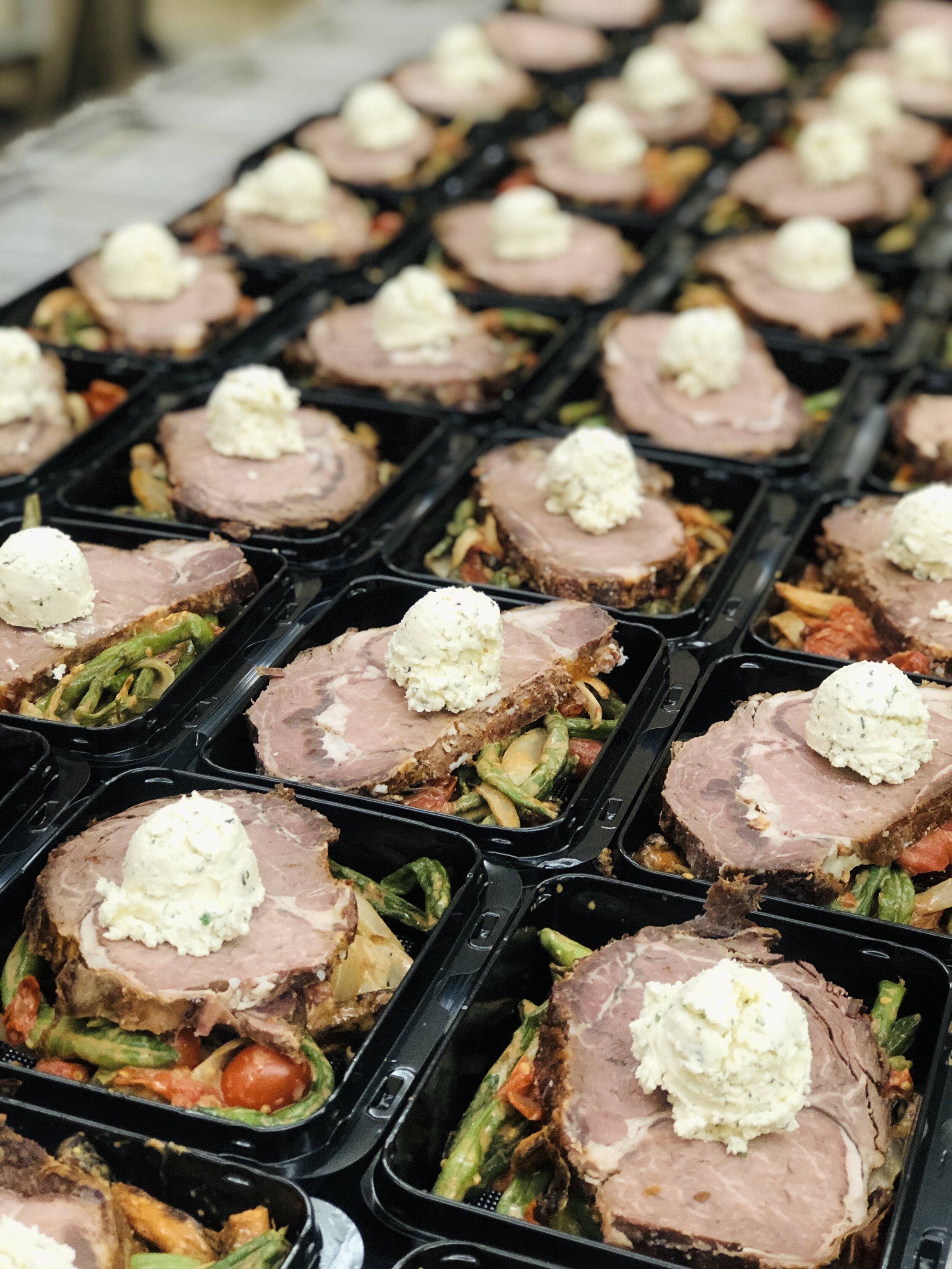
We, especially in this kitchen, are living in some uniquely bittersweet times. Everything seems to cut both ways. We have received some incredible donations of products lately that inspire me yet also sadden me in ways that I can’t really ever put words to. Some of it is from restaurant closures in the wake of COVID-19 pandemic, meaning much of it is food that we would never be able to serve on our own budget. Yet I know that every steak, shrimp, or salmon that we have the privilege to cook is a brutal reminder that it was someone else’s job to cook that thing. You just can’t help but wonder where they are and if they are okay. The thing that I love about kitchen work is that it is communal, so I’m always hoping the best for every person crazy enough to live this life. This creates conflict inside my heart when I cook their food. This is one of the countless ways that my world has changed.

Meals by David and his team made with donated ingredients.
Today, we are constantly reimagining things we thought of as constants. In a million years I could have never imagined a world without the tremendous volunteer support we receive in the kitchen. I could never have imagined creating meals that were not regulated by certain guidelines for federal reimbursement. These days the meals come with fewer restrictions but they also come at a great cost. It becomes a very real challenge to enjoy the privilege that symbolizes the loss of another person’s livelihood. I’ve always hated the saying, “There is no such thing as a free lunch,” because most people use it to justify societal oppression, but I am uniquely aware that everything comes with a price tag these days. All too often it’s rarely the price you want to pay and more often than not it’s the person who least deserves it who foots the bill.
My deepest hope in all of this is that I can honor the people who paid the price for my new creative outlet, to serve others with that sacrifice, and in some Karmic way I can make the best of what’s shared with us to do good in this world. I deeply, and to the point of tears, believe that all ships rise in the tide together. I believe that all people deserve to eat amazing food and to share it together even if you don’t conventionally have access to it. So, I dedicate myself to becoming as good as the best chef turning out food in this city, country and world. I dedicate myself so that I can give delicious food to the people I serve. That is my small place in the universe and it’s the only place I want to live. I have a long way to go, and so much to learn— but that coat said I could do it.
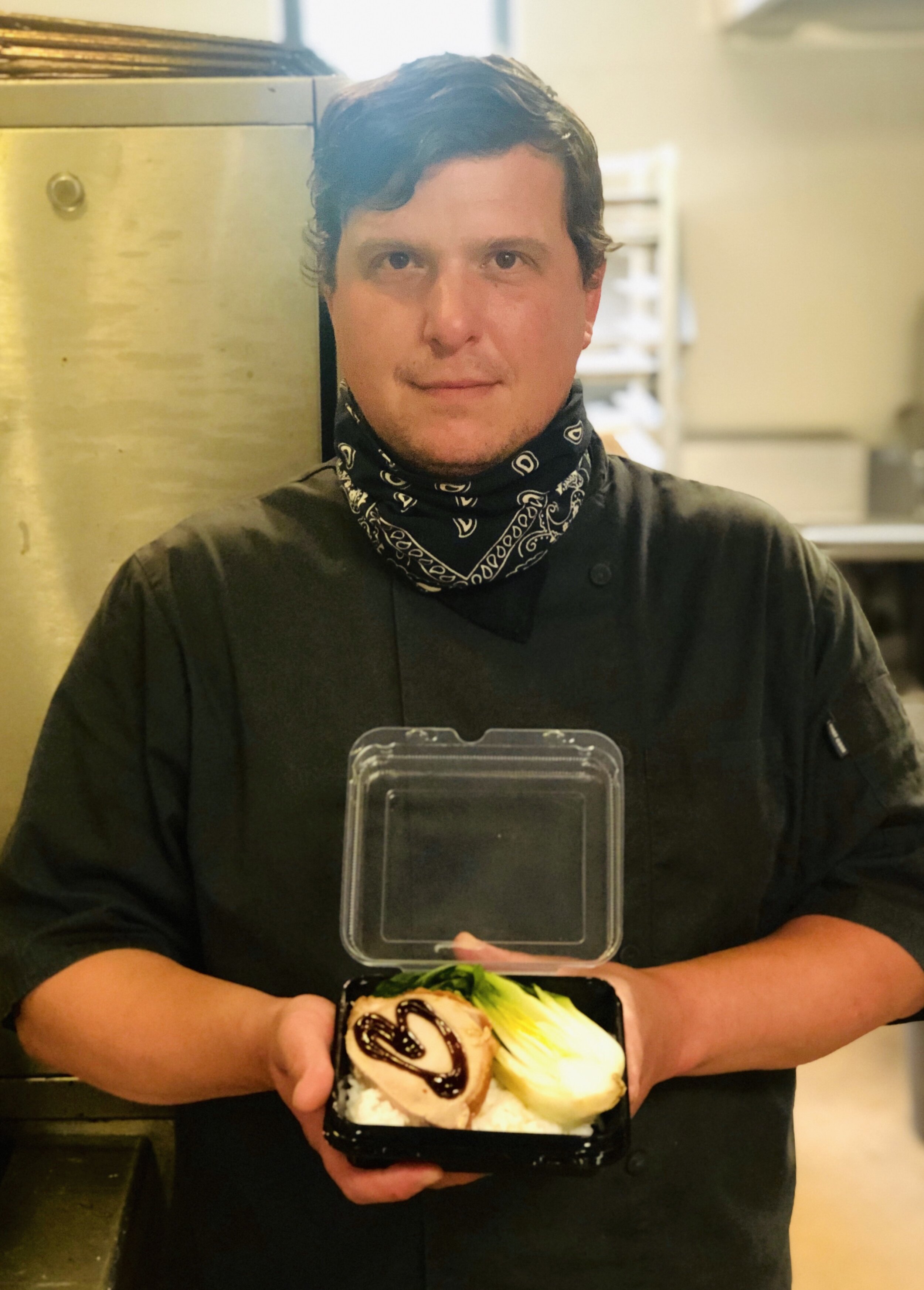
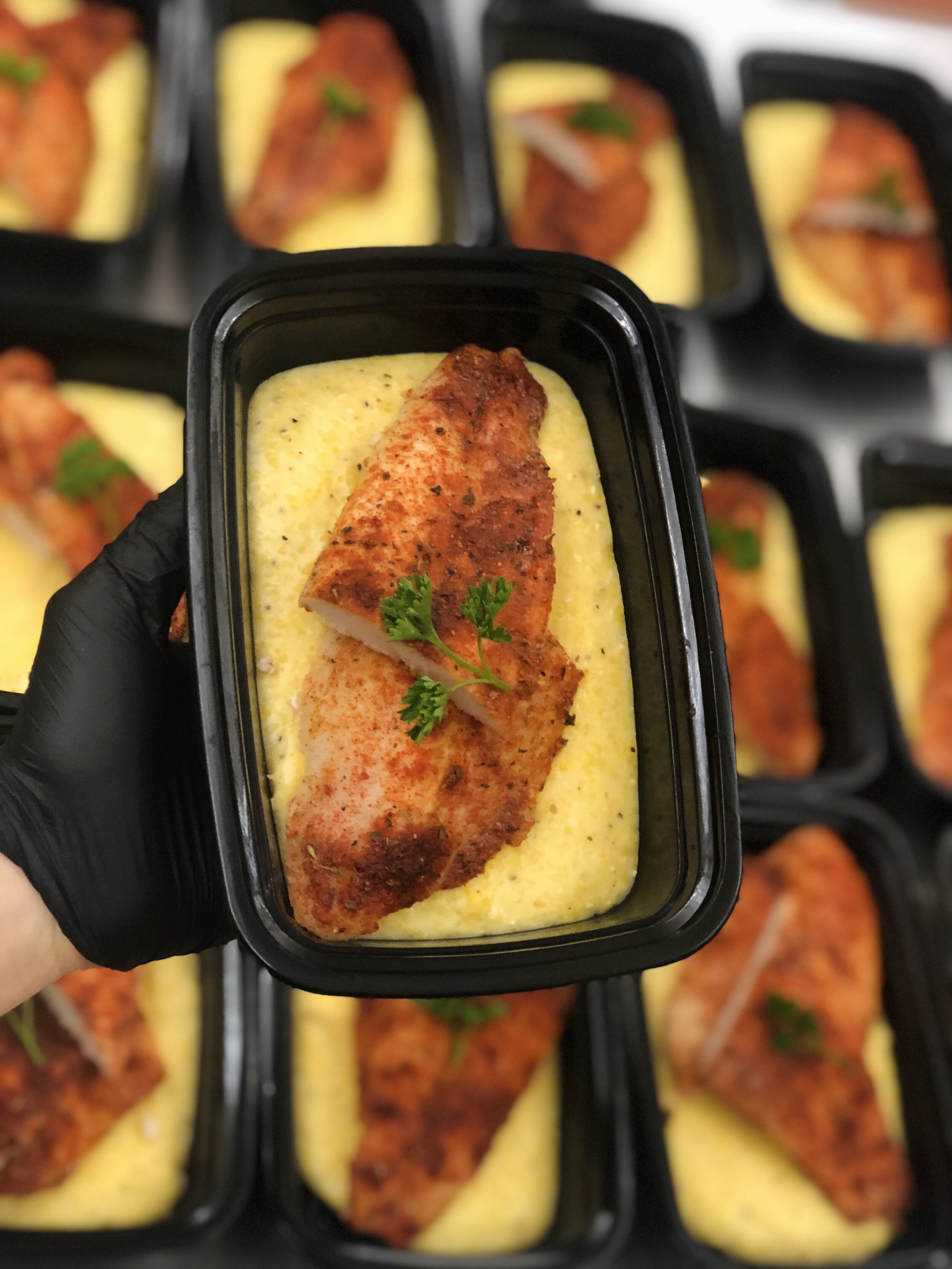
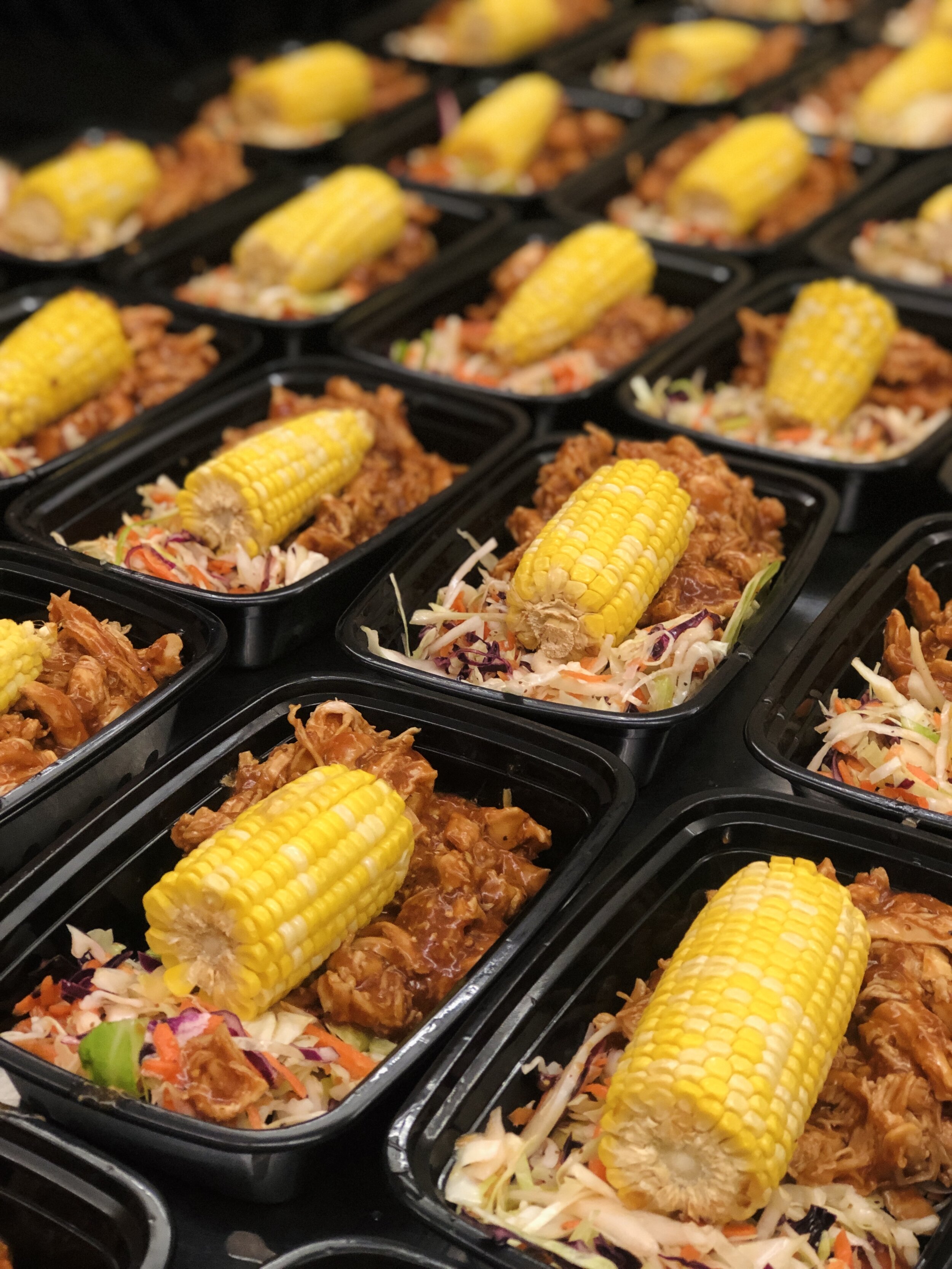

TNFP staff at the holiday party.
Nourish Nashville
“I must remind you that starving a child is violence. Neglecting school children is violence. Punishing a mother and her family is violence. Discrimination against a working man is violence. Ghetto housing is violence. Ignoring medical need is violence. Contempt for poverty is violence.”
— Coretta Scott King

““I must remind you that starving a child is violence. Neglecting school children is violence. Punishing a mother and her family is violence. Discrimination against a working man is violence. Ghetto housing is violence. Ignoring medical need is violence. Contempt for poverty is violence.” ”
The devastation caused by the pandemic has left millions of American households without adequate resources to put sufficient food on their tables. Families with young children are hardest hit, with more than 40% of them unable to afford enough food to meet their needs. The pandemic is not the cause of the gross inequity and economic distress that is pervasive across our nation. The crisis called poverty started long before the first COVID case was confirmed in our community. Decades of underfunding, oppressive policy, band-aid fixes, and neglect have resulted in a torn safety net that has left American families without the money, power and other resources they need to thrive.
As many Americans start or continue their journeys of learning and unlearning right now, we are all waking up to the many forms of institutional violence that are directed at BIPOC (Black, Indigenous, People of Color). Food aparteid, food insecurity, and land dispossession are forms of violence, and with renewed passion, we at The Nashville Food Project are digging into the healing work to make our vision a reality--that all Nashvillians have access to the food they want and need, through a just and sustainable food system.
“You have the duty to change what you have the power to change,” says author and activist Austin Channing Brown. We know that if we tried to do everything we would fail. But we also know we have a moral obligation and community responsibility to step in everywhere we can to uproot the violence of poverty. In this time of crisis that is not new but growing more complex, The Nashville Food Project is on the frontlines, growing food, cooking food, and sharing food in equitable ways throughout the city. We take seriously the clarion call from the late, great Mary "Mother" Jones who said while we "pray for the dead, we fight like hell for the living."
NOURISH NASHVILLE
As many of you already know, this year's Nourish fundraising dinner and auction event is cancelled. It’s not the year for a large, celebratory gathering, nor is it the year to pour our limited efforts of time and creativity into a special event when the critical needs of our neighbors continue to mount. But it is a time to Nourish Nashville more than ever. Nourish will be coming into your homes this year, and although virtual, we hope this makes for an intimate experience of connection with those in your household. Our team has enjoyed finding creative ways to raise the critical funds the Nourish event brings in, while engaging with you all virtually. We hope you enjoy these scrappy, behind-the-scenes snapshots at thenashvillefoodproject.org/nourish2020!
Sowing Seeds of Justice
It is past time to sow seeds that yield justice and a more equitable future. The profound impact of racism on life and death demands a full response from every single part of American society. At The Nashville Food Project we know we do not have all the answers, but we believe we can be part of the solution. We have learned and continue to learn that anti-racism work cannot be treated as side work, but it is the work of community food justice.

Greetings from my small corner of this city I love.
Emergency and urgency are all around us. Institutional violence, spiking unemployment, food insecurity, low-wage work without adequate protection, crippling debt, insufficient healthcare—all of these emergencies amplified by the weight of a global pandemic. The roots of these and other disparities are the result of legacies of white supremacy and systemic racism that have for centuries shaped policing, housing, food and land access, criminal justice, education, and healthcare.
So the turned up patches of dark, fertile soil in our gardens seem more urgent than ever. As we consider what we plant and how we plant, we’re mindful that we can’t expect a just yield without centering the work of equity and racial justice. The luminous Toni Morrison, in her novel The Bluest Eye, has me thinking about what soil can nurture and yield when she wrote, "the land of the entire country was hostile to marigolds that year. The soil is bad for certain kinds of flowers. Certain seeds it will not nurture, certain fruit, it will not bear, and when the land kills of its own volition, we acquiesce and say the victim had no right to live. We are wrong, of course, but it doesn't matter. It's too late."
It is past time to sow seeds that yield justice and a more equitable future. The profound impact of racism on life and death demands a full response from every single part of American society. At The Nashville Food Project we know we do not have all the answers, but we believe we can be part of the solution. We have learned and continue to learn that anti-racism work cannot be treated as side work, but it is the work of community food justice. The crucial nature of our mission to grow, cook, and share nutritious food must be paired with an active commitment to learn and unlearn, to listen, to deepen empathy, to name injustice, and to leverage every resource available to us—money, relationships, time, effort, ideas and more—to address and undo the systemic racism that permeates every aspect of American life.
In full transparency, in this time of COVID emergency and all the ensuing change, so much of what we at The Nashville Food Project want for our community has been relegated to the back burner. We are guilty of pausing our momentum towards fulfillment of our current equity goals, and we have work to do to re-center anti-racism as a crucial part of our daily work and identity. I want to share with you The Nashville Food Project’s Equity and Inclusion Plan, a true work in progress that we have been pulling together over the last few years. It is not perfect but neither is this work, and if these recommendations can amplify your own organization’s commitment to anti-racism, please feel free to lean on them and borrow freely! Our staff and board recommit to educating ourselves, amplifying voices of Black and brown leaders and communities, sharing resources and moving many of our equity and inclusion goals into actionable next steps. We recommit to making room for this work and funding our capacity to grow it. We will also be using our blog and social platforms to listen, share, respond, lead.
To the Black members of our community and other affected people of color—we mourn your pain, celebrate your joy, lift up your contributions, honor your experiences. We see you and are with you.
To the white members of our community, this work is lifelong. Start where you are and attend to it daily. Skip no days. Get in the conversation, do the work, listen deeply, make mistakes and own them, stay with it, and be transformed. Galvanize what you learn by turning your learning into action. It is our responsibility to bring our personal privileges into public life in support of real and lasting change.
Grace and peace,

Tallu Schuyler Quinn
Click here to read The Nashville Food Project’s Statement of Anti-Racism, as well as our other core organizational values that ground us to this work to which we are called and by which we are challenged.
I really appreciate this post by the brilliant nonprofit leader Vu Le about doing the daily work of flossing out racism.
Remembrance at the Community Farm at Mill Ridge
Let us first remember the trees.
If you can imagine 1,000 years ago, to when this hillside and all that our eyes could see was covered in a vast forest of maple, oak, chestnut, and hickory. A squirrel could travel for miles without touching the ground.
by Tallahassee May, Growing Together Education Manager, with information from the Southeast Davidson Regional Park Master Plan

Let us first remember the trees.
If you can imagine 1,000 years ago, to when this hillside and all that our eyes could see was covered in a vast forest of maple, oak, chestnut, and hickory. A squirrel could travel for miles without touching the ground.
Let us remember the indigenous people who lived here from time immemorial, who hunted the buffalo, elk, and deer that once roamed here. The Mississippian Indian Culture who created vast networks of agricultural communities and large cities, who raised the three sisters of corn, beans and squash and who built large ceremonial mounds throughout Tennessee and the Southeast.
Let us remember the Cherokee and the Shawnee, who thrived here for hundreds of years before European settlers arrived, who were forcibly removed by Andrew Jackson and his Indian Removal Act of 1830 and were marched on the Trail of Tears off of this land they had lived on for generations to new, unfamiliar, and unwelcoming territory.
European settlers started arriving in this area in the 1700’s. By 1850, the railroad had arrived, and this area of Mill Ridge supported a 400-acre, mixed-use vegetable and animal farm, owned by James Holloway. Twenty percent of Tennessee residents at that time were blacks living in slavery. Thirty-two enslaved people lived and worked on this nearby Holloway farm, and the graves of their descendants can now be found throughout this park property.
Let us remember that the conversion of these fields from forest to agricultural use—that the development of this community with a thriving agricultural economy—was dependent on the labor of black slaves.
The Moore Family bought this property in 1919. It was a dairy farm for many years, then converted to cattle only in 1950. In 1930, the house was built. It was one of the first in the area to have running water and an indoor bathroom. The house of the Moore Family Farm is now owned by Metro Parks, and it is hoped to be an integral part of this community farm development in the future.
Let us remember, and let us move forward in this remembering, giving thanks to those who came before and embracing the stewardship that is now our privilege to uphold.

Photo from the Grand Opening of the Community Farm at Mill Ridge, 2019.
Community Cupboard: a weekly grocery share
As part of our emergency response, we introduced a new initiative called Community Cupboard: a weekly grocery share. Through this program, we offer weekly grocery shares at no cost to those who have lost jobs and income as a result of COVID-19.
The Nashville Food Project believes that everyone deserves access to the food they want and need, but in the wake of the COVID-19 pandemic and recent tornadoes that devastated our community, so many are lacking that access right now. We have been hard at work shaping an effective community food response in this emergency time.
As part of that work, we introduced a new initiative in April called Community Cupboard: a weekly grocery share. Through this program, we offer weekly grocery shares at no cost to those who have lost jobs and income as a result of COVID-19.

With thanks to Fat Bottom Brewing, our on-the-ground partner in this endeavor, a good portion of those weekly shares will be distributed to out-of-work hospitality industry workers—a part of our community that has supported The Nashville Food Project in extraordinary ways over the years.

The grocery shares include a week’s worth of quality pantry staples, local vegetables, and fresh fruit, as well as local meats, dairy and eggs. With funding from sponsors and donors, we are able to focus on nourishing produce from local farms and producers, keeping dollars in our local economy. Just a few regional food businesses filling these bags include Noble Springs Dairy, Biscuit Love, KLD Farm, Bare Bones Butcher, Kenny’s Farmhouse Cheese, Just Love, Frothy Monkey, Charpier’s Bakery, and produce from our friends at Rally House Farms, HydroHouse Farms, Sweeter Days Farm, and our own Community Farm at Mill Ridge.

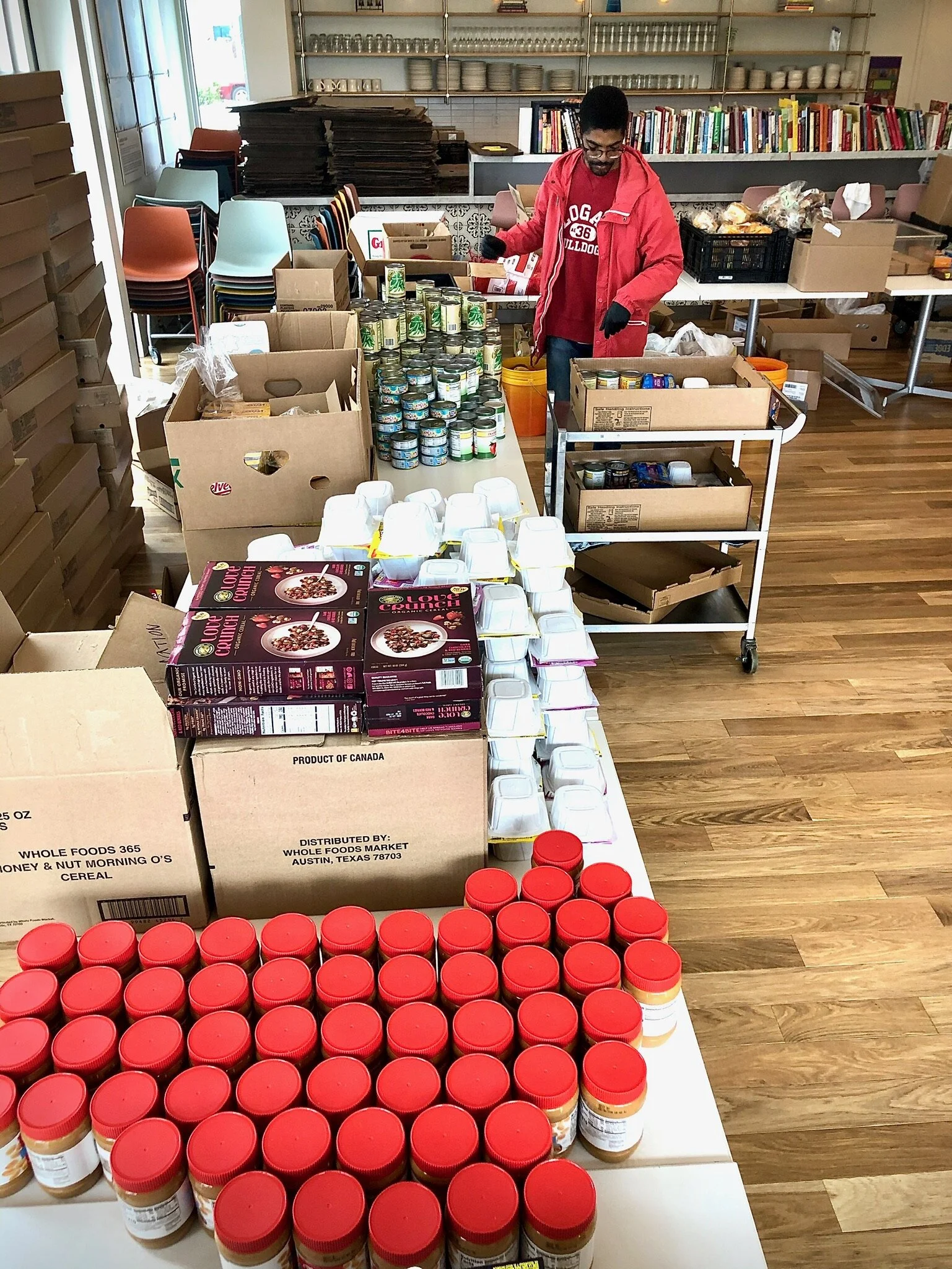

Grocery shares include microwavable, scratch-made meals from The Nashville Food Project kitchens too!

Many thanks to partners at Fat Bottom Brewery, Nashville SC and the sponsors who have made this possible, including Renasant Bank, 506 Lofts, the Russell, Captain Morgan and Piedmont Natural Gas.
Banana Bread for the Pandemic: Remembering a Loved One Lost to Coronavirus
In this time of unbelievable confusion and pain, we cling to the things that bring us comfort, and the most time tested ways of feeling better is to cook and eat a good meal, to bake a loaf of bread. We are reminded of the meals we have shared with the people we love. We ease the sting of separation with delicious memories of dinner parties past. We honor those we have lost by cooking something that they have loved.
by Nick Johnston, Sous Coordinator - St. Luke’s Kitchen
“Reach into your memory and look for what has restored you, what helps you recover from the sheer hellishness of life, what food actually regenerates your system, not so you can leap tall buildings but so you can turn off the alarm clock with vigor.” -- Jim Harrison, “Meals of Peace and Restoration”
“This is a hard place. God, it’s a hard place. But it wakes up every morning. No matter what you do to it the night before. It wakes up.” -- Jess Walter, “The Zero”

Photo by Airin Party
I was never very good at reading my grandmother’s handwriting. When I was a kid, her handwritten notes and postcards would arrive in the mail, and I would pass them along to my father to read them out loud. She wrote in a beautiful calligraphy — a dying art of sloping cursive letters that millennials like myself were ill-equipped to decipher. The one or two cursive lessons given in grade school were essentially useless. Some bang-up cursive seemed ineffective in impressing the young ladies of Ms. Lindsay’s 2nd grade class.
These letters from my grandma arrived in the brilliant dawn of the Email Age, when my love letters were more apt to be typed, thank you very much. So while I had trouble decrypting the lovely loops on the bird-themed stationary, I still hungered to hear what Grandma Ruth had to say, and my dad dutifully served as translator. She always wrote something about the weather, or her roses, or the approaching spring, or a visit she was looking forward to. I have a lot of these letters, recipes, and newspaper clippings stowed away.
The most valuable of the antediluvian artifacts my grandma had passed on to me was her recipe for banana bread. This recipe, along with a preserved and perfect loaf, I will perhaps one day submit to the Smithsonian. Its inclusion to the museum might tell Peoples Future a few things about the lives of Peoples Past. I imagine this loaf and recipe included in a large and fascinating exhibit devoted to explaining Life On Earth Before Covid-19. Students will hover about, notate on tablets, wonder about the coffee-stained recipe from a world where humans still shook hands and knew how to operate their own vehicles. They will also most certainly take pause to admire the graceful calligraphy of Grandma Ruth.
For me, now, waiting for a loaf of banana bread to finish in the oven, it is oddly comforting to imagine distant future school children gazing at my grandmother’s recipe. In a time of paralyzing uncertainty, there is comfort in knowing that this too will end, that history will do its thing, that the ache will dull with each generational wave. That the world will exhale this and that, spring will come again and we will rebuild tomorrow into something better. My grandma’s banana bread recipe calls for some seriously ripe bananas, or, in her words, “nearly rotten.” I’m also oddly comforted by easy metaphors and well-worn cliches these days, and it’s nice to think about something so warm, so profoundly simple and good, coming from something so rotten and dark.
In this time of unbelievable confusion and pain, we cling to the things that bring us comfort, and the most time-tested ways of feeling better is to cook and eat a good meal, to bake a loaf of bread. We are reminded of the meals we have shared with the people we love. We ease the sting of separation with delicious memories of dinner parties past. We honor those we have lost by cooking something that they have loved.
In this particular crisis, staying at home is in fact the heroic thing to do. While we are starved for connection in this time of isolation, it is nourishing to prepare the things that have been passed down to us on stained little pieces of paper, torn notebook pages, from our grandparents, our family, our friends. Our minds and bodies are fortified with the recipes of togetherness, and while we all have a little more time on our hands, we can hone these recipes for when we can cook and share them once again. When this is over the world will be hungry.
And for now we stay home. We clean up the backyard a little. We download Duo Lingo and give Italian another shot. We call our families and grieve the passing of our loved ones. We bake banana bread for our roommates. We turn up the John Prine. We rest inside stories of a world still breathing.
There is a letter from my grandmother I have been waiting to open. She passed away on April 2nd after a tragic battle with Covid-19. It has sat on my desk for a few weeks now. I have been waiting to open it for two reasons, the first being sort of morbidly practical, as this hellish virus can live on surfaces for a while. The other is just that it makes me sad still. I will open it soon, but not today.
Today it has been enough just to marvel at the cursive on the front of the envelope. The “J” in “Johnston” is particularly beautiful, two immaculate ovals that swoop bird-like into the o, h, and n, heading north to make the t, finishing off with an gracefully understated o, the n setting sail towards somewhere like the sun.

