
The Nashville Food Project’s Blog





Siddi Rimal: Gardener, Interpreter, Advocate
Siddi Rimal has tended a community garden plot and worked as a Nepali-to-English translator with The Nashville Food Project’s urban agriculture program for five years. Like many of the community gardeners and all the farmers in Growing Together, he came to the United States as a refugee…
By Jennifer Justus, Culinary Community Liason

Siddi Rimal: photo by Danielle Atkins
The farmers of Growing Together gathered under a pavillion near their farm plots and snipped the dried scapes off garlic bulbs and trimmed the roots they had planted the previous fall. They talked amongst themselves in their native Nepali as cicadas sang from the trees. And occasionally, a jet from the nearby Nashville airport buzzed their acre teeming with Nepali mustard greens, tomatoes, zinnias and dancing with butterflies and bees.
There’s always work to do as farmers, so cleaning garlic had to happen during their weekly meeting. But when the group starts communicating—especially from Nepali to English and back again—that’s when Siddi Rimal’s job begins.
Siddi has worked as an interpreter between the Growing Together farmers and community gardeners who speak Nepali and the English-speaking staff of The Nashville Food Project for five years. He’s crucial to the programs' successes. His support to the programs came at the perfect time and he has remained committed though he’s not professionally trained as an interpreter and he has another job (like many of the farmers) as a technician on the paint line at Nissan.
And it’s not that the Bhutanese and Burmese farmers in the program need help in knowing how to grow things. They’ve got that part down. Many of them came here with decades of experience and fill their plots to the edges with crops and trellises for hanging gourd and long beans. But they do need help navigating the red tape of American systems and sales outlets.
For example, in their meeting they discussed harvesting schedules and plans for packing CSA boxes. Tallahassee May, Education Manager for Growing Together, also talked with the farmers about wholesale orders for restaurants and plans for the Saturday booth at the Richland Park Farmers’ Market.
Siddi must listen carefully and then accurately convey what’s being said even if there’s not a direct translation. It requires concentration and patience because every conversation takes four times as long -- Tally to Siddi, Siddi to farmers, farmers to Siddi and Siddi back to Tally.

Siddi with Growing Together farmers and TNFP staff at the Haywood Lane garden.
But for Siddi, a man who spent half his life in a refugee camp, time is relative.
All the farmers in Growing Together came to the United States as refugees. In Siddi’s case, his family was evicted from Bhutan in 1992 during ethnic cleansing and complicated tangle of factors including religious, political, socioeconomic and geographical reasons (read a brief history of the Bhutanese refugee crisis here).
“Many people were killed and many people lost their homes, lost their property, land, cattle and all,” he says. “When we left, we had to leave our land, our home, cattle— everything. We had to run at nighttime.”
Siddi was 5 years old when his family fled.
“It was a violent moment,” he says. “As far as I know from history and people being a witness, we’re told that armies raped the women and killed some of the social activists. They sent some of them to prison and some were sent for no reasons and tortured there. Some people they kill —put in the sack and throw in the river. Lot of torture and things.”
At the refugee camp in Nepal, they received basic needs from organizations like the United Nations and Red Cross.
“But even though they help us, we had to spend a miserable life,” Siddi says. “We lived in a small hut, made of bamboo and like straw or plastic roof.”
The Nepali camps, which eventually swelled to about 100,000 people, had problems with malnourishment, illnesses, overcrowding.
“In the hut when the weather was very hot like this, it was very hard to live in there,” Siddi says. If there was heavy rainfall and storms, most of the rain goes into the house and floods. It was very hard to tell this story. Because we were in a very difficult situation. And not for a couple of years, it was 22 years.”
The refugees in Nepal often found jobs outside the camp with locals by working in their fields or cutting rice patties. Siddi, who was educated in the camp, worked as a trainer in camp where he met his wife. The couple started the process of applying to come to the United States when they were in their early 20s. It took them three years — repeated interviews, medical tests and background checks — before they were cleared.
“I came to Vegas the first time—Sept 25, 2012,” he says of his first placement in the United States at 26 years old. “There were a lot of people, and it was crowded. I was a little bit nervous there. I never had any experience with the airport, you know? We had to go to the train, so that was like...my mind was blown.”
After two days in Las Vegas, he made his way to Nashville where his wife’s family had already been resettled a couple years prior. Siddi’s father-in-law also later introduced him to The Nashville Food Project’s Wedegewood Urban Gardens, where Siddi began maintaining a plot as a community gardener. Then when the Growing Together program began for growers who take their produce to market, Siddi took on the role as interpreter.

Siddi translating introductions at a community garden potluck.
“Obviously it is very helpful,” he says of the Growing Together program. “Every time I meet with people, even at the grocery store, I always talk about the program.”
Farmers share that it helps provide fresh food for their families in addition to supplemental income. They’re able to grow crops traditional to their backgrounds like komatsuna, bitter gourd, long beans and hot peppers. It’s also a way for farmers to feel more rooted here. And even though the elders might struggle to pick up the language or feel as useful here compared to their younger family members, farming gives them the opportunity to pass along the life-giving skill of tending to the earth and coaxing nourishing treasure from it—all in the company of their community. As one farmer told TNFP, “It helps me feel less alone.”
Granted, there are still challenges. For many of the farmers and gardeners, transportation often arises as a hurdle since many don’t have a driver’s license or access to a vehicle. Language barriers for some, especially when Siddi isn’t around, also pose problems.
But just as TNFP’s Tally and Sally Rausch have picked up Nepali words, the farmers too have learned English words like the names for vegetables— “onion,” “tomato.” They know “gift,” which they use while pressing a potato into the palm of a friend. They issue lots of “good mornings.”
As the meeting at the Growing Together farm neared its end, one of the farmers, Nar, finished working through her stack of garlic, so she threw her arms up in a “V.” She flashed a smile and shouted a word in Nepali. The others laughed. And then she pressed her palms together at her heart.
Some things, it turns out, don’t need translating after all.
Bianca's Skillet Cornbread
Bianca Morton is up to her elbows in tomatoes. A few yellow bins sit brimming with red and orange orbs perfuming The Nashville Food Project kitchen with their clean, acidic scent and mingling with the earthy tones of pasta roiling in a giant kettle…
By Jennifer Justus, Culinary Community Liason

Bianca Morton, Chef Director at TNFP’s California Avenue kitchen.
Bianca Morton is up to her elbows in tomatoes. A few yellow bins sit brimming with red and orange orbs perfuming The Nashville Food Project kitchen with their clean, acidic scent and mingling with the earthy tones of pasta roiling in a giant kettle.
The pasta will get tossed in tomato sauce, of course. That’s because Bianca has been working quickly to have all the summer tomatoes processed—chopped for green salads, dehydrated for later, or whirled up in enchilada sauces and marinas for layering into lasagnas.
She has to think smart and fast every day about how to use thousands of pounds of food that generously come through our doors from farms and markets. And then she works with volunteers and TNFP co-workers to turn ingredients into scratch-made meals for those who need it.
And it’s not just tomatoes. As Bianca sorted donated chicken from Cracker Barrel recently —determining its next iteration as chicken salad, chicken pot pie or roasted with balsamic and rosemary—a volunteer team filled pans with roasted peppers from our production gardens with hunks of bread that will become strata.
“Do you have any spinach?” one of the volunteers asked.
Bianca disappeared to the walk-in, one of her kitchen domains, and returned a few moments later carrying containers from Whole Foods.
“How about baby kale?”
“Perfect,” the volunteer said.
While the stratas will go to the YWCA and veterans through Operation Stand Down and workers’ dignity workshops on wage theft, Bianca is already thinking about meals for seniors at Wedgewood Towers and Fifty Forward.

Breakfast stratas being prepared for meal partner sites.
The truth is Bianca has been sharing food long before her days at the food project.
During middle and high school, she baked her step-grandmother’s pound cake every time someone had a birthday. “I would bring it in a cake container. Cut slices all day long and share with everybody,” she says.
She had turned to cooking as a way to help cope with a clinical depression diagnosis as a teenager. “I cooked when I was happy. I cooked when I was sad. I cooked when I was angry,” she says. “When I was angry, I would go in there and bang the hell out of pots everywhere. You were liable to get two meats for dinner that night.”
She cooked for the family at least four days a week. But she always brought her lunch the next day sharing the leftovers. “This is funny now that I’m thinking about it and here (at TNFP)… I would bring enough to feed four or five people,” she says. “Everyone would eat off my lunch.”
Bianca’s curiosity about food came early, but she skipped a few steps on the typical path. When her mother bought her an Easy Bake Oven at age 10, Bianca left it in the box. But when her mom went out to choir practice or Bible study on Wednesday nights, Bianca snuck into the kitchen for the real thing. “I knew I had a three-hour window. I would take her Betty Crocker cookbook, and I would flip through that and figure out what I was gonna make.”
That usually meant cakes since they often had pantry staples on hand.
“As soon as she would leave… I was on it. I would fix my cake batter up and bake my cake. I would cool my cake and put it in a Zip-lock bag with a butter knife. I had cakes hidden in the piano bench, in my toy box, where I could go any time and cut me a little slice of cake off.”
The night her mother caught her, though, Bianca had fallen asleep with a cake in the oven. She woke up to find it, burnt and black, outside her door with a note. Her mother instructed her to change clothes after school and be ready to go. “I was like ‘she is gonna drop me off somewhere,’” she recalled. “She is literally abandoning me.”
But her mother took her to the grocery store instead.
“We were walking down the aisles and she said pick out stuff you want to learn how to make. So, I was like grabbing meats and everything. She would cook that for dinner and have me watch. I was like, ‘I love this.’”
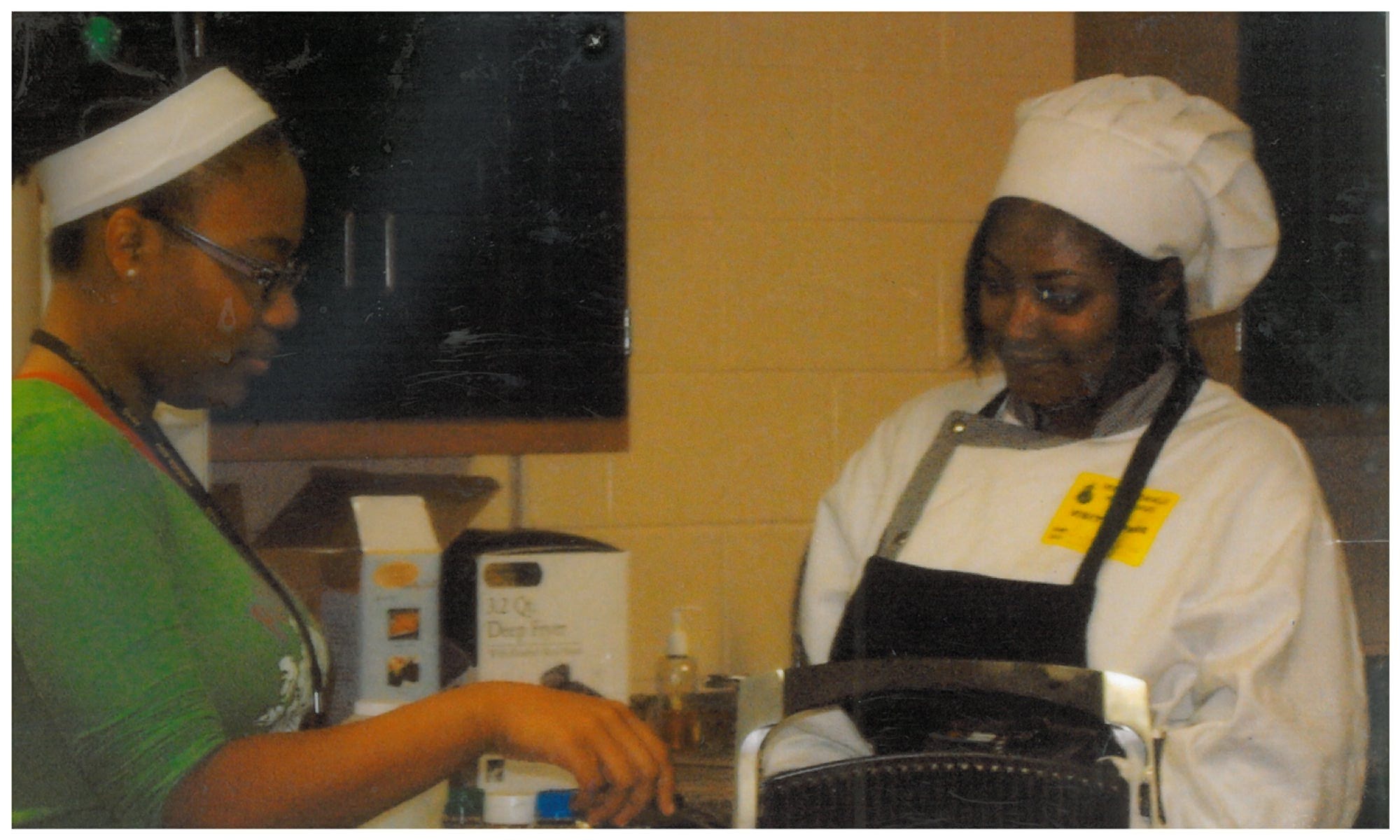
Bianca (right) at culinary school in Atlanta.
After high school, Bianca went to culinary school in Atlanta. She took double the course load and graduated early while also working full-time as dining coordinator in a retirement center. Then she moved back to Nashville and took jobs at convention centers and downtown hotels.
Those jobs warranted a tough exterior with their anxiety-inducing pace and high volume in a male-dominated and often unhealthy industry. But she also learned lessons that stick with her today. Like the time an unexpected snowstorm hit Nashville turning a 20 percent occupancy hotel to 100 percent within minutes as a line formed out the door. Bianca slept (or more like napped occasionally) at the hotel for three days and learned that staying ahead—even chopping onions and peppers when there’s an extra few minutes— is essential.
Now at The Nashville Food Project, Bianca says the intensity of turning out thousands of meals each week takes on a new meaning. “In that instance, it was like ‘okay we gotta get the job done.’ But now, it’s rewarding. It makes me feel lighter, like I have an effect on other people — that I’m actually working in my gift. That I have a purpose… I care about the impact that I have on the next person whether it’s direct or indirect. So I’m constantly thinking, how I can make it better? Or, how can I make best use of my skills to be a blessing to someone else in any kind of capacity?”
That doesn’t mean she’s lost all her hardcore kitchen vibes. You’ll find her some days cruising through the kitchen on a mission — cell phone tethered to one ear via ear bud and a Venti Starbucks nearby with more pumps than she probably ought to admit. Working in a nonprofit kitchen, after all, has taken some getting used to.

An incoming donation from the Bells Bend Conservation Corridor this summer.
When she first started at TNFP, a truck full of donations would arrive – all needing to be sorted, sized up and put away quickly – and Bianca viewed it as time and work. But Katie Duivan, catering and events manager would “turn flips,” Bianca says. “She would be like, ‘Oh my god look at this. This is beautiful.’”
“Where I come from you couldn’t show that,” she says. “I had to be hard. I couldn’t be friendly. Then they’d be like, ‘Oh, you’re a woman and that’s a weakness.’ I had to run with the big dogs.”
But being here makes it easier to be genuine, she says. “I can smile. And the days I don’t smile, and I’m gruff, it’s fine. They accept me for who I am. Here they celebrate our differences and what makes us uniquely us.”
Plus, she says Katie, her other co-workers and the environment of a kitchen filled with the purpose of stewardship and service, might have rubbed off on her bringing her back to those days when she shared lunch at the cafeteria table with nothing to gain or prove.
“It’s kind of like somebody is throwing happy glitter,” she says. “You’re going to get some happy glitter on you, and you’re not gonna be able to get it off.”
Lodge Cast Iron recently donated several skillets to The Nashville Food Project. We asked Bianca to share her favorite skillet recipe for cornbread. In her family, they like it sweet, almost like cake, she says. “I was raised that if you didn’t eat sweet cornbread, you were making dressing.”
She bakes this version for her family every other week and considers it a staple at Sunday dinner. Tag us on social media in a photo of your favorite cast-iron recipe, and we’ll enter you into a drawing for a new Lodge skillet.

Bianca’s Skillet Cornbread
Ingredients
1/2 cup self-rising cornmeal
1 1/2 cup self-rising flour
2/3 cup sugar
1/3 cup oil plus 3 tbsp oil
2 eggs beaten
1 1/4 cup milk
2 teaspoons honey
3 tablespoons melted butter
Directions
Preheat oven to 350 degrees.
In a medium bowl, combine cornmeal, flour and sugar. Mix in 1/3 cup of the oil, eggs and milk.
Heat remaining 3 tablespoons oil in the cast-iron skillet. Pour hot oil into mixed batter. Bake for 30 minutes or until golden brown.
Top with the melted butter and honey before serving.
Introducing Tastes of Burma and Bhutan
With market season well underway, the Growing Together farmers are busy harvesting, washing and packing their crops for restaurants and markets, as well as preparing for their fall CSA and a new September partnership with MEEL, a local online marketplace and farmstand…
By Grace Biggs, Impact Manager

With market season well underway, the Growing Together garden is a busy, vibrant place, full of life and movement. Farmers gather to harvest, wash, and pack their crops from their individual plots three times a week, often with the support of their families. Each farmer is autonomous, planting the crops they want, working according to their own schedule, and setting their own financial goals for the food they sell. But there’s also a lot that the farmers share.
“Being on a shared space has so many benefits,” explains Sally, the Growing Together Market Manager. “There’s the immense learning opportunity of seeing what other farmers are doing and learning from your peers. And there’s also a benefit in having shared market outlets.”

Marketing and selling to new customers is a huge challenge for any farmer. This season, the Growing Together program is connecting farmers with a wide variety of market outlets: the Richland Park Farmer’s Market on Saturdays, wholesale listings on Nashville Grown and Locally Grown, direct sales to area restaurants, a 20-customer fall CSA, and (new this year) weekly farm stands at TNFP’s headquarters on Wednesday evenings.
“The Growing Together farmers offer something unique,” says Sally. As a customer, you can expect to see many vegetables you are familiar with here in the South, like tomatoes and salad greens. You can also expect to taste traditional crops from farmers' home countries of Burma and Bhutan, such as bitter gourd, daikon radishes, and mustard greens.

I see this firsthand while sitting with Sally at the farm stand in the Nations on a Wednesday night, as a return customer walks up to the booth, bags in hand. They chat about their weeks, and Sally begins to point out what’s for sale. “Here’s arugula, and this is a leafy chinese cabbage. It’s great raw, similar to lettuce, but you can also cook it.” Customers come and go throughout the evening, taking their pick of veggies ranging from yellow squash to shisoto peppers, often leaving with at least one food they hadn’t heard of before that day.
““The familiar veggies and flower bouquets make the booth accessible, then we get to introduce other new foods. It’s such as long process to change people’s preferences. Luckily, we have an amazing base of customers who are interested in trying something new!””
This willingness to try something new has also been true of many of our chef friends, including City House, TKO, Two Ten Jack and Green Pheasant. In addition to ordering what they know they need for their menus, they’ve been excited to incorporate whatever the farmers have available, including the farmers’ traditional foods.

As summer winds down, farmers are gearing up for their fall CSA. “There’s going to be such a huge difference in the CSA this year. The transition from summer to fall can be a hard time in the season to have produce ready to harvest, especially if you’re trying to offer a diversity, but after learning so much in the first year, farmers are coming in more prepared, especially for the first few weeks of the CSA.” The 2019 Fall CSA is sold out, but you can sign up for the Growing Together email newsletter to stay in the loop on next year’s CSA here.
Ready to try some tastes of Burma and Bhutan for yourself?
For the month of September, Growing Together produce will be featured by MEEL, a local online marketplace and farm stand, including a special menu of Dinner Kits inspired by traditional Bhutanese and Burmese dishes such as Komatsuna with Creamy Heirloom Polenta and Ema Datshi with Bhutanese Red Rice and Suja.
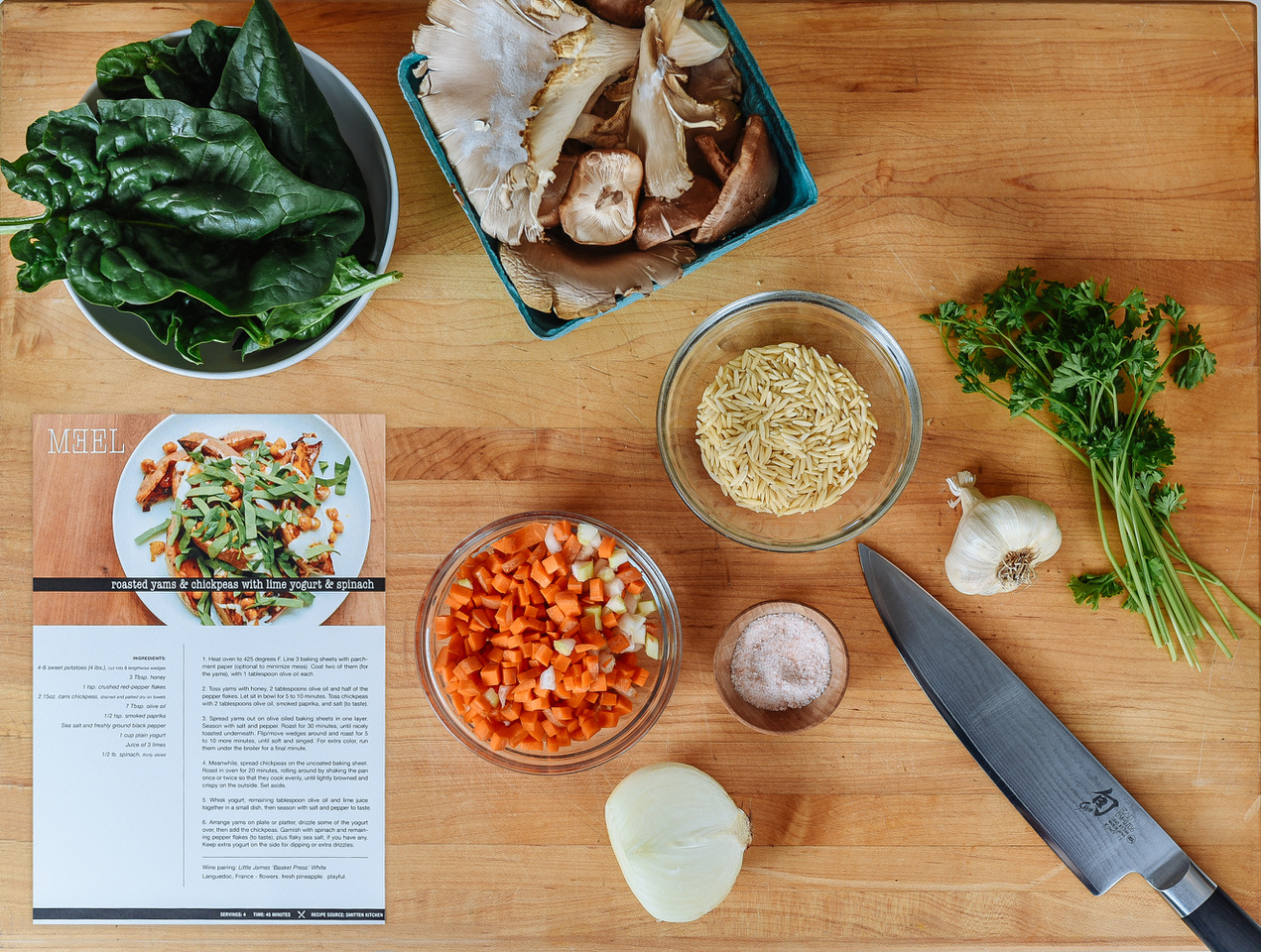
These Growing Together MEEL Kits and a Growing Together Farmstand Box will go “live” on Monday, August 26th, available for delivery beginning September 3rd. Menus will be available at this link. Use the promo code “GROW” and they’ll donate 10% of your purchase to The Nashville Food Project!
Also, through the end of October, you can visit the Growing Together farmers at the Richland Park Farmers’ Market every Saturday 9 am to 12:30 pm, and at our headquarters in the Nations (5904 California Avenue) every Wednesday 5 pm to 7 pm.
Sweet Peas Recap & Bean Burrito Bowl Recipe
Throughout the summer The Nashville Food Project dramatically increased the meals we shared through partner non-profits to an all time high of 7,500 meals weekly to support the summer nutrition needs of children’s programming in addition to our ongoing partnerships…
By Elizabeth Langgle-Martin, Community Engagement Manager

ONE side dish for one day’s summer meal deliveries ready to be loaded at our California Avenue kitchen.
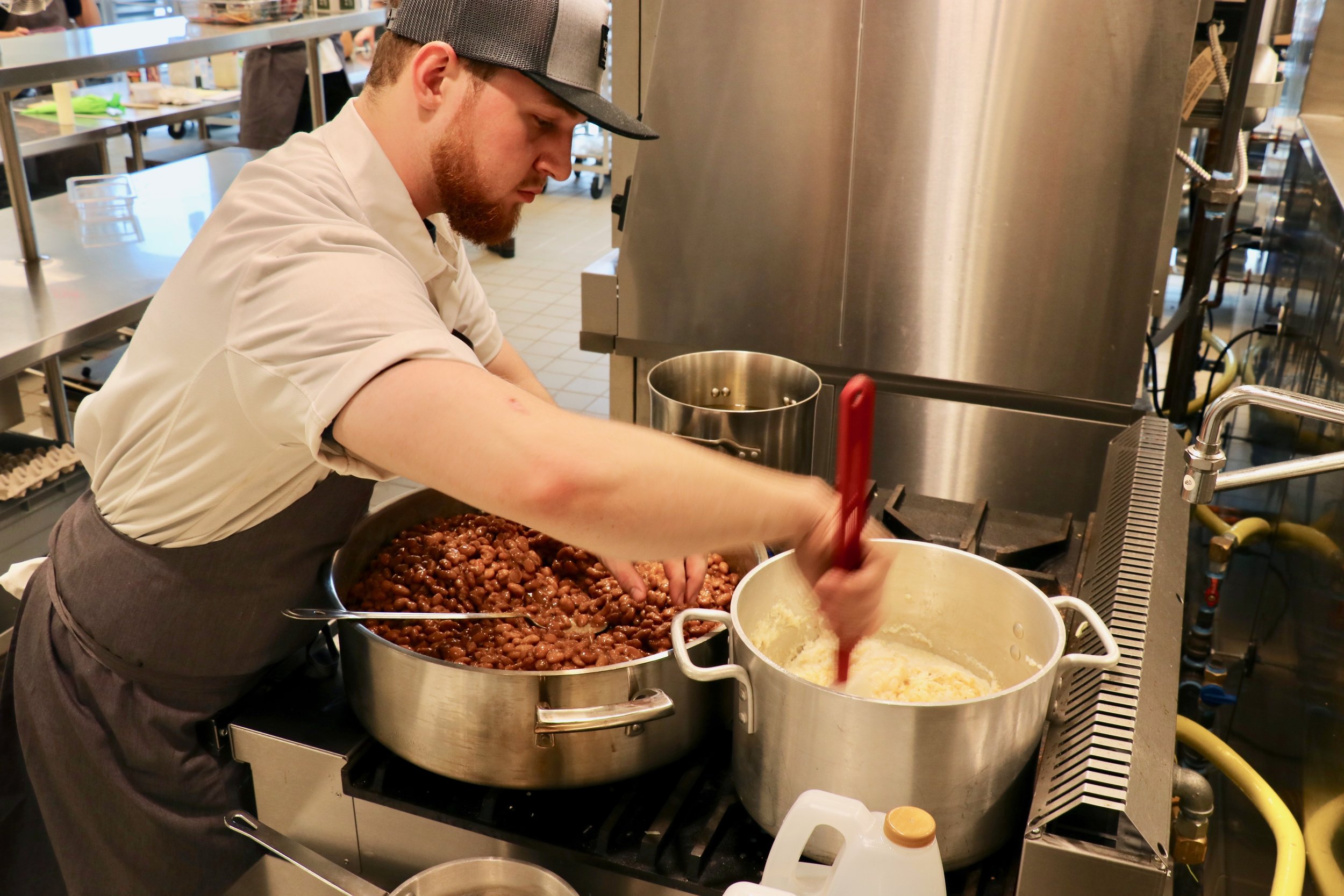
Throughout this summer The Nashville Food Project dramatically increased the meals we shared through partner non-profits to an all time high of 7,500 meals weekly to support the summer nutrition needs of children’s programming in addition to our ongoing partnerships.
Carefully curated meals were prepared and delivered daily using gifted produce, recovered food, and the efforts of countless volunteers and their culinary creativity. Hefty servings of gumbo, chicken carbonara, veggie wraps, fruit and garden salads were delivered in gleaming pans.

Insulated food carriers used to deliver meals. All of these (plus more!) were cram-packed with freshly made, nutritious meals cooked in our two kitchens by TNFP staff, interns and volunteers.
Our partners are always serving to a range of palates. Naturally, some children are more adventurous while others try new dishes with a little more caution. We were thrilled when we received the following feedback from one of our summer programming partners:
““The kids really loved the burrito bowls. That was a major hit. Actually, all the meals this week went over really well.””
Burrito bowls are perhaps the perfect food as they allow the incorporation of so many fresh ingredients while permitting a wide range of people to customize tastes and textures that hit the spot. Here is our Chef Director Bianca’s bean burrito bowl recipe that was all the rage this summer!

Bianca’s Bean Burrito Bowls
Serves 4-6
Ingredients
2 tbsp olive oil
1 red onion diced
1 bell pepper diced
1 tbsp ground cumin
1 tsp salt and pepper
3 cloves of garlic chopped (or 3 tbsp garlic powder)
1 lb cooked beans (or 4 cans) - Black, Pinto or Kidney are our favorites!
1/2 c cilantro
1/4 cup of your favorite salsa
3 cups brown rice (cooked)
1 to 3 cup of cheese
Plus any additional sautéed seasonal veggies if desired!
Directions
In the olive oil, sauté onions, peppers, spices and garlic until tender. Add cooked beans and cilantro. Mix in salsa. Scoop cooked rice in bowl. Top rice with the bean mixture and shredded cheese.
Feeling fancy? Garnish with salsa, avocado, cilantro, sour cream or green onions!
Do you make burrito bowls at home? What are your favorite flavor combinations?
Bonnaroo Service Project Leads to Meaningful Meal Sharing
Bonnaroo teamed up with a group of varied nonprofits this year — including The Nashville Food Project — to host the festival’s first-ever, onsite service project making meal kits of beans and rice for more than 1,400 people. For our first food sharing opportunity with the kits, we brought more than 200 meal kits and produce to a housing community in North Nashville.

On the final day of Bonnaroo Music & Arts Festival — with bass thumping across the grounds and temperatures in the upper 80’s — a group of strangers gathered under a wide tent and exchanged introductions. It’s the sort of thing that happens throughout the festival weekend — a young man from Alabama making new friends with a couple from Michigan. But in this instance it wasn’t the music entirely that brought about 30 festival-goers together, it was an opportunity to give back.
Bonnaroo teamed up with a group of varied nonprofits this year — including The Nashville Food Project — to host the festival’s first-ever, onsite service project making meal kits of beans and rice for more than 1,400 people. Oxfam and Eat for Equity shared the use of their space for the project in Bonnaroo’s Planet Roo; Kim Warnick of Calling All Crows spearheaded logistics and pulled in The Outreach Program, a company that packs and ships dry goods meal kits. Bonnaroo handled spreading the word about the volunteer opportunity to festival attendees who showed up to form assembly lines across long tables. Each time a team filled a box of 36 meals, a volunteer clanged a bell and the group cheered.
Members of The Nashville Food Project team helped package the meals and then transported them back to Nashville where TNFP also will be in charge of distribution. Each meal kit comes with a sticker offering tips on adding fresh vegetables to the kits.

For our first food sharing opportunity with the kits, we took more than 200 meal kits to a housing community in North Nashville. We had learned that a large number of young people live in the apartments and were lacking regular access to school food. Community organizer Otis Carter of The 200 Man Stand offered support and then he helped spread the word. Residents of all ages came out.
To supplement the meal kits, we took several bins of produce purchased and donated by the Bells Bend Conservation Corridor from area farms — tomatoes, corn, peppers, eggplant, potatoes and summer squash. Our meals team also pulled together snack bags for kids to eat right away including healthy trail mix and orange wedges. Bags of biscuits mix went quickly too.
We believe sharing food is sharing nourishment — as much for spirit and soul as for the body. Procurement and Sustainability Manager David Frease has plans to deliver meals across many of our partner sites. In the meantime, we’re grateful in thinking of all the people and hands who came together to make these meals and help nourish more than 1,400 of our Nashville neighbors.

Nourish 2019: A Recap
Last week we were honored to host our 9th annual fundraising dinner — Nourish, presented by Kroger Zero Hunger Zero Waste — sharing joy and connection over a beautiful, meticulously planned and prepared meal. Beyond raising money to support our mission, this is a special time to celebrate this shared work with so many friends, volunteers, community members, and supporters…

Last week we were honored to host our 9th annual fundraising dinner — Nourish, presented by Kroger Zero Hunger Zero Waste — raising over $160,000 to support our mission! Beyond raising funds, this is a special time to share joy and connection over a beautiful meal and celebrate this shared work with so many friends, volunteers, community members, and supporters. And, like each of the meals we create and share from our kitchen, Nourish is a chance to build relationships with those across the table and build a community of compassion, solidarity, and belonging.
The Meal

We are incredibly thankful for the beautiful dishes prepared by this year’s inspiring lineup of chefs! Our lead chef team was Sarah and Karl Worley, chef-owners of the popular Biscuit Love restaurants, and forthcoming ‘Za - a pizza joint in Hillsboro Village. The Worleys have long inspired us not only for the quality of the food they turn out, but for how they run their businesses and support their employees. In fact, Food and Wine magazine named the Worleys and Biscuit Love as a national example of how to do radical care and compassion in the restaurant industry — an industry known for grueling physical work, long hours, abuse and low pay. They’ve supported us in so many ways, and having them at the helm of Nourish 2019 was yet another testament to how deeply they care about our work and our Nashville community.
To complete the meal, Karl and Sarah invited the chefs who inspire them:

Cold Fusilli Pasta Salad, by Charlie Hilly and Sarah Hadzor
Charlie hosted a pop-up called Namaste Y’all at age 13 and continues to inspire through his dedication to his own learning and development of his own craft.

Fennel Salad, by David Dawson and Karl Worley
A mentor for Karl in culinary school at Johnson & Wales, Chef David Dawson worked with Thomas Keller as executive sous chef and led the opening culinary team at Euro Disney.

Red Beans and Rice with Cornbread, by Pableaux Johnson
New Orleans-based writer, photographer and author models hospitality and community as host of "Red Beans Roadshow."

Green Masala Trout with Warm Heirloom Tomato Salad, by Asha Gomez
This Atlanta-based chef and author works passionately with the United Nations and the James Beard Foundation to reduce global food insecurity.

“Ice Cream Cake,” by Lisa Marie White
Marsh House and L.A. Jackson’s Lisa Marie White inspires with her top-notch pastries and the passion and joy with which she brings to new experiences.
The Why
The Nashville Food Project’s mission is bringing people together to grow, cook, and share nutritious food, with the twin goals of cultivating community and alleviating hunger in our city. It was a mission cooked up from scratch, trying in our earnest ways, to chart new territory and bring about, at least locally, a community food system in which every Nashvillian has the food they want and need. Not a band aid for this social wound. Not another charity. But community food work that is nourishing, culturally appropriate, rooted in justice, aligned in partnerships where the power is shared, with meaningful inclusion of those most in need of the social change we are after.
On the night of Nourish, we shared this video update:
The Thomas Williams Golden Skillet Award Winner

Congratulations to Billy Bird, this year's Thomas Williams Golden Skillet Award Winner!
In 2017, we unveiled an award established in honor of one of our founding board members. Thomas Williams, who created this yearly celebration we call Nourish. The annual award in his name acknowledge someone who has boundlessly, beautifully supported The Nashville Food Project, in ways that are beyond measure.
This year’s award recipient, Billy Bird, has been driving the streets of Nashville in food project vehicles since 2009. For a full ten years he has arrived willingly, generously, open-heartedly to share scratch-cooked meals with Nashville residents and the clients of our partners during lunch time. His spirit is contagious. His laugh is big and his heart is bigger. He engages with everyone around him, no matter who they are or what they’ve been through. He has a way of setting others at ease with his welcoming personality. When we make decisions he doesn’t like, he tells us. When the meal hits the spot, he reports back. In all these ways, he is the best kind of volunteer. Reliable, devoted, cheerful, willing, and generous.
This summer he’s increased his long-standing two-times a month volunteer commitment by coming in to cook in our kitchen at St. Luke’s Community House. If he is half as competent in the kitchen as he is engaging with people in our community, then we are in good hands. His presence and generosity have been enormous blessings in the life and rapid growth of our organization. And ten years in he’s still so genuinely interested and invested in the work we do, and he shares his excitement for it in the way he lives and loves other people.
Thank you, Billy, for all that you do for The Nashville Food Project and the Nashville community!
The Sponsors
Nourish would not be possible without sponsors to underwrite the cost of this event. We would like to thank…
Presenting Sponsor
Kroger Zero Hunger Zero Waste
Longtime Nourish Sponsors
First TN Foundation
Jackson National
Vanderbilt University Medical Center
Dorothy Cate and Thomas Frist Foundation
in-kind sponsors
Lipman Brothers
Creation Gardens
Lodge Cast Iron
We are so grateful for the compassion and support that all of our sponsors have offered The Nashville Food Project!
The People Behind It All
We want to give our sincere thanks to this year’s event co-chairs for helping us pull together an incredible lineup of chefs, the loaded down silent auction, and a really special live auction — Mara Papatheodoro, Natasha Powell, and Cindy Wall — along with Director of Marketing and Development Teri Sloan and Culinary Community Liason Jennifer Justus.
The Nashville Food Project has been blessed from the beginning with thoughtful, compassionate leadership from our Board of Directors. Thanks to our Board for their generosity, time, wisdom, insight, relationships, guidance!

This life-giving work is made possible by the wonderful community that supports us daily through volunteering, food donations, and financial contributions. To learn more about ways to get involved and support, visit thenashvillefoodproject.org.
4 Tips to Growing When the Going Gets Hot
July in Tennessee can be a tough time to stay motivated to get outside and face what seems like an endless wave of weeds, bugs, and humidity. But season after season, you may find yourself being drawn back in. How do you stay motivated to keep gardening? We asked our staff to share their tips and advice on staying inspired and active in their own gardens.

Gardens are pretty magic, especially in the spring. Soil is freshly turned, the air is cool, seeds are planted, and everything seems possible. Then the weeks roll on, and slowly but surely, summer arrives. As your harvest starts to come in, the days are getting hotter, the pests are getting bigger, and the weeds are getting higher.
Sound familiar? You’re not alone! July in Tennessee can be a tough time to stay motivated to get outside and face what seems like an endless wave of weeds, bugs, and humidity. But season after season, you may find yourself being drawn back in.
How do you stay motivated to keep gardening? We asked our staff to share their tips and advice on staying inspired and active in their own gardens.
Do a Little Every Day
“Do a little bit every day, preferably in the morning or evening when it’s cool and you can stay out of the sun. If there’s an area with loads of weeds, use the summer sun’s power to kill them by mulching the area with black plastic for awhile. Another tactic could be putting down a thin layer of cardboard covered with compost for weed killing.
”
2. Don’t Just Work, Enjoy!
“My favorite thing to do to stay motivated in the garden is to not just go out to the space to work, especially when it’s hot! I like to reserve some time early in the morning or as the sun is setting to just spend some time in the garden enjoying the abundance and beauty of the space. To pick a few flowers or fruits just for myself to enjoy and to sit and watch and listen as birds and bees move happily around me. It’s a grounding time and reminds me why we work so hard to grow our own!
Also... Buy a nice stirrup hoe. They are the best.”
3. It’s Better Together
“Ask a friend to help you! I’m not the best at asking for help - and honestly not the best at acting out this advice - but the times I’ve asked or had a friend offer to work with me not only helps knock out some weeds, it’s also been a great way to spend time together and share some veggies. The best times have been when we can cook a meal together afterward.”
4. Remember why You Work
“I’m motivated by thinking about how growing food is an act of resilience! The more that I practice and share in the practice with others, the more knowledge and experience I can hold and share with future generations.
For me, getting in my garden after I work is a way to decompress and to be present and engaged with my surroundings. It’s something that makes me feel alive. So, that’s pretty motivating, too!”
Why do you garden? What keeps you motivated? Let us know in the comments!
If you don’t have a garden of your own and feel inspired to dig your hands into the dirt, we welcome you to volunteer with us! Click here to learn more about volunteering in our garden as either an individual or a group.
Extending Hospitality: From Restaurant Tables To Our Neighbors
So many Nashville restaurants have offered vital support to our work over the years, extending hospitality through generous donations of food, purchasing from Growing Together farmers, and more. As Nashville continues to change and grow, we’ve sadly seen some beloved restaurants make the decision -- for various reasons -- to close…
By Jennifer Justus, Culinary Community Liaison
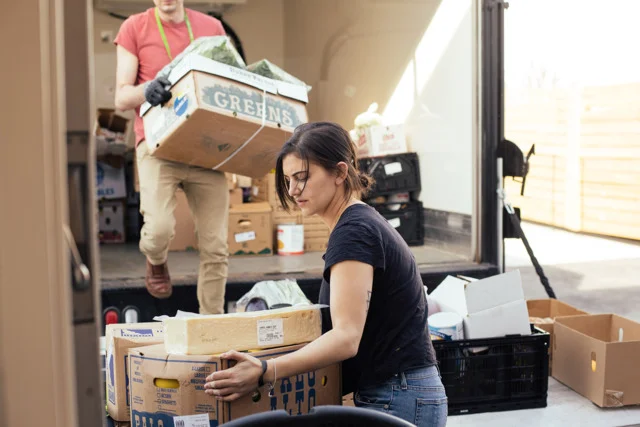
Photo by Daniel Meigs
So many Nashville restaurants have offered vital support to our work over the years, extending hospitality through generous donations of food, purchasing from Growing Together farmers, and more. As Nashville continues to change and grow, we’ve sadly seen some beloved restaurants make the decision -- for various reasons -- to close.
But here at TNFP we’ve found ourselves in the position of trying to find a sliver of positivity in the wake of those changes.
For example, when the 26-year institution Tin Angel closed after Rick and Vicki Bolsom’s decision to retire, they graciously gifted us their leftover produce, spices and other dry goods -- more than 1,000 pounds of food -- that we could use in making meals shared in partnership with poverty-disrupting and community building nonprofits in Nashville. Writer Margaret Littman with the Nashville Scene wrote about the Bolsom’s gift while including it in this larger story about our efforts and others in Nashville to minimize food waste as a whole.

More recently, we accepted a donation from Flyte World Dining & Wine when it closed after more than a decade serving Nashville.
The Flyte donation included citrus fruits, mixed greens, wild rices, high-end oils and vinegars, canned tomatoes, flour, maple syrup and vanilla extract. We’ll continue to work through those products for our meals program for months to come, but most immediately we added Flyte mushrooms and potatoes to a stir-fry that went to seniors at FiftyForward and Vine Hill Towers. The stir-fry also helped provide healthy meals for Sweet Peas, our new summer meals program for kids.
We consider it an honor to be a part of extending the hospitality of these restaurants. From their tables to our neighbors, we do our best to make the most of what’s given to us for providing high-quality, nourishing meals.
Orange, Mushroom, Potato and Bell Pepper Stir-Fry
A lot of times we need to move fast at TNFP -- especially this summer as we’ve ramped up from 5,500 to 7,500 meals a week. Stir-fries offer a great way to make meals quickly while also packing in lots of nutritious vegetables coming out of the gardens at peak season.
Ingredients
1/4 cup canola oil, divided
2 cups potatoes, diced
1 tablespoon cornstarch
1/2 cup fresh orange juice
2 cups mushrooms
1 cup thinly sliced yellow onion
1 cup sliced green bell pepper
1 cup sliced red bell pepper
1 tablespoon thinly sliced garlic
1/2 teaspoon grated orange rind
1/2 teaspoon crushed red pepper
3 tablespoons reduced-sodium soy sauce
1 tablespoon unseasoned rice vinegar
1 teaspoon light brown sugar
1/2 teaspoon kosher salt
2 (8.8-oz) pkg. precooked brown rice (such as Uncle Ben's)
2 tablespoons chopped fresh cilantro
Directions
Heat 3 tablespoons oil in a large nonstick skillet over medium-high. Add potatoes to pan; cook 8 minutes or until golden. Remove from pan.
Combine 1 tablespoon cornstarch and orange juice in a small bowl. Heat remaining 1 tablespoon oil in pan over medium-high. Add mushrooms, onion and bell peppers; cook 5 minutes. Add garlic, orange rind, and crushed red pepper; cook 1 minute. Add juice mixture, soy sauce, vinegar, sugar, and salt; bring to a boil. Stir in potatoes. Place 1/2 cup rice on each of 4 plates; top each serving with 3/4 cup of vegetable mixture. Sprinkle evenly with cilantro.
Recipes adapted from Cooking Light.
Crossroads Campus
When Katie Kuhl of Crossroads Campus approached The Nashville Food Project about providing a meal to be served alongside their Wednesday afternoon self-development and skills training activities, we knew that we wanted to leverage our efforts to support the work the Crossroads team is doing with young people and with animals in our city.
“We don’t derive strength from our rugged individualism, but rather our collective ability to plan, communicate, and work together.”
By Elizabeth Langgle-Martin, Community Engagement Manager
At The Nashville Food Project, we are passionate about many things: a freshly pulled carrot making its way from our gardens to our kitchen, an especially generous produce or protein donation from a local farm, watching young volunteers make popcorn on the stove top for the first time, and seeing neatly stacked pans of incredible food being loaded into our vehicle, ready to make a trip to its final destination. But perhaps most of all, we are passionate about our meals being served in partnership with diverse, essential non-profits doing poverty interrupting work in our community.

When Katie Kuhl of Crossroads Campus approached The Nashville Food Project about providing a meal to be served alongside their Wednesday afternoon self-development and skills training activities, we knew that we wanted to leverage our efforts to support the work the Crossroads team is doing with young people and with animals in our city. Crossroads Campus is nestled in the center of Nashville on the edge of Germantown towards North Nashville. It boasts a multi-use space which includes a retail store for pet supplies, a full service grooming facility, kennels for small adoptable dogs and a cat room brimming with soft kittens ready for a place of their own. Four apartments also are wrapped into their expansive space, offering respite for young people who have experienced barriers to stable housing. Crossroads retail store, grooming services, humane education efforts, dog treat social enterprise and adoption mission all provide a job training environment for additional young Nashvillians termed interns who need both a soft place to land and a launching place from which to prepare for their next steps. These young folks, age 17 to early 20s, engage in paid internship experiences and become proficient in retail, pet grooming skills, and animal care with extra attention to humane education. Interns have access to weekly case management support and Wednesday afternoons are reserved for special activities which range from yoga and learning about taxes to button making and conflict resolution. TNFP recently began providing meals to accompany these essential times, from jerk chicken and island rice to chicken parmesan, always with hefty portions of fruit and seasonal salad.

The Nashville Food Project holds tight to this idea of interdependence, one of our key values. TNFP sees its work of growing, cooking, and sharing nourishing food in order to cultivate community food security as only possible and only valuable when we do it in relationship with others. When we see our food served alongside the deeply invested work of groups like Crossroad Campus, we see our mission realized in new and vibrant ways and are encouraged by organizations that see our meals as a resource to enhance the unique community that our partners foster.
To see our list of other non-profit partners, check out our website.
Interested in exploring meal partnership? We will be opening up space for new inquiries at the beginning of July! Add your email here to receive a notice when we start to explore fall partnerships.
What We Have Right Before Us
On any morning during the spring and summer, the Growing Together garden is a bustling place. The greens sparkle in the dampness and gentle, early light. The farmers, moving back and forth from their plots to the central washing station, are usually harvesting their crops…
By Tallahassee May, Growing Together Education Manager

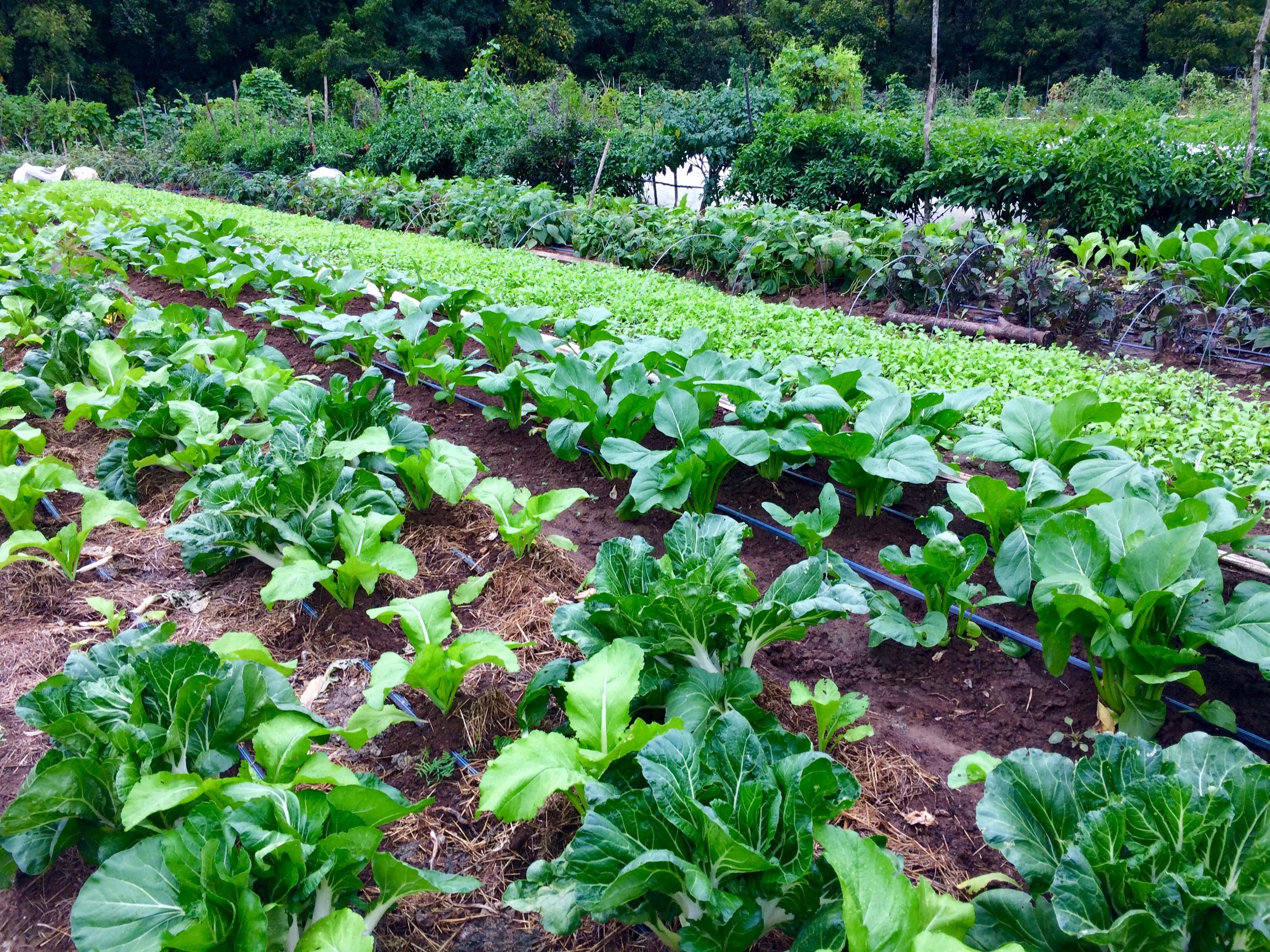
On any morning during the spring and summer, the Growing Together garden is a bustling place. The greens sparkle in the dampness and gentle, early light. The farmers, moving back and forth from their plots to the central washing station, are usually harvesting their crops to fill vegetable orders from restaurants around the city. Discreetly tucked behind a church parking lot, nestled in between Nolensville Rd. and interstate 40, the one acre garden is an urban oasis as well as a model for small scale agricultural productivity.
One of my favorite parts of my job as Education Manager of the Growing Together Program at TNFP is getting to walk through the garden in the morning with fresh eyes. Inevitably, while I spent time at the office for the afternoon or was home for the weekend, the farmers have added something new to their plots. This usually takes the form of a farming technique or innovation that may not previously fit with my experience.

Any farmer or gardener is familiar with the practice of trellising a vining crop, mulching, or seed-saving. And while most of us would run to the nearest Lowe’s or Home Depot for supplies, the New American farmers of the Growing Together program often make other choices. Foraging branches from the surrounding scrubby woods, they build support structures out of the salvaged material, sharpening with their knives the ends of the sticks until they are pointy enough to sink deep in the ground. The material is held together with strips of fabric or even the heavy duty plastic from fertilizer bags, tied securely at the joints. The towering structures remind me of fantastical childhood forts. The affect is incredibly artistic and lends a beautiful aesthetic to the space. It may not be fitting for larger scale production, but is perfectly suited for the amount of crops being grown by each farmer, the resources that are readily available, and the financial investment that is desired.

Entering through the gate of the garden, any visitor is welcomed by the crazy quilt-like visual of all the work taking place. The one-acre field is divided up into 7 plots; the newer farmers having a smaller growing space than the more experienced ones. Each farmer is autonomous, planting the crops they want and working according to their own schedule. All the farmers share practicing certain techniques. The yellow flowers of the blooming mustard greens are left on the plant to eventually mature into dried seedpods. Sometimes these long stalks are tied into neat bundles as they dry, and sometimes they are left to sway in the wind. The seed saved in many cases is of certain crops that are hard for the New American farmers to source here in the States, such as a Nepali variety of mustard green, or a particularly hot pepper variety.

If you can look more closely, past the long stems of seed -ripening vegetables, you will notice a lack of bare dirt. Every little bit of space in the garden is well used, as larger crops are interspersed with smaller crops, slow growing crops mixed in with fast. Although sometimes a more Westernized practice of straight rows is used, more often the entire 3 foot wide bed is filled with various crops at various stages. Again, this doesn’t necessarily fit well in a larger scale agricultural situation, especially one that uses tractors for cultivating. But maximizing space through the technique of intercropping is perfectly appropriate technique for a farmer in a small space that wants to maximize the food they produce.
This time of year, as we transition from spring to summer crops, the farmers are replacing cool weather vegetables with heat loving ones. New seedings and transplants are carefully mulched using the pulled up leaves and plants from the previous crop. The large, flat leaves of old cabbage plants are gently laid over new rows of carrots, keeping the soil moist and cool as the seeds germinate. Old stalks of kale are pulled up and now form tents over tender squash transplants, nursing them until they are well established in their new home. Eventually the re-purposed mulch returns to the dirt as compost, feeding the soil biology and keeping the circle intact.

The narrative of these times is one of rapidly disappearing farmland and the demise of the family farm. Driving through Nashville’s surrounding rural areas and counties, it is obvious how quickly the farmscape and green space is being transformed into subdivisions and parking lots. The Growing Together market farming program is inspiring in so many different ways, and has the capacity to mean various things and include a broad reach of people. One of the most inspiring components for me is that the garden space, and the farmers that work it, demonstrates that large acreage or big equipment are not required for a healthy agricultural system that produces a bounty of food. The Nashville Food Project believes that the equitable sharing of food and resources nurtures a vibrant community. The Growing Together program extends that mission to include land access and market inclusion to people who otherwise may not have such needed resources.
This acre of green space that is the Growing Together garden is a wonder. The beauty of it is not only found in the vegetables and flowers that the farmers cultivate and in the generous bounty they produce for the Nashville community, but also in the care and devotion the farmers and their families give back to their small bit of earth. The garden is a small part of all that The Nashville Food Project works to achieve, but the Growing Together market farming program shows that meaningful work can begin with what we have available right before us.

Between May and October, you can visit the Growing Together farmers at the Richland Park Farmers’ Market every Saturday 9 am to 12:30 pm, and at The Nashville Food Project in the Nations every Wednesday 5 pm to 7 pm.
Learn more about this work and how you can support the Growing Together farmers here, including where to find Growing Together produce.
Our Simmer Series: An Update
Thanks to a generous food community and your support, we’ve hosted two sold-out Simmer dinners in our community dining room recently. We’re grateful as funds raised at these pop-ups go directly back to our work, and we’ve been thrilled to see community cultivated over these special meals.
By Jennifer Justus, TNFP Culinary Community Liaison
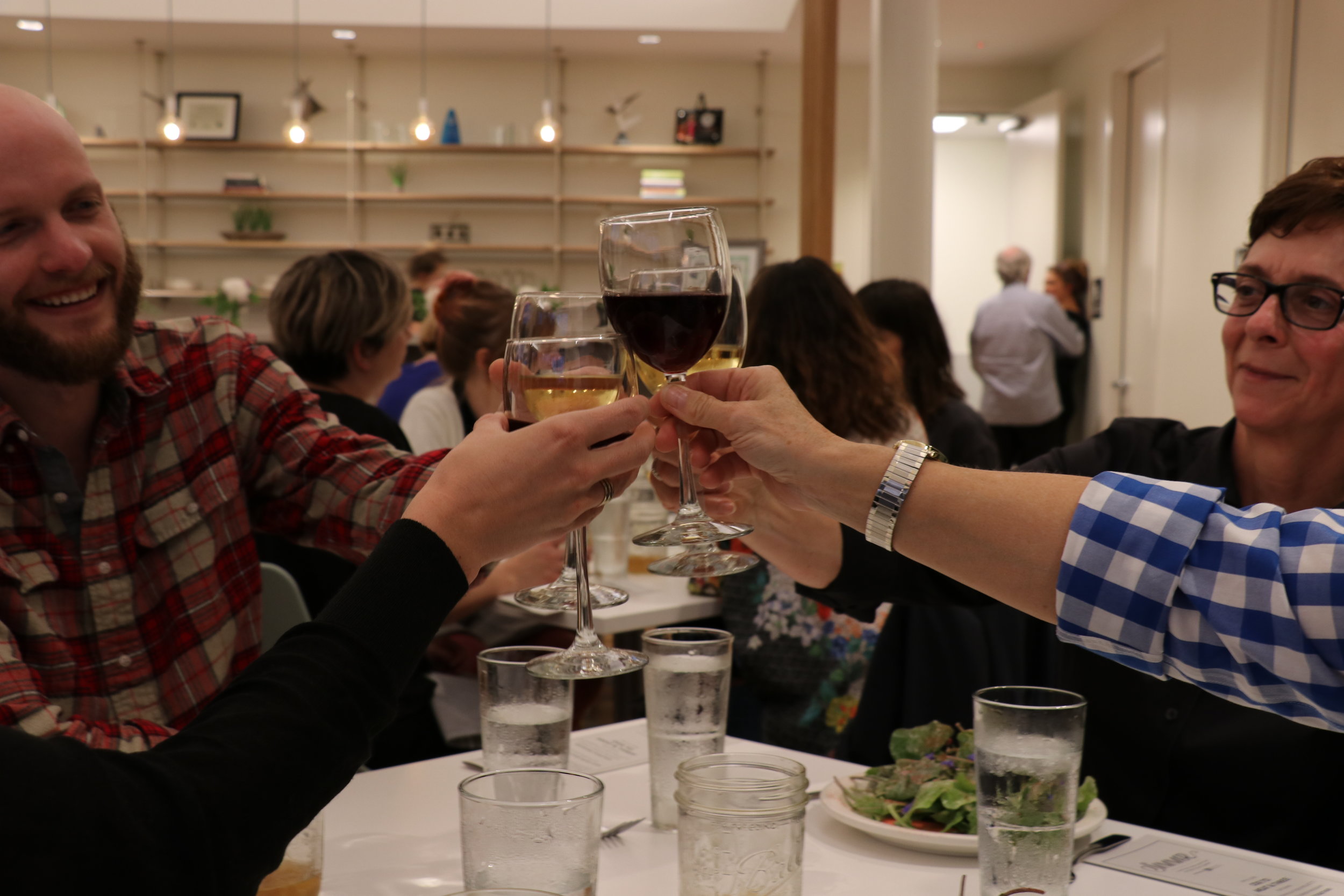
Thanks to a generous food community and your support, we’ve hosted two sold-out Simmer dinners in our community dining room recently. We’re grateful as funds raised at these pop-ups go directly back to our work, and we’ve been thrilled to see community cultivated over these special meals.
In April, Executive Chef Katie Coss from Husk took over our commercial kitchen with her crew to prepare an epic “Ode to Meat and Three.” She incorporated an Asian twist thanks in part to produce from TNFP’s Growing Together farmers. But more like a “meat and 10,” the courses flowed beginning with passed appetizers — crunchy bites of shiitake lettuce wraps, ham pimento cheese tea sandwiches and cups of shrimp and grits. A salad course highlighted strawberry season and then family-style platters of Thai barbecue Boston butt hit tables with bowls of Tokyo bekana Slaw and other dishes alongside rolls slick with butter and flecked of benne seeds.
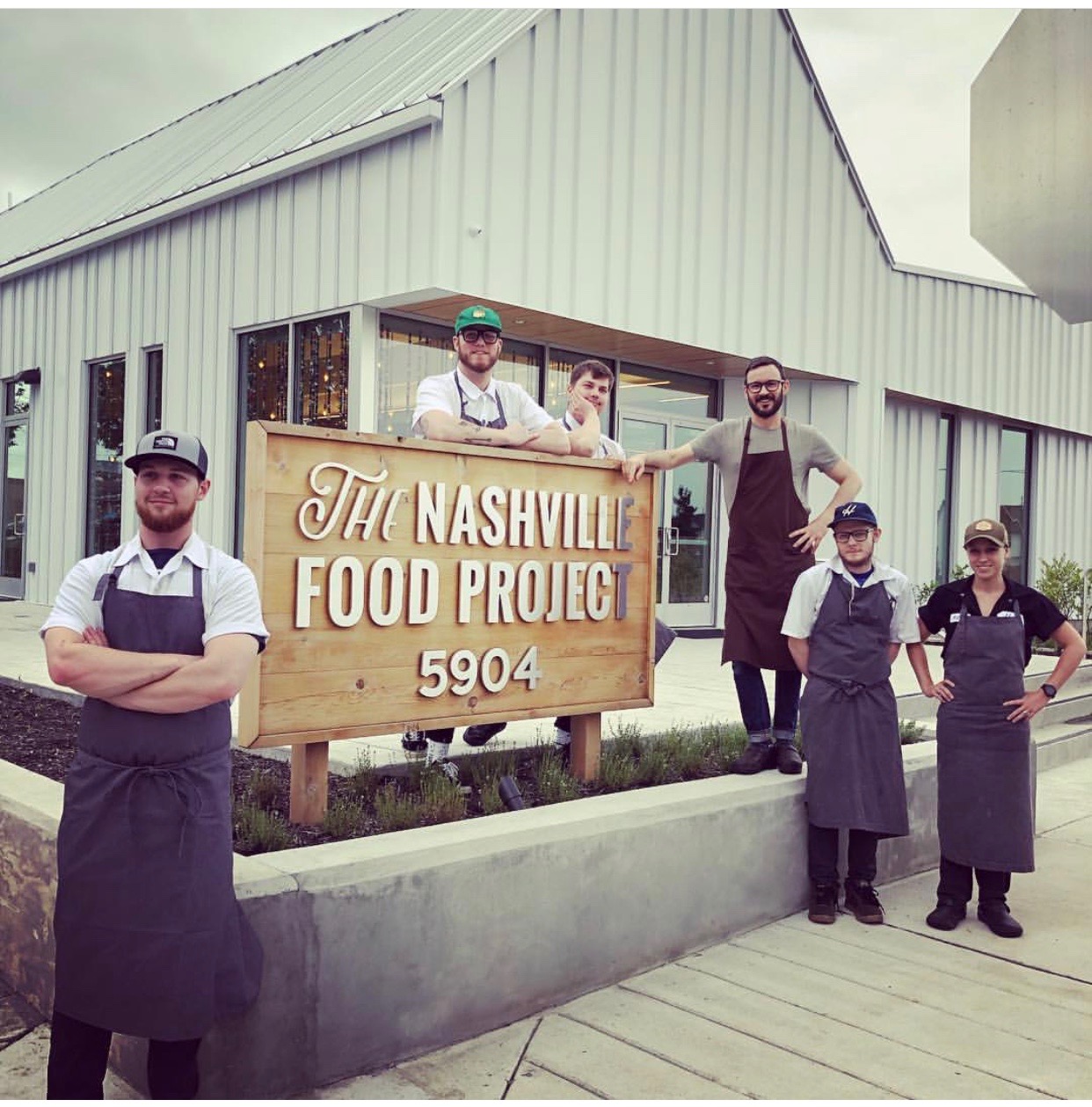
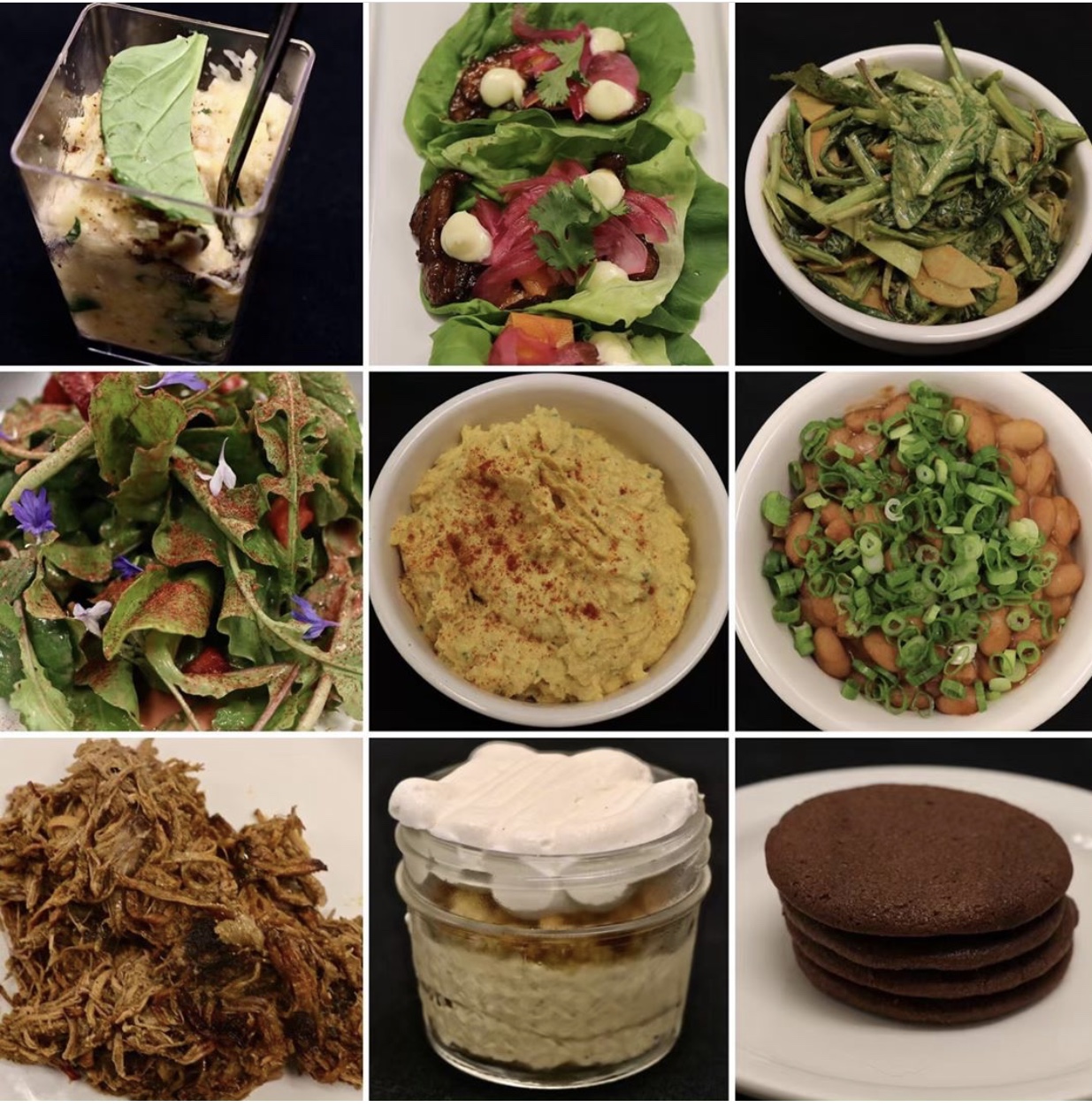
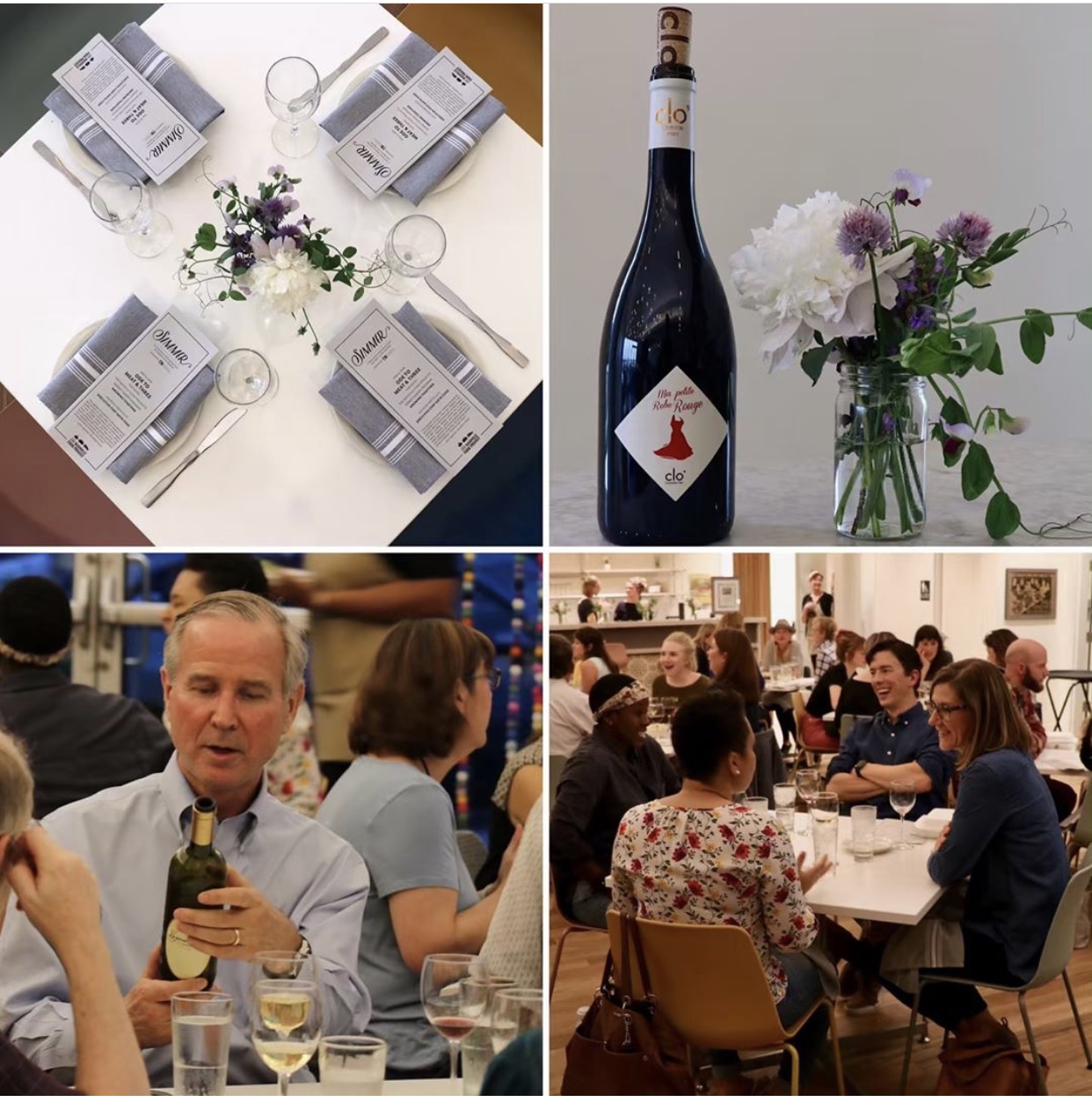
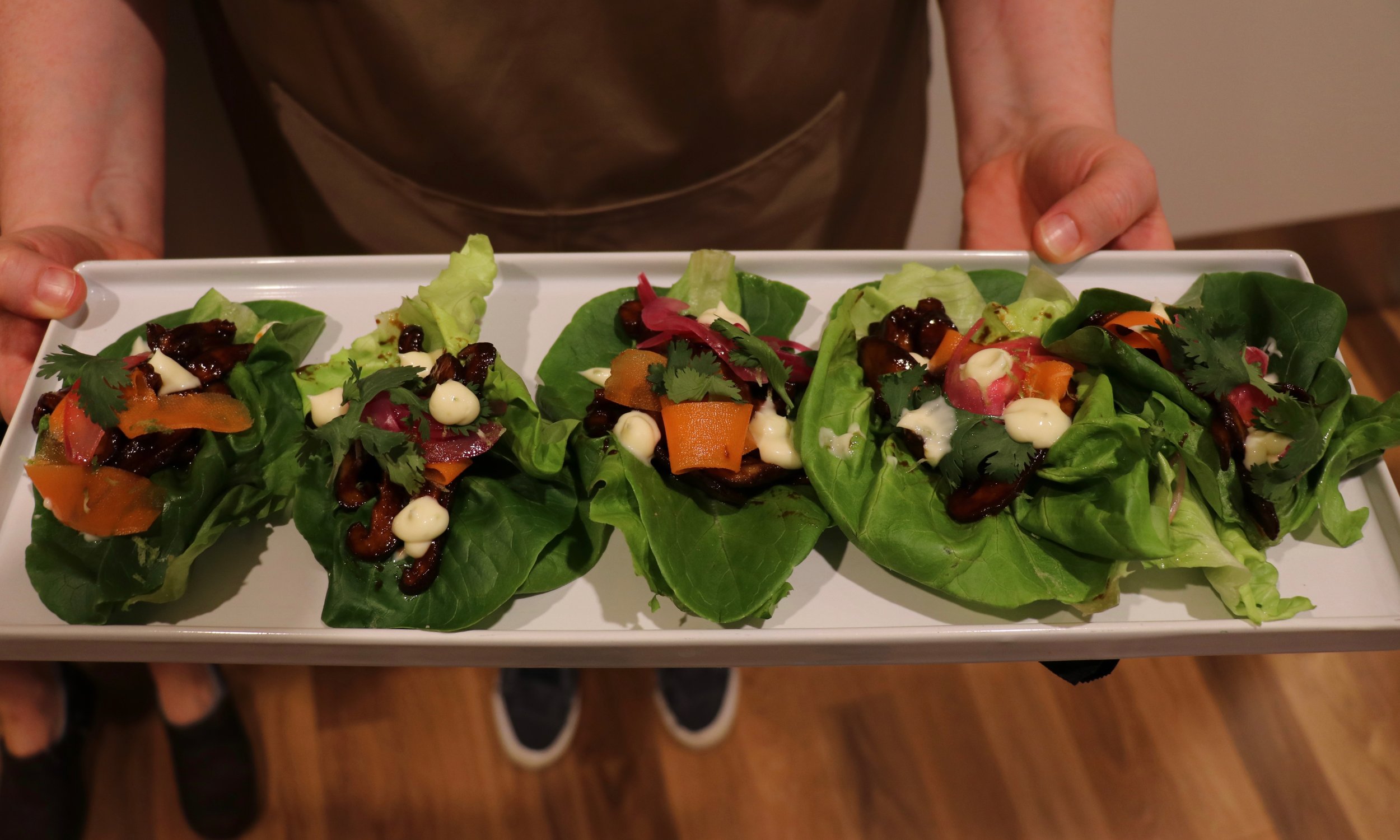
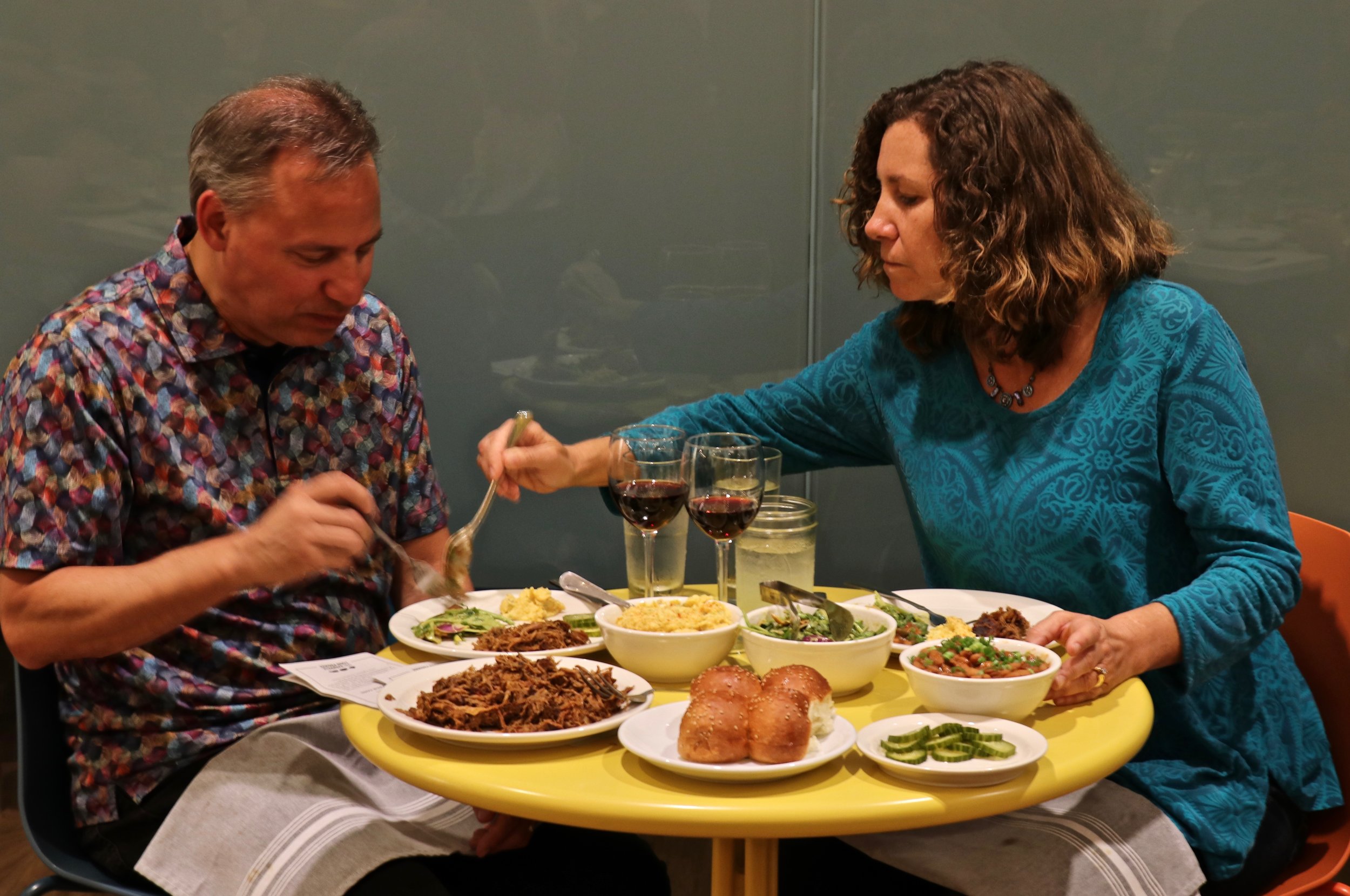
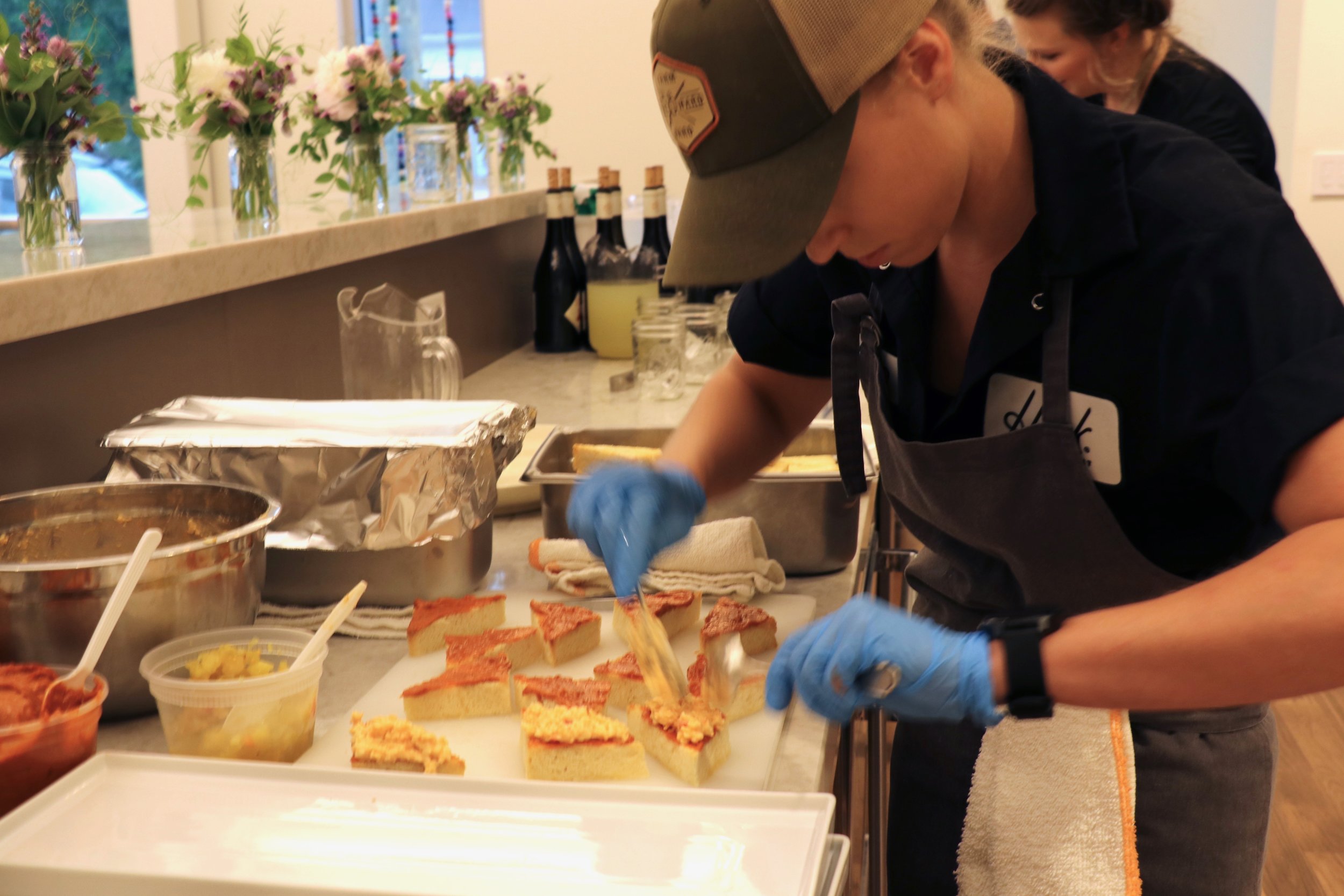
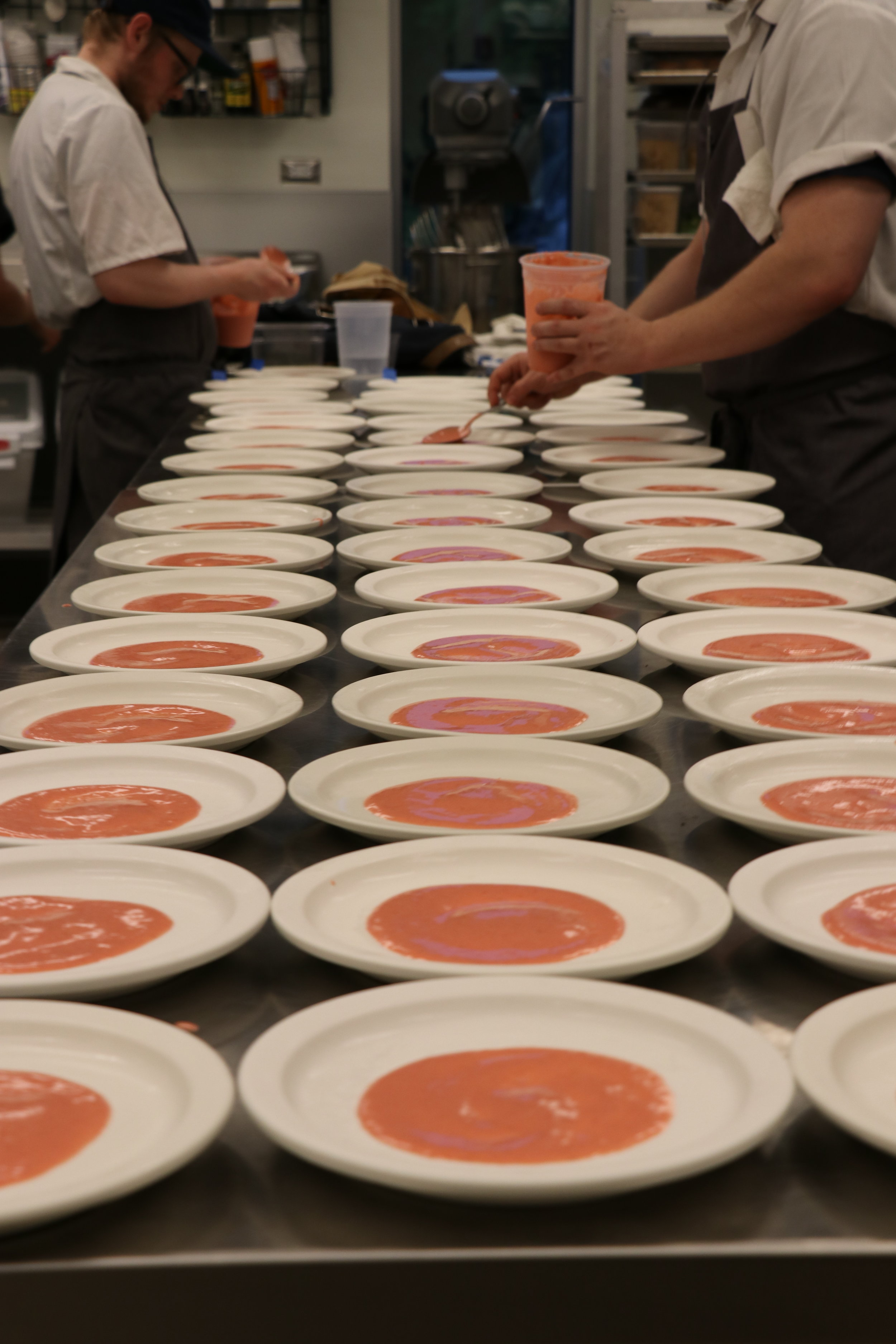
Then earlier this month, Top Chef alum and Nashville native Arnold Myint paid tribute to his mother Patti Myint who opened International Market & Restaurant (Nashville’s first Asian restaurant) in 1975. A pioneer as both woman and immigrant in the industry, Patti passed away in October 2018 and inspired Arnold to take a trip to Thailand, which inspired his menu. It began with pork floss wrapped inside betel leaves and studded with peanuts and whole chopped lime, and it ended with a dramatic coconut soup garnished with edible flowers, ruby water chestnut boba and lychee agar jelly. In between, a bevy of dishes brought Thai tradition and a family’s journey to the plate with five-spice duck, trout with curry custard and more. Chef Arnold will serve a version of the menu at the James Beard House in New York City later this month.
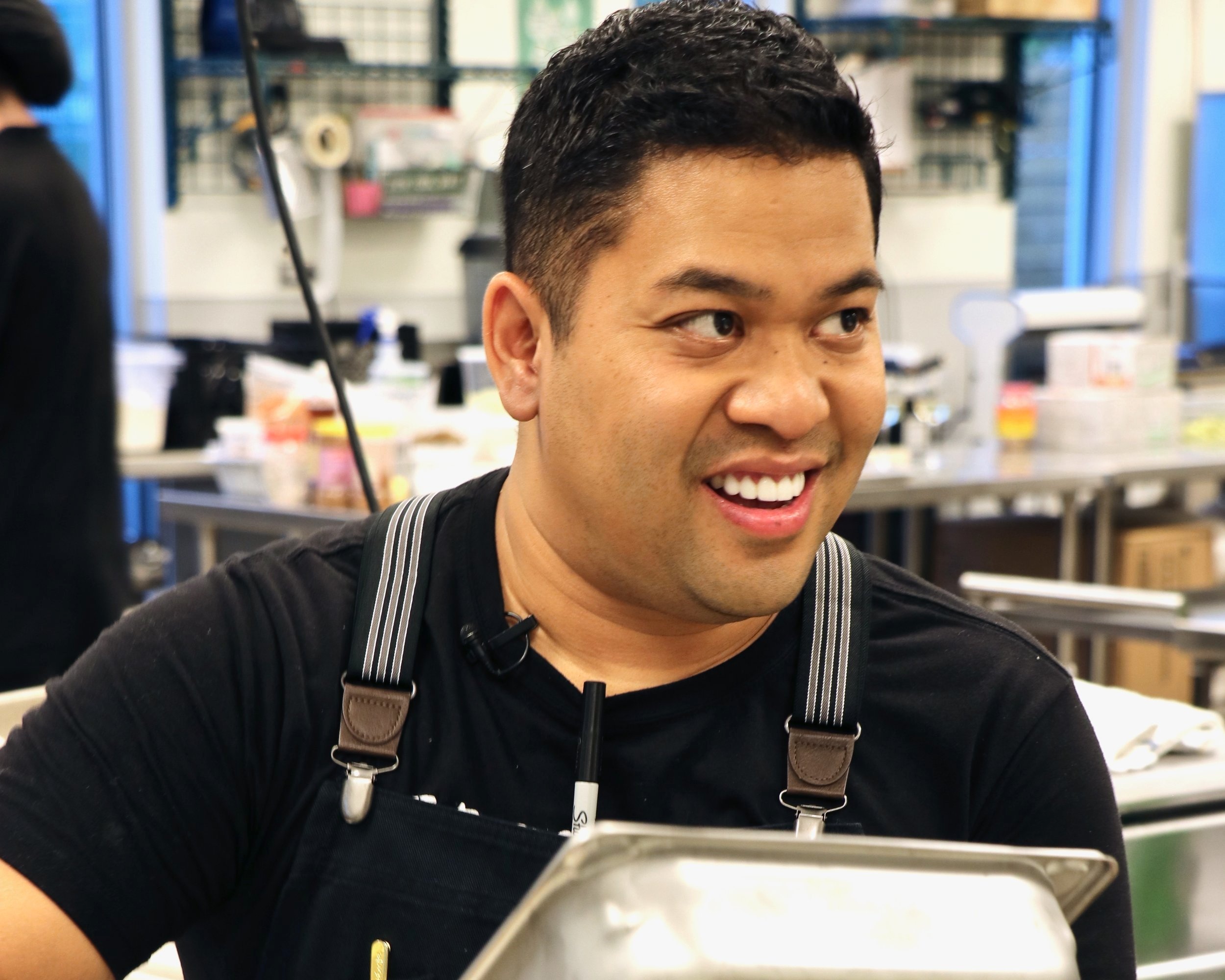
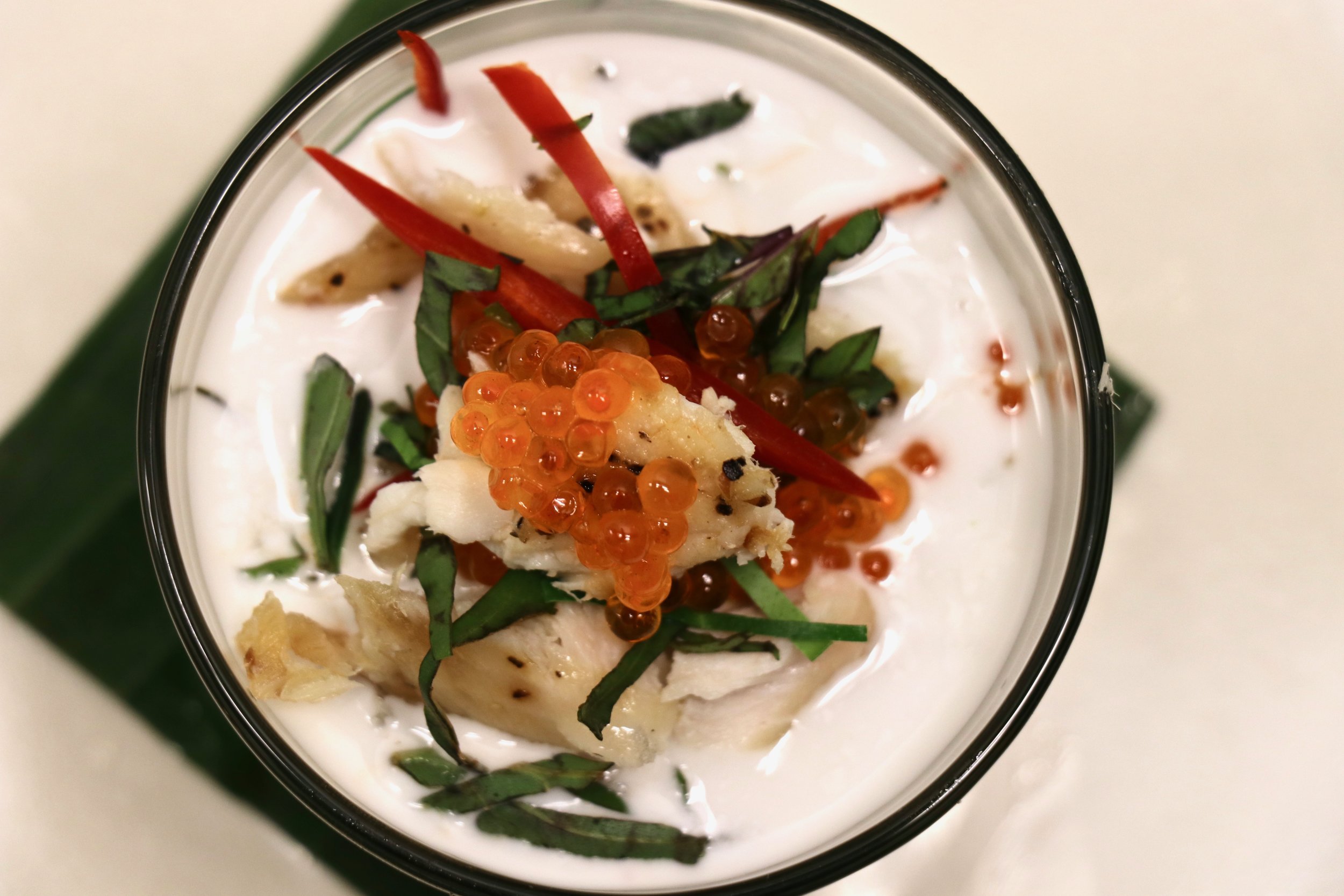
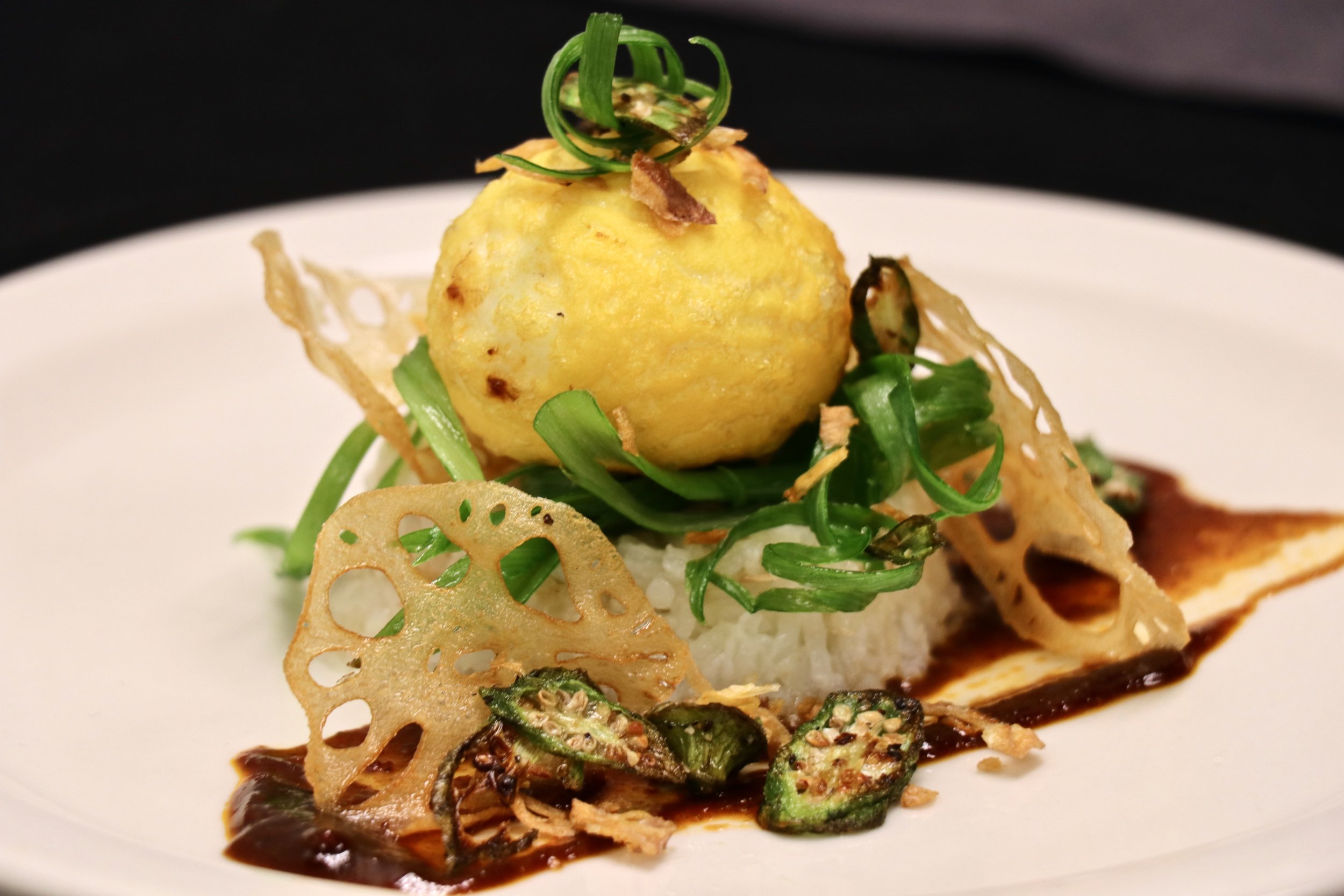
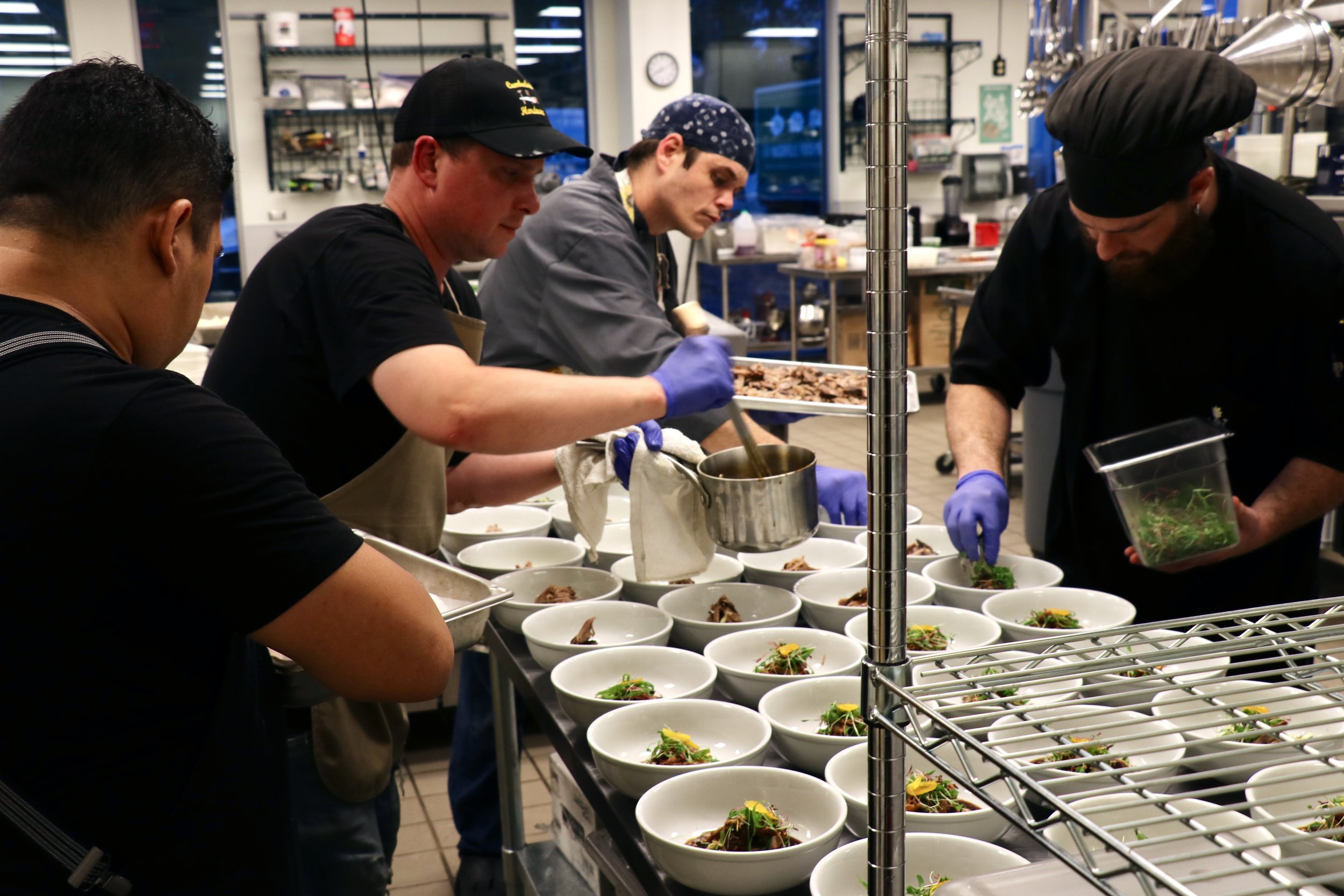
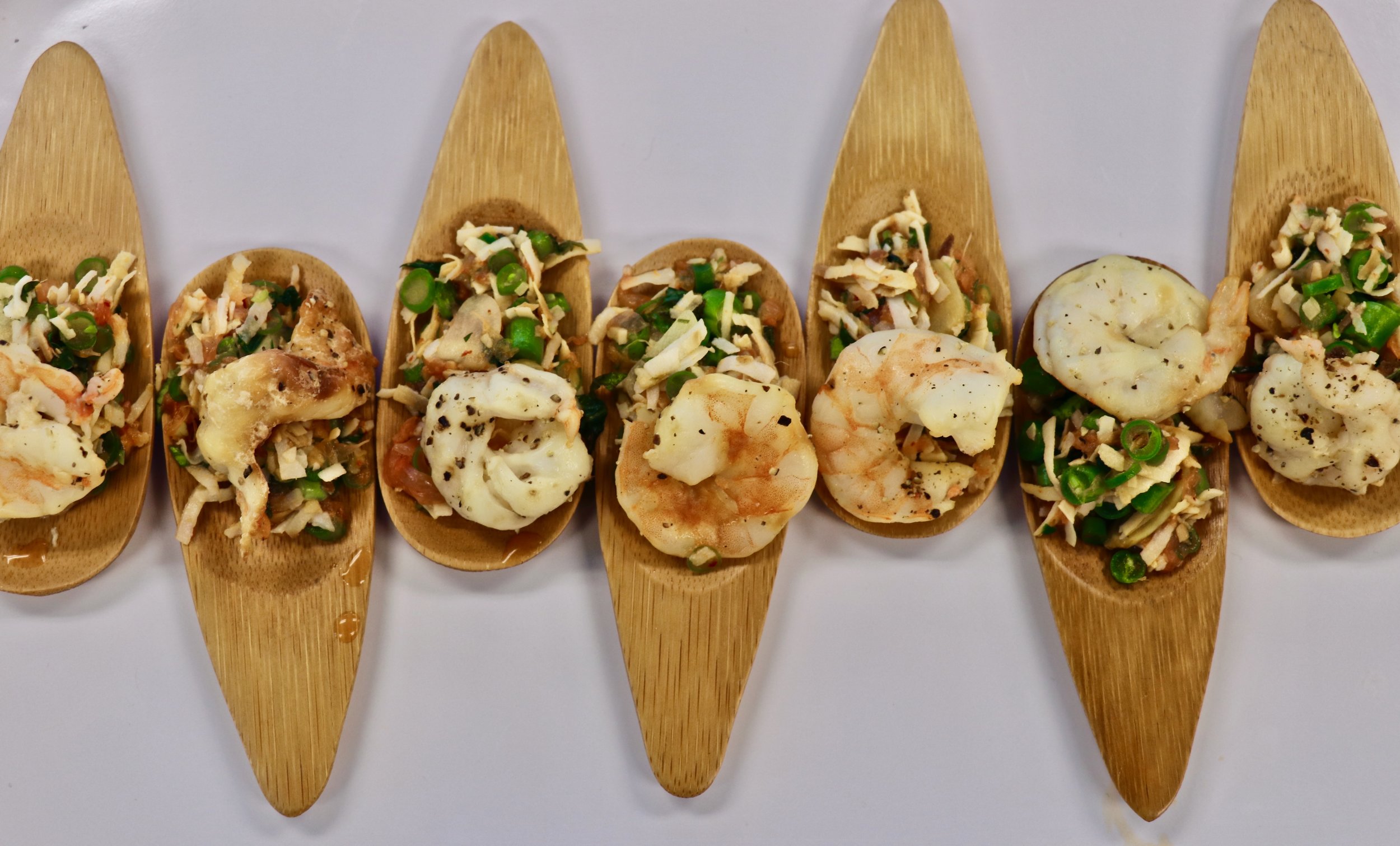
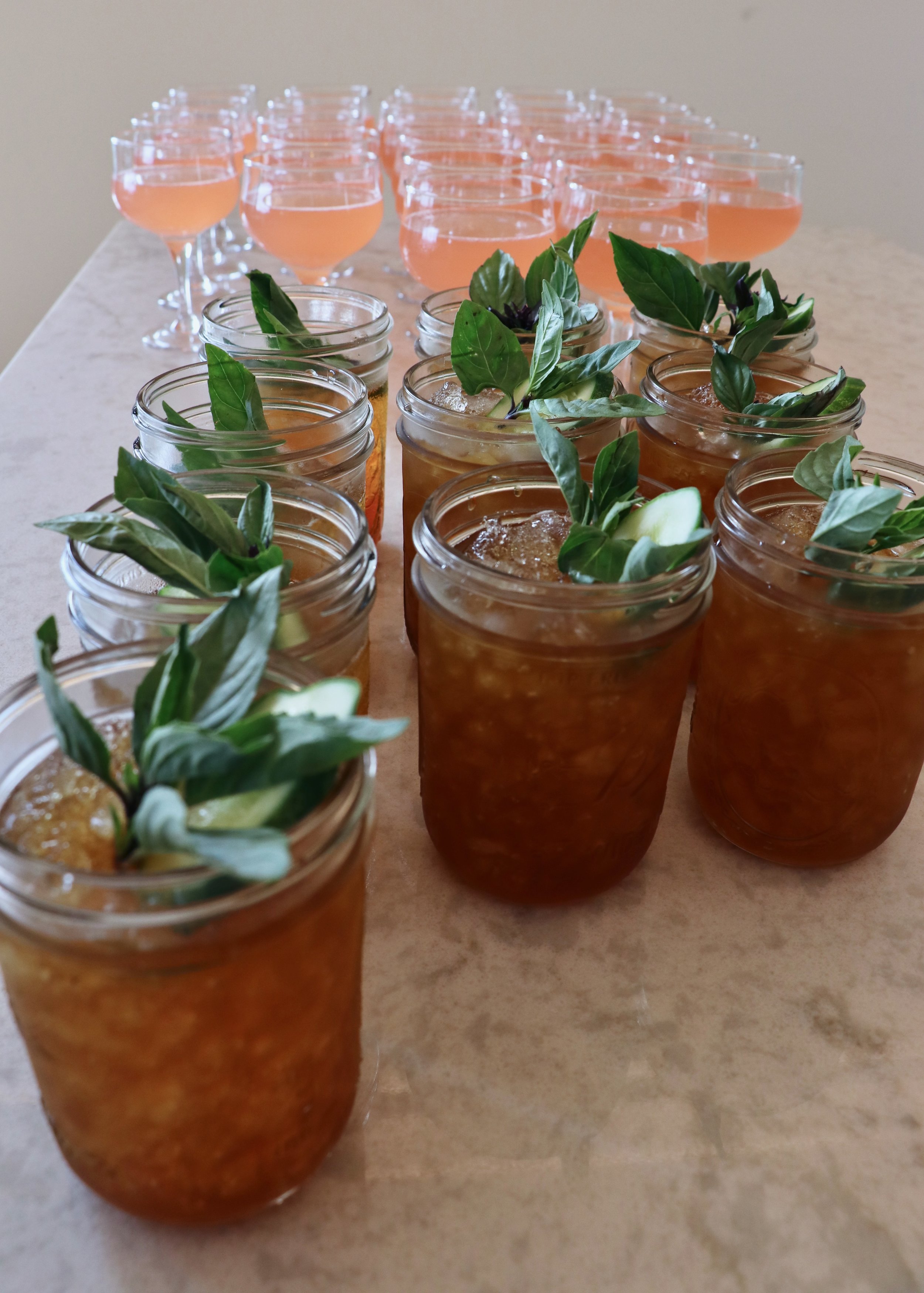
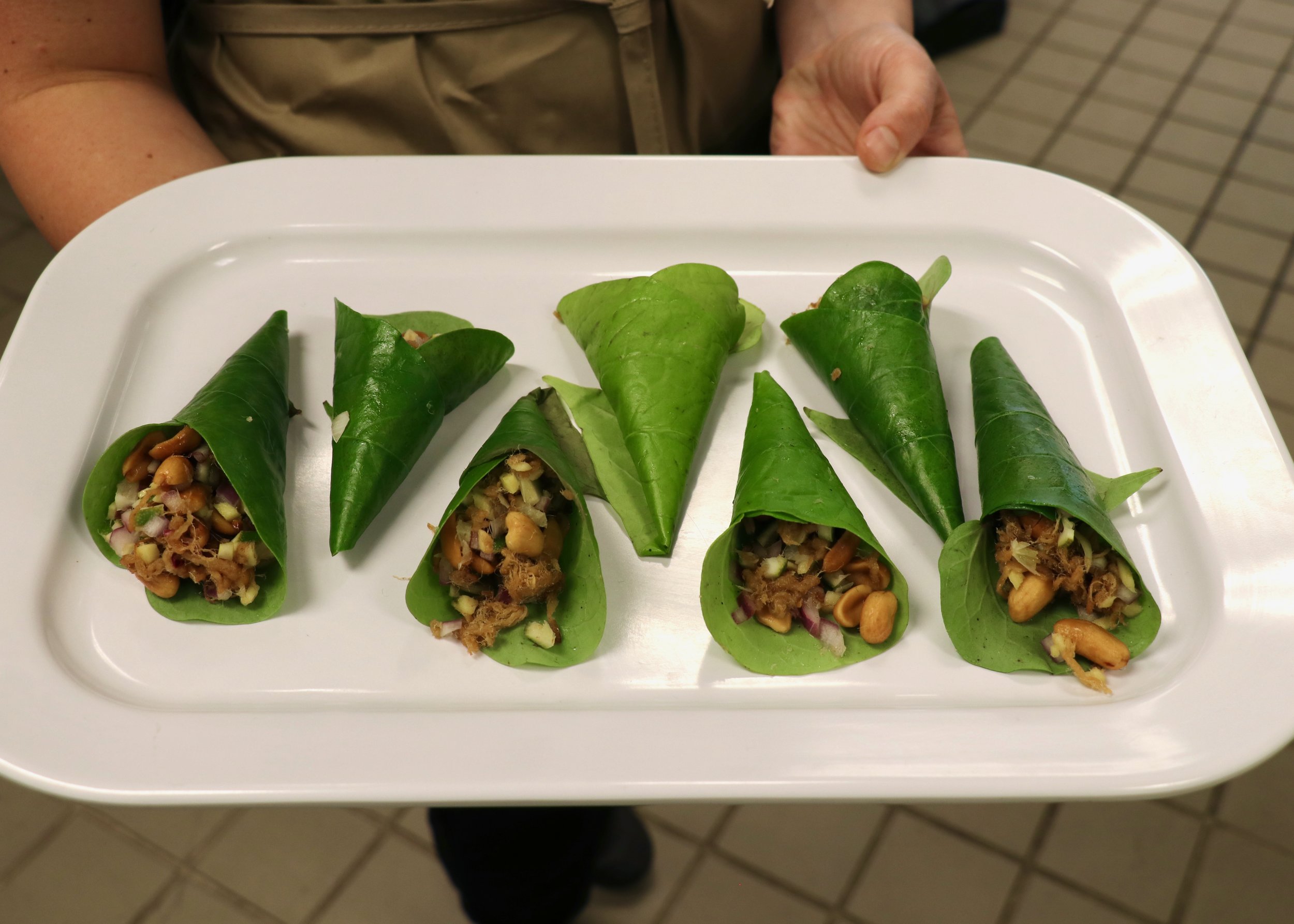
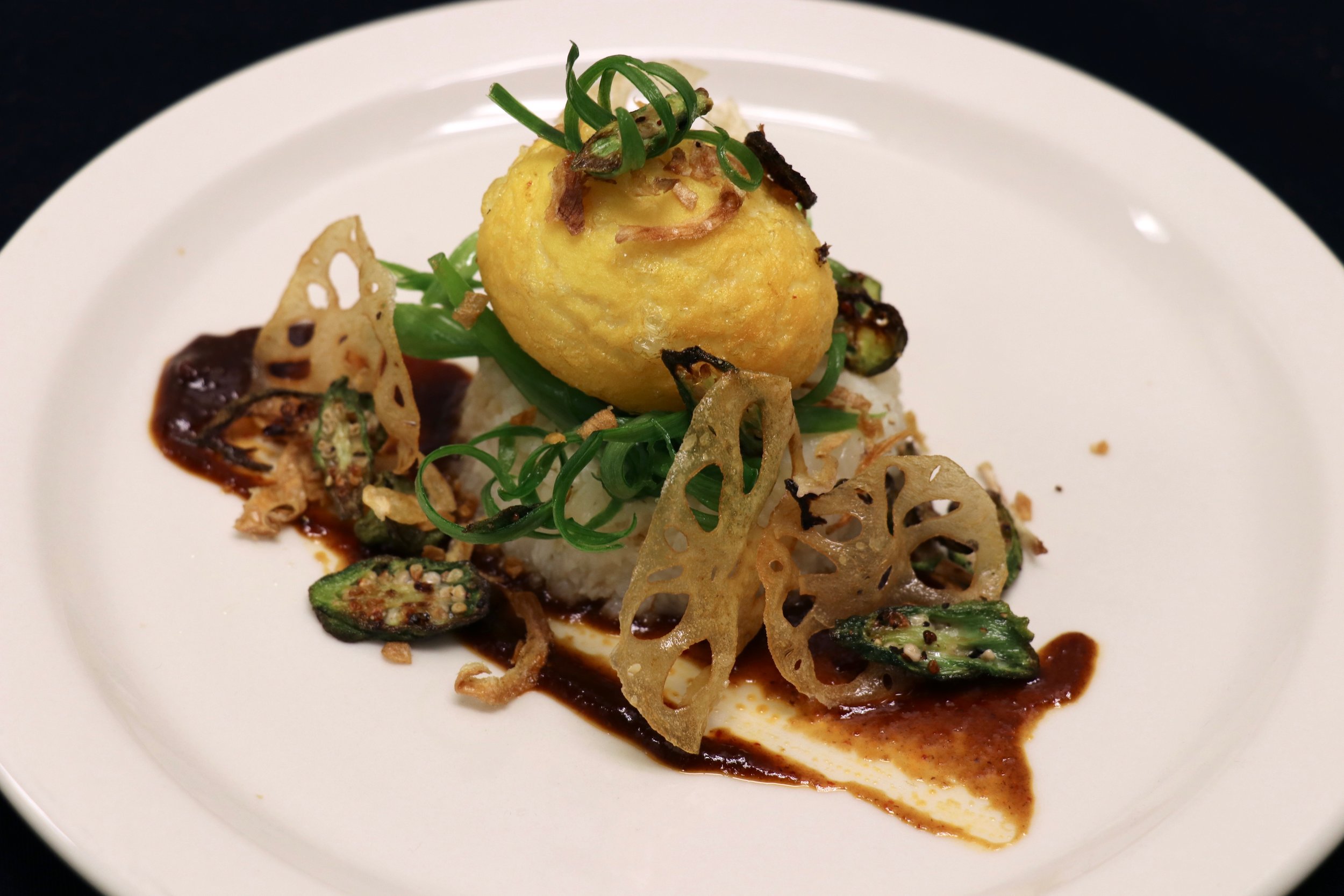
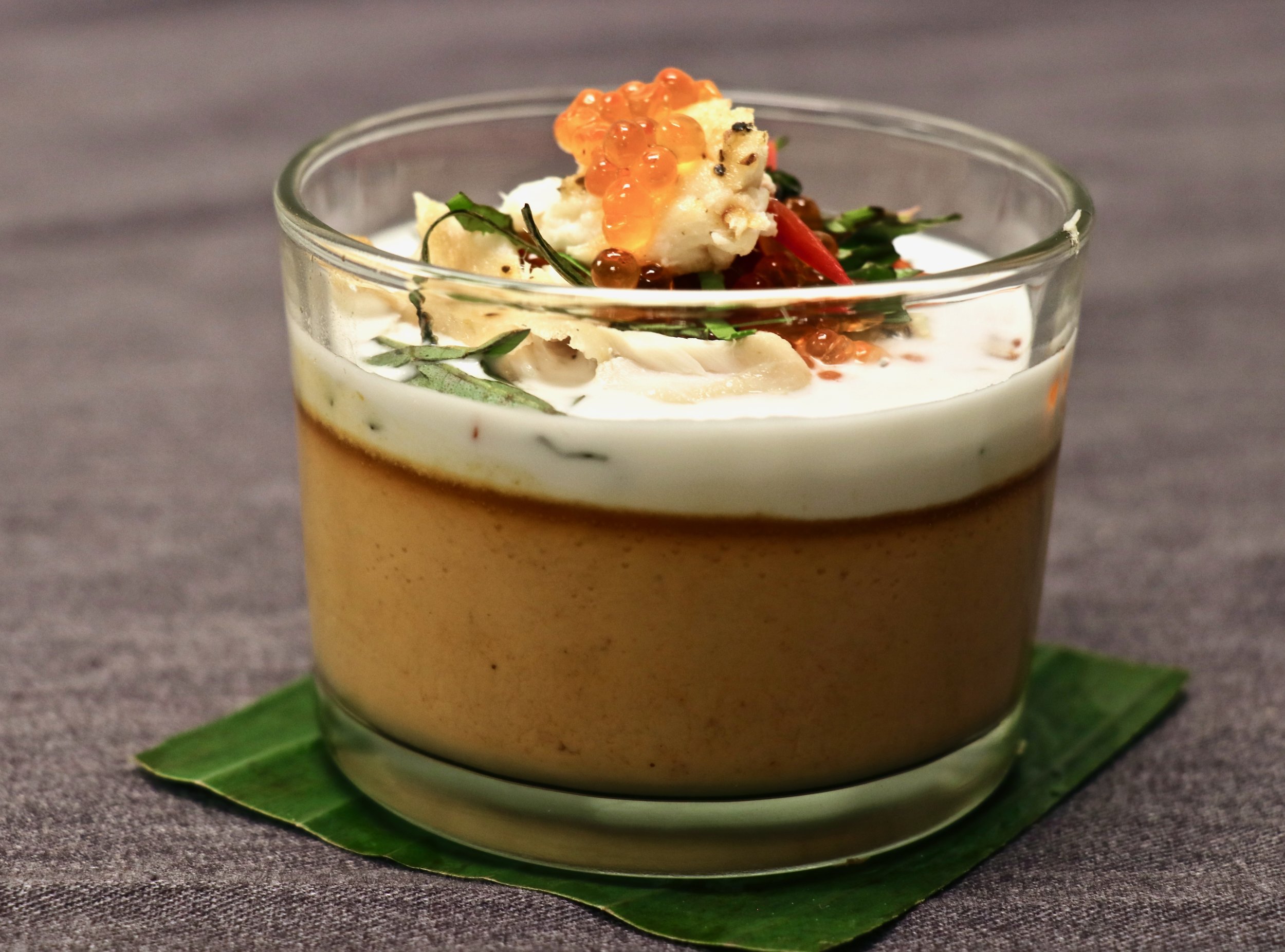
It has been a thrill to see our kitchens turned into a sea of plated finer dining cuisine, and the food at all the Simmer dinners has no doubt been phenomenal. But beyond that, we’ve also loved the stories shared behind these dinners and the bridges built between the restaurant community and our work.
Arnold Myint gave an emotional toast to his mother who helped inspire him to give back. Guests shared stories too including one diner who said he has been eating for 40 years at International Market — a testament to its long run as community gathering place.

Chef Arnold Myint
Chef Katie of Husk also shared stories at her dinner. She spoke about an appreciation for local farmers, which came through in every course including succulent ribbons of shredded pork donated by Bear Creek Farm. Then over mini Mason jars of banana pudding, she talked about her path, which included a background as a ballerina. Her former job required her to stick to a strict meal plan, but Katie also kept a beloved copy of a Better Homes and Gardens Cookbook. While rehearsing, she said she would daydream about meals she wanted to make, and sometimes she baked cakes to stash under her bed. Looking back now, it seems a career in the kitchen—a different sort of dance—was inevitable.

Chef Katie Coss
The morning of Katie’s dinner, the following article appeared in Forbes:
“How Nashville Is Becoming an Inclusive Magnet for Women Chefs and Restaurant Owners.”
It told stories of Nashville restaurant matriarchs like Chef Margot McCormack of Margot Cafe, Chef Deb Paquette of Etch and celebrities like Chef Maneet Chauhan. But it also included a newer guard such as Chef Katie, who took the reigns at Husk restaurant (previously associated with international superstar Chef Sean Brock) late last year.
Had the story been written earlier, it might have included Patti Myint and her legacy too. And while Patti would have no doubt been proud of her son Arnold at his dinner, we can’t help but imagine how she would have been proud of Katie, making her way as a women, in the restaurant scene too.

Patti Myint of Nashville’s International Market. Photo courtesy of The Tennessean.
Thank you to our sponsor Piedmont Natural Gas and to all in-kind sponsors including Creation Gardens, BonusBev, Athens, Lipman, Nelson’s Green Brier Distillery, Bear Creek Farm and Tallahassee May for the flower arrangements.
Interested in attending future Simmer dinners? Next up we have a Sunday Brunch Spectacular with Jaime Miller of Lockeland Table, Carter Hach of Hachland Hill and Kurdish pastry chef Najat Al Zahawi on Sunday, June 23, 1:00 PM
Pastry chef Jaime Miller will host a pop-up Sunday brunch with friends including Chef Carter Hach, grandson of Tennessee culinary legend Phila Hach and proprietor of Hachland Hill Inn, and Najat Al Zahawi, a Kurdish pastry expert who also cooked with Phila Hach. Discussion will include Jaime’s approach as well as Phila’s legacy and influence in creating community through food.
Click here for tickets.

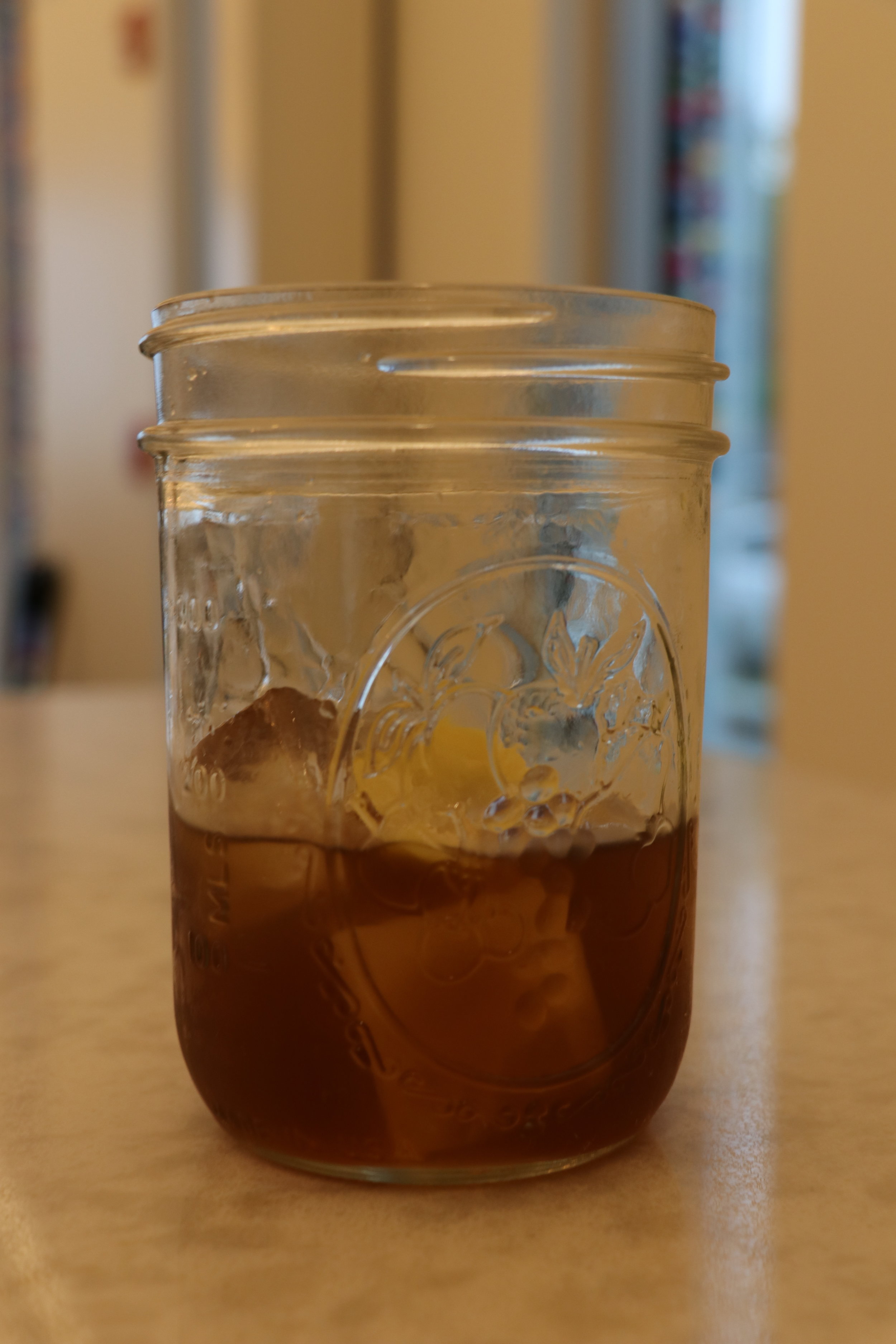
Springs Sorghum Simmer Cocktail
Husk Bar Manager Adam Morgan concocted this “welcome cocktail,” the Springs Sorghum Simmer, which includes a generously provided nip of Belle Meade Bourbon.
For the Basil Sorghum Shrub
2 quarts sorghum syrup
1 quart basil leaves
2.5 ounces apple cider vinegar
For the Cocktail
2 barspoons Basil Sorghum Shrub
2 ounces Belle Meade bourbon
Pinch Maldon Salt
2 dashes Angostura Bitters
1. Make the shrub: Combine 2 quarts sorghum and one quart water to a sauce pan and bring to a gentle boil. Add the basil leaves and apple cider vinegar. Let steep for 24 hours. Strain. Keep refrigerated up to 2 weeks.
2. Make the cocktail: Combine 2 barspoons of shrub with bourbon, salt and bitters. Serve over ice with a twist of citrus.
Local Food + Lemon Shallot Vinaigrette
As construction cranes loom over Nashville and development creeps into the countryside, we’re thankful for a growing number of farmers who make the best use of our fertile land and do the hard work of tending it for produce that nourishes our community. The Nashville Food Project wants to support this work. In fact, our commitment to purchasing local food is a growing portion of how our meals happen…
By TNFP’s Culinary Community Liaison, Jennifer Justus

As construction cranes loom over Nashville and development creeps into the countryside, we’re thankful for a growing number of farmers who make the best use of our fertile land and do the hard work of tending it for produce that nourishes our community.
The Nashville Food Project wants to support this work. We’re committed to a vision of vibrant community food security, in which all members of our community have the food they want and need through a just and sustainable food system. With this vision in mind, we’ve committed to deepening our relationship to local farms by purchasing and supporting local food.
In fact, our commitment to purchasing local food is a growing portion of how our meals happen. We entered 2019 knowing this would be a year of transitions for our own gardens, moving all production to the newly opened Community Farm at Mill Ridge Park (read more about the grand opening of that farm here). With less produce coming from our gardens this season, we sought farm partners we can support with our dollars whose produce can help supplement the food we grow and meals we make and share. Currently, the majority of food for our meals comes from donated and recovered food. The slice of pie for ‘local food’ represents our food purchases from local farms.
What’s going into a TNFP MEAL?

With a dedicated local farm purchasing budget, we put out the word early this year that we’re seeking to purchase locally-grown produce from area farmers on a weekly, seasonal basis for use in our meals program. This resulted in new relationships with four farms: Rally House Farms, Bloomsbury Farms, West Glow Farm, and SE Daugherty & Sons.
Here’s a bit about each farm:
Rally House Farms recycles shipping containers for growing hydroponically and providing healthy, fresh produce year round. The operation needs 90 percent less water, no harmful pesticides or herbicides and a fraction of the physical space of traditional farms, which means they’ve turned a paved corner of Murfreesboro Pike and Fesslers Lane into a thriving, sustainable food source. Though Rally House Farms operates as its own for-profit business, it’s connected with Rally House Recovery Homes, which aims to provide temporary structure and employment to those in recovery and transition.
Bloomsbury Farms is located over 400 acres in Smyrna, Tennessee. Owner and farmer Lauren Palmer has farming in her family. Her father grew up on a dairy farm, though his parents were forced off the land by the Army Corps of Engineers and eminent domain. A love of the land continued with his motto: “bloom where you were planted.”
West Glow Farm is a small-scale, Kingston Springs farm with naturally grown vegetables, fruits and flowers. Farmer Booth Jewett (a Nashville Food Project alum) works to grow food in a way that honors and regenerates the land and all who live on it.
SE Daugherty & Sons launched in 2016 with Shaun Daugherty at the helm. As lead cultivator (and former personal trainer), he’s made it his life’s mission to make “good-tasting, good-for-you foods accessible to everyone.”

In one of our first farm partner deliveries to our kitchen from Rally House, we received lettuces. Here’s a go-to recipe we often use when whipping up dressings for our salads. It’s a simple set of directions for committing to memory that allows the gifts of the earth to shine.
Lemon Shallot Vinaigrette
(courtesy of Christa Bentley)
Yields 2 cups
Ingredients
2 shallots, finely chopped
2 cloves of garlic, finely chopped
1/2 cup lemon juice
2 tablespoons white wine vinegar
2 tablespoons Dijon mustard
1 cup olive oil
1 tablespoon honey (or until desired sweetness)
Salt and pepper to taste
Directions
In a medium bowl, combine shallots, garlic, lemon juice, vinegar and mustard. Whisk in olive oil and honey. Season with salt and pepper to taste. Drizzle on local greens, toss and serve.
Celebrating the Community Farm at Mill Ridge
Since last fall, we’ve been busy breaking ground and building infrastructure at our newest garden site in southeast Nashville - the Community Farm at Mill Ridge Park. Located in Metro Nashville's newest regional park, this community farm will be a new home to TNFP garden programs. So much planning, love and work has already been poured into this project, and we were incredibly excited to celebrate with a grand opening of the farm on Saturday!
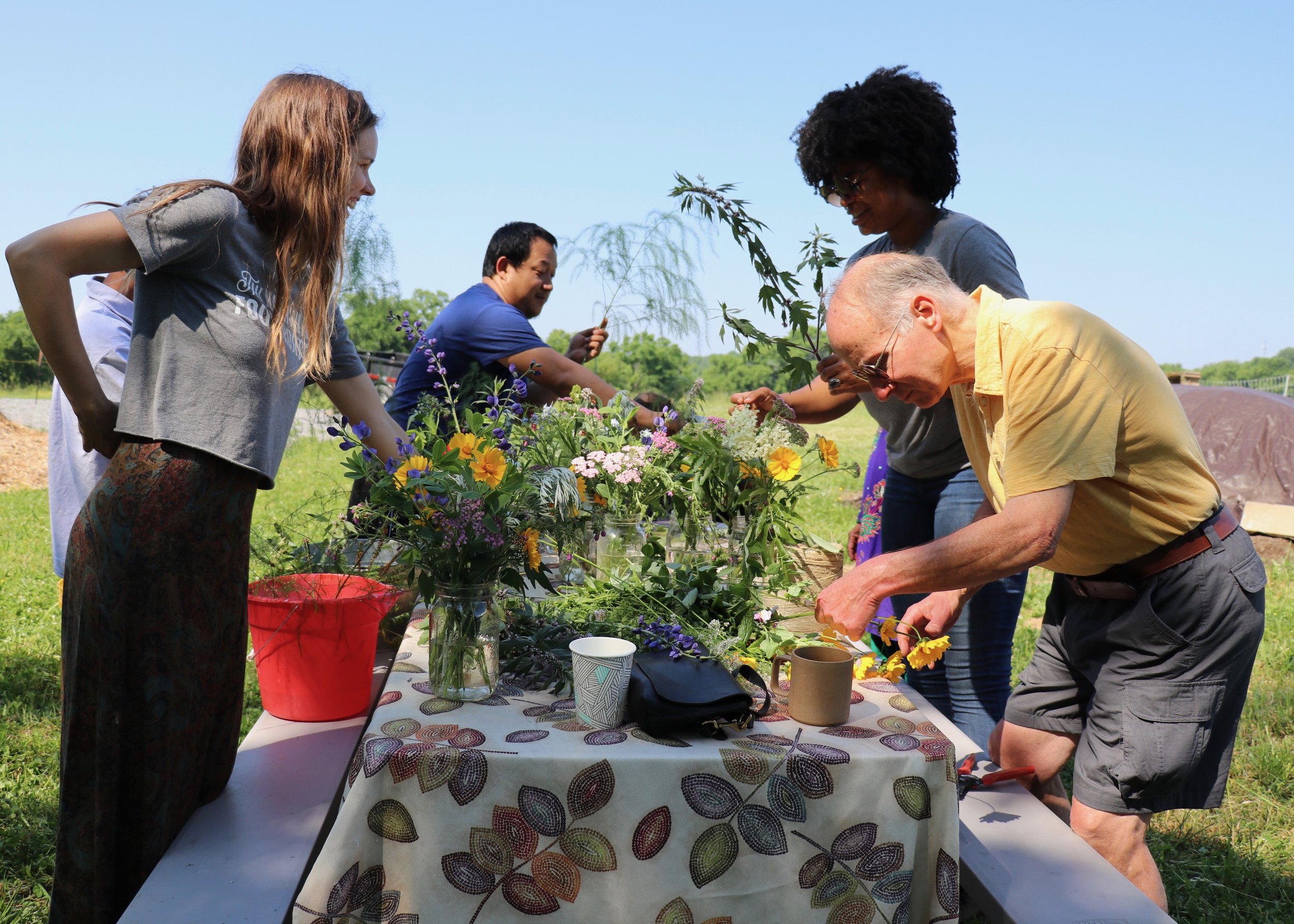
Since last fall, we’ve been busy breaking ground and building infrastructure at our newest garden site in southeast Nashville - the Community Farm at Mill Ridge Park. Located in Metro Nashville's newest regional park, this community farm will be a new home to TNFP garden programs. So much planning, love and work has already been poured into this project, and we were incredibly excited to celebrate with a grand opening of the farm on Saturday!
From the moment staff, volunteers and gardeners first arrived to begin set up on the morning of the party, this was truly a community event. Everyone pitched in with setting up tables, chairs, activity stations, flower arranging, and more.

As guests arrived, staff began to offer tours of the gardens. This year, TNFP is opening the farm with two elements of our garden programming: production and community gardens. The production gardens offer a way for folks to play a role in growing food for our meals program, engaging volunteers in a small-scale and efficient garden. The community garden at Mill Ridge hosts 12 families this season, offering land, resources and education opportunities for folks to grow food for themselves and their families, with plans to expand next year.

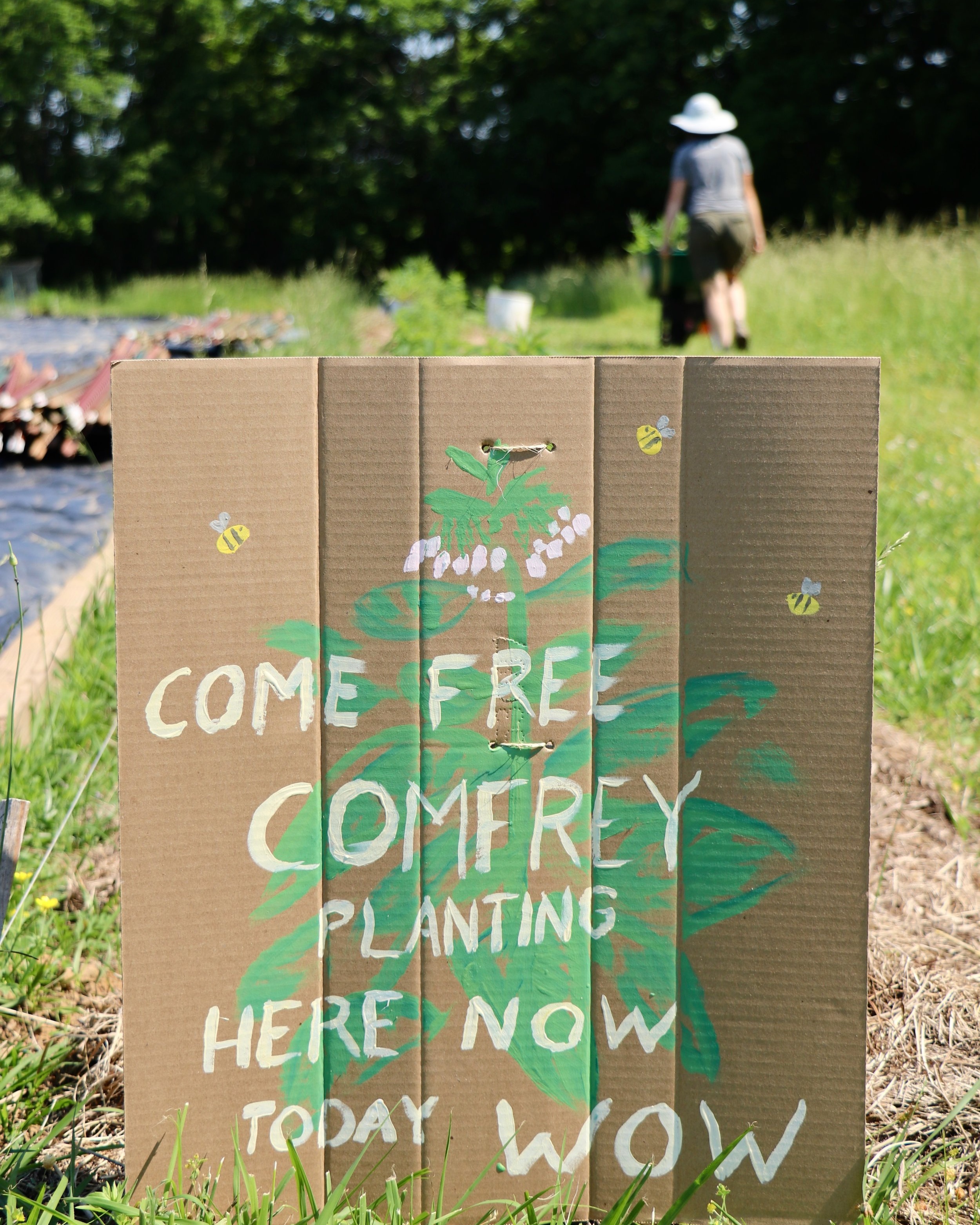
Throughout the property, visitors to the farm also found opportunities to engage in community art projects, a comfrey planting, and offerings of free plants and seeds for their own home gardens. And, of course, it wouldn’t be a TNFP event without lots of snacks, marked with a “Lettuce Eat!” sign.
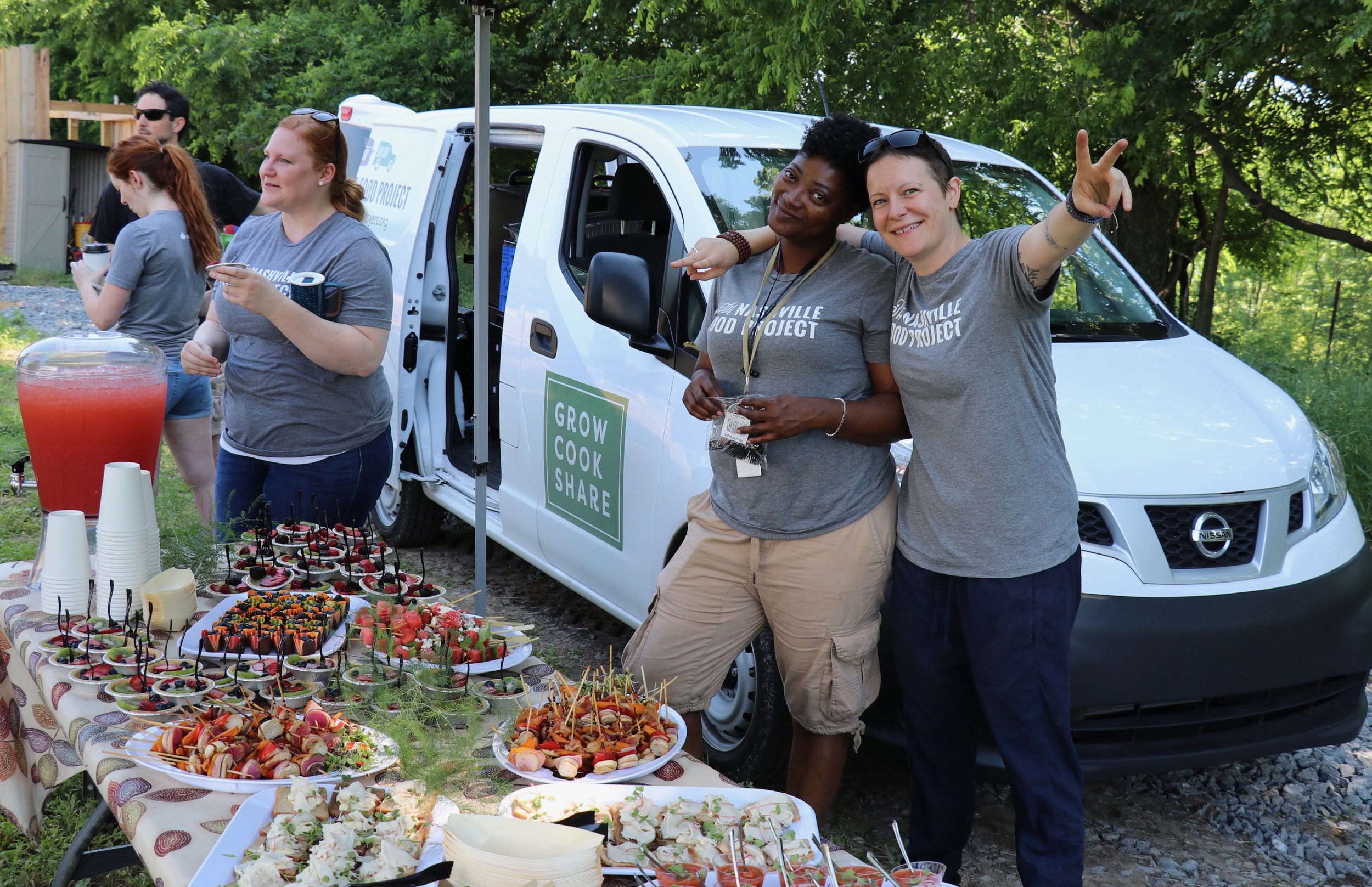
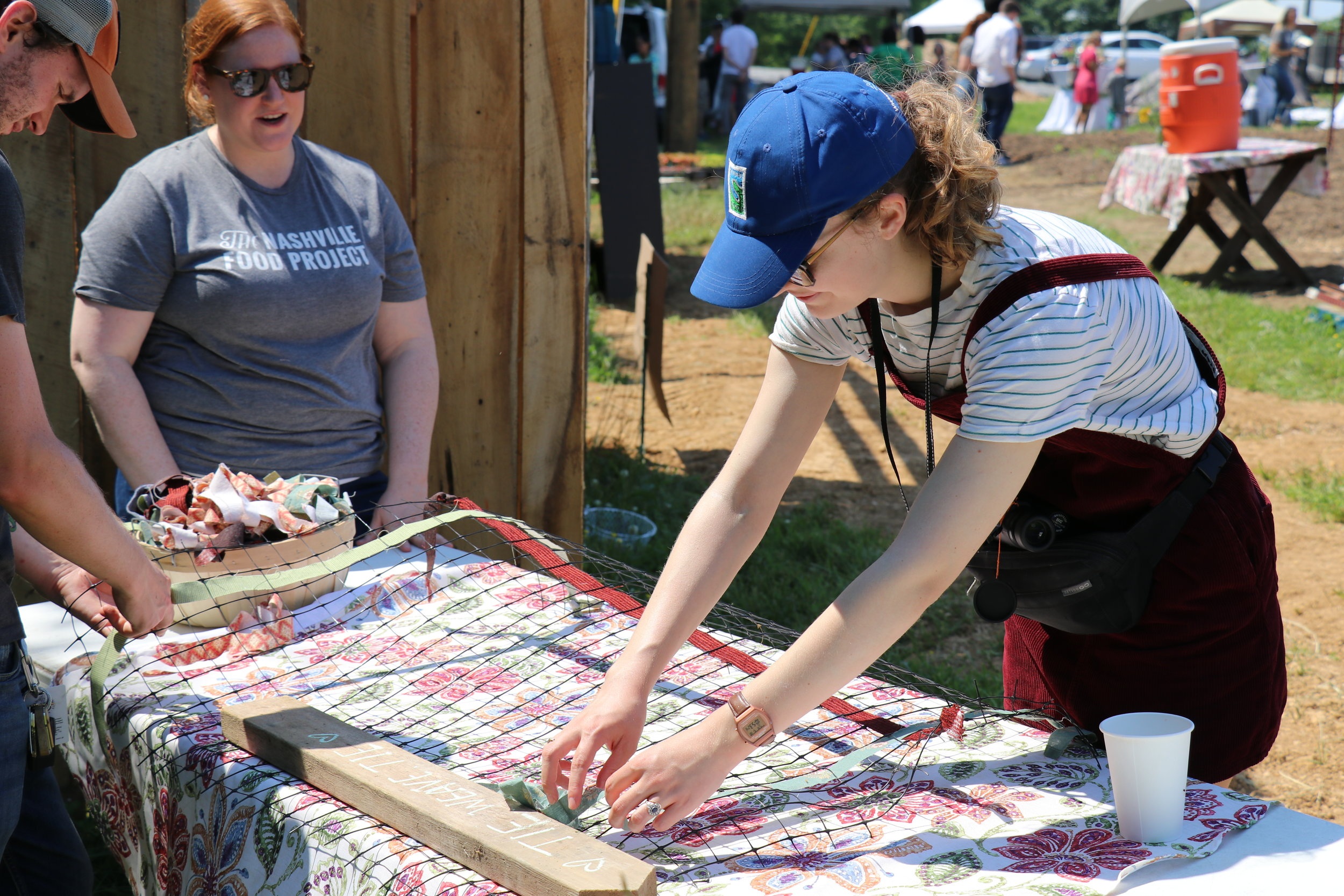
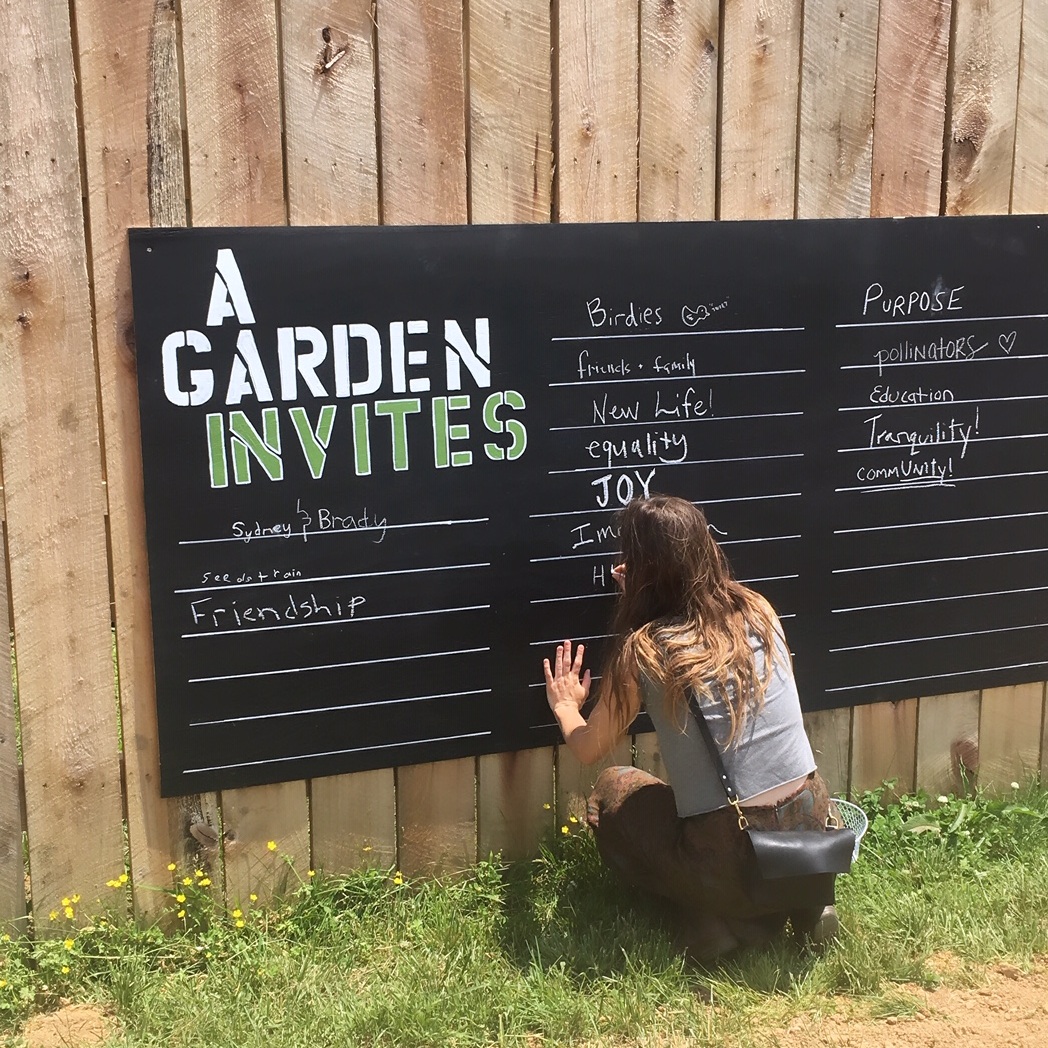
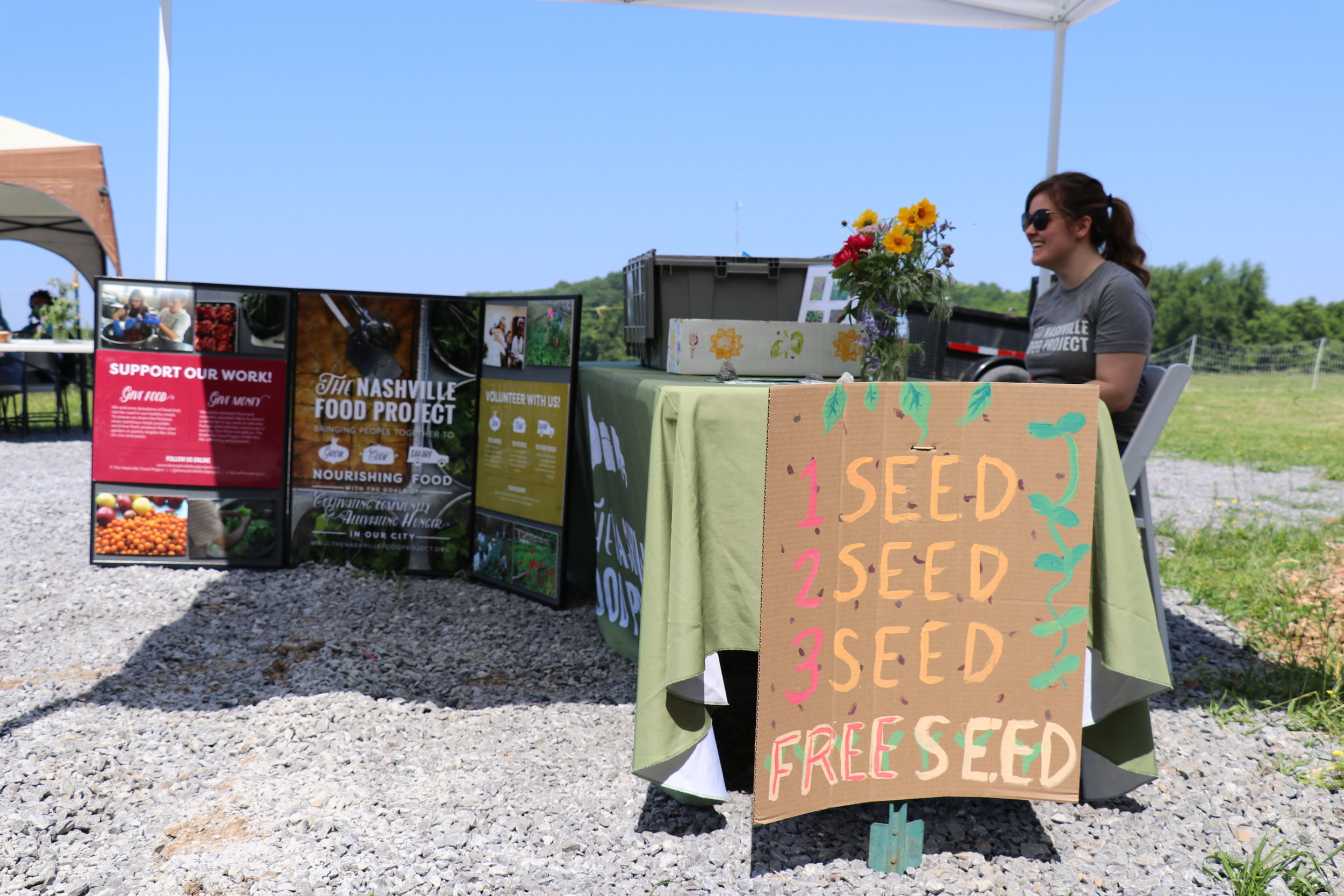
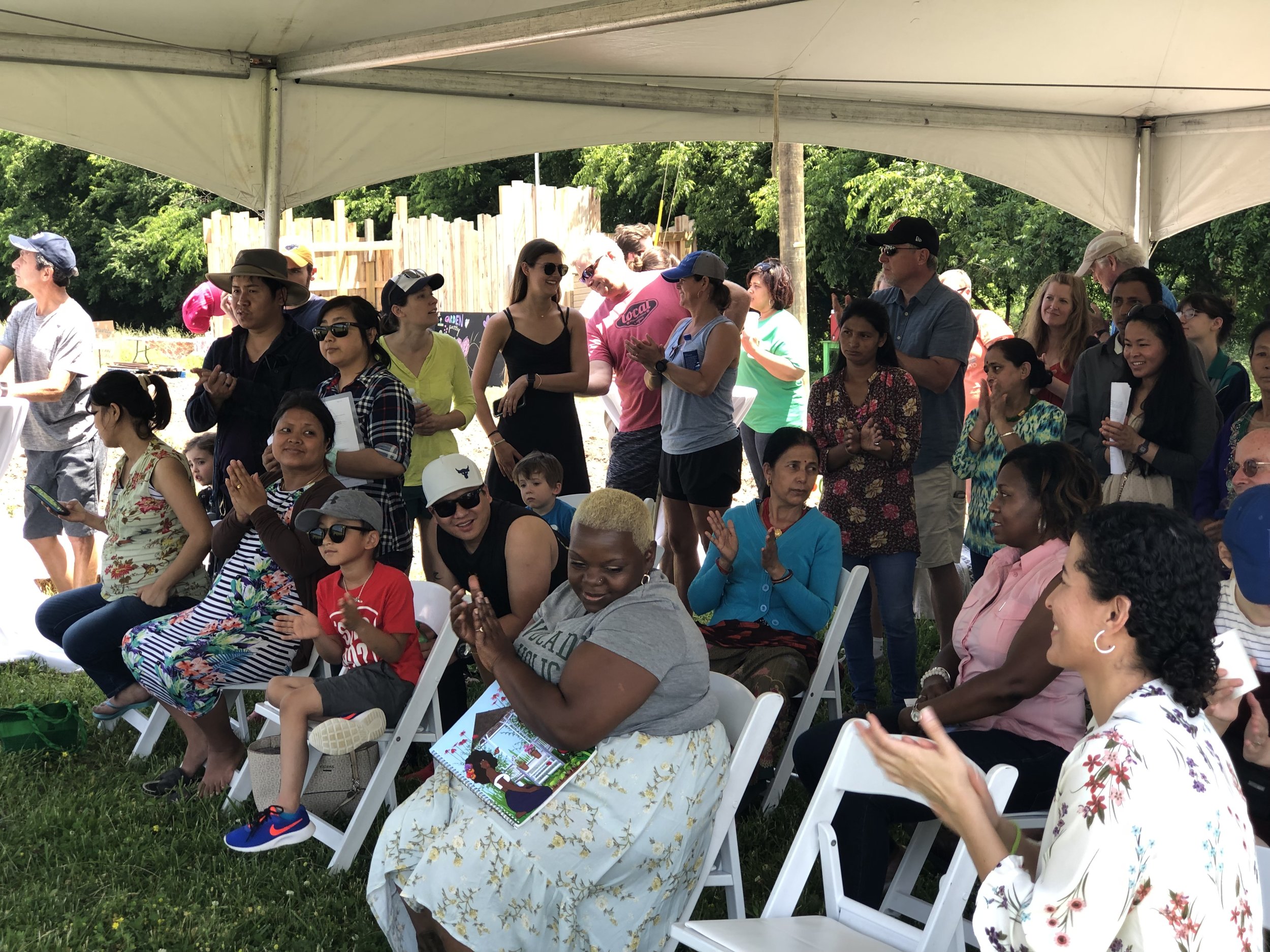
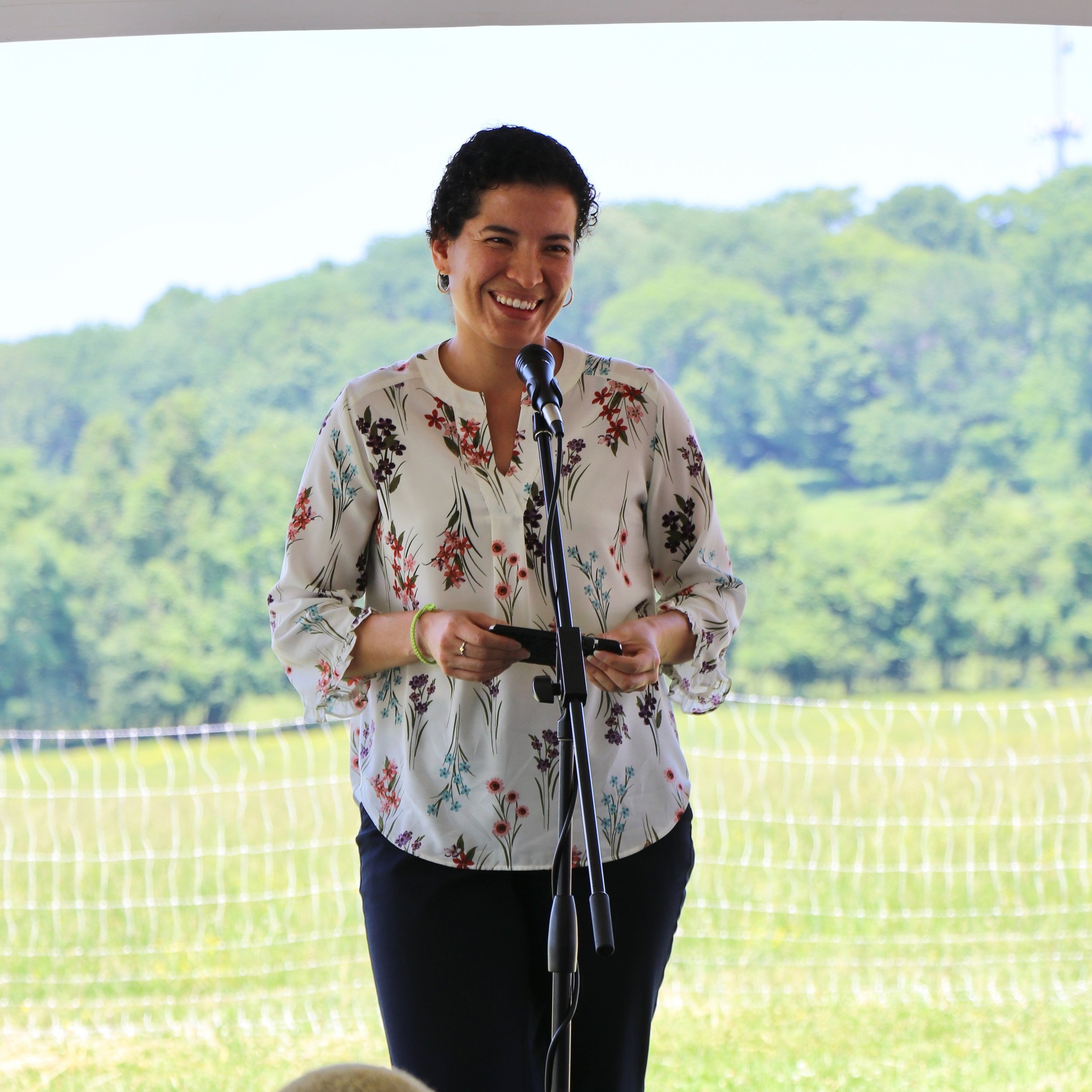
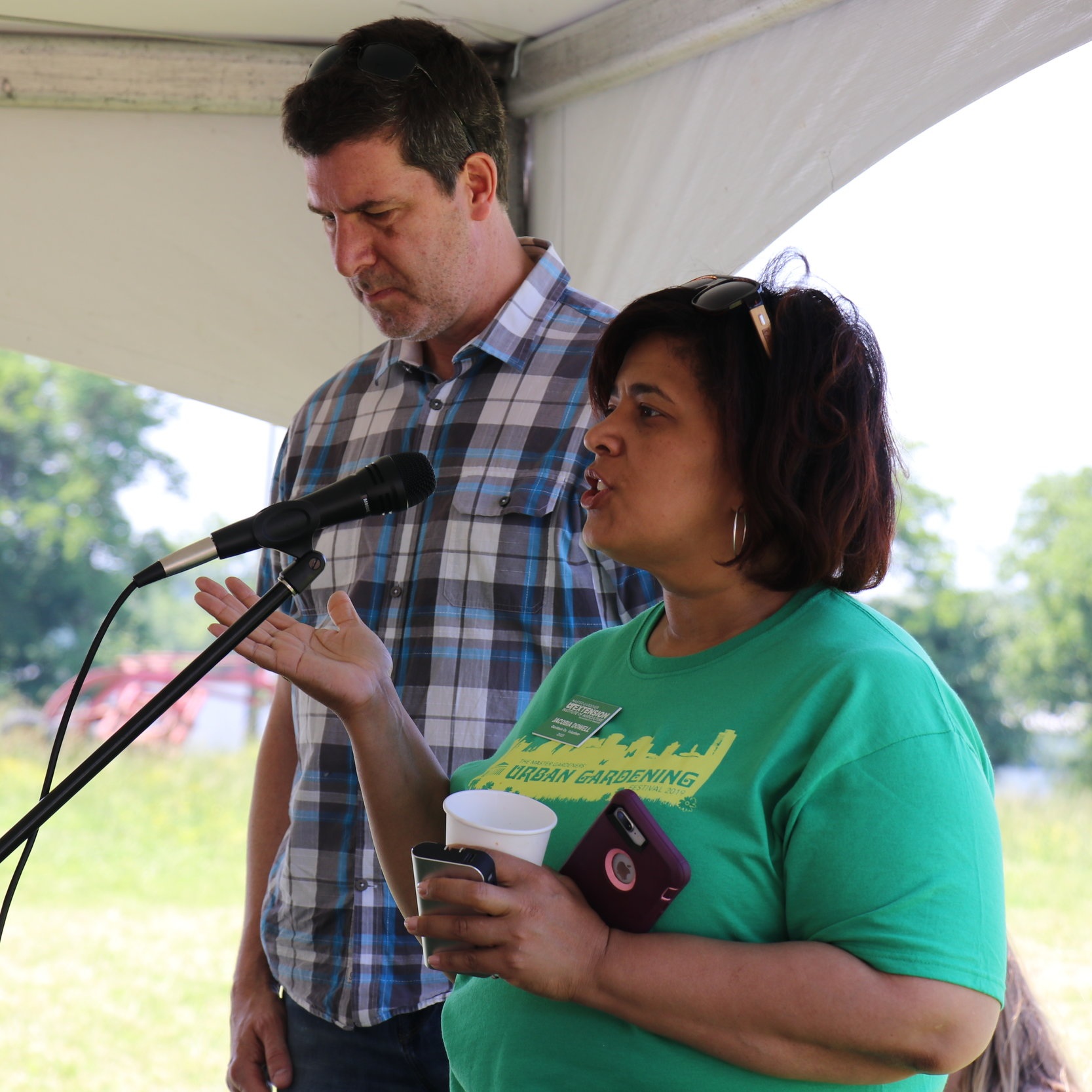
Next, everyone gathered in the tent for an INCREDIBLE line-up of speakers. Lauren Bailey, Hannah Davis and Christa Bentley of TNFP, Darrell Hawks of the Friends of Mill Ridge Park, Monique Odom of Metro Parks, Metro Councilwoman Jacobia Dowell, Community Gardener Bridget Bryant, Vanessa Lazon from the Mayor’s Office, and a beautiful performance and blessing by Rashad Rayford of Southern Word. The speakers talked about their excitement for people to have the opportunity to grow their own food in community at this farm.

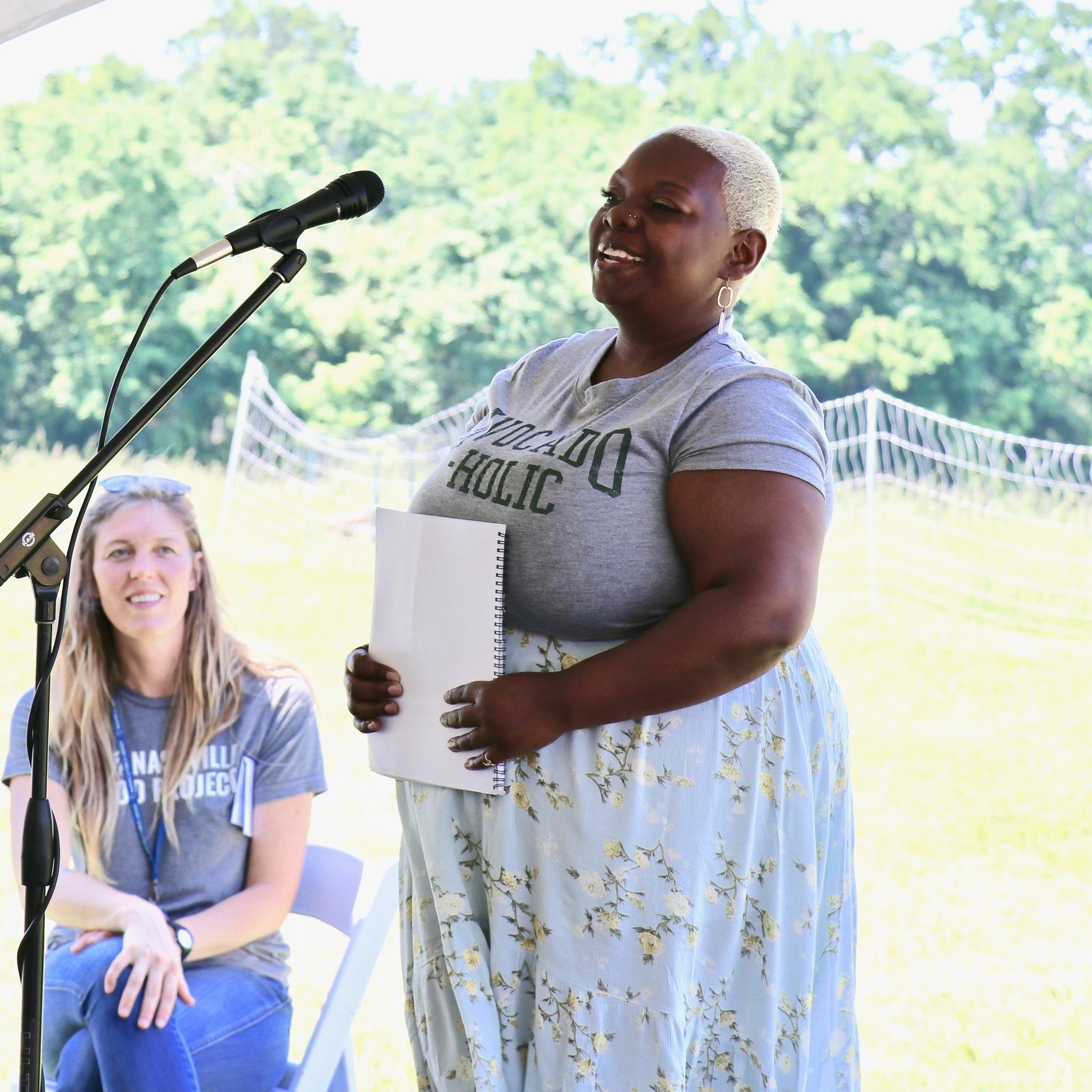

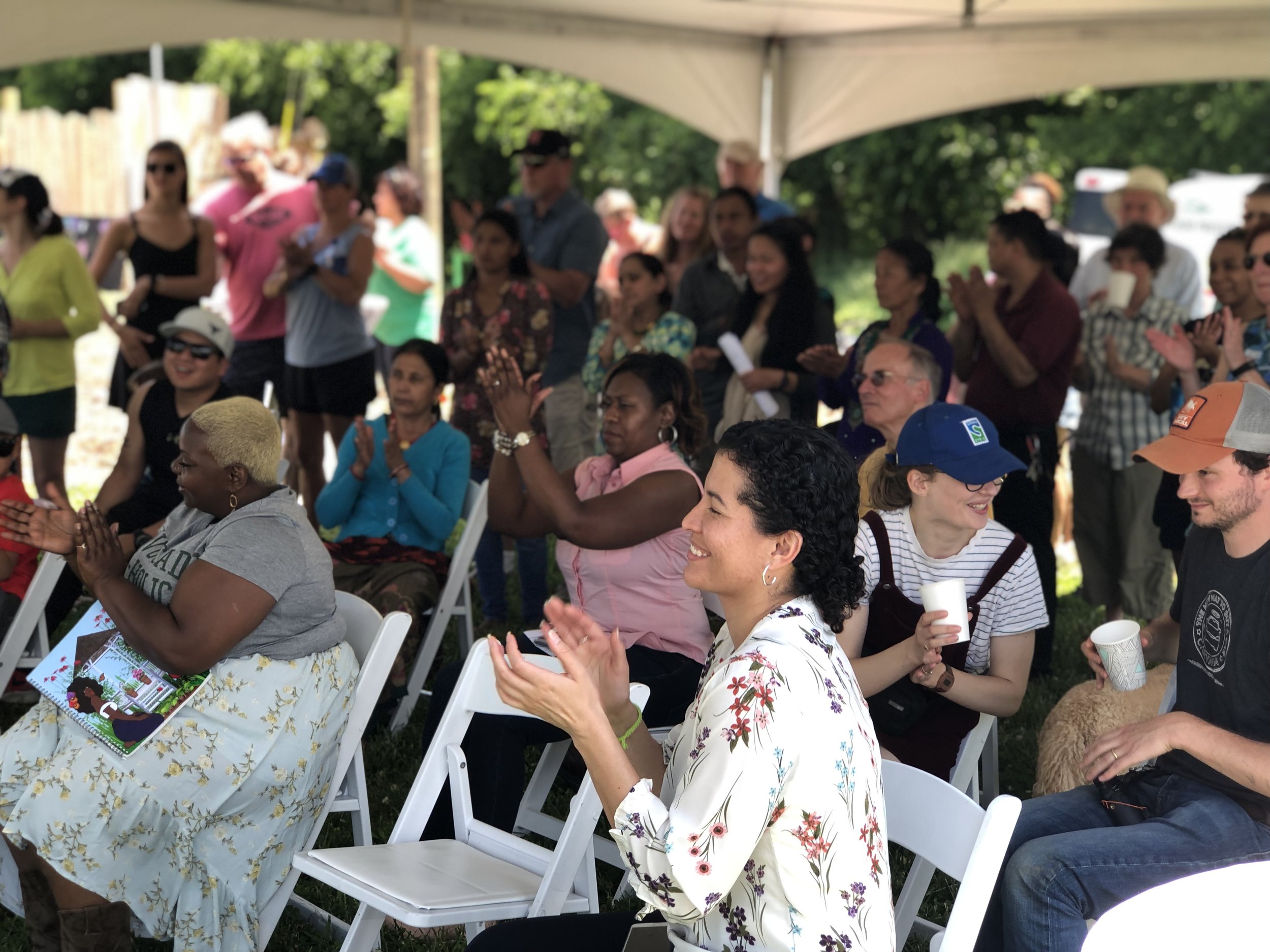
We were also honored to have Ms. Mary Moore and Ms. Aileen Williamson attend the celebration, whose family owned and ran the property as a family livestock farm beginning in 1919. Before it was purchased by the Moore family, the property was owned by the Holloway family, who grew commodity crops and kept livestock. When the Holloways settled here in 1850, they had two young children and owned 32 slaves. In 2015, Metro Parks of Nashville purchased the Moore Farm and several adjacent properties to create what is now Mill Ridge Park.

The Moore sisters, Ms. Mary Moore and Ms. Aileen Williamson
As the speakers closed, Sankofa African Drum and Dance of Tennessee led us all in dancing together as a community. They shared with us that Sankofa is an Akan word that means, "We must go back and reclaim our past so we can move forward; so we understand why and how we came to be who we are today.”

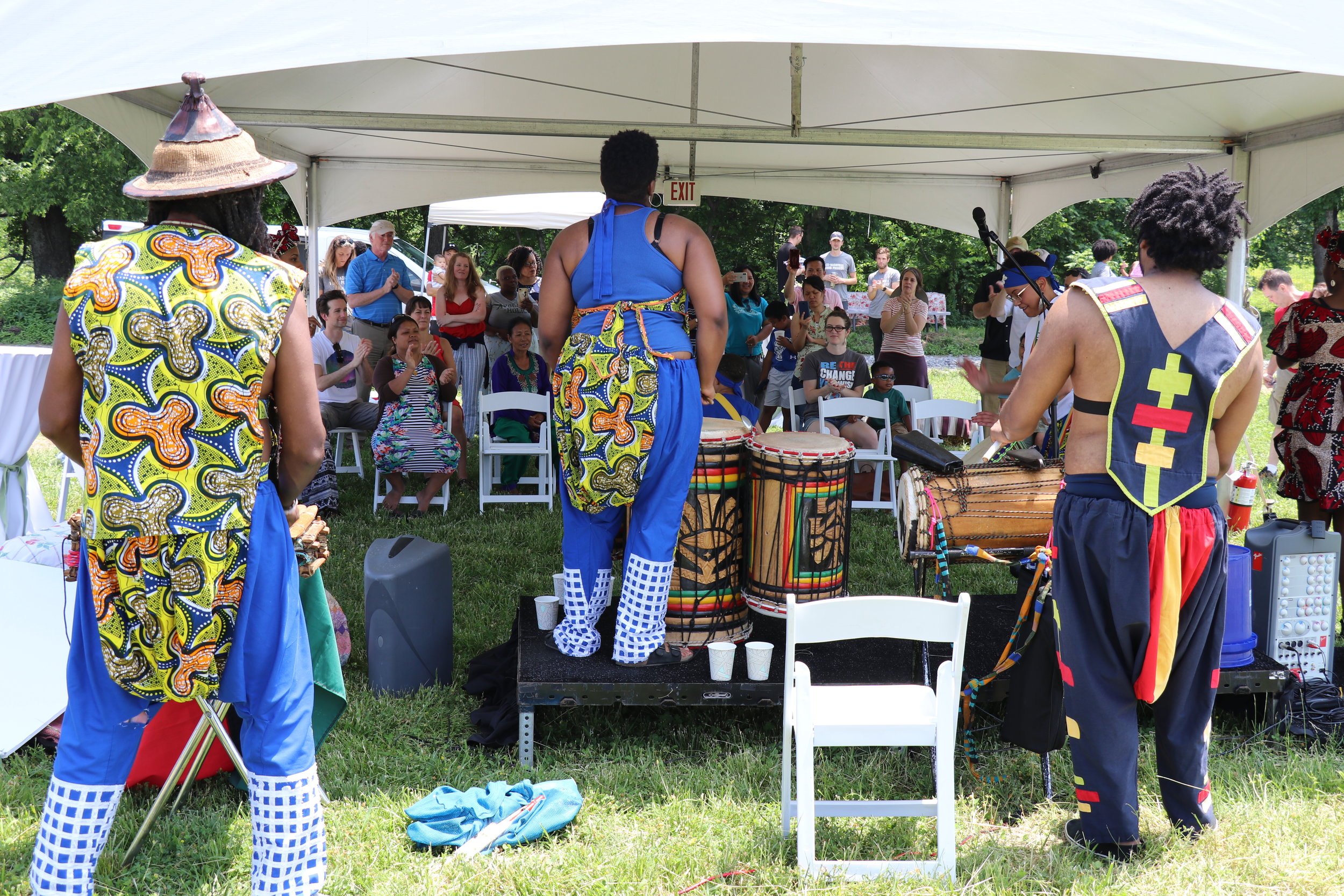
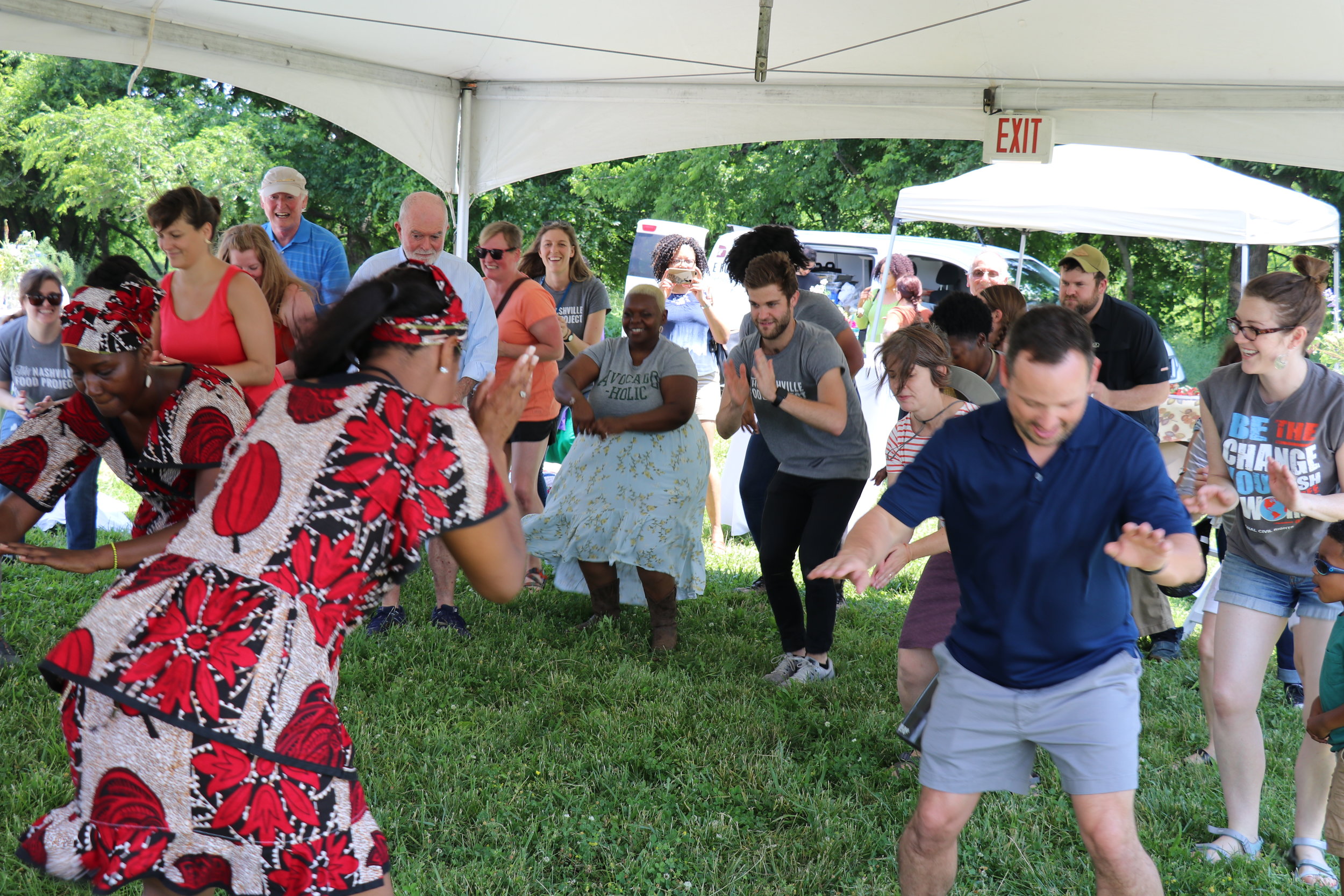
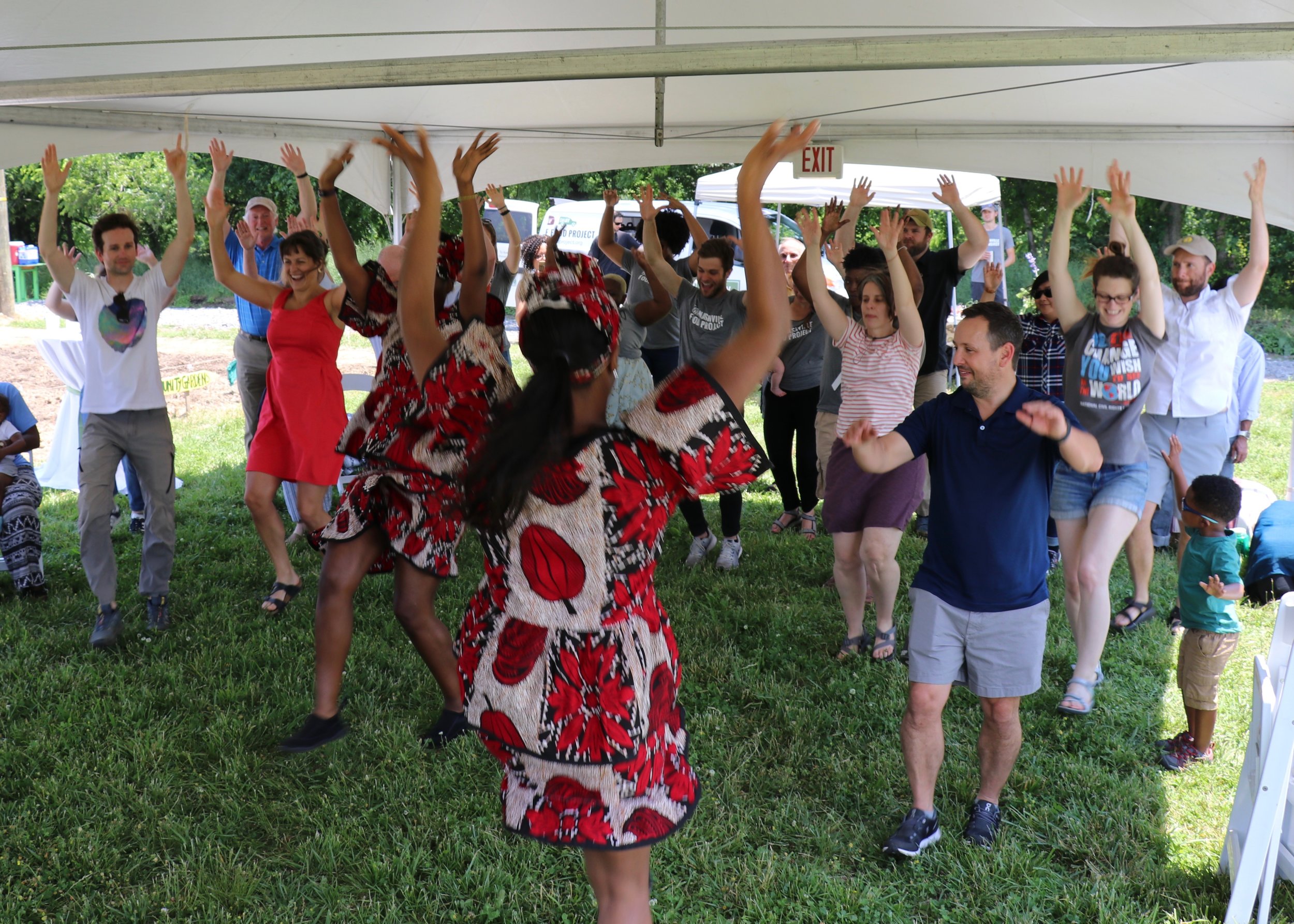

This call to understand our past, including slavery and the genocide of native peoples, is vital to understanding where we are today in agriculture. At TNFP we envision vibrant community food security where people have the food they want and need through a just a sustainable food system. We know that we have never had a just and sustainable food system, so we hope that you'll join us in this work to create a just and sustainable food system through this community farm!
Learn more about volunteering in our gardens at thenashvillefoodproject.org/givetime.
Sweet Peas: Summer Eats for Kids
Over the last few years, we have been learning about the incredible need for summer meals for youth in Nashville and wishing we could do more. Every school year, Metro Nashville Public Schools serves 8.4 million lunches and 4 million breakfasts. During the summer months, without these daily meals, many children and youth are at risk of hunger. According to Feeding America, this could be as many as 1 in 5 children under the age of 18. These numbers are staggering, and we are finally in a position to do something about it. We are thrilled to announce a new initiative for our meals program: Sweet Peas, summer eats for kids.
By Christa Bentley, Interim Chief Programs Officer

Since moving into our new building in December we have been learning a lot. Dipping our toes into what’s possible in our incredible, shiny new kitchen; inviting our volunteers to get comfy here; meeting our neighbors; making new friends; and working hard to make this kitchen a home for ourselves and, we hope, for many others. Our meals program has been slowly adding meals as we’ve been getting to know this new space and the incredible capacity that comes alongside it.
But now, we’re ready to GROW. Over the last few years, we have been learning about the incredible need for summer meals for youth in Nashville and wishing we could do more. Every school year, Metro Nashville Public Schools serves 8.4 million lunches and 4 million breakfasts. During the summer months, without these daily meals, many children and youth are at risk of hunger. According to Feeding America, this could be as many as 1 in 5 children under the age of 18.

These numbers are staggering, and we are finally in a position to do something about it. We are thrilled to announce a new initiative for our meals program: Sweet Peas, summer eats for kids. This summer, The Nashville Food Project is partnering with the YMCA of Middle Tennessee, Project Transformation, the Martha O’Bryan Center, United Way’s SPARK program at Haywood Elementary, and Nashville International Center for Empowerment to share over 35,000 nutritious meals with over 600 of Nashville’s children and youth. This is in addition to the ongoing local meals partnerships the Food Project maintains all year long.
These meals will not just be another drop in the bucket. They will be healthy, delicious, local, and made-from-scratch. Our hope is that the love that goes into these meals from the hundreds of volunteers who had a hand in their making will be evident to the children who eat them. That they will inspire a new salad lover, a new broccoli eater, some orange smiles. This is the kind of community food we have been working towards all these many years, and now we are ready to act in a larger way.

We need your help to bring this work to life! This expansion will cost over $36,000 and require hours of additional volunteer time, but the impact -- putting good food on the table for so many children and community partners this summer -- will be well worth the effort and expense. You can help us today by donating or signing up to volunteer at one of our kitchens in West Nashville, St. Luke’s Kitchen and California Avenue.
I hope daily that our work at The Nashville Food Project will no longer be necessary because everyone in our community will have access to the most basic human right of nutritious food. But as long as we are needed, these meals, and the many more we plan to cook over years to come, will continue to amplify our vision of nourishing, community food for all.
I hope you’ll consider supporting this important work.
Christa Bentley, Interim Chief Programs Officer

Want to learn more about meals available for Nashville area children and youth this summer? Addressing the summer nutrition gap requires collective work by many, and we’re grateful for the incredible programs and community partners who are sharing in this work! As we learn about additional summer meal resources, we’ll be adding and updating information here.
Metro Action Commission’s Summer Food Service Program prepares nearly 6,000 meals daily during June and July for an average of 110 sites and 3 communities served by the agency's Mobile Youth Café Diners.
Information on Metro Action Commission sites and all Summer Food Service Program sites is available on the Department of Human Service website. You can find meal sites near you by:
1. Going to https://www.fns.usda.gov/summerfoodrocks to use the Site Finder
2. Texting “Summer Meals” to 97779
3. Calling 1-866-348-6479
Metro Nashville Public Schools’ summer meals program is free to children ages 0 to 18, regardless of whether or not they attend Metro Schools. Adults aged 19 and over can receive meals at a reduced cost of $3.75. There are no income requirements or registration. It is paid for through the U.S. Department of Agriculture and comes to Nashville at no net cost to taxpayers.
J.E. Moss Elementary School - June 3 to July 12
1-2 p.m.
4701 Bowfield Dr.
Antioch, TN 37013
Gra Mar Middle School - June 10 to July 3
1-2 p.m.
575 Joyce Ln.
Nashville, TN 37216
The Nashville Food Project is partnering with local organizations this summer to share over 35,000 nutritious meals with over 600 of Nashville’s children and youth. This is in addition to the ongoing local meals partnerships the Food Project maintains all year long. Click here for a list of all Sweet Peas partner locations and dates/times of meal service - note that some of these sites require enrollment.
Second Harvest Food Bank of Middle Tennessee sponsors the Summer Food Service Program (SFSP) at sites throughout Middle Tennessee each summer. Free meals that meet Federal nutrition guidelines are provided to all children at SFSP sites in areas with significant concentrations of low-income children.
List of Second Harvest’s open SFSP Sites
List of Second Harvest’s SFSP Sites that require enrollment
Do you know of additional summer meal resources for children and youth in the Nashville area? Add them in the comments!
Understanding Garden Pests
It’s a beautiful spring day, and neighbors are gathering for garden workshop at the Wedgewood Urban Garden, an urban oasis tucked off of Wedgewood Avenue near the Tennessee State Fairgrounds. Today, we’re learning about garden pests. Whether it’s aphids or caterpillar worms, many gardeners can relate to pest problems. At TNFP gardens, we’re using and encouraging an approach to natural pest control called Integrated Pest Management…
By Grace Biggs, Impact Manager

It’s a beautiful spring day, and neighbors are gathering at the Wedgewood Urban Garden, an urban oasis tucked off of Wedgewood Avenue near the Tennessee State Fairgrounds. Since The Nashville Food Project undertook management of the space in 2011, hundreds of Nashvillians have grown their own food in community at the garden.
There are many different methods utilized to establish community gardens. Here at TNFP, gardeners manage their own individual or family plots. With the support of monthly garden trainings and community work days combined with assistance from TNFP garden staff and community leaders, each gardener is well equipped and supported for a successful growing season. So far there are 25 people who have signed up for a plot at the Wedgewood Urban Garden. This includes both new and long-time Wedgewood-Houston neighbors, as well as families who came to the United States as refugees from Bhutan.
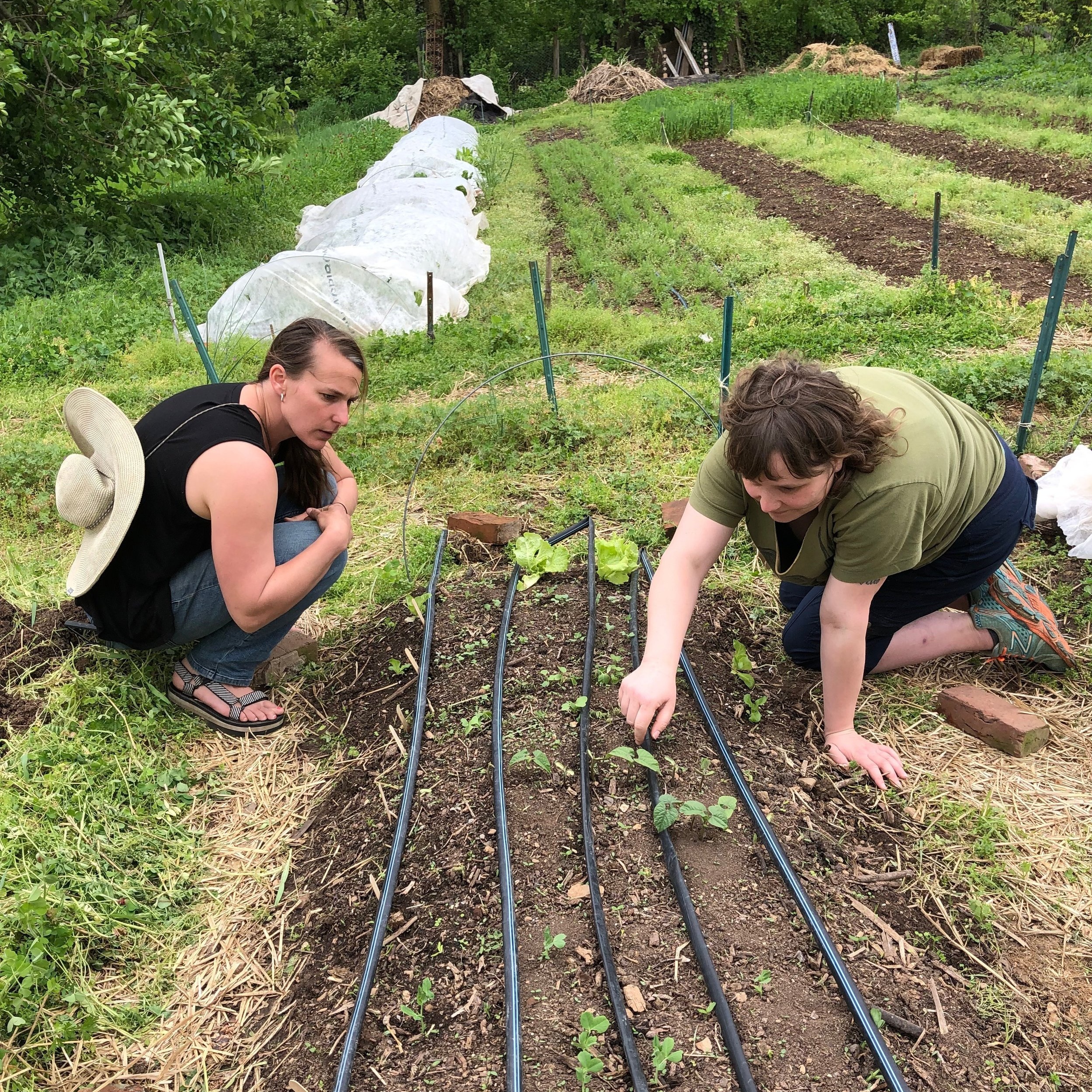
Today, I’m joining the neighborhood gardeners for their monthly garden training. As I come up the hill to the upper garden, I see a few gardeners have arrived and are already working. Some are tending to their young spring crops while others are just starting their garden journey and are preparing their beds for planting. As I walk around, I get the run-down on what people have planted: arugula, collards, radishes, carrots, bush beans, snap peas… the list goes on!
When it’s time to start the training, we head down to a shaded deck in the lower garden, surrounded by trees, perennial herbs and flowers. Lauren, TNFP’s Director of Garden Programs, uncovers a board with an outline on today’s topic: spring garden pests.

“There are some pests that will out-compete us if we don’t get ahead of the game,” Lauren begins as we settle in for the workshop. To start off, we went around the circle and shared about any past experiences we’d had with garden pests.
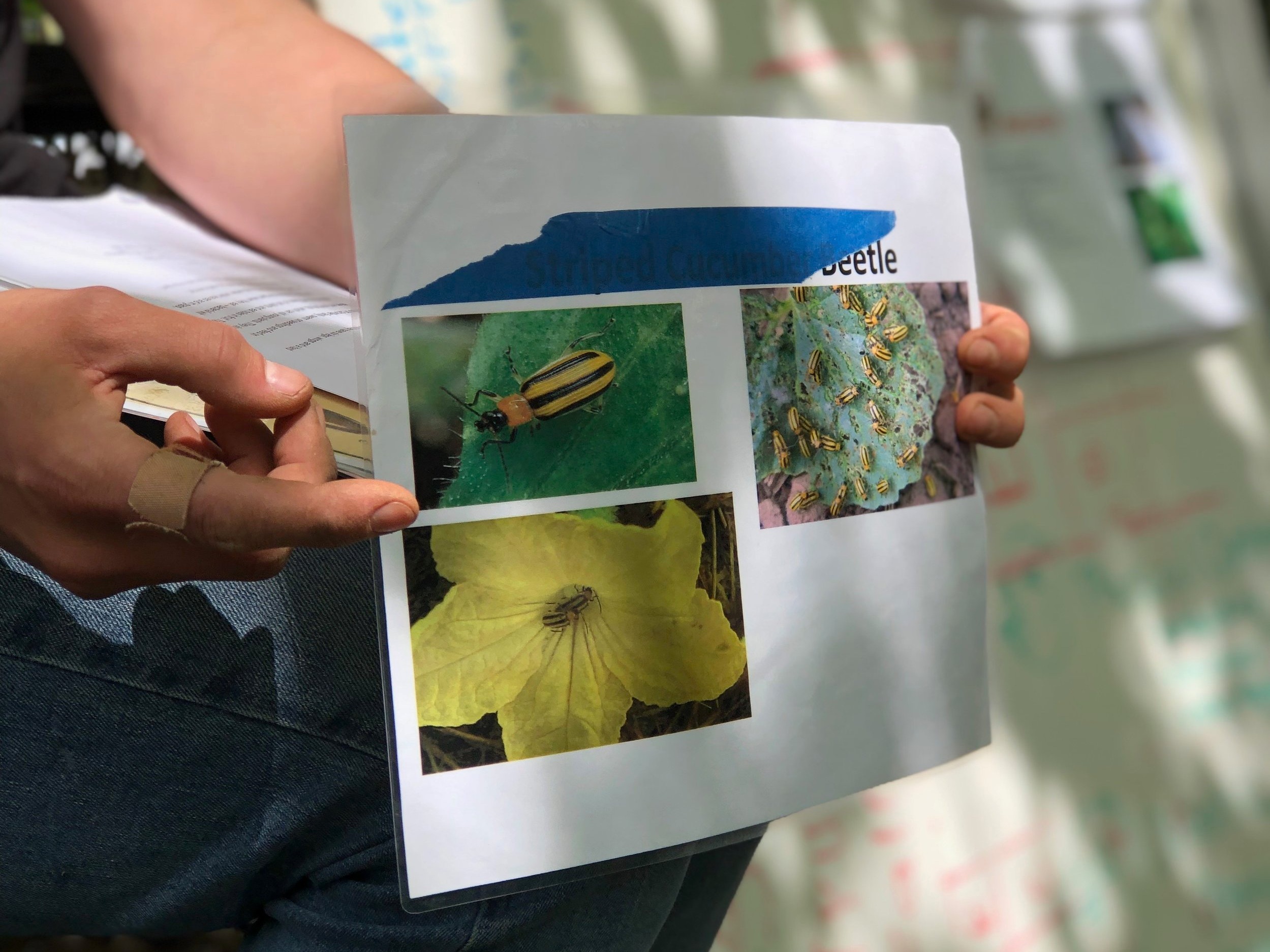
“I had a lot of beetles on my cucumbers last year,” said one gardener. “Never caught any in the act, just saw the evidence after.”
There were many nods of agreement as we took turns sharing our experiences. Whether it’s aphids or caterpillar worms, many gardeners can relate to pest problems.
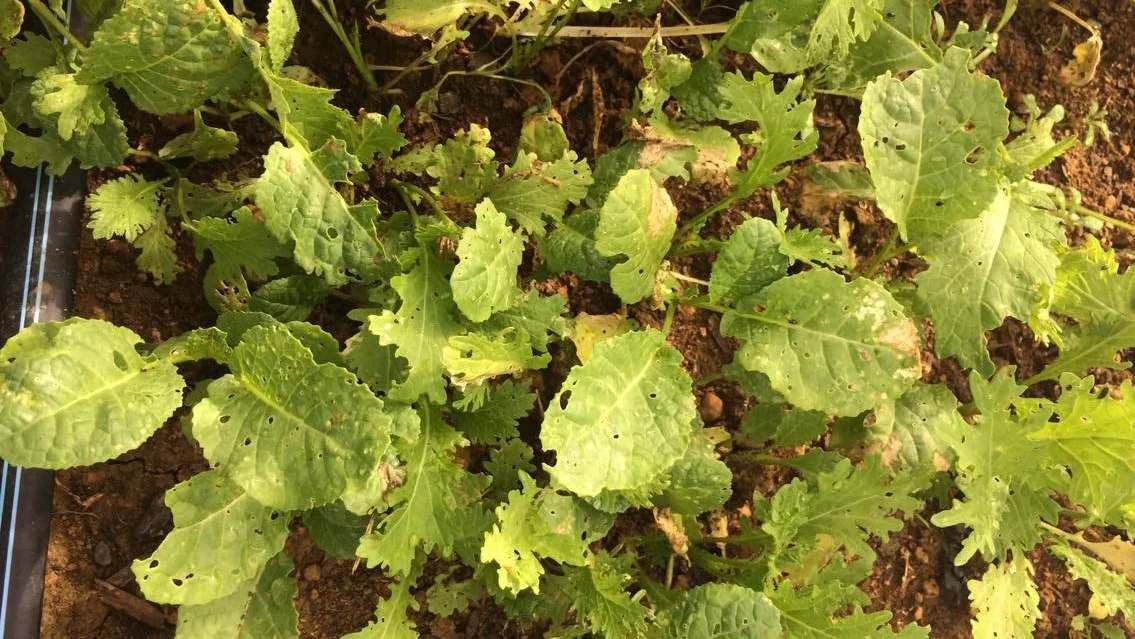
So why not spray a chemical and be done with the problem?
The gardeners have agreed and are committed to only utilizing organic methods of gardening, which also includes pest control. Most chemical insecticides can’t target a particular kind of insect, so they kill not just the pests but their predators as well. That means, ironically, that these pests can easily return -- unless you spray again, and again.
At TNFP gardens, we’re using and encouraging an approach to natural pest control called Integrated Pest Management. Lauren broke it down for us into four steps: 1) identifying and understanding the pest, 2) prevent, 3) physical control, and 4) organic chemical control.
1) Identifying and understanding the Pest
“When you’re able to identify the pest and understand their behavior, it’s like knowing your enemy. If you know their behavior, you’re better able to stay one step ahead.”
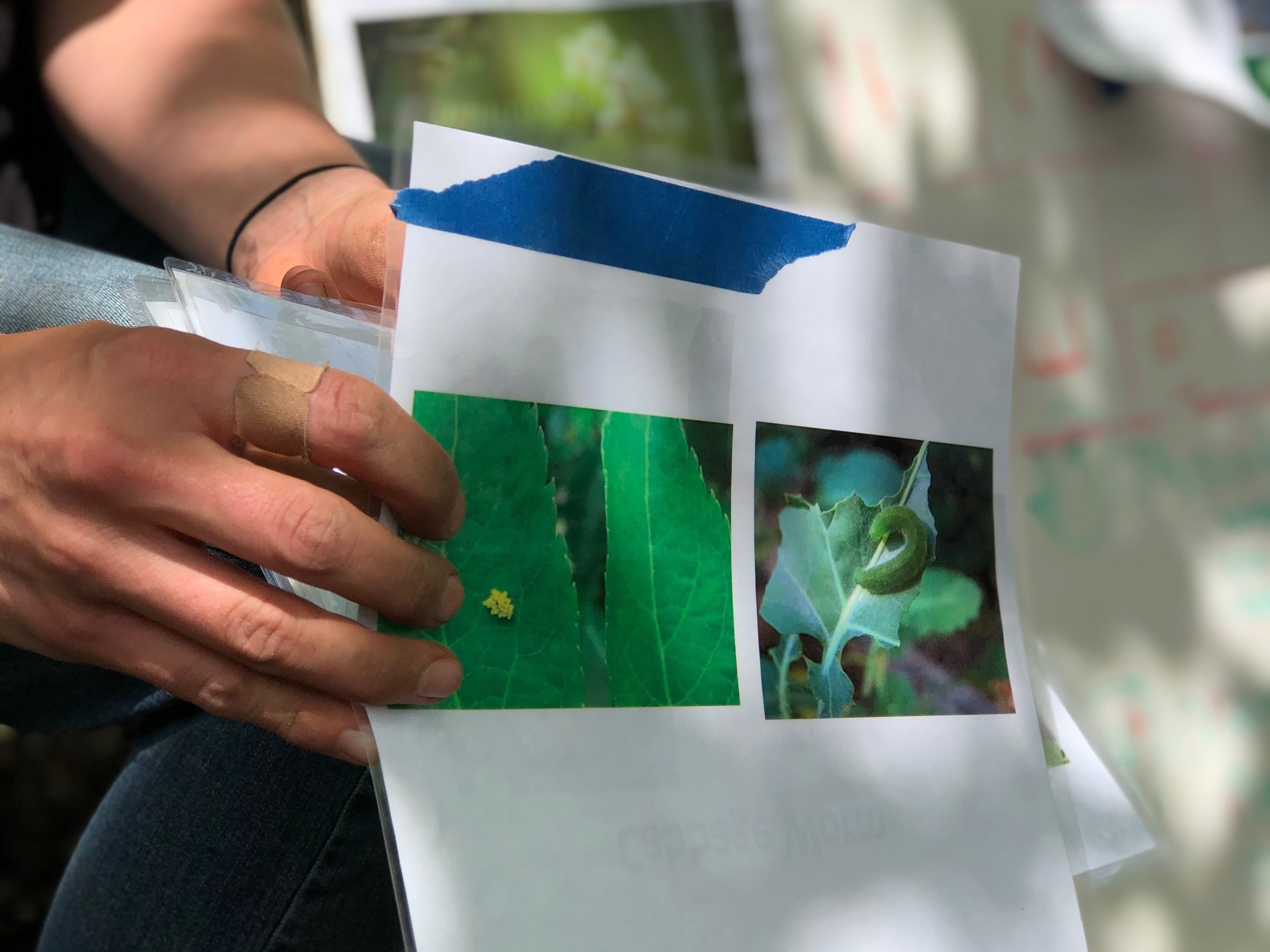
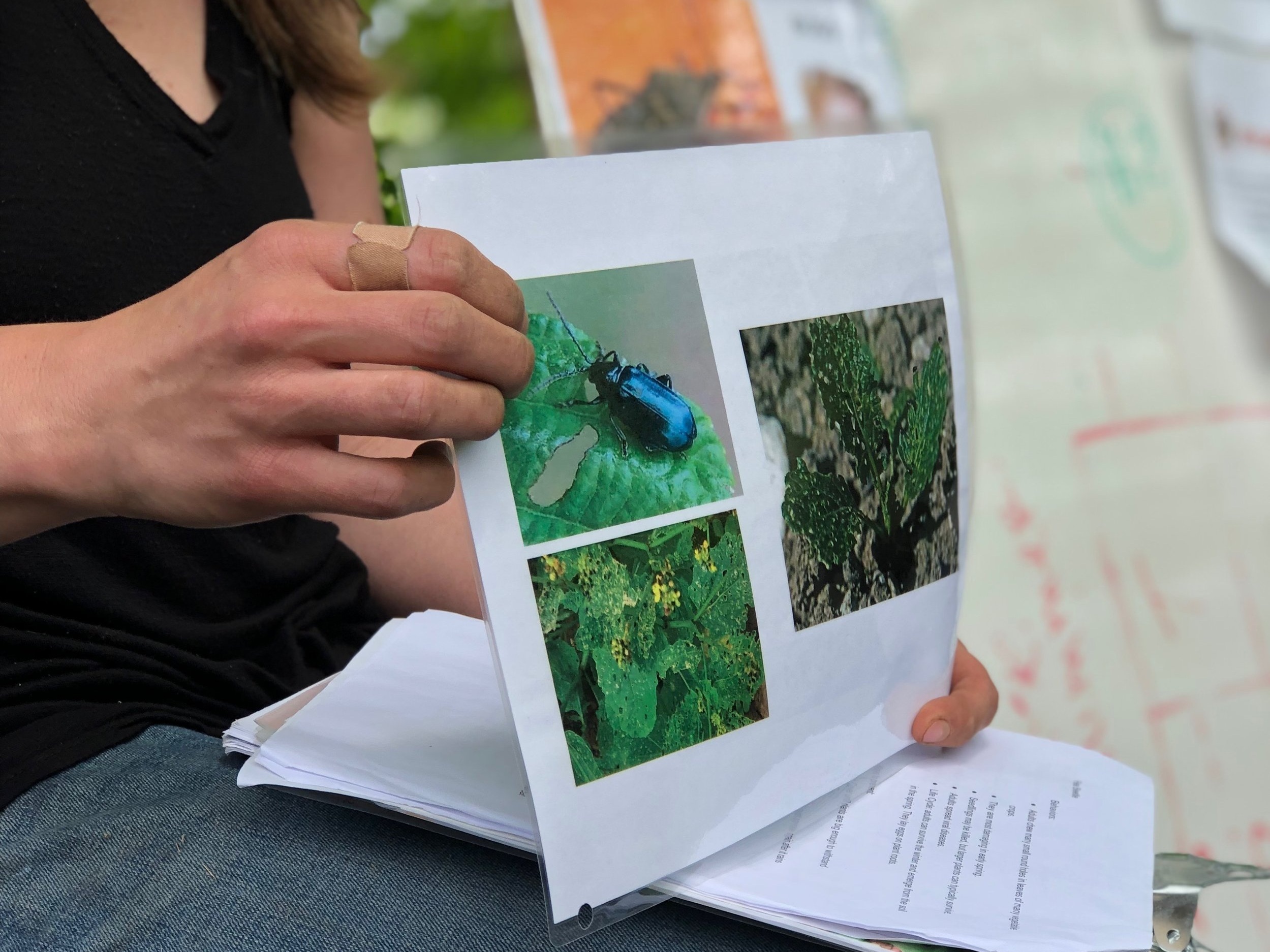
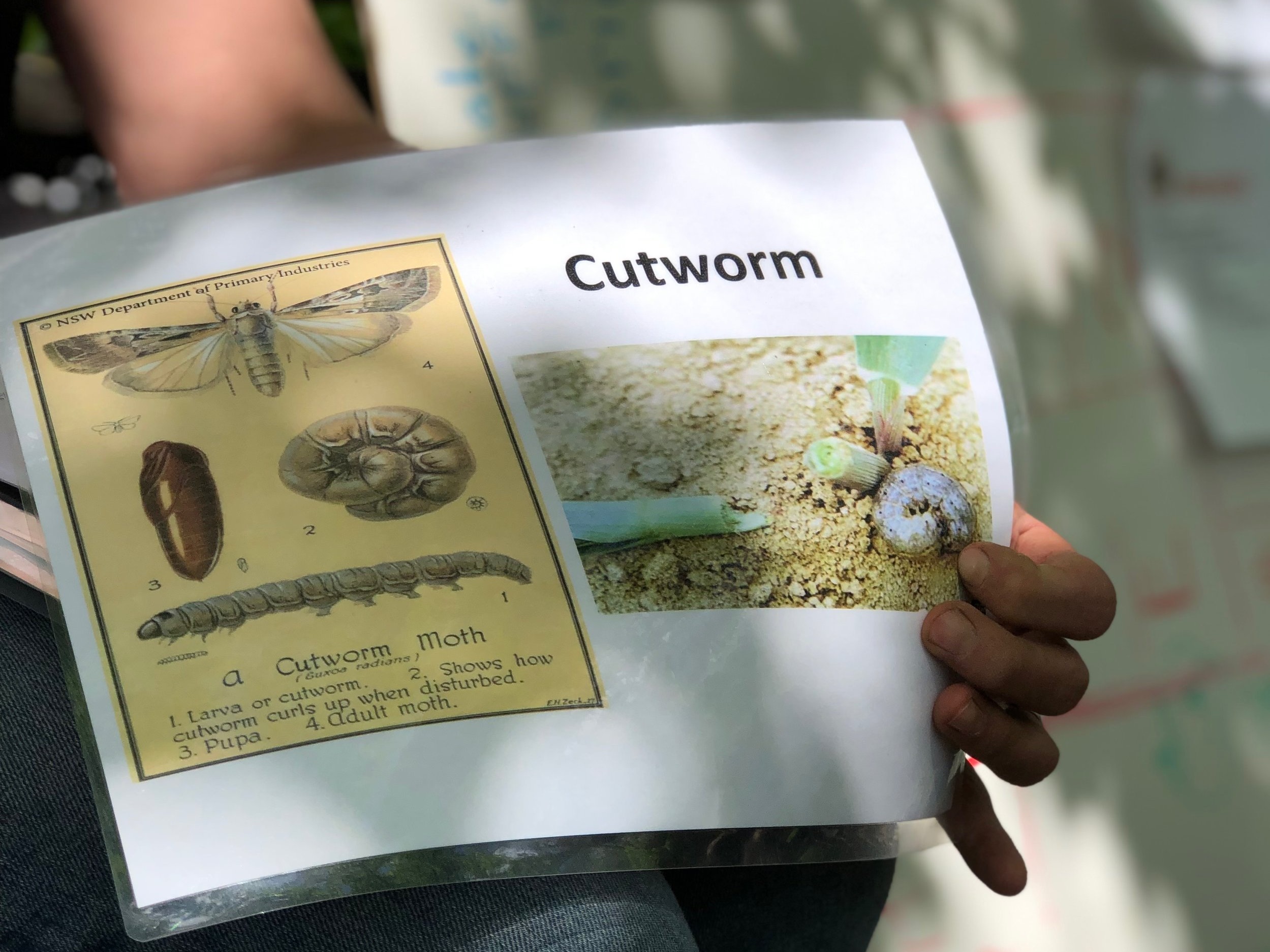
Identifying and understanding the pests in your garden is the foundation of integrated pest management. If you’re trying to identify a pest in your garden, these questions can often help get you there…
What does it eat?
What does it look like or how does it behave?
What kind of insect is it? A beetle, bug, caterpillar or worm, or maggot?
Click through the photos below for some examples of spring pests and their behavior.
2) Prevent
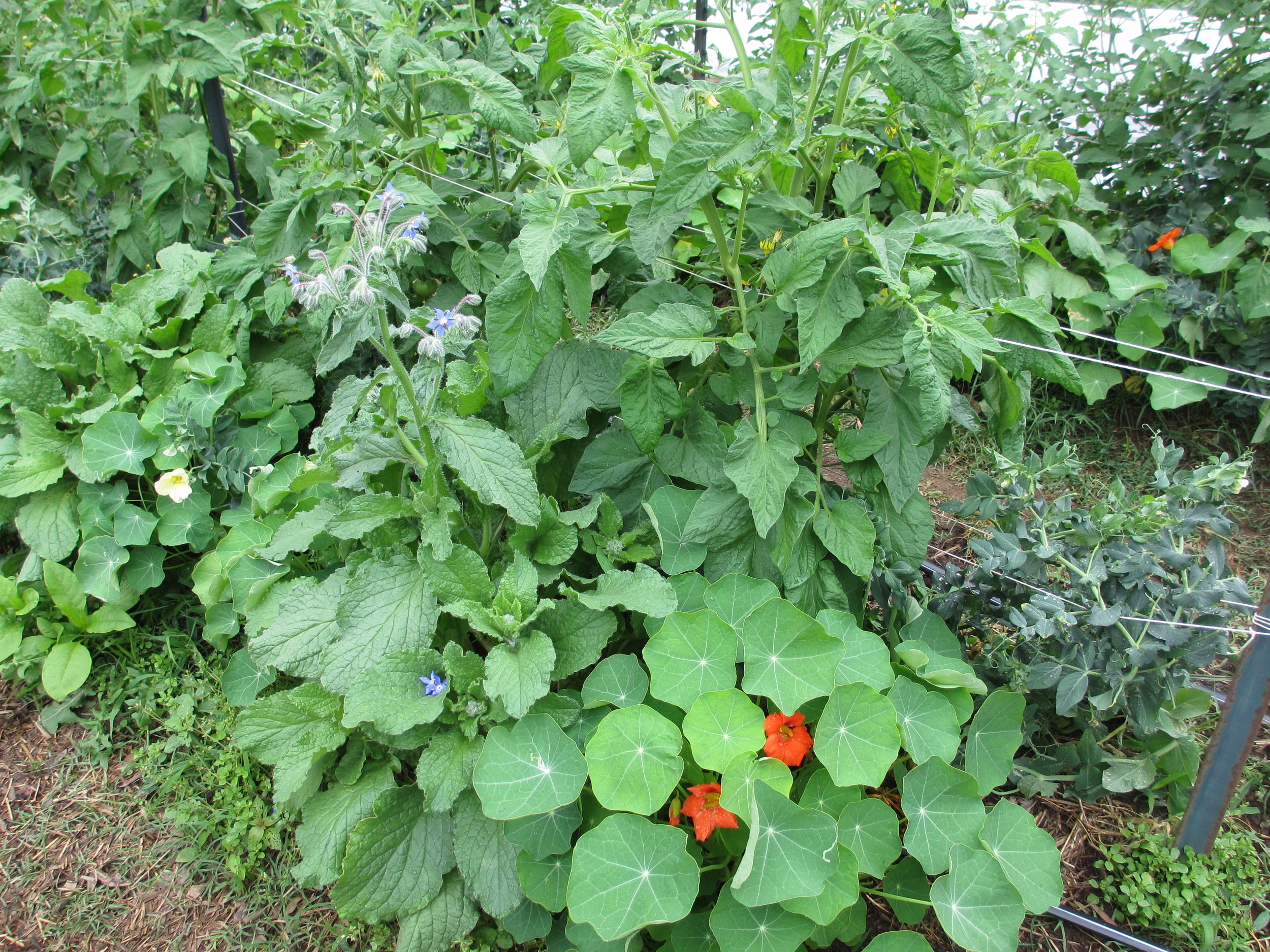
Now that you’ve identified and understand the behavior of the pest, you can prevent! Being prepared for pests and doing what you can to discourage them can save your plants from damage and lessens the need for other controls later on.
There are lots of approaches to both long and short-term prevention that you can apply to your garden. Click through the photos below for some examples!
Long term prevention:
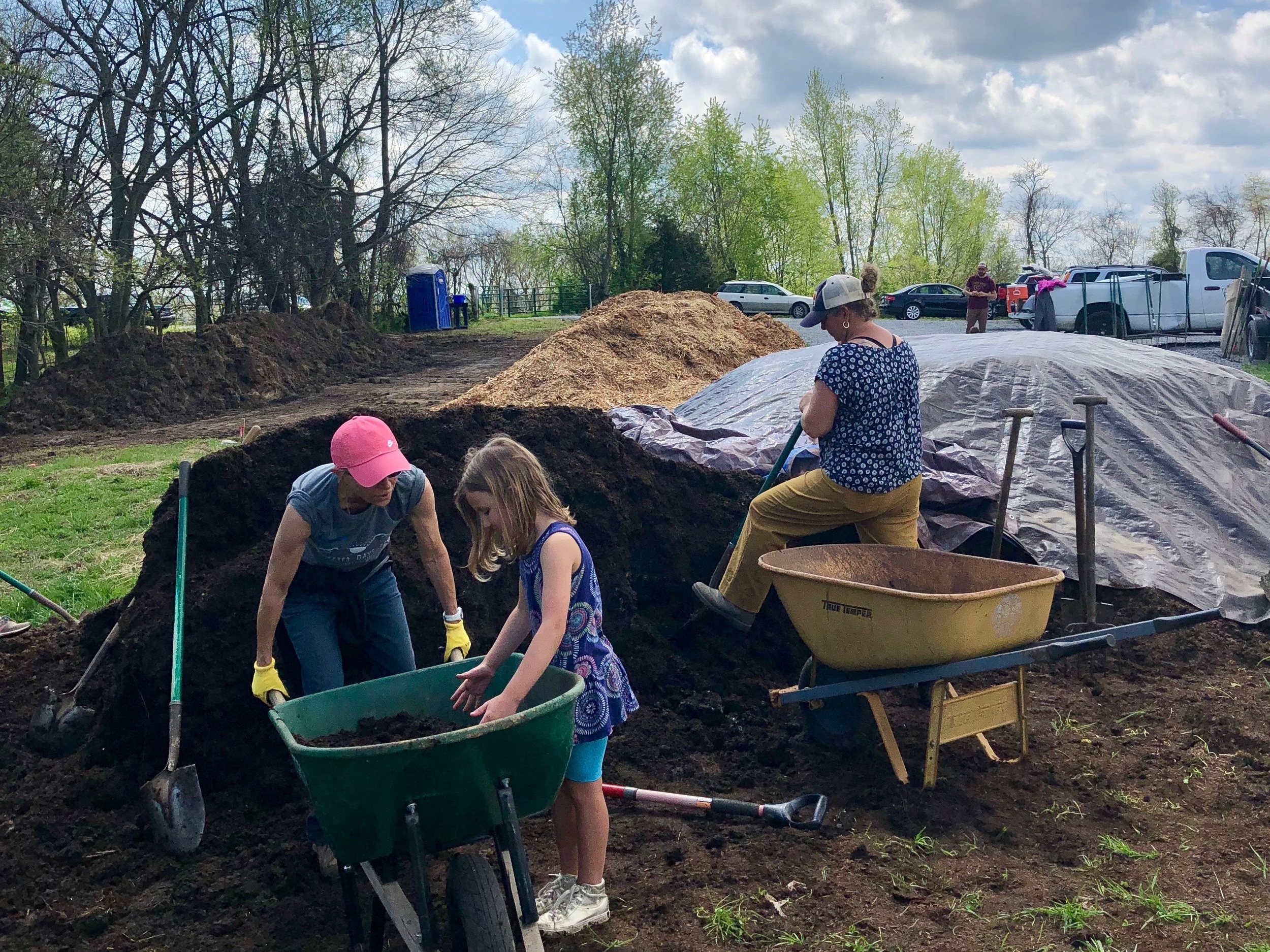
Short term prevention:
3) Physical control
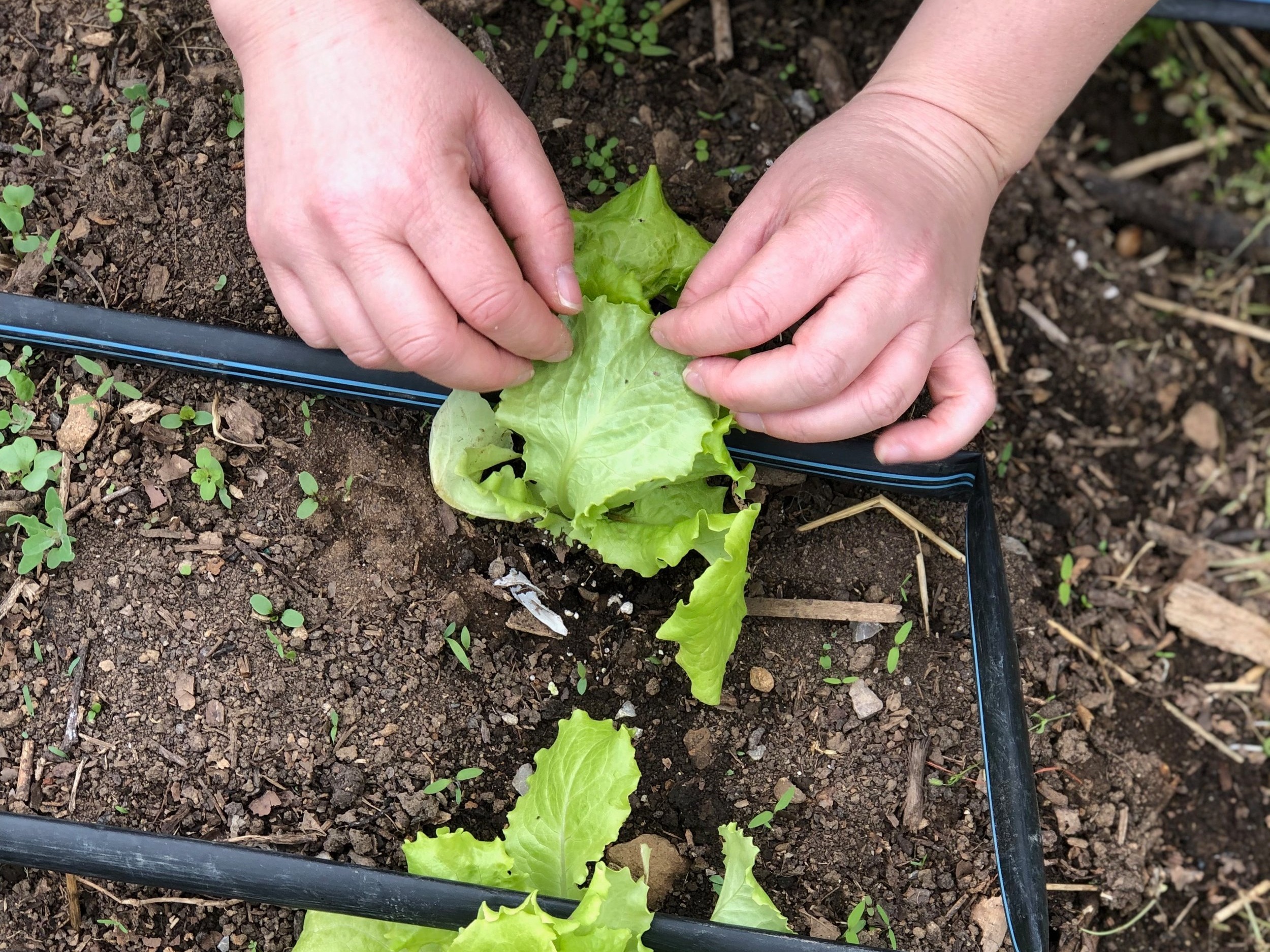
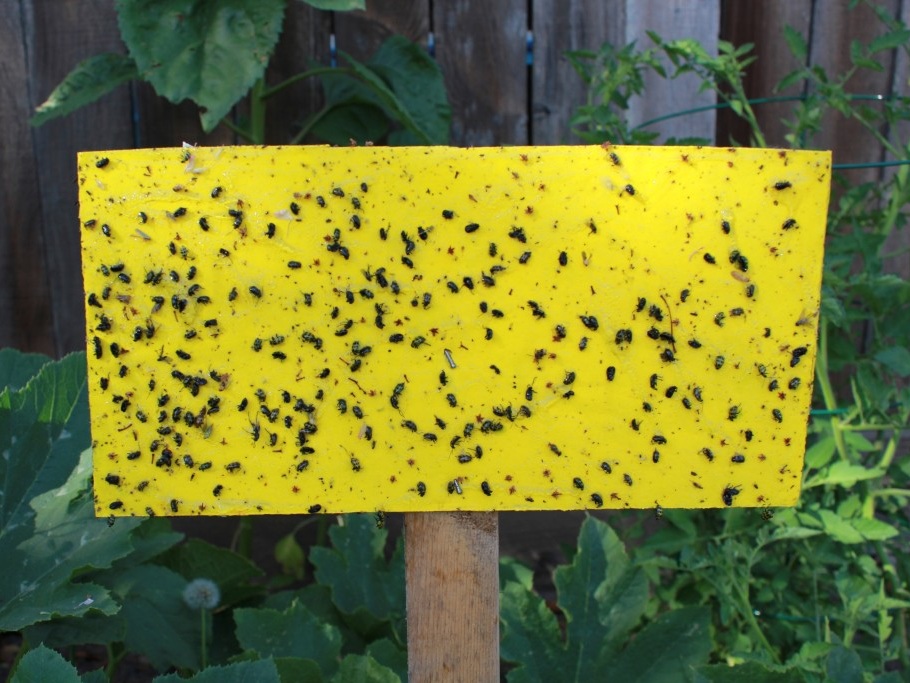
Even after using these prevention methods, there’s a good chance you’ll still confront some pests in your garden, especially in a shared space. The next step in integrated pest management is physical control, such as knocking pests off of plants with a spray of water or using barriers and traps.
Here are some examples…
4) Organic chemical control
If all else fails, there are a number of organic chemical control options that are not particularly toxic except to insects. We use this as a last resort, since some of these approaches can also harm beneficial insects. Look for products that are approved by The Organic Materials Review Institute (OMRI) - a private, nonprofit organization that determines whether or not a product qualifies as organic under the USDA's National Organic Program. Food grade versions of Diatomaceous earth, Safer Soap and Neem Oil are a few examples.
We often say the trainings at our community gardens are more of a knowledge exchange… many of the gardeners bring a wealth of different experiences, and we’re always learning more together!
If you’re interested in reading more about natural pest control, The Organic Gardener’s Handbook of Natural Pest and Disease Control is a great resource that you can find at the Nashville Public Library. We also love The Timber Press Guide to Vegetable Gardening in the Southeast as a general guide to gardening in Tennessee.
What pest control approaches have worked for you in your garden? Let us know in the comments!
New Ways of Being With Each Other
This article by TNFP’s Growing Together Market Manager, Sally Rausch, was recently featured in Tending the Fire Quarterly, which reports on efforts of contemplative justice within St Augustine’s Chapel, the Center for Contemplative Justice and the wider world.
This article by TNFP’s Growing Together Market Manager, Sally Rausch, was recently featured in Tending the Fire Quarterly, which reports on efforts of contemplative justice within St Augustine’s Chapel, the Center for Contemplative Justice and the wider world.

In a time of extreme division in our country - most notably, the fight for a literal wall to separate us from our southern neighbor, I am time and again reminded that we long for deeper connection, deeper relationships, and a deeper sense of belonging to each other.
During my recent knitting project, a blanket, I couldn’t stop thinking about this innate desire. As a (very) novice knitter, this project improved my ability to pick up dropped stitches. As I moved along, I slowly got better at seeing them, picking them up, mending the hole they’d created in my work, and incorporating the stitch back into the pattern of the blanket. Knitting seems a fitting metaphor, a tangible representation of the way we are all woven together in this large patchwork connecting people, the earth, and all beings that inhabit this place. Some of the holes are gaping, seemingly too large to mend, but the blanket is meant to be whole.
I have the privilege to work at The Nashville Food Project, where we believe food is one way we can begin to pick up the dropped stitches and reincorporate them into the fabric of our shared humanity. As a manager of our market garden program, Growing Together, I work alongside eight farmers and their families who grow vegetables to sell across Nashville. These families came to Nashville as refugees from Burma and Bhutan, bringing with them cultural traditions and years of experience working with and rooted in the land.

As I witness the farmers and their families in the plots, tending the soil, pulling weeds, and harvesting for the day, it is hard to miss the reconciliation unfolding. Farmers who were forcibly removed from the land they called home, many of whom spent decades in refugee camps, are now putting down roots and reconnecting to the land in this new place. Farmers who are spending countless hours every week tending their plots side by side are connecting to each other and to the Nashville community through this shared work.
I notice a similar pattern at the Richland Park Farmers’ Market. Here the Growing Together booth is piled high with veggies of all kinds, a dozen varieties of mustard greens, radishes of many shapes and colors, spinach and arugula, tomatoes and peppers. But what’s missing if you only look at the beautiful vegetables on a steamy summer day are the hands that got those veggies to the table and every touchpoint of connection between seed and sale.

Noticing the baseball bat-sized bottle gourd at the farmers’ market booth one Saturday, I smiled, remembering the cold March day when the farmers and staff gathered together at The Nashville Food Project’s greenhouse to plant seeds for summer crops. Several staff members and I were busily distributing the seeds that farmers had ordered for their disease-resistant and heirloom varieties of tomatoes. As I moved from one table to another, I was greeted by Chandra, one of the farmers who has grown with Growing Together since its inception. He was holding out to me a large tooth-shaped seed from a cluster cupped in a wrinkled paper towel that he had pulled from his pocket. It was unlike any seed I’d ever seen – it was a bottle gourd seed. Chandra had been saving this seed over the course of several seasons, perhaps even traveling with it across thousands of miles from a refugee camp in Nepal to Nashville several years ago. With encouragement, Chandra assured me that I too could grow this crop, and I slipped the seed into my pocket, a gift. He was right! The plant was prolific, the vine growing across the metal archway leading into our home garden an invitation to delight. The gourds filled our kitchen counter in the late summer, gifting me the opportunity to seek advice from the Bhutanese farmers about how they prepare and eat bottle gourd at home. That one seed bridged language, culture, and place, teaching me not only what a bottle gourd is (and how many people one plant can feed!), but also that our differences create opportunities to learn from each other.

Often, tomatoes are piled all around the bottle gourds on the market table. As I stood admiring them on a humid August morning, I was reminded of a moment earlier in the week when I’d watched a farmer, Garja, and the look of pure joy on his face as he ate a tiny, sweet, cherry tomato straight off of one of his plants. I too have experienced this same pleasure in my garden, finding nature’s sweet candy irresistible and filling my belly before I even make it to the kitchen. While our differences create opportunities for learning, our similarities cultivate connection.
I remember so vividly a coworker and I were standing between two farmers’ plots one morning, listening as they shared about their prayer rituals performed before coming to the garden. Their morning prayers always include a prayer for peace. After listening intently, my colleague said, “every day I pray for that, too.” Maybe the prayer rituals look differently, but the fiber of the blanket sure seems the same.

I must admit that I come to the communion circle at St. Augustine’s Chapel without any idea what it means to eat the body of Christ. The theological implications seem inaccessible and the mystery too great. What I do know is that I’m hungry, that I long to receive a piece of bread from my neighbor and I delight in sharing the same gift with another. Just as I long for the sour leaves and shrimp paste my farmer friend brings to share with me, I delight in sharing my zucchini muffins as we stand at the farmers’ market table together. Food binds us together simply because we all need it! Growing Together has taught me that we need the nourishment of connection just as much as we need the nourishment of food. And Growing Together reminds me of what is possible: to give and to receive nourishment, love, and our gifts, this is justice.
I am not sure I know what prayer is, but my hope is that we continue living out our deep desire to weave our human fabric closer to wholeness.
Beginning in May, you can visit the Growing Together farmers at the Richland Park Farmers’ Market on every Saturday through October. The farmers are also offering a Fall CSA. Learn more about this work and how you can support the Growing Together farmers here.
Corn Five Ways
As our gardens begin to thrive and the kitchens ramp up for the summer, things have been heating up and coming together in beautiful ways at The Nashville Food Project — “simmering,” if you will. And that’s part of why we gratefully launched the first installment of our new fundraiser this month, “Simmer: a chef series where good food and ideas come together.”
By Culinary Community Liaison, Jennifer Justus

Author and journalist Erin Byers Murray welcomes guests.
As our gardens begin to thrive and the kitchens ramp up for the summer, things have been heating up and coming together in beautiful ways at The Nashville Food Project — “simmering,” if you will.
And that’s part of why we gratefully launched the first installment of our new fundraiser this month, “Simmer: a chef series where good food and ideas come together.” It includes nine, monthly events running through the end of the year and aims to take guests a bit deeper by telling the stories behind the food and the people in our city who grow, cook and share it.

For the first installment, we invited author and journalist Erin Byers Murray to speak about her new book “Grits: A Cultural & Culinary Journey Through The South.”
Erin prepared, naturally, a grits dish -- warm bowls of long-cooked grits held together with grueye and topped with a mix of oyster mushrooms, shiitakes, butter and flecks of thyme. She also asked some friends to join her in telling the stories from her book through food.
Food writer and spirits expert Jim Myers prepared variations on “corn from a jar.” Thanks to a donation by Pennington’s Distilling Co., we learned about the local company’s new Davidson Reserve Tennessee Whiskey. Jim spoke about the charcoal-mellowing process that gives a whiskey its Tennessee distinction, and we tasted unaged whiskey (or “white dog” as it’s called) before and after the charcoal filtering process.

Jim Myers pouring his almost legendary sangrita!
Jim also whirled together a Mexican sangrita. Similar in appearance to a bloody mary, the sangrita is nothing of the sort. Ancho chiles rather than tomatoes give it the deep red hue while orange juice, pomegranate syrup, onion, lemon and lime provide a balance of tart, sweet and heat. Though traditionally served with tequila, Jim mixed his sangrita with Pennington’s unaged Davidson Reserve Tennessee whiskey.
“The fine line between the grits miller and the distiller had long been blurred, over and again, into one long, woven story of similar purpose. The two end products, one solid, one liquid might differ in terms of texture, style, and, of course, resulting fortitude once consumed, but their coexistence creates a through-line for grits and whiskey, both of which are claimed as deeply Southern totems. Grits are the happy, soul-sustaining by-product of the moonshiner’s bounty.” -- Erin Byers Murray, “Grits”

Karla Ruiz hand pressing corn tortillas for the first dish of the evening.
Guests were handed corn tortillas hand-pressed by Karla Ruiz of Karla’s Catering and topped with cochinita pibil. Karla shared stories about coming to Nashville from her native Mexico and landing at Belle Meade Plantation where she became a quick study in the kitchen on Southern American cooking, which she marries with her native cuisine and its nearly 60 varieties of indigenous corn. Karla says cochinita pibil comes from Yucatán, Mexico, and involves wrapping pork in banana leaves, marinating it in sour orange and achiote (a sweet peppery red sauce made from annatto seed), and baking it for several hours, traditionally in buried or underground pits.
As for the tortillas, the Mayans and Aztecs viewed corn as a foundation of humanity. When the Spanish arrived in the New World, they took note of the flat corn breads made by the Aztecs and called them tortillas.

Tandy Wilson preparing thin sour grit cakes.
Tandy Wilson, chef/owner of City House, served a third corn-related course and spoke about the part he played in Erin’s book. Erin joined Tandy on a trip to Orlinda, Tennessee, where he buys his corn from Windy Acres Farm. Then, he takes the extra tedious and labor-intensive step of milling his own corn for grits and cornmeal. Tandy served thin sour grit cakes (which undergo a three-day souring process) with scoops of beef sugo made possible through a donation by Bear Creek Farm. Spicy bits of arugula -- grown by Growing Together farmers -- brightened the dish.

Tandy’s dish: Sour Corn Cake, Bear Creak Beef Sugo and Spring Vegetables
And to end things on a sweet note, Rebekah Turshen, pastry chef at City House, spoke about the fresh cornmeal she uses fresh from the restaurant’s mill for desserts like the buttermilk cornmeal cookies she served pressed together with a scoop of tart creme fraiche ice cream.

Rebekah Turshen finishing her buttermilk cornmeal cookie ice cream sandwiches.
Special thanks to Piedmont Natural Gas for their sponsorship of Simmer. Thank you to in-kind sponsors: Ian and Kady Navarro of Creation Gardens and Pennington’s Distilling Co. Last, but far from least, thank you to Erin Byer Murray, Karla Ruiz, Jim Myers, Rebekah Turshen and Tandy Wilson for donating their time and talents.
To see the full Simmer lineup and purchase tickets to future events -- including our next installment of farm dinner by Katie Coss from Husk on May 4 -- please visit thenashvillefoodproject.org/simmer.
And check out the recipes below to try out Jim’s sangrita and Erin’s grits!


Jim Myers’ Almost Legendary Sangrita Recipe
Ingredients
64 ounces fresh orange juice
1 cup fresh lime juice
5 ancho chiles
2 cups white onion, chopped
4 tablespoons pomegranate syrup
2+ tablespoons chili piquin (pequin) powder
Salt to taste
Directions
1. Tear open dried ancho chiles and remove stem and seeds. Roast chili pieces in cast-iron skillet to release flavor, being careful that the pieces don't burn or char. Admire the sweet aroma and have a sip of some good reposado and turn up the music a little bit.
2. Place roasted chili pieces in a stainless steel bowl and add enough boiling water to cover. Weigh down the chili pieces with another bowl on top. Let soak for about 15-20 minutes.
3. Have another little sip of tequila and call that friend you've been missing. Lie about your weight. As you're catching up on the last 10 years, squeeze your limes with a hand-squeezer. Remember to wash your limes first, and then roll them on the counter with the palms of your hand. This makes juicing them easier.
4. Chop your onion and put it in a blender. Cry, but only for a moment, over all of life's lost opportunities. No, wait, that was just the onions. Take another sip of tequila and throw into the blender a couple hearty pinches of salt and the soft ancho chili pieces. Pour in enough of the rusty-colored soaking liquid to make blending easy. Blend until all is well-pureed.
5. Combine in a large pitcher (1 gallon) the orange juice, lime juice, chili/onion puree and the pomegranate syrup. Add a tablespoon of salt and a tablespoon of the pequin powder, shake well and let sit refrigerated overnight. Have another sip and put on that old DVD of "Night of the Iguana" and look at how cool Puerta Vallarta was in the '60s. Have another sip as you wonder if you were ever as cool as Richard Burton. Have yet another sip with the realization that the answer will always and forever be "no."
6. The next day, fix yourself a cup of strong coffee and taste the sangrita for balance. This is where I add what seems to be too much salt, but it has to compete with the sourness and acidity of the pomegranate and lime. Just add what's needed for the right balance and your personal taste, and then do what I always forget to do -- write down exactly what and how much you added.
7. Finally, adjust for your level of heat. I usually start with a tablespoon of the piquin powder, and then add a bit at a time, remembering to stir well in between. Stop and marvel, for just a moment, at how improbably blue the sky is. Call your friends or make some new ones. Find some cool small glasses that are bigger than standard shot glasses. Pick out your favorite guayabera and crank up the music.
8. Serve sangrita with a good quality tequila. I prefer reposado, but choose whatever you fancy. Sangrita also mixes well with clear spirits like vodka and gin (and moonshine).
9. Salud!
Notes: This recipe is perishable and should be used within 48 hours. All ingredients are available at K&S Markets on Charlotte and Nolensville Pike.
Recipe from Jim Myers (jim@culinarity.com)
Erin’s Gruyère Grits with Wild Mushrooms

Serves 8
Ingredients
3 cups stone-ground grits, cooked
½ cup heavy cream or whole milk
1 cup grated Gruyère cheese
2 tablespoons butter
¼ teaspoon white pepper
2 or 3 shallots, cut into thin slivers (about 1/3 cup)
1 or 2 garlic cloves, finely minced
1 teaspoon chopped fresh thyme, plus leaves for garnish
8 ounces sliced mixed mushrooms (about 2 cups)
½ cup dry vermouth or white wine
Salt and freshly ground black pepper
Directions
In a heatproof bowl or serving dish, combine the warm cooked grits with the cream and Gruyère. Cover the bowl with a lid or foil and keep the grits warm while you prepare the mushroom.
In a medium nonstick skillet, melt the butter over medium heat and season with the white pepper. Add the shallots and garlic and cook, stirring, until the shallots are translucent, 1 to 2 minutes. Add the thyme and mushrooms and cook, stirring, until the mushrooms begin to brown, about 2 minutes. Add the wine and simmer the mixture until most of the liquid has evaporated and the mushrooms are tender. Depending on the mushrooms you’re using, you may need to add more liquid and simmer a few moments longer to ensure they’re tender.
Fold the mushroom mixture into the grits. Taste for seasoning - you may need more salt. If the grits seem too thick, add a splash of water. If they’ve cooled down too much, reheat them in the microwave. Top with freshly ground black pepper and a sprinkle of fresh thyme leaves.
Recipe from “Grits: A Cultural & Culinary Journey Through The South” by Erin Byers Murray.
Making Gold: Composting In Nashville
Did you know 28% of all waste in Nashville is compostable material? Here at TNFP, the idea and act of composting is a value: taking our forgotten bits, our discarded carrot ends, broken eggshells and spent coffee grounds and diverting them to be used as rich inputs for the earth which we've too often abused and abandoned. Learn how YOU can make gold out of your own leftovers, including FREE compost drop-off at select Metro convenience centers.
By TNFP’s Community Engagement Manager, Elizabeth Langgle-Martin
“The world gives you so much pain and here you are making gold out of it, there is nothing purer than that.”
This quote from Rupi Kaur is one of my favorites. This idea, this value, of creating worth out of something that can be seen as the garbage of life (literally or figuratively), is inspiring and challenging.
I’m fairly certain the Rupi Kaur wasn’t talking about compost, but the idea of taking our forgotten bits, our discarded carrot ends, broken eggshells and spent coffee grounds and diverting them to be used as rich inputs for the earth which we have abused and abandoned for so long feels almost holy.

This ritual, this practice, of carefully collecting the skins of onions, the stubby bottoms of asparagus and the spinach that has developed an acute layer slime, speaks to a level of restoration that is life giving to me.
In both of our TNFP kitchens, you’ll see volunteers and staff alike hoarding apple cores and potato peels and transporting them to our compost bins to be turned lovingly into invaluable nutrients that are sown back into our gardens to grow countless more serving of organic fruits and vegetables for individuals facing food insecurity in the Nashville area.
Not all of us operate commercial kitchens or spend our days tending production and community gardens. However, there is space for each of us to create rhythms of intentionality in reducing the waste we contribute to the landfill and leveraging every smidge of our resources for the benefit of our world.

So how can you make gold out of the forgotten bits of tonight’s dinner or tomorrow’s lunch?
We often have folks reach out and ask this exact question. Individuals living in apartments or families who may not have the time, space, or desire to facilitate their own composting process but who are acutely aware of the need for a change in the way we view and handle our kitchen waste.
Many Nashville neighbors aren’t aware that Metro Nashville provides drop off for compostable materials at 4 of its convenience centers scattered throughout Davidson county. These sites allow residents who are interested in the practice of composting a feasible way to make a shift in the way they view and revere scraps and other materials. Their website notes that 28% of all waste in Nashville is actually compostable materials.
Metro provides simple guidelines for those wishing to participate:
Ensure that all the items you are collecting are truly compostable. See their whole list HERE. Unlike many home compost systems, Metro Convenience Centers can even accept meat, fat and bone scraps. Double check that your contribution is free of materials deemed off limits: Plastic, expanded foam, metal, aluminum foil, animal or human waste and dryer sheets.
Collect items in a compostable bag or cardboard container. Alternatively, you can transport your items in a re-usable container and dump the contents directly in the compost container at the convenience site.
Deliver to one of the four designated Convenience Center Sites free of charge.
And the options don’t end there! If you’re interested in paying to have your compost picked up from your home or business, The Compost Company and Compost Nashville are two great local resources.
The practice of compost exists at the intersection of our TNFP values of Interdependence and Stewardship. We are committed to seeing these values realized in our spaces as an organization, but feel truly effective when we see them spill over into the homes of our friends, our teams, our volunteers and families.
We invite you to participate as we strive to honor both those around us and our world more fully each day, with our words, our actions, and yes… even our moldy strawberries.
Homemade Pasta
Any given day you walk through The Nashville Food Project’s kitchens or gardens, the incredible care put into the little details of the work is so evident. One great example? Every week, a group of friends and acquaintances comes together in our kitchens to make fresh bread and pasta from scratch for our meals program.
By TNFP’s Impact Manager, Grace Biggs

Any given day you walk through The Nashville Food Project’s kitchens or gardens, the incredible care put into the little details of the work is so evident. One great example? Every week, a group of friends and acquaintances comes together in our kitchens to make fresh bread and pasta from scratch for our meals program.
The group is led by long-time TNFP volunteer Rob Stein, a retired orthopedic surgeon and bread maker. He started inviting friends to bake with him at our St. Luke’s kitchens about three years ago, where they’ve made everything from challah to artisan dinner rolls. Fresh pasta is their most recent addition.

“My wife and I had been making pasta at home for many years,” says Rob. “And we just thought, hey, why don’t we do it at the Food Project? Fresh pasta normally would be considered a gourmet item… I think it’s nice that at TNFP you can say you’re sharing the best. We want to be proud of the food we’re sharing with our community.”
I’m joining them on one of their regular Wednesday prep times at our California Avenue kitchen. Today, they’re making fettuccine as an entree for fifty seniors. “We’ve gotten very efficient,” says Rob. “When we bake rolls at the St. Luke’s kitchen on Thursdays, we scoot off to the side and make the pasta dough so it has time to rest.” Like clockwork, aprons are handed out, and the team starts clamping pasta machines onto the prep tables. Though some were new to the group, an easy flow quickly develops.
Pasta making is a two-part process. First, you make the dough. Then, after a rest period, you roll it out the dough and cut it to shape, such as lasagna sheets, ravioli, or linguine.
For the dough, Rob uses a light egg pasta recipe by Lidia Bastianich, a renowned Italian-Croatian chef. “It’s a very reliable recipe,” he explains. “It’s more of a northern Italian recipe, because it’s got 2 eggs in it. In the south, they don’t use eggs at all. It’s just flour, oil and water.” To cut and roll your pasta, we recommend using a pasta machine (like this one), but you can also roll and cut the dough by hand.

Ready to try it out for yourself? Don’t be intimidated, it’s easier than you think! Below, we’re sharing Lidia’s recipe for a light egg pasta dough, plus a guide on using a pasta machine.

Homemade Pasta

Part One: Making the Dough
recipe by Lidia Bastianich
Ingredients
2 cups all-purpose flour, plus more for dusting (Rob also recommends using semolina flour)
2 large eggs
¼ cup extra virgin olive oil
3 tablespoons water
To make the dough by hand, measure the flour and shake it through a sieve into a medium mixing bowl. Drop the eggs and/or egg yolks into a small bowl; beat briefly with a fork to break them up. Pour in the measured amounts of oil and water, and mix well with the eggs. Pour the wet ingredients into the flour. Toss and mix everything with a fork until all the flour is moistened and starts to clump together. Lightly flour your hands, then gather the clumps and begin kneading right in the bowl, folding the raggedy mass. Turn the dough out onto a very lightly floured surface and knead by hand for another 30 seconds or so, until it’s smooth, soft, and stretchy. Form the dough into a disk, wrap it tightly in plastic wrap, and let it rest at room temperature for at least ½ hour.
Part Two: Rolling and Cutting
(adapted from The Spruce Eats)

Set up your pasta machine, clamping it to a table. Turn the dial to the widest setting (usually 1). Next, divide the pasta dough into four pieces. Take one piece, and flatten it into a rectangle shape and feed it through the rollers. It's best to work with a helper, so one person can turn the crank and the other person can guide the dough into the machine with one hand and catch it with the other hand.
Begin rolling it thinner by turning the dial to the next narrowest setting (usually 2). Roll the pasta through the machine. Continue reducing the settings until the dough is rolled as thinly as you'd like (we usually go to 6). If the sheet of pasta gets too long, you can cut it in half with a knife.

Attach the noodle-cutting attachment to the pasta machine. Then, feed the thinly rolled sheet of pasta into the cutting attachment, catching the noodles by draping them over your hands as they're cranked out of the machine.
Repeat the entire process with the remaining pieces of dough.

Finished noodles can be kept on a special pasta drying rack or you can scatter them on a sheet pan that's been dusted with rice flour or cornmeal. Be sure to separate the noodles and toss them with rice flour so they don’t stick together.
To cook the pasta, add a small handful of salt to the boiling water and add your pasta. Fresh pasta only takes 2 to 3 minutes to cook in boiling, salted water. Drain the pasta well and serve it with the sauce of your choice.
A Guide to Seed Starting
Since gardeners and farmers growing in many spaces can utilize and benefit from starting seeds indoors, we thought we’d share some of the tips and tricks the Growing Together farmers and staff of The Nashville Food Project use to grow the healthiest transplants!
By TNFP’s Growing Together Market Manager, Sally Rausch

Lal Subba, Growing Together farmer, mixing potting soil in the Nashville State Community College greenhouse.
It’s officially spring! And like many vegetable growers, the Growing Together farmers are in the flurry of activity that comes with warmer weather and the beginning of a new growing season. These days you’ll find the farmers at their garden in South Nashville getting their plans and seeds in order, tilling their beds, and planting cool weather crops. But you’ll also find these farmers starting seeds in the greenhouse on Nashville State’s campus, which they generously share with The Nashville Food Project.
Starting seeds indoors is a primary component of spring farming work (and is utilized throughout the growing season as well). This allows farmers to get a head start on the growing season, cut costs (seeds are much cheaper than purchasing seedlings), and maintain control over the health of their seedlings.
Since gardeners and farmers growing in many spaces can utilize and benefit from starting seeds indoors, we thought we’d share some of the tips and tricks the Growing Together farmers and staff of The Nashville Food Project use to grow the healthiest transplants!

Materials You Need
Potting Mix: You can find pre-made potting mix at most local hardware or garden stores. When the Growing Together farmers purchase their own potting soil, they look for brands that are organic to eliminate any chemicals that might have been added. You can also make your own potting soil! There are many recipes out there, but you can find the recipe The Nashville Food Project uses at the end of this post.
Seed Trays: Growing Together utilizes various types of trays depending on what they are planting, but it’s really up to you and your preferences. You can find seed trays at your local hardware store, or you can get creative and use recycled items like egg cartons, eggshells (be sure to carefully crack the eggs, so that most of the shell is retained like a small bowl), homemade newspaper boxes, K-cups from your morning coffee, and so much more. Click here for an article with even more ideas! Just make sure your medium has a drainage hole of some sort.
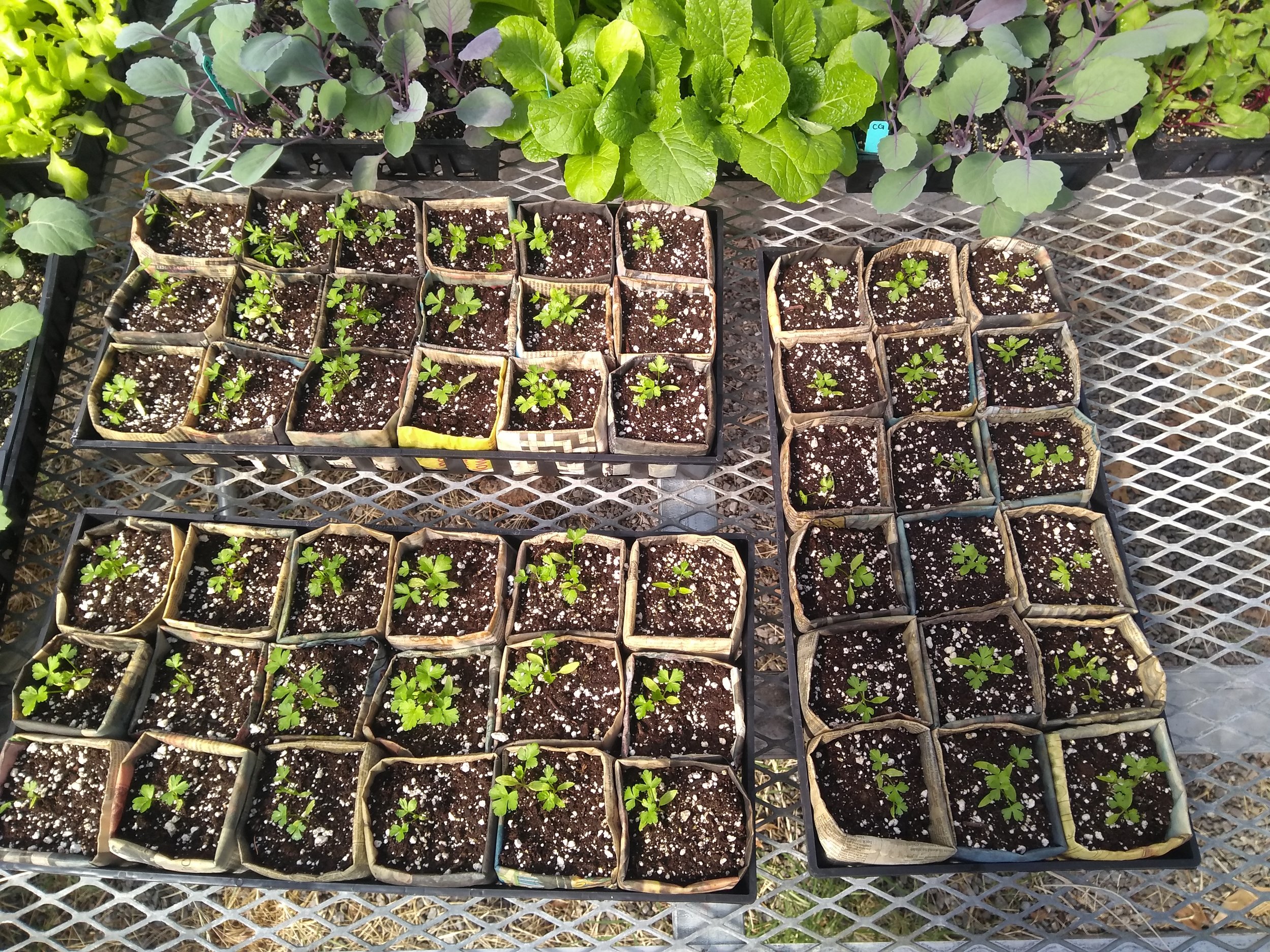
Seeds: Growing Together purchases their seeds from several seed companies, but many of the farmers also save their own seed from year to year! Here’s a great resource for learning more about the best tips for saving your own seeds.
Getting dirty!
1. Adding water: We often transfer the potting mix from our large bag into a smaller container, so that we can mix in water more easily. A five-gallon bucket works great when seeding smaller amounts. Begin adding water and mixing it into the soil. You want the soil wet enough that it clumps together when you squeeze a handful, but not so wet that it drips water when you squeeze it. Adding water before you put the soil in the trays helps the soil to absorb water more evenly after you plant your seeds. Beginning with dry soil, you run the risk of flooding the tray and disrupting your seeds when you water them.

After adding some water, we begin filling the seed trays.
2. Filling trays: Once your soil is ready, you can begin to transfer it into your trays. A great tip is to fill the entire tray and then go back through and press down gently with two fingers. This will lightly compact the soil, so you can then go back through and top off the tray with potting. This ensures that the seeds you plant will have the best growing environment to successfully germinate and begin growing roots.
3. Now it’s time to plant! Some tips to follow when you’re planting:
Depth matters! This is listed on the seed packet, or a good rule of thumb is to plant seeds 2-3 times as deep as the diameter of the seed.
Plant extra seeds, because sometimes every seed doesn’t germinate. You can always thin out extras later.
After you plant, place your seed trays in a warm location. Seeds germinate best at different temperatures, so it’s helpful to use the seed packet to find this information. For seeds that prefer warm soil to germinate (like tomatoes and peppers), we often put the trays on heating mats in our greenhouse. There are some DIY heating mat options out there, although this step isn’t absolutely necessary.
Once seeds germinate, make sure they are in a very sunny location. Seedlings will get leggy quickly if they are reaching too hard to find the light they need.
Water regularly to maintain soil moisture. You never want the soil to dry out, but balance is key. Add too much water and you run the risk of either your seeds or roots rotting.
Label your seeds! No matter how much you think you’ll remember, it’s always better to label what you’ve planted and when.

Remember to label!
When to start seeds
When to plant your seeds indoors varies greatly. Location, first and last frost dates, and crop are all things that impact planting dates. We love this resource that creates a planting calendar for your specific location with information about each crop’s best planting dates.
Ready to get started? Make your own potting soil at home using TNFP’s recipe below! You can also purchase produce directly from Growing Together farmers — find out where here, including information on purchasing a Fall CSA share (hurry, before it sells out!).

TNFP Homemade Potting Mix
Measure with a 5 gallon bucket:
3 buckets peat moss or coir
½ cup lime (to adjust pH)
Mix well.
Add:
2 buckets coarse sand (for drainage)
2 cups feather meal or blood meal (for nitrogen)
2 cups greensand (trace minerals)
Mix well.
Add:
1 bucket sifted soil (adds healthy bacteria from the garden)
2 buckets sifted compost (good organic matter)
Mix well.
